

Greg Langdon
5.4K posts

Greg Langdon retweetledi

Don’t forget! The Student Venture Capital Summit is this Thursday, March 27 at @SparkHaus in Covington, KY. The event is designed for students eager to learn the ins and outs of venture capital.
Free to attend, register here ➡️ luma.com/b5de3cz2
English
The American Healthcare Conundrum:
github.com/rexrodeo/ameri…
"The American Healthcare Conundrum is an investigative data journalism project. Each issue identifies one fixable problem in the US healthcare system, quantifies the waste, and recommends a specific solution.
English
A guide to thinking about competitive risks to existing B2B SaaS companies from AI: saas-capital.com/blog-posts/int…
"We developed the three candidate Rating Dimensions that we believe are close to the “principal components” of B2B SaaS AI risk as we understand it.
English
Impact of LLM-driven development on incumbent enterprise SaaS platforms.
"If your data genuinely cannot be replicated, LLMs make it MORE valuable, not less.
Nicolas Bustamante@nicbstme
English
A more rigorous test of LLM logic and reasoning using the Car Wash Test: opper.ai/blog/car-wash-…
"I want to wash my car. The car wash is 50 meters away. Should I walk or drive?"
English
KY Startup Scene Navigator:
keyhorse.notion.site/StartupKY-Navi…
from Rron Thaci at @keyhorsevc
English
Insight from 10 years as an engineering manager: jampa.dev/p/lessons-lear…
English
Best practices for reporting ARR: thesaascfo.com/cfos-guide-to-…
English
AI agents are starting to eat SaaS: martinalderson.com/posts/ai-agent…
"But my key takeaway would be that if your product is just a SQL wrapper on a billing system, you now have thousands of competitors: engineers at your customers with a spare Friday afternoon with an agent.
English
Greg Langdon retweetledi
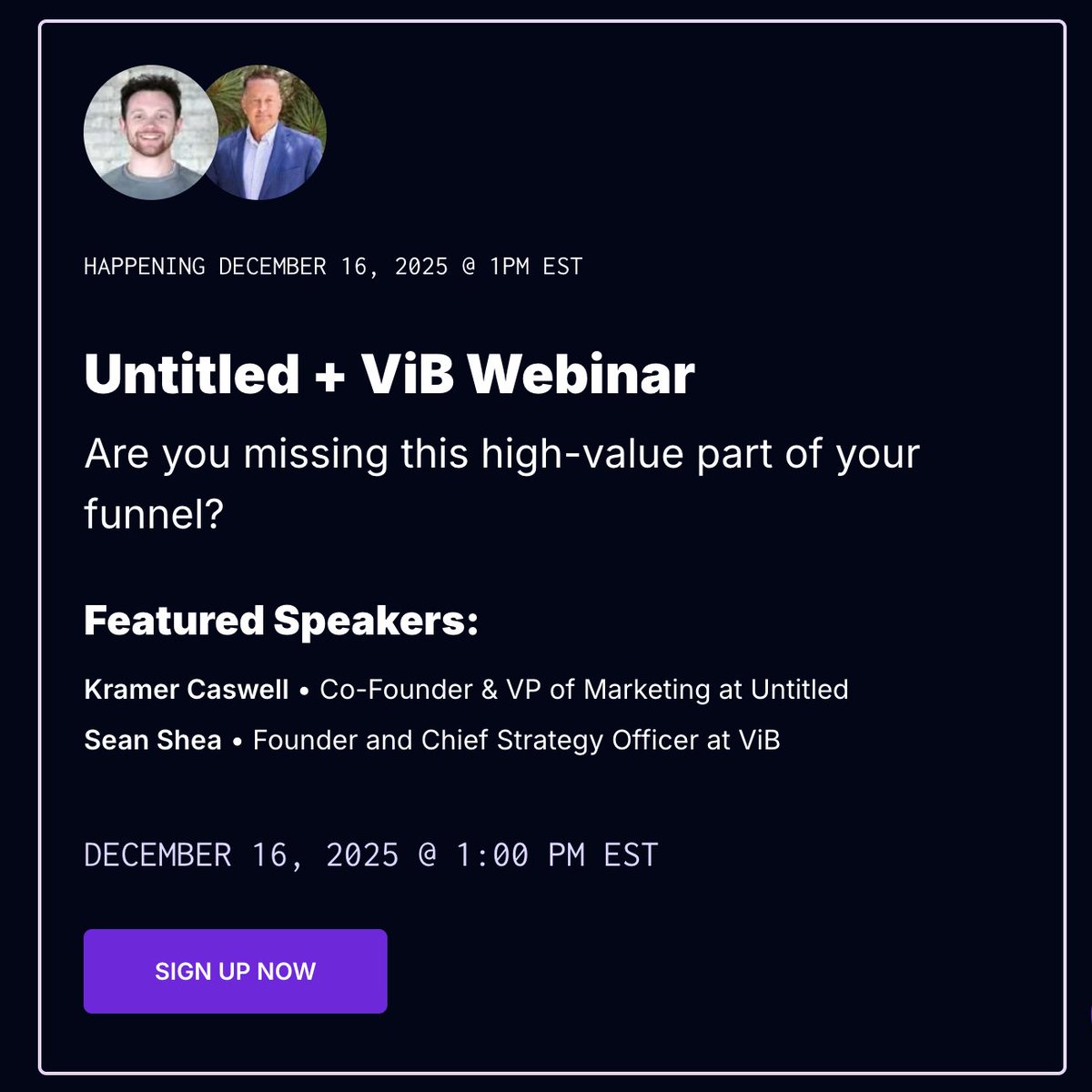
Most brands overlook a high-value part of their funnel: visitors who show intent but never convert. Untitled solves this by combining Identity Resolution and Contextual Intent Data into a single platform. Join Untitled and ViB for a webinar! REGISTER: getuntitled.ai/upcoming-webin…?
English
"For us, we had 10 SDRs doing this inbound workflow, & now we just have one that is effectively QAing the agent. The other nine, we deployed on outbound. We were able to hold that lead-to-opportunity conversion rate flat. So the agent is as good as our humans were.
Tomasz Tunguz@ttunguz
I remember hosting a dinner of sales leaders to talk about AI. I asked them what will your CRM do for you in the future? Nearly unanimously came the reply : enable salespeople to spend most of their time with customers. Listening to Lenny’s Podcast with Jeanne Grosser, COO at Vercel, I discovered how some companies are achieving that milestone by transforming their inbound sales teams in six weeks. For us, we had 10 SDRs doing this inbound workflow, & now we just have one that is effectively QAing the agent. The other nine, we deployed on outbound. It was six weeks before we felt confident going from 10 to 1. So it wasn’t like this was a multi-quarter process. It actually moved super quickly. We were able to hold that lead to opportunity conversion rate flat. So the agent is as good as our humans were. In retrospect, it should be obvious that speed creates an unexpected advantage. A sales representative, or an AI sales representative, can respond & analyze a lead at any point during the day. It’s important to meet a customer at the point of maximum interest to capitalize on their inertia or excitement. It’s actually condensed the number of touches it takes to convert because it’s so much quicker at responding relative to leads inevitably sitting in the queue or coming in at nighttime & no one can get to it. The build? One engineer, part-time. The person who built the lead agent was a single GTM engineer. He spent maybe 25, 30% of his time on this. The target that every sales leader at that dinner articulated is now within reach. I think we’re getting to a point where with layering in agents, ideally, we finally get salespeople to a point where they’re actually spending 70% of their time interacting with humans. Thirty percent customer-facing time becomes seventy percent. Double the human contact means salespeople developing deeper relationships, driving more success for customers, & less on administration. That’s the promise of AI in the workplace. tomtunguz.com/vercel-ai-sale…
English
Your target market isn’t demographic - identifying an accurate ideal customer profile: longform.asmartbear.com/target-market/
English
Greg Langdon retweetledi
Join us on November 13th at the Kentucky Derby Museum for Vogt Awards Demo Day.
Hosted by the @cflouisville, this free event starts at 5:30 p.m. with six innovative founders showcasing their groundbreaking ideas.
RSVP here --> eventbrite.com/e/vogt-inventi…
English
"Vibe engineering establishes a clear distinction from vibe coding. It signals that this is a different, harder and more sophisticated way of working with AI tools to build production software: simonwillison.net/2025/Oct/7/vib…
English
The Content Signals Policy initiative for search engines & LLMs: arstechnica.com/ai/2025/10/ins…
"allows website operators to consent to the following use cases:
- search: providing search results
- ai-input: retrieval augmented generation
- ai-train: training or fine-tuning AI models
English
Traction and funding for vibe-coding startups: techcrunch.com/2025/09/29/vib…
"The company’s initial traction was explosive, reaching $2 million annualized run rate in just two weeks.
English
A staff engineer's 6-week journey with Claude Code: sanity.io/blog/first-att…
"Treating AI like a junior developer who doesn't learn became my mental model for success.
English
Greg Langdon retweetledi
🚨 We’re #hiring! 🚨
Join Kentucky’s startup & venture capital scene with Keyhorse Capital.
📌 Venture Platform Manager (Remote, KY-based)
📌 Venture Programs Coordinator (Remote, KY-based)
Apply now ➡️ kstc.org/job-opportunit…
#StartupJobs #VentureCapital
English