Greg Kaplan

247 posts

Greg Kaplan banner
Greg Kaplan

Greg Kaplan

@GregWKaplan

Professor of Economics @ University of Chicago Editor @ Journal of Political Economy Lead Editor @ JPE Macro Chairman @ e61 Institute

Chicago, IL Katılım Ocak 2019
289 Takip Edilen10.5K Takipçiler
Greg Kaplan retweetledi

NBER
NBER@nberpubs·
Examining the effect of changes in mortgage payments when mortgage rates are linked to the short-term policy rate in Australia, from Matthew Elias, Christian Gillitzer, @GregWKaplan, Gianni La Cava, and Nalini V. Prasad nber.org/papers/w34461
NBER tweet media
English
1
4
21
5.1K
Greg Kaplan retweetledi
Joseph Noel Walker
Joseph Noel Walker@JosephNWalker·
Had so much fun chatting with Greg Kaplan (@GregWKaplan) and Michael Brennan of @E61Institute about Australia's stagnant productivity growth and how to fix it. The 2010s saw Australia's weakest productivity growth in 60 years. It was in many ways a lost decade. And it's dragging on—unlike the US, we haven't bounced out of covid with strong productivity growth. We discuss the extent to which this is being (i) caused by frontier-wide factors; (ii) caused by Australia-specific factors; and (iii) simply an artefact of how productivity is measured. We also go into a bunch of specific ideas, like: - why it could be better to densify Canberra than Sydney/Melbourne; - what should Albo do if he was bullish on AI; and - what we can learn from the stunning innovativeness of Australia's agricultural sector. And we discuss deeper questions around the role of government—as it's not really clear what levers the government currently has over productivity (at least for its *growth rate*). Links below. Enjoy! Timestamps: (0:00:00) - Introduction. (0:01:47) - Why has construction productivity stagnated—in Australia and the West? (0:08:38) - Can housing supply meaningfully grow just by improving construction productivity (without planning reform)? (0:12:50) - If construction and regulatory bottlenecks ease, what becomes the new supply constraint? (0:21:49) - Would densifying Sydney/Melbourne deliver big productivity gains—or should smaller cities scale? (0:29:48) - The most important limitations of GDP as a metric. (0:34:29) - Growth accounting in ~8 minutes: capital, labour, TFP. (0:43:04) - Is there a single “north-star” metric for policymakers? (0:47:12) - Should policymakers care more about TFP or labour productivity? (0:52:11) - Why revenue per worker is an imperfect proxy for firm-level productivity. (0:56:00) - Do these measurement critiques change what policy should do now? (0:58:25) - Stylised facts about the Australian economy. (1:04:01) - Status update on the health of the Australian economy. (1:06:43) - What would it take for Australia to be the richest country again? (1:11:23) - What growth rates are realistically achievable for Australia? (1:15:24) - How much GDP do we forgo over 10 years if weak productivity persists? (1:16:23) - Services, Baumol’s cost disease, and measurement. (1:29:18) - Lowest-hanging fruit for quality/productivity gains in services. (1:35:29) - Australia-specific vs frontier-wide causes of the slowdown. (1:39:51) - Best/worst Australian industries for TFP (i.e. “MFP”) growth over recent decades. (1:53:18) - Why has TFP slowed across almost every industry? (The chart behind the slowdown.) (1:59:41) - What is Australia’s “single most productive” company? (2:01:43) - Which industries have the biggest gaps between frontier and laggard firms? (2:07:53) - Is the median US firm more productive than its Australian counterpart, or is the US average skewed by superstars? (2:10:10) - What would Australian management look like if we converged on US practices? (2:13:15) - Why has the US—almost alone among rich countries—had strong recent productivity growth? (2:15:11) - How much of the US–Australia TFP gap is “culture”? (2:21:21) - Minimum reforms needed to restore 1–2% annual labour-productivity growth? (2:24:38) - Beyond Sydney/Melbourne: building (or scaling) new cities. (2:28:59) - If you were Anthony Albanese and bullish on AI, what would you do? (2:31:21) - How important is the CSIRO to Australia’s TFP? (2:33:02) - Three sensible reforms: tax; carbon pricing; road-user charging. (2:40:46) - Are the 1980s microeconomic reforms overrated? (2:44:33) - What levers reach the productivity growth rate—or is lifting levels the only game? (2:49:54) - Are we too concerned about the reform era ending? (2:56:12) - Most non-obvious lessons from the reform era.
English
44
11
86
128.7K
Greg Kaplan
Greg Kaplan@GregWKaplan·
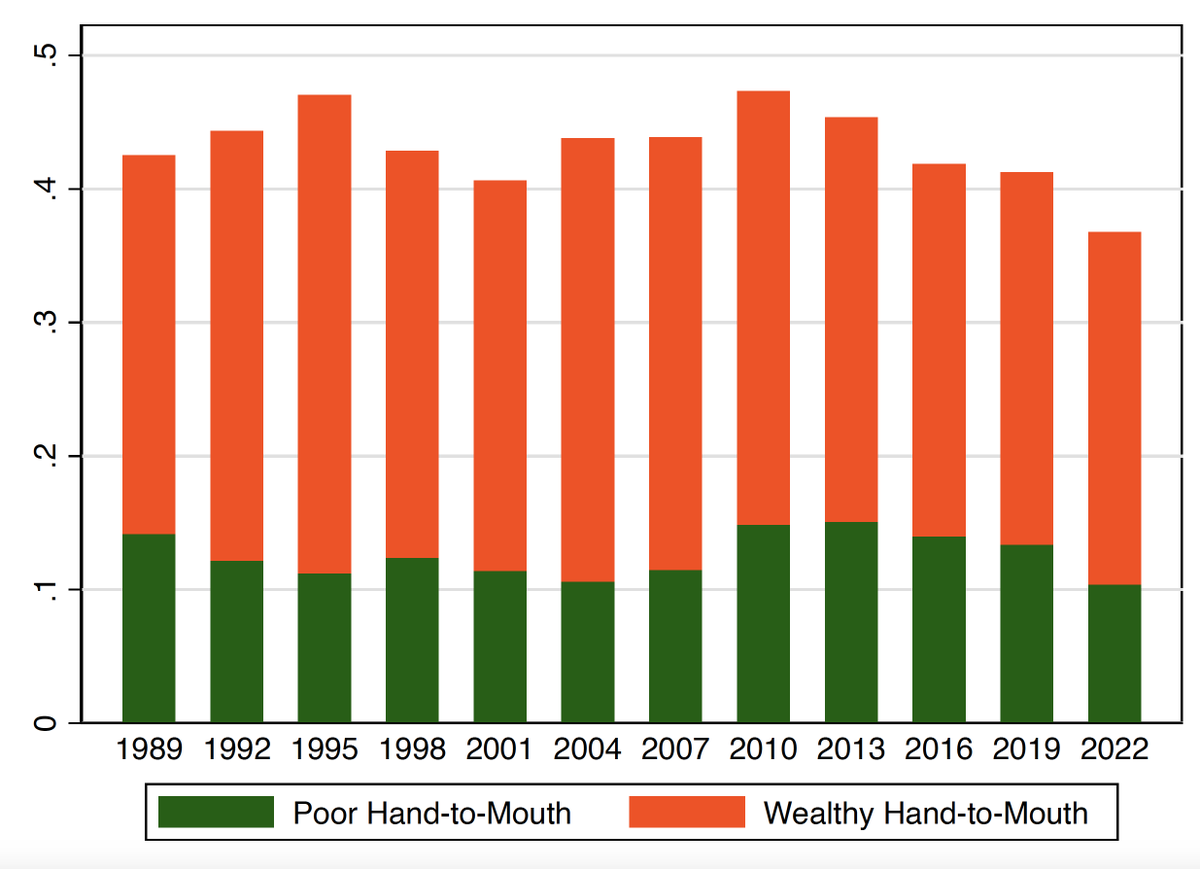
Liquid wealth defined as total financial assets excluding certificates of deposits, savings bonds, life insurance, annuities, trusts, retirement accounts, less lines of credit and credit card balances. Data from SCF Summary Extract Public Data
English
1
1
7
2.3K
Greg Kaplan
Greg Kaplan@GregWKaplan·
Hand-to-mouth households are defined as those with liquid wealth or net worth less than two weeks of earnings. Earnings defined as wage, salary, social security and pension income.
English
1
0
8
2.5K
Greg Kaplan
Greg Kaplan@GregWKaplan·
Here is my update of *very simple* hand-to-mouth calculations for the USA from the Survey of Consumer Finances, updated to 2022. The fraction of both wealthy and poor HtM continue to decline from their 2010 peak:
Greg Kaplan tweet media
English
4
15
105
25.6K
Greg Kaplan retweetledi
e61 Institute
e61 Institute@E61Institute·
Today NSW’s year 12 students will receive their ATAR results. For many, today’s results will give them an indicator of what university degrees they can enroll in. But what do ATARs mean for future earnings? 1/n
e61 Institute tweet media
English
1
4
37
7.8K
Greg Kaplan retweetledi
Neil Mehrotra
Neil Mehrotra@neilmehrotra·
This morning, the Bureau of Economic Analysis (BEA) released its latest benchmark revisions for the national income and product accounts. 🧵on the work that goes into BEA's efforts to measure the economy: 1/14
English
9
55
271
152.2K
Greg Kaplan retweetledi
e61 Institute
e61 Institute@E61Institute·
For famed investor Warren Buffet, the most important thing for a prospective investment is its economic moat, ie the way in which a business makes itself impervious to new competitors. New e61 research raises a vital query: are these moats trapping us in economic stagnation? 1/10
English
1
8
16
5.7K
Greg Kaplan
Greg Kaplan@GregWKaplan·
@mikelpetri @glviolante Households willing to hold less debt at these lower rates. So in this case the difference between the RA and HA economies is that in the HA economy steady-state govt debt demand depends on the real rate; in RA govt debt demand is perectly elastic at one possible real rate.
English
0
0
0
65
Greg Kaplan
Greg Kaplan@GregWKaplan·
@mikelpetri @glviolante With no change in nominal rate, this means higher steady-state inflation. Intuitively, bigger deficits mean governments need to collect larger interest real interest payments (i.e. r-g even must be even further below zero) to finance those deficits.
English
1
0
0
70
Greg Kaplan
Greg Kaplan@GregWKaplan·
Macroeconomists are focused on three things these days: inflation, inflation, inflation. New paper with @glviolante and George Nikolakoudis (Princeton Ph.D. student) has some new theoretical results and useful insights about the current state of affairs in many modern economies.
Greg Kaplan tweet media
English
5
95
372
45.4K
Greg Kaplan
Greg Kaplan@GregWKaplan·
Taking stock: We extend the Fiscal Theory of the Price Level to Bewley models. Our results illustrate the importance of household heterogeneity, redistribution and precautionary saving in determining inflation dynamics. END
English
1
0
5
1.9K
Greg Kaplan
Greg Kaplan@GregWKaplan·
Policy lesson #3: Redistribution amplifies fiscal inflation. In the RA model, unfunded fiscal transfers that expand deficits by 10%, generate 10% of cumulative inflation. In our model, redistribution to high-MPC households generates higher inflation. Sounds familiar?
English
1
0
7
2K