

Brian Leon
6.4K posts

Brian Leon
@GreyMasterBrian
Web Developer and photographer
Charlotte, NC Katılım Temmuz 2009
365 Takip Edilen189 Takipçiler

@GreyMasterBrian Thank you :D It was random, didnt plan for it but saw it on the way home and needed to capture it.
English


@SpikeIsAZombie definitely something worth drinking there, from both of them
English

Brian Leon retweetledi

Brian Leon retweetledi

In 1984, Ruth Coker Burks was 25 years old, visiting a friend at a hospital in Little Rock, when she noticed nurses drawing straws outside a patient's room. Someone had to go in. She didn't wait for the straws. She opened the door herself. What she found inside would define the next decade of her life. 🕯️**
Inside was a young man reduced to bones — maybe 80 pounds, dying alone, terrified. He kept whispering one word.
*"Mama."*
Ruth told the nurses to call his mother.
They laughed.
*"Honey, we've called. He's been here six weeks. Nobody's coming."*
Ruth made them give her the number. She tried one last time.
The mother's answer was cold and final: her son was sinful, already dead to her, and she would not be coming.
So Ruth went back into that room. She took his hand. She stayed.
For 13 hours, she held the hand of a dying stranger, promising him he wouldn't leave this world alone.
When he died, his family refused to claim the body.
Ruth decided she would bury him herself.
She owned plots in her family cemetery in Hot Springs — where her father and grandparents rested. The nearest funeral home willing to handle an AIDS death was 70 miles away. Ruth paid from her own pocket. A local potter gave her a chipped cookie jar for an urn.
She used posthole diggers to dig the grave herself.
She spoke kind words over the earth because no minister would come to pray over a man who died of AIDS.
Ruth thought that would be the end.
It was the beginning.
Word traveled through the quiet networks of fear and desperation across Arkansas.
*There's a woman in Hot Springs who isn't afraid. There's a woman who will sit with you. There's a woman who will make sure you're buried with dignity when your own family won't claim you.*
They started arriving. Dying young men from rural hospitals across the state, abandoned by the people who were supposed to love them most.
Over the next decade, Ruth Coker Burks cared for more than 1,000 people dying of AIDS.
She personally buried 40 of them in Files Cemetery — digging the graves herself, with her young daughter beside her carrying a small spade, holding their own funerals because no one else would speak over these graves.
Of those 1,000 people, only a handful of families didn't abandon their dying children.
Ruth called parents. Begged them to come say goodbye. To claim their child's body.
Most refused.
*"Who knew,"* she said, *"there'd come a time when parents didn't want to bury their own children?"*
But she also witnessed something else — something that stayed with her.
She watched gay men care for dying partners with a devotion that shattered every stereotype. She watched a terrified community take care of its own — and take care of her.
*"They would twirl up a drag show on Saturday night and here'd come the money. That's how we bought medicine. That's how we paid rent. If it hadn't been for the drag queens, I don't know what we would have done."*
By the mid-1990s, new treatments emerged. The crisis began to shift.
And then, like so many heroes of the AIDS crisis, Ruth Coker Burks faded from public memory.
She wrote a memoir in 2019 called *All the Young Men* because she needed people to understand what happened in Arkansas. What happened across America. What happens when fear convinces people to abandon their own children.
And what happens when one person refuses to walk past a door everyone else fears.
She didn't have medical training. She didn't have institutional backing. She didn't have money.
She had compassion. Courage. Posthole diggers. And a family cemetery.
That was enough to make sure 1,000 people didn't die believing they were worthless.
The next time someone says one person can't change anything —
Remember the red bag on the door.
Remember the 13 hours she stayed with a stranger.
Remember the 40 graves she dug with her own hands.
She walked through that door in 1984. And 1,000 lives were forever changed because of it.

English
Brian Leon retweetledi

Before the war:
1) Iran didn't control the Strait Of Hormuz, now it does
2) Iran oil was sanctioned, now it's not
3) Iran was not building a nuke, now it will
4) US bases in the Gulf were assets, now liabilities
5) Inflation was declining, now increasing
Definitely winning!
English
Brian Leon retweetledi

This is the most important piece of technology analysis published since the war began. Read every word. My good friend @veronken just connected a chain that nobody in Silicon Valley, Wall Street, or the Pentagon has connected in a single document.
The chain: a missile hits a gas facility in Qatar. The gas facility produces helium as a byproduct of LNG liquefaction. Qatar produces 33 percent of the world’s helium. All three Ras Laffan helium plants have been offline since March 2. QatarEnergy’s CEO confirmed the strikes reduced helium export capacity by 14 percent with repairs taking three to five years. One-third of the world’s supply of a gas that cannot be manufactured, only extracted from billion-year geological decay, removed from the market by the same missiles that took out 17 percent of global LNG.
Helium is not a balloon gas. It is the most critical process gas in chipmaking. Its thermal conductivity is six times nitrogen. In plasma etching, the step that carves nanoscale circuits into silicon, there is no deployed substitute at scale. The chips do not get made without helium. The AI does not train without the chips.
South Korea imports 64.7 percent of its helium from Qatar. South Korea is home to SK Hynix, which holds 62 percent of the global High Bandwidth Memory market, the single component NVIDIA cannot build an H100 or Blackwell without. NVIDIA accounts for 27 percent of SK Hynix’s total revenue. The $54.6 billion HBM market that Bank of America calls a 2026 supercycle depends on fabs that are now losing their helium, their oil, and their LNG from the same chokepoint simultaneously. Seoul imposed fuel rationing on March 25. QatarEnergy declared force majeure on South Korean LNG contracts on March 24.
Here is where Veron’s analysis goes beyond anything I have seen from Fortune, Bloomberg, Fitch, or any institutional research desk. South Korea does not just make the memory. South Korea builds the ships. Korean shipyards delivered 83.8 percent of global LNG carriers over the past five years. They hold two-thirds of the global orderbook. The world needs more LNG carriers to replace Qatar’s lost output. The country that builds those carriers is the same country being energy-starved by the loss of that output. The feedback loop is closed. The energy crisis hits the shipyards. The shipyard delays worsen the energy crisis. The energy crisis hits the fabs. The fab delays worsen the AI supply chain. One country. Three vulnerabilities. One chokepoint.
The buffers are real and Veron states them honestly. SK Hynix holds six months of stockpile. Samsung’s recycling system cuts consumption 18 percent. Over 70 percent of leading fabs recycle 80 to 95 percent of process helium. These buy time. Not immunity. If the strait reopens within 60 days, the supply chain exhales. If closure extends past six months, stockpiles thin and the structural deficit has no solution because the US cannot rapidly scale and Russia’s Amur plant faces sanctions.
This is the Nitrogen Trap applied to silicon. The same thesis this series demonstrated for diesel, sulfuric acid, and fertiliser now applies to the noble gas that makes AI physically possible. Jensen Huang’s roadmap runs on atoms before it runs on bits. The atoms are helium. The helium comes from Qatar. Qatar is offline. And the country that fabricates the memory and builds the replacement ships is being triple-starved by the same strait that Fink says determines whether we get $40 oil or $150 oil.
Read @veronken’s X Article. It is the best piece of supply chain analysis I have seen this year so far. The AI boom was built on an assumption so fundamental nobody stated it: that the physical world would cooperate. The physical world has stopped cooperating. The atoms are stuck. And the bits cannot move without them.

Veron Wickramasinghe@veronken
English
@buitengebieden His feet looks like another set of hands which is appropriate if meant to grasp tree limbs like his hands
English


Brian Leon retweetledi

OpenAI and Anthropic engineers leaked a prompting technique that separates beginners from experts.
It's called "Socratic prompting" and it's insanely simple.
Instead of telling the AI what to do, you ask it questions.
My output quality: 6.2/10 → 9.1/10
Here's how it works:
English
Brian Leon retweetledi

Brian Leon retweetledi

@DrClownPhD The UK does some powerful road ads.
This is still my favourite.
'Live With It'
Warning - Viewers may find this upsetting.
English
Brian Leon retweetledi

This is seriously the best ad ever made about speeding. I don’t think a single person was indifferent to it.
English
Brian Leon retweetledi


Brian Leon retweetledi

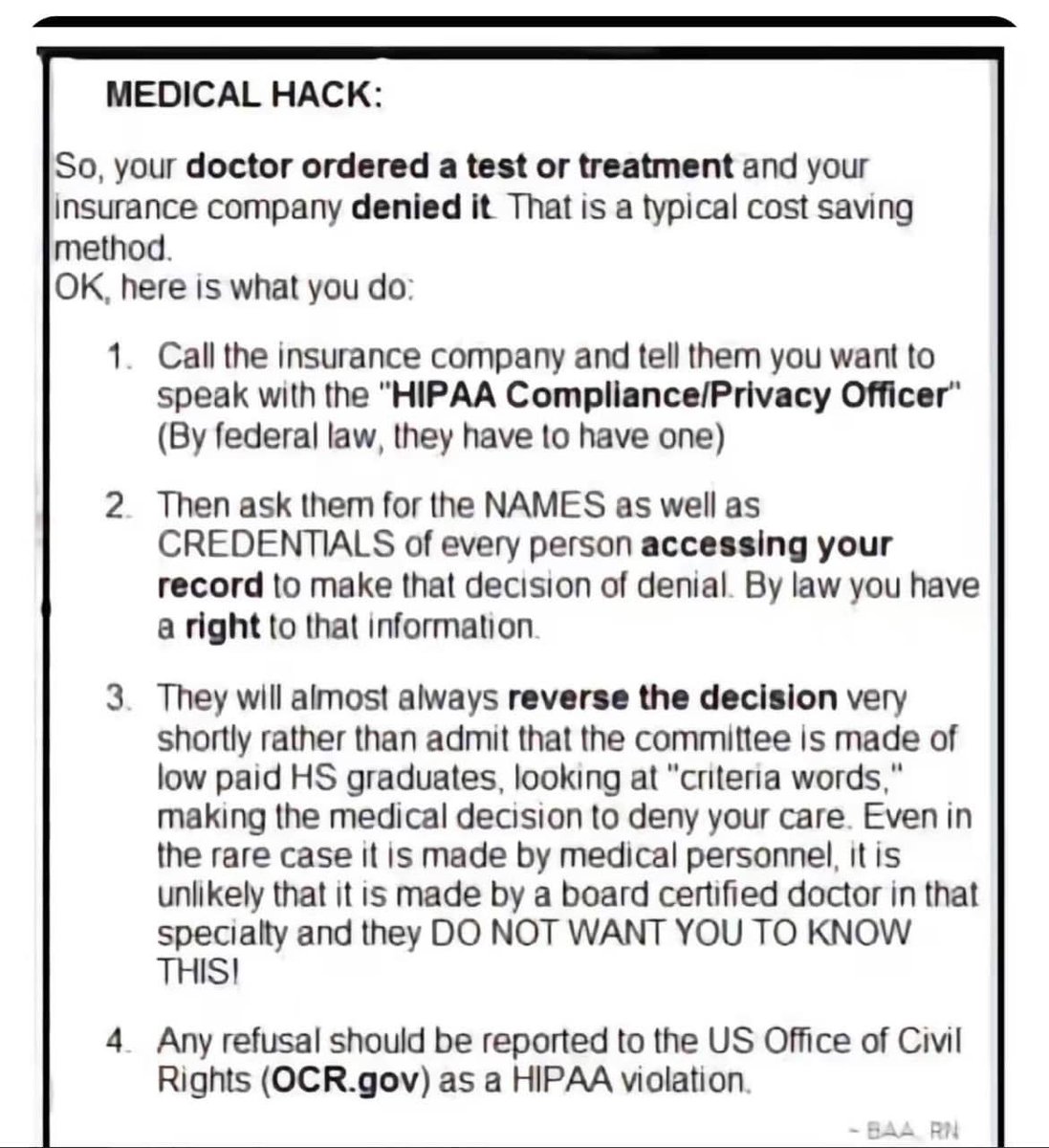
So, your doctor ordered a test or treatment and your insurance company denied it. That is a typical cost saving method.
OK, here is what you do:
1. Call the insurance company and tell them you want to speak with the "HIPAA Compliance/Privacy Officer"
(By federal law, they have to have one)
2. Then ask them for the NAMES as well as
CREDENTIALS of every person accessing your record to make that decision of denial.
By law you have a right to that information.
3. They will almost always reverse the decision very shortly rather than admit that the committee is made of low paid HS graduates, looking at "criteria words." making the medical decision to deny your care.
Even in the rare case it is made by medical personnel, it is unlikely that it is made by a board certified doctor in that specialty and they DO NOT WANT YOU TO KNOW THIS!!
4. Any refusal should be reported to the US Office of Civil
Rights (OCR.gov) as a HIPAA violation.
Be safe out there 🫵🏻✨
Know your rights 👊🏼
#ThrowbackThursday
English
Brian Leon retweetledi

If all I had was a set of dumbbells and a bench, these are the 11 Exercises I would use to get in the best shape of my life:
(Videos of each included)
English
Brian Leon retweetledi

Last September I announced mandatory return-to-office.
Five days a week.
I called it a "culture-first initiative."
Culture means presence.
Presence means badge swipes.
Badge swipes mean metrics.
Metrics mean I can prove something to the board.
I don't know what.
But I can prove it.
The announcement went out on a Tuesday.
I sent it from my home office.
In Aspen.
I have an exemption.
"Strategic leaders require location flexibility to maintain global perspective."
I wrote that policy.
HR approved it.
HR approves everything I write.
By Wednesday, 340 employees had updated their LinkedIn status to "Open to Work."
I called it "natural attrition."
Natural attrition means they quit before I had to pay severance.
Very natural.
We lost 47 engineers in the first month.
I told the board it was "alignment correction."
The people who left weren't aligned.
With coming to an office.
That I also don't come to.
But that's different.
I'm strategic.
The office costs $4.2 million per year.
Empty, it was a write-off.
Now it's a "collaboration hub."
I measured collaboration.
Average daily Zoom calls from the office: 7.4 per employee.
They commute 45 minutes.
To take calls they could take from home.
But now they're "present."
Presence is culture.
I've never been more certain of anything.
A senior engineer asked why we couldn't stay remote.
She had metrics.
Productivity was up 23% during remote work.
I said, "Productivity isn't everything."
She asked what else mattered.
I said, "Serendipitous collisions."
She asked how we measure serendipitous collisions.
I said, "You can't. That's what makes them serendipitous."
She stopped asking questions.
Then she stopped showing up.
Then LinkedIn said she's at a company that's "remote-first."
Good luck with that.
They'll learn.
We installed badge tracking software.
It cost $380,000.
It tells me exactly when people arrive.
And when they leave.
And how long they spend in each zone.
I check it every morning.
From home.
The data is fascinating.
Average arrival time: 9:47 AM.
Average departure time: 4:12 PM.
I sent a Slack message.
"Core hours are 9 to 6."
Arrival times shifted to 9:02 AM.
Departure times shifted to 6:01 PM.
Productivity did not change.
But the metrics look better.
Metrics are culture.
We have a "hybrid" option now.
Three days in office.
Mandatory Monday. Mandatory Wednesday. Mandatory Friday.
That's called "hybrid."
Because Tuesday and Thursday are optional.
But there are "anchor meetings" on Tuesday and Thursday.
Attendance is "strongly encouraged."
"Strongly encouraged" means mandatory without the liability.
I learned that from legal.
The head of product asked if he could work from home when his wife had surgery.
I said, "Of course. Family comes first."
Then I said, "But let's revisit your Q4 performance targets."
He came to the office.
His wife understood.
I assume.
I didn't ask.
That's personal.
The CFO asked about ROI on the RTO policy.
I showed him the badge data.
"Presence is up 340%."
He asked if revenue was up.
I said, "Revenue is a lagging indicator."
He asked what the leading indicator was.
I said, "Badge swipes."
He nodded.
The lease renews next year.
Seven more years.
$29 million committed.
We needed bodies in the building.
Now we have bodies.
Fewer than before.
But present.
Morale is down.
Glassdoor says we're "hostile to work-life balance."
I told HR to respond.
They wrote, "We're a high-performance culture that values in-person collaboration."
That's corporate for "the review is accurate."
But it sounds like a rebuttal.
The CEO asked if RTO was working.
I said, "Absolutely."
He asked for evidence.
I showed him a photo of the office.
Full desks. Glowing monitors. Bodies in chairs.
He smiled.
"This is what culture looks like."
It looked like a stock photo.
Because I got it from a stock photo website.
The real office has 40% occupancy on a good day.
But he doesn't know that.
He's also remote.
We're both strategic.
Next quarter I'm proposing a "collaboration bonus."
$2,000 for anyone with 95% badge-in compliance.
The bonus costs less than the turnover.
And it shifts the narrative.
We're not forcing people to come in.
We're "incentivizing presence."
Incentivizing means paying people to do something they don't want to do.
It's different from mandating.
Legally.
The employees who stayed are "loyal."
Loyalty means they have mortgages.
And kids in school districts.
And RSUs that haven't vested.
They're not loyal.
They're trapped.
But on paper, it looks like loyalty.
And paper is what the board sees.
I've been doing this for 22 years.
I know what culture looks like.
It looks like butts in seats.
Butts in seats mean control.
Control means management.
Management means me.
RTO isn't about productivity.
It never was.
It's about seeing people.
So I know they exist.
So I know they're working.
So I know I'm in charge.
That's culture.
As long as the badge swipes go up and to the right.
English
Brian Leon retweetledi

If Google wants you to pay for Gmail storage, do this first.
I went from 14.9/15GB to 6GB in one afternoon.
I hope this helps you as it has helped me:
English