
Shaneka AneIam Perare ⚡️
124 posts

Shaneka AneIam Perare ⚡️
@GusPapp
Author of The Ascent Begins. Independent Analyst. Money, geopolitics, AI, science, and sovereignty. Mapping the collapse and the reconstruction of order.
Katılım Şubat 2011
38 Takip Edilen49 Takipçiler

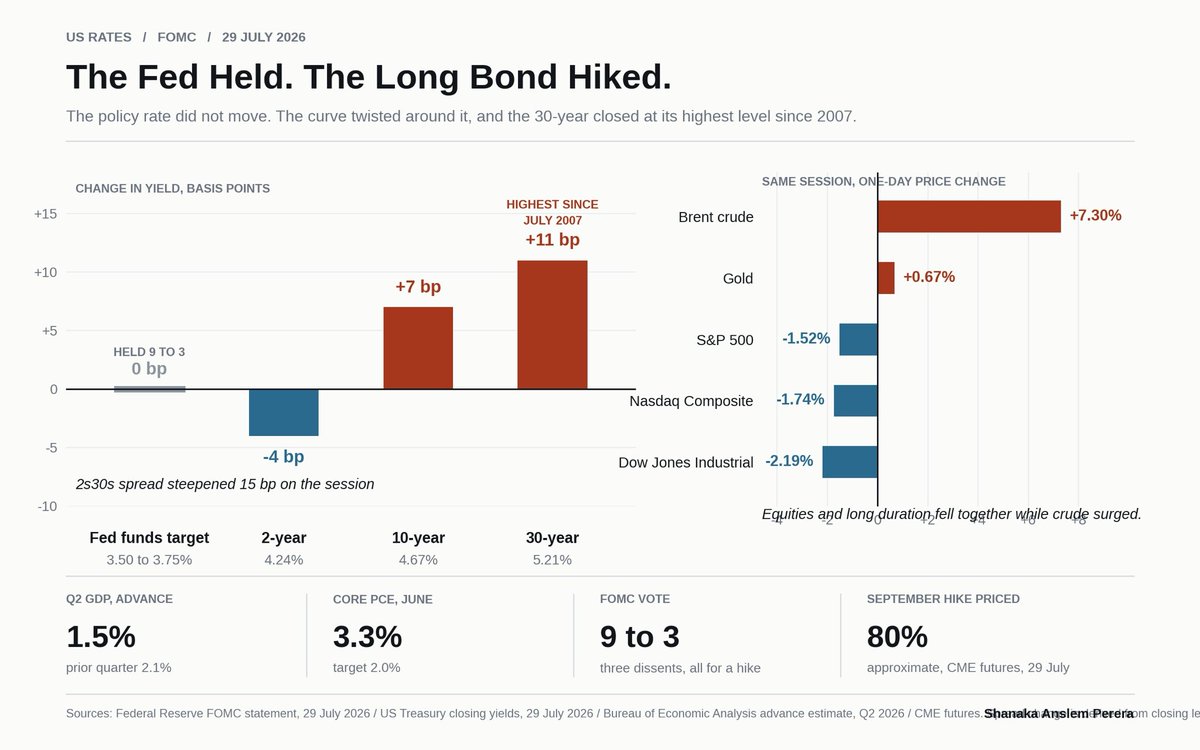
This morning America printed 1.5% growth with core inflation at 3.3%. Twelve hours earlier the 30-year Treasury closed at its highest level since 2007 and the Dow lost 1,153 points.
On the day the Federal Reserve voted, 9 to 3, to do nothing.
Two shocks hit the same session. Iran's Revolutionary Guard fired ballistic missiles at American forces, collapsing the ceasefire and sending Brent crude up 7% through $90. And the Fed held at 3.50% to 3.75% while the presidents of the Cleveland, Minneapolis and Dallas Feds all dissented for a hike, the most hawkish split since 2016, at a central bank that cut three times late last year with inflation above target.
The tape graded both at once. The Dow fell 2.19%, its worst day since April 2025. The Nasdaq 100 slid into correction. Chip stocks are down roughly 10% in a week. The 2-year yield fell to 4.24%. The 30-year rose 11 basis points to 5.21%, a level last seen in July 2007. Gold managed 0.67%. Investors needed cash more than hedges. By the close, futures priced roughly 80% odds of a September hike.
Underneath the wreckage sits the mechanism well worth understanding. Two completely different forces entered one yield that afternoon. Part of 5.21% is real restraint, the kind that cools housing and capex and does the Fed's work for it. Part is compensation for $90 oil, a live war and a committee that cannot agree, which is not restraint at all. It is the price of doubt. A Fed that holds because the market has already tightened risks counting the doubt as the discipline.
Fed chair Kevin Warsh said there is only one goal and that is 2%, and that the Fed will not hesitate to act. He has stripped forward guidance on purpose. The bond market answered with a 19-year high in the long yield and Jeffrey Gundlach saying the signals now require a hike. When a central bank stops describing its path, the long bond writes one for it.
Then this morning sealed the squeeze. Growth came in at 1.5% against 2.1% expected. The quarter's PCE prices ran 5.1% annualized on the energy shock, with annual core still at 3.3%. Slowing growth for the front end. Oil, war and inflation for the long end. Stocks and bonds falling together while crude rises. That combination has a name, and it has not been needed since the 1970s.
The calendar now does the work. Warsh speaks at Jackson Hole in late August. The next vote lands September 15th and 16th, with markets 80% priced for the hike three of his own officials demanded this week. Between now and then, every inflation print gets read twice, once for the data and once for whether 5.21% was an oil premium or the opening price of a new regime.
The Fed held. The long bond hiked.
The dangerous part is why.
English
Nashville agreed to almost 25 miles of tunnel beneath it and is putting in zero capital. The airport authority collects roughly 343 million in fees. Elon Musk's company carries the risk and collects the fares for 50 years.
That is what the 20 billion valuation is buying, and it has little to do with digging faster. The bet is that venture capital can replace the municipal bond.
Three markets price three different things. A venture valuation says investors believe it will work. A public quote says shareholders will hold it today. Project finance says it can pay for itself.
Only the third is a real test, and it has not happened yet.
English
Many of my followers have already joined our WhatsApp group.
Get free real-time trading alerts, investment strategies, and market forecast analysis.
Join the group here 👉🔗 api.whatsapp.com/send?phone=160…
➡️ Send Join to this WhatsApp number: +16057288208
English
The Fed held rates. The bond market hiked them anyway, driving the 30-year to 5.23%, the highest since July 2007. That is not monetary tightening. It is a fiscal bill. Treasury needs $671B this quarter and dealers see a $1.3T gap across 2027 and 2028 at current auction sizes.
English
Life is the universe becoming fragile enough to finally have something at stake.
English
Many of my followers have already joined our WhatsApp group.
Get free real-time trading alerts, investment strategies, and market forecast analysis.
Join the group here 👉🔗 api.whatsapp.com/send?phone=160…
➡️ Send Join to this WhatsApp number: +16057288208
English
Iran has not closed the Strait of Hormuz. It has made itself the only authority permitted to say which water inside it is safe. Eight commodity vessels crossed on Tuesday. Before the war there were roughly 125 a day.
Tehran did four interesting things on Tuesday night. It rejected Oman's 50-50 management plan. It counter-proposed running the critical segments of both lanes through Iranian waters. It said it no longer recognises the traffic separation scheme the IMO adopted in 1968, which Iran and Oman had proposed together. And it barred any third country from clearing the mines, even at Oman's invitation.
That last one is the machine.
The 1968 route is unusable because of mine risk. Iran has already refused demining by the European-led mission whose vessels were positioned and ready. The Pentagon estimated full clearance would take up to six months using three dedicated ships. So the old chart stays unusable, temporary lanes stay the only option, and whoever draws those lanes decides who sails.
The apparatus is already running. The Revolutionary Guard says safe passage exists only on Tehran-approved routes, with authorisation and continuous contact on Channel 16. A Persian Gulf Strait Authority processes the requests. In a circular to the IMO in March, Iran wrote that the United States, Israel and other participants in the aggression do not qualify for passage at all.
The IMO says it is not part of these talks.
The toll was never the asset. The authority to decide which water counts as safe is the asset.
It has been exercised before. Chinese ships trapped in the Gulf were held until Tehran authorised them, then crossed on Iran-designated lanes while paying a fee. This week the Houthis cleared Chinese vessels through Bab el-Mandeb while others turned back. Two exits, one permissions desk.
The law disagrees. Transit passage through an international strait cannot be suspended and cannot be charged for. Iran signed that convention and never ratified it.
Tehran does not need to win the argument. It needs captains and underwriters to behave as though its chart is the only one that keeps them alive.
Whether Hormuz is open matters less now than who draws the chart.

English
South Korea approved 2x leveraged retail bets on the only two companies that qualified. Those two companies are half its stock market. Three months later the exchange broke twice in two days and three of the country's most senior financial officials apologised to parliament.
On 27th May 2026, Seoul launched single-stock leveraged ETFs. Under the eligibility rules only Samsung Electronics and SK Hynix made the cut, the same two names that together account for nearly half the KOSPI. Retail investors bought 14 trillion won of them, about 9.7 billion dollars, against roughly 2 trillion won from foreigners. Households outbought the rest of the world seven to one on a doubled bet on their own index.
Those two companies also produced roughly 60% of all first quarter operating profit across the relevant KOSPI companies. The concentration was not a mania. The index followed the money. Korea's benchmark and Korea's corporate earnings had converged on one industrial bottleneck, and the leverage was then bolted onto exactly that point.
On 27th July China's CXMT listed in Shanghai, raised 8.6 billion dollars and closed 466% above its offer price. Only about 6.7% of its shares were freely tradable, so the headline valuation was distorted, and it is not yet a peer in high bandwidth memory. The capital was real regardless. China had just funded a challenger to the memory rent holding up Korea's index.
On 28th July the KOSPI fell 10.84%. Samsung fell 13.4%, its worst day in almost two decades. SK Hynix fell 14.7%. Trading stopped for 20 minutes.
On 29th July SK Hynix reported the best quarter in its history. Revenue up 257%. Operating profit up 557%. An operating margin of 76%. The stock fell as much as 17%.
The KOSPI dropped as much as 12.6% and halted again, the first back to back circuit breakers on record. Lawmakers called the market a gambling den. The finance minister said he was sorry for launching the product without careful consideration. The head of the Financial Services Commission said they had fallen short of the public's expectations. The head of the Financial Supervisory Service apologised too. All of them sat down at an emergency meeting that evening.
A 76% margin was not enough, because the market had stopped pricing the quarter and started pricing how long the quarter lasts.
Scarcity inflated the earnings. The earnings inflated two index weights. The weights made those two names the only ones eligible for leverage. The leverage turned a change in belief about the future of memory into a national trading halt.
The boom built the concentration. The concentration invited the leverage. The leverage built the channel.
Samsung reports tomorrow. If a record quarter takes back control of the price, earnings still govern this market. If it does not, the index has stopped measuring a country with two chip champions and started measuring one memory cycle with a country attached.

English
JUST IN: America's Patriot inventory has fallen from 2,330 interceptors before this war to somewhere between 759 and 827. THAAD has gone from 452 to between 234 and 278. Those are CSIS estimates drawn from budget documents, published Monday. The Pentagon says it still has what it needs.
Both statements are true, and the way they are both true is the story.
Yesterday tested it twice. At a quarter to six Eastern, CENTCOM said Revolutionary Guard forces fired ballistic missiles at American forces in an attempted surprise attack and that all were intercepted. Hours later Jordan said its air defences destroyed five more launched from Iran. The Guard said it had aimed at American targets in Jordan. Every missile was stopped.
Stopped by a Patriot magazine that is at least 65 percent smaller than it was in February.
Mark Cancian, who co-wrote the CSIS analysis, named the adjustment that follows. American forces could begin firing two interceptors at each incoming missile instead of three. The share that gets through does not jump. It rises a little, quietly, everywhere at once.
That is not running out of anything. It is thinning, and it is how sufficiency survives a two-thirds drawdown.
Which is what made yesterday in Washington so exposed. Zelensky spent the morning asking for licences to manufacture Patriot interceptors rather than simply receive them. Seventeen countries besides the United States and Ukraine fire that same round. Netanyahu came to talk about Iran. Both men then buried the senator who spent a career insisting America could arm every front at once.
The fronts kept multiplying anyway. Saudi Arabia, which avoided this war for five months, joined American strikes on Iran-backed militias in Iraq after drone attacks on its oil facilities. Satellite imagery from Monday showed smoke over Abqaiq.
Every interception this week was a success. Each success made the next one thinner.
English