Peter S. Nordholt

1.8K posts

Peter S. Nordholt banner
Peter S. Nordholt

Peter S. Nordholt

@GuutBoy

Interested in cryptography. I mostly tweet excited announcements of new secure computation papers appearing on IACR’s ePrint archive.

Danmark Katılım Mayıs 2013
481 Takip Edilen480 Takipçiler
Sabitlenmiş Tweet
Peter S. Nordholt
Peter S. Nordholt@GuutBoy·
My website has moved to a cool new domain! mpc.dk 🎉
English
1
4
11
0
Jonatan Pallesen
Jonatan Pallesen@jonatanpallesen·
@GuutBoy I also found one saying 100-120. Let me redo the calculations with 120
English
1
0
0
228
Jonatan Pallesen
Jonatan Pallesen@jonatanpallesen·
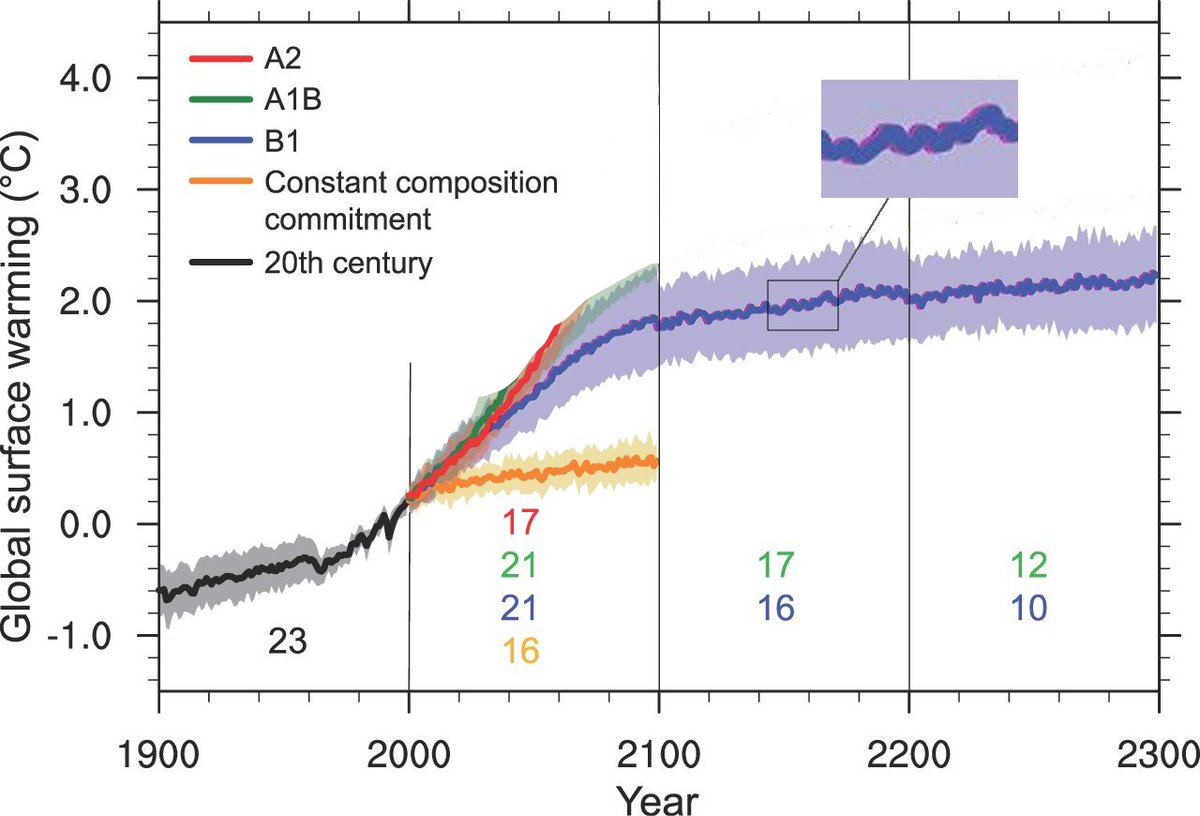
Improved graphic of the total effect on global temperatures of the immediate disappearence of all cattle in the world: Going from the blue line to the red line.
Jonatan Pallesen tweet media
Jonatan Pallesen@jonatanpallesen

Worrying about cows regarding global warming is a confusion. 5% sounds like a lot, but the crucial thing to understand is that emissions from cows are part of a cycle: After about 12 years, the emissions from cows will cycle back and be taken up by plants again, which the cows then eat, and so on. This is different from how it works with fossil fuel emissions. When you burn coal, it is not the case that after 12 years it will go back from the air into a lump of coal in the ground. To make it specific, when a cow eats some grass, eventually that grass will grow back. When it does, it binds CO2 from the atmosphere. (And if a cow doesn't eat the grass, there is a limit to how high it would grow.) That means that if we stopped cow farming, the greenhouse gas emissions would be reduced for 12 years, and then that's it. It is a one time benefit. Let us try and consider the extreme hypothetical of ending all cattle farming today. Bill Gates says that emissions from cows are 5% of the total each year. So this would give us a one time reduction of 12 * 5% = 0.6 years emissions. Therefore we can see the potential impact of the extreme hypothetical of ending all cattle farming in the world, by comparing the current forecast with one that is pushed forward by 0.6 years. I have done that below, applied to the middle purple line. I have overlaid a pink line, and moved it forward by 0.6 years. When I look at the image in full resolution, I can see a faint pinkish coloration on the left side of the middle purple line. This is the potential change in development we would get regarding global warming if we hypothetically ended all cattle farming today. Practically invisible. The methane emitted from cows is a potent greenhouse gas, until it breaks down to CO2. So some estimates for the proportion of greenhouse higher than the 5% figure Bill Gates mentions here. The highest I could find was 19.6%. If we use that figure, ending all cattle farming today, would reduce emissions by an equivalent of 12 * 0.196 = 2.352 years. Under these generous assumptions, the effect from hypothetically ending all cattle farming is now visible in the chart below. But the real-world importance of this effect is elusive.

English
1
4
25
4.1K
Peter S. Nordholt
Peter S. Nordholt@GuutBoy·
@jonatanpallesen Maybe they are just too busy to mess around on X? ChatGPT thinks is can be estimated to 100-120 over 12 years
English
1
0
0
80
Jonatan Pallesen
Jonatan Pallesen@jonatanpallesen·
@GuutBoy Yes. Really someone who knows climate science should be doing this. But for some reason they aren't
English
1
0
0
156
Jonatan Pallesen
Jonatan Pallesen@jonatanpallesen·
@GuutBoy Maybe even more over a 10 year period then? Need to find the accurate number
English
1
0
0
55
Peter S. Nordholt
Peter S. Nordholt@GuutBoy·
@jonatanpallesen Your factor of 25 appears to be the 100 year equivalence factor. Over a 20 period it’s reported as a factor of 84.
English
1
0
1
93
Jonatan Pallesen
Jonatan Pallesen@jonatanpallesen·
Yes. I found a source that had various estimates of the proportion of greenhouse gasses that are emitted from cows, and it gave estimates in the range of a few percent up to 19%. [A quick sanity check: 38 billion metric tonnes of CO2 each year. 570 million metric tonnes of methane each year 570 * 25 times more potent = 14 billion. So some fraction of the total greenhouse gas effect. And cow emissions are only part of the total methane emitted. So it checks out.] I took 16.6% as a high end estimate of the total ghg emitted by cows (as measured by their ghg effect), and used that. The logic of the figure is, the cycle doesn't add extra methane over time. But it keeps more methane in the air as part of the cycle. Let's call the total greenhouse gas burden that is added to the atmosphere from carbon and methane in one year G. Now let's look at what happens if hypothetically all cows are immediately disappeared. Then next year, 16.6% less ghg burden would be added to the atmosphere. That is 1/6G less. Over 6 years that is 1G less. Over 12 years that is 2G less. But then no more! Because methane is in a cycle of 12 years. So the total gain from disappearing all cows has a ceiling of 2G. Ok, what does a world with 2G less ghg in the atmosphere look like? 1G is defined as the ghg that is added in a year, so we have a way of modelling this: Look like what the projections are for two years in the future. Since this is a world with 2G more in the atmosphere than we have today. Therefore on can draw the red line same as the blue line, but moved 2 years back. (Adjustment: 44% of all carbon emissions each year is taken up by the soil and oceans, whereas methane is not. It would be an overestimate to count these carbon emissions as not mattering, but I go ahead and make this overestimate anyway. Then we would instead have 2.88G extra from the disappearance of all cows. So I moved the line 2.88 years back, instead of 2 years.)
English
3
0
1
99
Peter S. Nordholt
Peter S. Nordholt@GuutBoy·
@jonatanpallesen I see, it’s a bit hard to read on the graph. I still wonder about drawing this conclusion from the 5% number. Could something important be lost in the translation to CO2 equivalents? In particular is the relatively large short term benefit of cutting methane accounted for?
English
1
0
0
93
Jonatan Pallesen
Jonatan Pallesen@jonatanpallesen·
@GuutBoy It is actually plotted from now to 2050 as well. You can see the blue line, and a red line behind it but slightly skewed to the left.
English
1
0
0
94
Peter S. Nordholt retweetledi
Claudio Orlandi
Claudio Orlandi@claudiorlandi·
The program for the next edition of NordiCrypt (in Odense, November 15th) is now online.
English
1
2
6
794
Jonatan Pallesen
Jonatan Pallesen@jonatanpallesen·
@GuutBoy Thats not how the problem is stated though. It just says that it “often” predicts, or that it is 90% accurate in its predictions. It doesn’t say or imply anything about this equivalence.
English
1
0
0
74
Jonatan Pallesen
Jonatan Pallesen@jonatanpallesen·
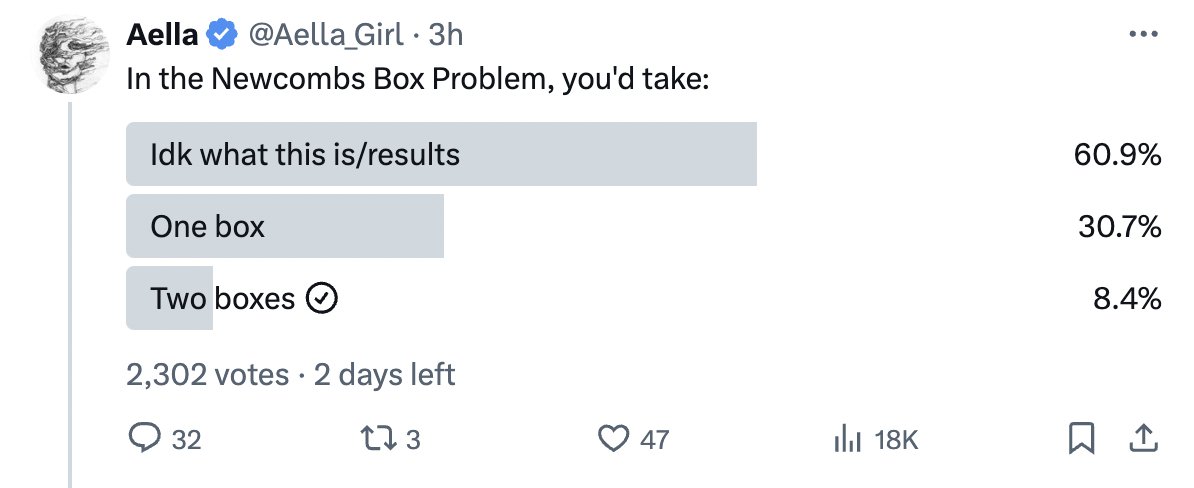
Rather surprising to see so many 1-boxers. What's in the boxes has already been decided, and won’t change based on your choice. So of course choose 2 boxes. People come up with some probability payout calculations to support picking 1 box. But such calculations can be tricky, and it is easy to be misled. Consider, for example, the Monty Hall paradox. On the other hand, the fact that you can't change the past is quite easy and simple. So we have on the side supporting 1-boxing a probability calculation that might be wrong, and on the side supporting 2-boxing the fact that you can't change the past. Clearly the argument for 2-boxing is stronger. The paradox: Scientists have invented a machine for predicting human decisions. The machine scans a person’s brain, then scientists input a precise description of a possible situation. The machine does some incredibly complicated calculations, then predicts what the subject would do in the given situation. The machine has been found to be 90% accurate: i.e., if a person is put in the given situation, 90% of the time the person does what the machine predicted. Your brain was scanned yesterday, and scientists entered a description of the choice situation you are about to face, namely: you are shown two boxes, box A and box B. You may take either box B, or both boxes. Box A contains $1000. Box B contains either $1 million or nothing. If the machine predicted that you would take both boxes, then the scientists put nothing in box B. If it predicted that you would take only B, then they put $1 million in B. What should you choose?
Jonatan Pallesen tweet media
English
54
1
52
20.9K
Peter S. Nordholt
Peter S. Nordholt@GuutBoy·
@jonatanpallesen In my game there is a clear connection between the the concrete choice I make and the prediction made. It is equivalent (I believe) to the predictor postponing its choice till after I have made my pick.
English
1
0
0
42
Jonatan Pallesen
Jonatan Pallesen@jonatanpallesen·
@GuutBoy A follow-up question could be "Is that the same as that it has 90% accuracy in its predictions?"
English
1
0
0
57
Peter S. Nordholt
Peter S. Nordholt@GuutBoy·
@jonatanpallesen It seems to me we are both making assumptions to serve our view. You are saying the predictor and its reliability is statistical and thus my choice is independent of the prediction. I am saying the prediction will align with my choice with some given probability.
English
1
0
0
25
Peter S. Nordholt
Peter S. Nordholt@GuutBoy·
@jonatanpallesen I did say “along the lines of”. It’s just to say that each prediction is right with 90% probability
English
1
0
0
24
Jonatan Pallesen
Jonatan Pallesen@jonatanpallesen·
@GuutBoy Nozicks just said "has often predicted". I can't imagine any context where someone says that X often predicts Y behavior, or predicts it with high accuracy, and that actually means that it has perfect prediction but flips to wrong x% of the time. Not even if it was an alien.
English
1
0
0
30
Peter S. Nordholt
Peter S. Nordholt@GuutBoy·
@jonatanpallesen It also does not state anything about a high accuracy statistical model. I believe Nozick talks about a (possibly alien) being making “almost certain” predictions. I guess it’s open to interpretation (although in your formulation I will concede it sounds more like a stat thing)
English
1
0
0
29
Jonatan Pallesen
Jonatan Pallesen@jonatanpallesen·
@GuutBoy But you are choosing to read this thing about infallibility into the paradox, when its not a part of it.
English
1
0
0
32
Jonatan Pallesen
Jonatan Pallesen@jonatanpallesen·
@GuutBoy Why would you think that? If someone at my work tells me he has made a model that predicts behavior with 90% accuracy, I would not assume he has made an infallible predictor, and flipped it with 10% probability.
English
1
0
0
29
Peter S. Nordholt
Peter S. Nordholt@GuutBoy·
@jonatanpallesen Maybe we are the reliability concept differently. I am think a long the lines of an infallible prediction that’s flipped with 10% probability.
English
1
0
0
24
Jonatan Pallesen
Jonatan Pallesen@jonatanpallesen·
@GuutBoy Nozicks original version was even just says "high accuracy", so that would also be an allowed answer. Say your boss want to know if the approach you made has low, medium, or high accuracy.
English
1
0
0
47
Peter S. Nordholt
Peter S. Nordholt@GuutBoy·
@jonatanpallesen In a real world case like that I can’t be sure my prediction holds with some specific probability. I would have to make some kind of fuzzy statistical argument. Maybe this is where these arguments seems detached from the paradox to me.
English
1
0
0
24
Jonatan Pallesen
Jonatan Pallesen@jonatanpallesen·
@GuutBoy Lets say your job is to identify people at high risk of crossing red light. You make a machine that checks for color blindness, which it turns out work quite well. Your boss asks you what the reliability / accuracy is of your approach. What do you answer?
English
1
0
0
52
Peter S. Nordholt
Peter S. Nordholt@GuutBoy·
@jonatanpallesen Yes, and in that case I will cross a red light with whatever level of reliability the prediction has … or it will not have that reliability, a contradiction. No?
English
1
0
0
40
Jonatan Pallesen
Jonatan Pallesen@jonatanpallesen·
@GuutBoy Its just a machine that measures whether you are colorblind. If yes, it makes a prediction that you will cross a red light. Nothing magical about it.
English
1
0
0
61