Tomas Hromada

480 posts

Tomas Hromada banner
Tomas Hromada

Tomas Hromada

@Gyfis

Building observability products that don’t suck @BetterStackHQ. Rails 💎, Vue, Postgres, Clickhouse.

Prague Katılım Ocak 2010
1.3K Takip Edilen262 Takipçiler
Tomas Hromada retweetledi
Better Stack
Better Stack@BetterStackHQ·
Collect logs, traces, and metrics from your clusters with zero code changes via eBPF and auto-instrumentation.
English
1
4
5
765
Tomas Hromada retweetledi
Ayush Sharma
Ayush Sharma@theayush·
We use @BetterStackHQ heavily in my company. It works wonders for us, without them we couldn't possibly fix the production bugs that we get. We have BetterStack set up everywhere, and hands down, the best service for error tracking, error logging, and everything that you need, they have it.
Juraj Masar@jurajmasar

Today, we're making Error Tracking by @BetterStackHQ generally available. Sentry-compatible. AI-native. At 1/6th the price. Here's why we built it, and how to get the most out of it. What's wrong with error tracking today? Most teams use Sentry. It's solid! But at scale, the bills get brutal. Just 100M exceptions with 90 day lookback? ~$30,000 on Sentry. We charge ~$5,000 for the exact same thing. The math isn't subtle. And so most teams still end up sampling. Which means missing the exact exception that caused the outage. The bigger problem: errors are orphaned data. Your exception lands in Sentry. Your logs are in Datadog. Your traces are somewhere else. Root cause analysis becomes a multi-tab archaeology project at 3 am. We built error tracking natively inside Better Stack: the same platform where your logs, traces, metrics, uptime checks, and on-call schedules already live. Errors are just another signal. They belong together. The part that changes how your team works: Our AI SRE doesn't just surface errors. It fixes them. See a new exception? One click. The AI SRE analyzes the full context, from stack traces, environment variables, browser sessions, related logs and recent deploys, and opens a pull request. Not a ticket. Not a summary. A pull request with the fix. This is what happens when error tracking is fully integrated with the rest of your observability stack instead of bolted on separately. The AI has everything it needs to actually act. The migration is trivial: 1. Keep your existing Sentry SDK. Don't touch a single line of instrumentation code. 2. Point the DSN at Better Stack. 3. Done. Errors flow in. Your dashboards work. Your alerts work. 4. New exception appears. Click "Fix with AI SRE." Pull request lands in your repo. 5. Review, merge, close. That's the whole workflow. The AI angle is real, not a marketing badge. LLMs are genuinely good at fixing bugs if they have full context. The reason AI coding assistants sometimes frustrate engineers is incomplete information, not the model. We solve that by giving the AI SRE your entire telemetry stack as context. Stack traces, logs, traces, service maps, previous incidents and much more. All of it, in one place, at the moment it matters. Observability tools are only useful if you actually ingest all your data. At current prices of other tools, most teams can't afford to. Now you can, and your AI SRE can actually do something about it.

English
2
5
11
1.2K
Tomas Hromada
Tomas Hromada@Gyfis·
We built Error Tracking, because we were frustrated by the speed and cost of other tools when fixing bugs. Out, for us, and everyone else. Go, team 🚀
Juraj Masar@jurajmasar

Today, we're making Error Tracking by @BetterStackHQ generally available. Sentry-compatible. AI-native. At 1/6th the price. Here's why we built it, and how to get the most out of it. What's wrong with error tracking today? Most teams use Sentry. It's solid! But at scale, the bills get brutal. Just 100M exceptions with 90 day lookback? ~$30,000 on Sentry. We charge ~$5,000 for the exact same thing. The math isn't subtle. And so most teams still end up sampling. Which means missing the exact exception that caused the outage. The bigger problem: errors are orphaned data. Your exception lands in Sentry. Your logs are in Datadog. Your traces are somewhere else. Root cause analysis becomes a multi-tab archaeology project at 3 am. We built error tracking natively inside Better Stack: the same platform where your logs, traces, metrics, uptime checks, and on-call schedules already live. Errors are just another signal. They belong together. The part that changes how your team works: Our AI SRE doesn't just surface errors. It fixes them. See a new exception? One click. The AI SRE analyzes the full context, from stack traces, environment variables, browser sessions, related logs and recent deploys, and opens a pull request. Not a ticket. Not a summary. A pull request with the fix. This is what happens when error tracking is fully integrated with the rest of your observability stack instead of bolted on separately. The AI has everything it needs to actually act. The migration is trivial: 1. Keep your existing Sentry SDK. Don't touch a single line of instrumentation code. 2. Point the DSN at Better Stack. 3. Done. Errors flow in. Your dashboards work. Your alerts work. 4. New exception appears. Click "Fix with AI SRE." Pull request lands in your repo. 5. Review, merge, close. That's the whole workflow. The AI angle is real, not a marketing badge. LLMs are genuinely good at fixing bugs if they have full context. The reason AI coding assistants sometimes frustrate engineers is incomplete information, not the model. We solve that by giving the AI SRE your entire telemetry stack as context. Stack traces, logs, traces, service maps, previous incidents and much more. All of it, in one place, at the moment it matters. Observability tools are only useful if you actually ingest all your data. At current prices of other tools, most teams can't afford to. Now you can, and your AI SRE can actually do something about it.

English
0
0
1
41
Tomas Hromada retweetledi
Daniel Lockyer
Daniel Lockyer@DanielLockyer·
Thanks to @BetterStackHQ for fixing a bunch of performance issues I reported in their dashboard! The experience is so much faster now 🤩 My response:
Daniel Lockyer tweet media
English
4
4
38
2.8K
Tomas Hromada
Tomas Hromada@Gyfis·
We previously replaced Papetrail and Grafana with our own product. Happy to see us replace New Relic, too 👋
Juraj Masar@jurajmasar

Today, we're introducing eBPF-based OpenTelemetry tracing alongside a remotely controlled Better Stack Collector. eBPF is ready for prime time. Here's the playbook for adopting it. What's eBPF? "extended Berkeley Packet Filter" is a Linux kernel technology that lets you run sandboxed programs inside the kernel safely and efficiently. Thanks to eBPF, you can now instrument your clusters with OpenTelemetry without changing any application code 🤯 The eBPF ecosystem has matured significantly over the past few months and many Better Stack customers are already using it in production. Until now, deploying eBPF to production has been tricky. We're simplifying it today by bundling the best of the open source eBPF sensors into a single remotely controlled Better Stack collector you can deploy with a single command. Better Stack collector gives you granular control over what exactly gets instrumented. Get the service map of your cluster, RED metrics for individual services, see network flows, and aggregate your application and system logs out of the box. Without changing any code. Observability tools are only useful if you actually ingest all relevant data. Today, we're making that simpler and more convenient than ever. The eBPF OpenTelemetry playbook™ = "Do the easy thing before doing the hard thing" 1. In your staging environment. 2. Deploy the eBPF collector into your distributed cluster. 3. In 98% of cases: Declare victory, your app is now instrumented. 4. In 2% of cases: You notice a particular service has slowed down. For example, the CPU utilization on a high-throughput Redis instance handling millions of operations per second got noticeably higher. Better be safe, so you disable eBPF for this single instance while keeping it enabled for the other 98% of services. 5. If needed, use the OpenTelemetry SDK auto-instrumentation to instrument the last 2% of applications. Most teams today still start with step 5. If you're revisiting your observability stack, I encourage you to give eBPF a chance: it has matured significantly and is better than you might expect. Better Stack encourages combining OpenTelemetry traces from the OTel SDK, eBPF, and your frontend. That's the only way to get the clearest picture of what's actually happening in your application. Want to chat eBPF? Catch me at KubeCon in Amsterdam next week!

English
0
0
0
67
Tomas Hromada retweetledi
Juraj Masar
Juraj Masar@jurajmasar·
Today, we're introducing eBPF-based OpenTelemetry tracing alongside a remotely controlled Better Stack Collector. eBPF is ready for prime time. Here's the playbook for adopting it. What's eBPF? "extended Berkeley Packet Filter" is a Linux kernel technology that lets you run sandboxed programs inside the kernel safely and efficiently. Thanks to eBPF, you can now instrument your clusters with OpenTelemetry without changing any application code 🤯 The eBPF ecosystem has matured significantly over the past few months and many Better Stack customers are already using it in production. Until now, deploying eBPF to production has been tricky. We're simplifying it today by bundling the best of the open source eBPF sensors into a single remotely controlled Better Stack collector you can deploy with a single command. Better Stack collector gives you granular control over what exactly gets instrumented. Get the service map of your cluster, RED metrics for individual services, see network flows, and aggregate your application and system logs out of the box. Without changing any code. Observability tools are only useful if you actually ingest all relevant data. Today, we're making that simpler and more convenient than ever. The eBPF OpenTelemetry playbook™ = "Do the easy thing before doing the hard thing" 1. In your staging environment. 2. Deploy the eBPF collector into your distributed cluster. 3. In 98% of cases: Declare victory, your app is now instrumented. 4. In 2% of cases: You notice a particular service has slowed down. For example, the CPU utilization on a high-throughput Redis instance handling millions of operations per second got noticeably higher. Better be safe, so you disable eBPF for this single instance while keeping it enabled for the other 98% of services. 5. If needed, use the OpenTelemetry SDK auto-instrumentation to instrument the last 2% of applications. Most teams today still start with step 5. If you're revisiting your observability stack, I encourage you to give eBPF a chance: it has matured significantly and is better than you might expect. Better Stack encourages combining OpenTelemetry traces from the OTel SDK, eBPF, and your frontend. That's the only way to get the clearest picture of what's actually happening in your application. Want to chat eBPF? Catch me at KubeCon in Amsterdam next week!
Juraj Masar tweet media
English
5
14
54
39.6K
Tomas Hromada retweetledi
Better Stack
Better Stack@BetterStackHQ·
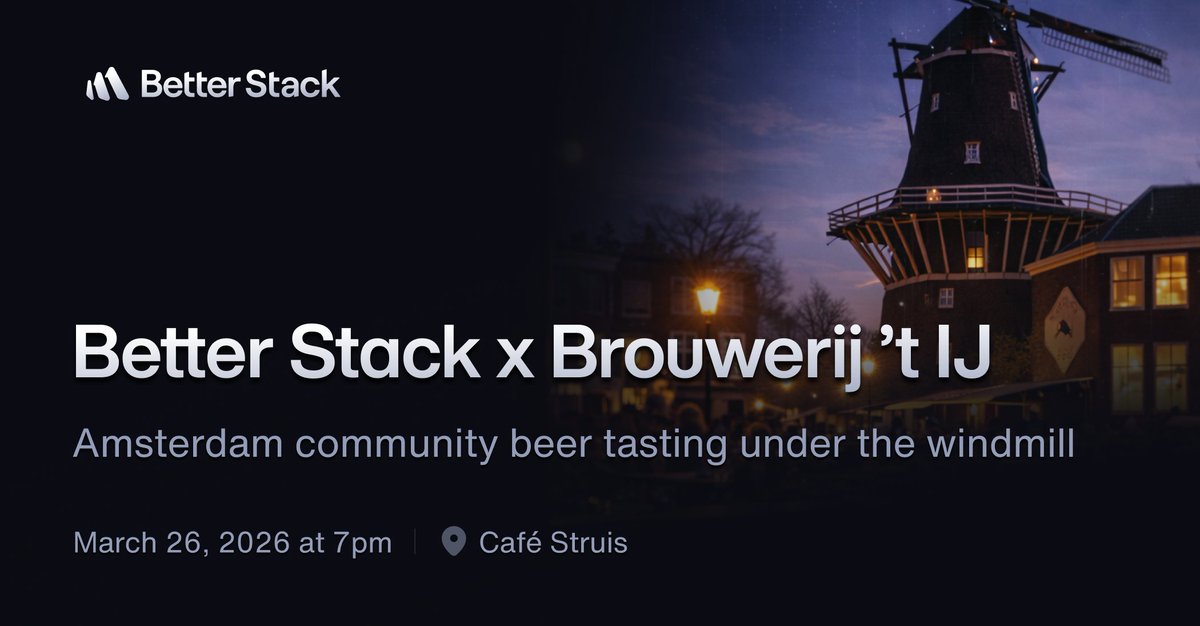
Some evenings in Amsterdam are simply gezellig. On March 26 at 7:00 pm, we’re hosting a beer tasting at Café Struis, the official @BrouwerijtIJ tasting room. No pitches. No slides. Just award-winning beers brewed under the windmill. Join us! RSVP link in the thread below ↓
Better Stack tweet media
English
1
5
5
525
Tomas Hromada retweetledi
Better Stack
Better Stack@BetterStackHQ·
What do you do when you’re in Amsterdam? You get on a boat! March 24, 8:30 PM. We’re hosting a private canal cruise for the cloud native crowd. Cold beers. Dutch snacks. Zero agenda. Join the Better Stack crew for a night on the water! Link to RSVP below ↓
Better Stack tweet media
English
1
5
5
447
Tomas Hromada retweetledi
Better Stack
Better Stack@BetterStackHQ·
Don’t visit our booth. Unless, of course, your observability bill is starting to cost more than your infrastructure. Sound familiar? Let us show you a better way at KubeCon + CloudNativeCon 2026. Stop by booth 892 to meet the team, see the platform in action, and experience our AI SRE firsthand.
Better Stack tweet media
English
2
4
11
4.4K
Tomas Hromada retweetledi
Better Stack
Better Stack@BetterStackHQ·
See how you can connect AI assistants to your Uptime and Telemetry data through the Model Context Protocol.
English
0
1
5
490
Tomas Hromada retweetledi
Better Stack
Better Stack@BetterStackHQ·
In the latest episode of the podcast @evanyou tells us his journey from Vite to founding @voidzerodev and developing a complete Rust-based JavaScript toolchain. The 50-100x performance gains with OXC, and how Vite Plus aims to simplify the entire JavaScript onboarding experience.
English
4
17
114
12.8K
Tomas Hromada retweetledi
Juraj Masar
Juraj Masar@jurajmasar·
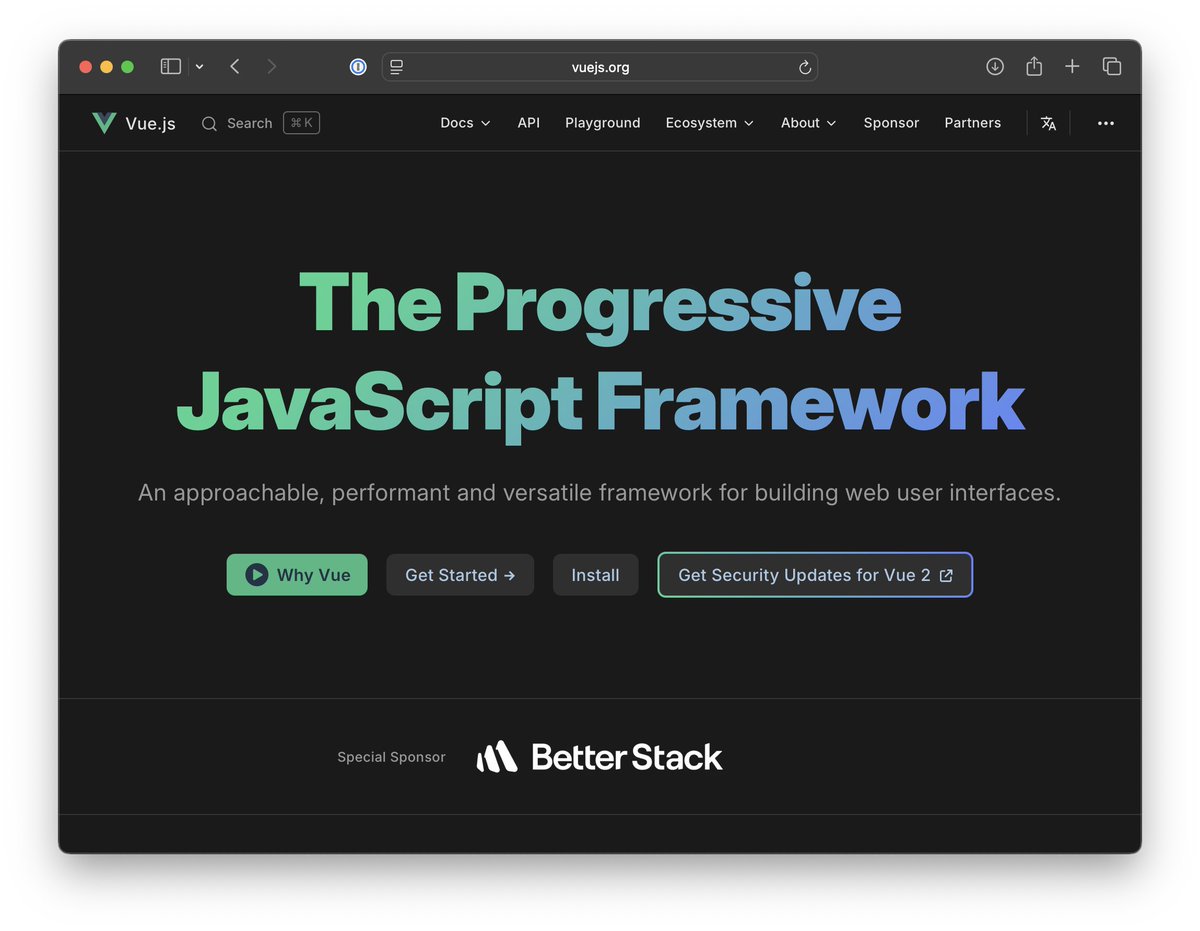
I'm proud for @BetterStackHQ to sponsor @vuejs 🔥 @evanyou, the creator of Vue.js, is also the guest of the latest episode of the Better Stack podcast. Give it a listen, it's a great one! Link in a thread
Juraj Masar tweet media
English
12
12
104
12.8K
Tomas Hromada retweetledi
Juraj Masar
Juraj Masar@jurajmasar·
This wasn't on my bingo card: @BetterStackHQ ▶️ button
Juraj Masar tweet media
English
4
3
26
1.3K
Tomas Hromada retweetledi
Better Stack
Better Stack@BetterStackHQ·
In the latest podcast episode, @sudobunni tells us her journey from Neovim to Doom Emacs, her love/hate relationship with Linux ricing, and how she's building an inclusive coding community through her streams.
English
0
3
22
4.7K
Tomas Hromada
Tomas Hromada@Gyfis·
You find new music on Spotify. I find new music in the "fix this immediately" review Loom from my boss. We are not the same.
English
1
0
3
67
Tomas Hromada retweetledi
Juraj Masar
Juraj Masar@jurajmasar·
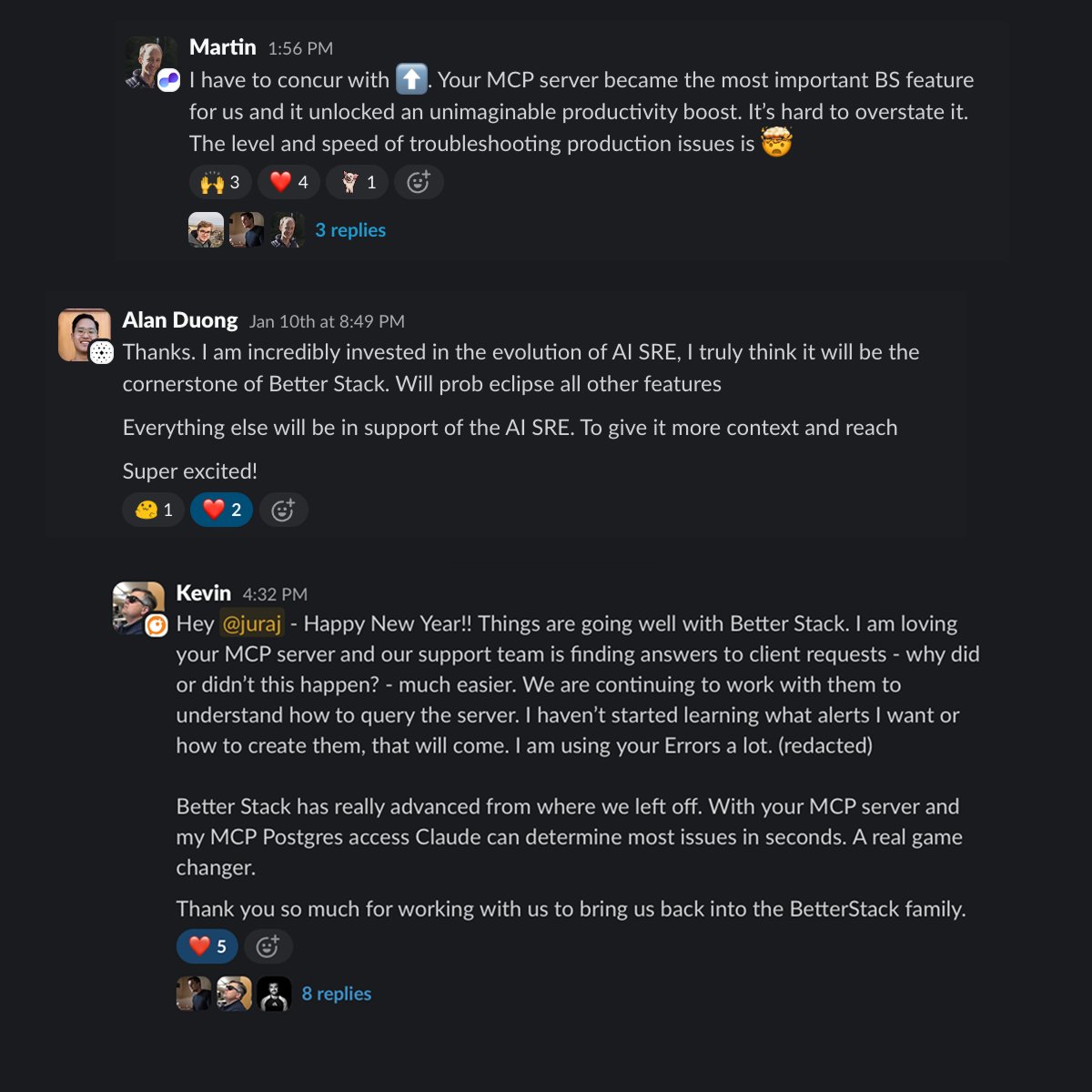
AI SRE is no longer just a cool demo. It's real, it works, and can debug real issues. Today. How do I know? @BetterStackHQ customers keep telling me 😂 AI SRE is one of those rare features that our customers are *truly* excited about. My favorite use case? Letting the wider company use the MCP server to debug issues on behalf of customers, eliminating many "L2" technical support requests for engineers. And 2026 has just begun 🤯
Juraj Masar tweet media
English
5
4
17
6.6K