In Honour Of Thomas W Phelps

4.2K posts

In Honour Of Thomas W Phelps

In Honour Of Thomas W Phelps

@HOThomasWPhelps

Ex-Merck Process Research, biochem professor. Current research/analysis focuses on ITK inhibition, STAT6 degradation, Treg, Th2, Th17 in autoimmune diseases.

Katılım Eylül 2024
131 Takip Edilen2.6K Takipçiler
In Honour Of Thomas W Phelps
In Honour Of Thomas W Phelps@HOThomasWPhelps·
Atopic Dermatitis Trials Exclusion/Inclusion Critera ⤵️ Patient Disease Severity from lowest to highest, refractory hardest to treat $NKTR #Rezpeg, IL-2 $KYMR KT-621, STAT6 $APGE APG777, IL-13 $SNY $REGN #Dupilumab, IL-4 $AMGN #Rocatinlimab, OX40L $CRVS #Soquelitinib, ITKi
In Honour Of Thomas W Phelps tweet media
In Honour Of Thomas W Phelps@HOThomasWPhelps

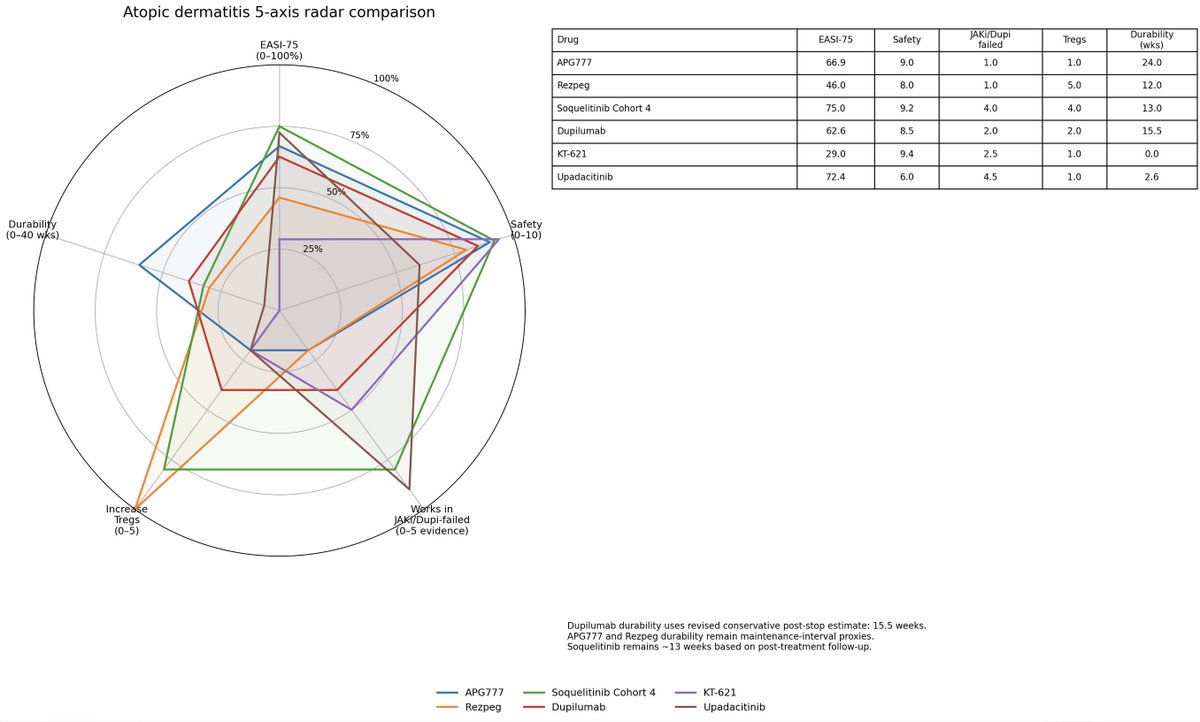
Atopic Dermatitis Landscape: Updated earlier 5-axis radar graph w/ actual data for: EASI-75, Safety, Durability, Treg, Failed Patients ⤵️ $SNY $REGN #Dupilumab,IL-4 $ABBV #Upadacitinib, JAKi $APGE APG777, IL-13 $NKTR #Rezpeg, IL-2 $KYMR KT-621, STAT6 $CRVS #Soquelitinib, ITKi

English
3
11
55
8.4K
In Honour Of Thomas W Phelps
In Honour Of Thomas W Phelps@HOThomasWPhelps·
Atopic Dermatitis Landscape: Updated earlier 5-axis radar graph w/ actual data for: EASI-75, Safety, Durability, Treg, Failed Patients ⤵️ $SNY $REGN #Dupilumab,IL-4 $ABBV #Upadacitinib, JAKi $APGE APG777, IL-13 $NKTR #Rezpeg, IL-2 $KYMR KT-621, STAT6 $CRVS #Soquelitinib, ITKi
In Honour Of Thomas W Phelps tweet media
In Honour Of Thomas W Phelps@HOThomasWPhelps

Summary graphic of atopic dermatitis drugs/targets by benefit/treatment profile: SOC benchmarks: #Dupilumab $SNY $REGN and #Upadacitinib $ABBV Compare to: Injectables in Ph2b trials #APG777 $APGE #Rezpeg $NKTR Oral drugs in Ph2b trials #soquelitinib $CRVS KT-621 $KYMR

English
3
10
50
18.6K
In Honour Of Thomas W Phelps
In Honour Of Thomas W Phelps@HOThomasWPhelps·
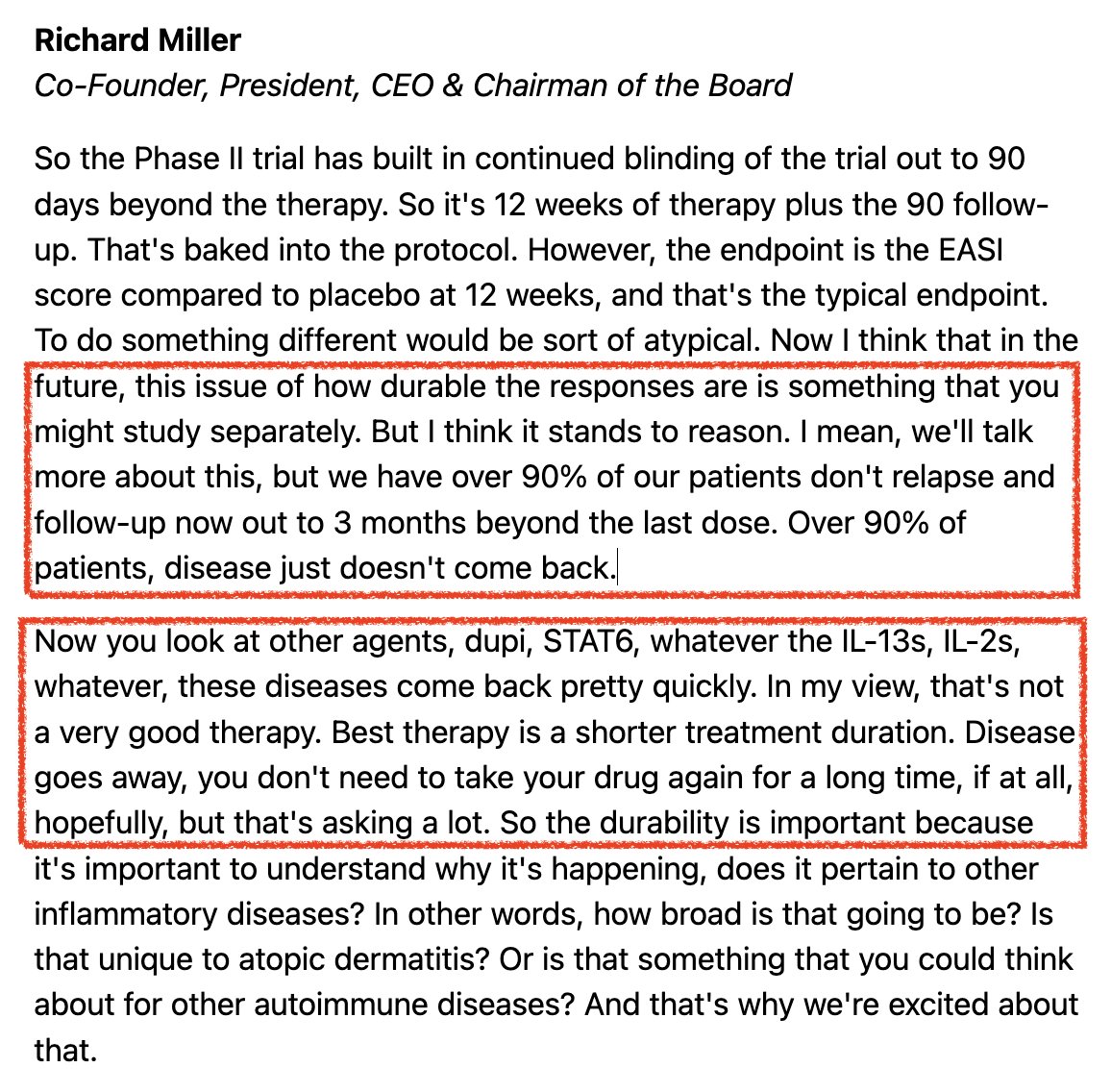
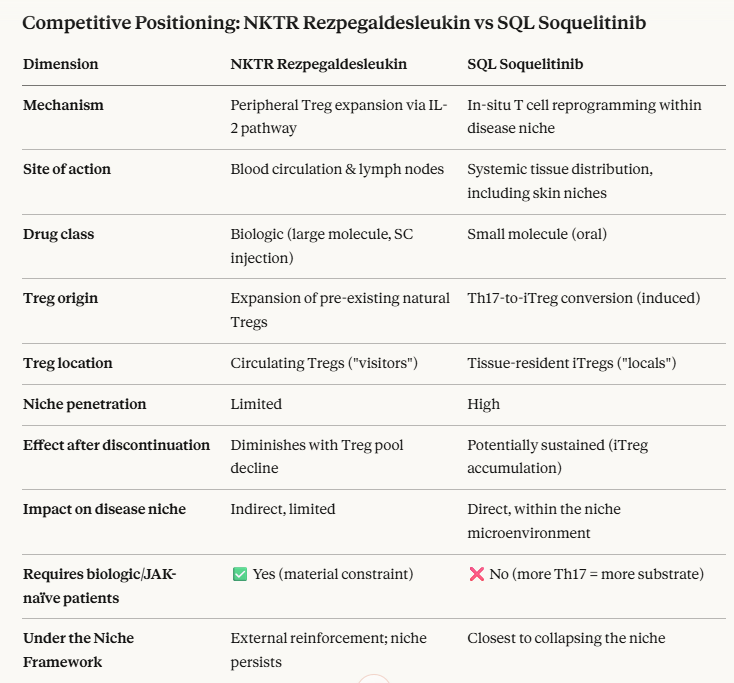
$CRVS #soquelitinib unique among AD agents as only drug targeting Tcell Signal 1 - inhibiting ITK Paper strengthens explanation for soquelitinib durability: It may preferentially silence or suppress pathogenic tissue niche memory circuits in AD, rather than merely blunt acute inflammation via cytokine blockades, the MOA of most other AD drugs $CRVS CEO Richard Miller revealed that 90% of patients benefiting from soquelitinib do not relapse, even after 3 months post-treatment of just 4wk or 8wks of oral therapy. When other treatments that just target Signal 3 blockade are stopped diseaese quickly returns (i.e., "JAK rebound" or #dupixent injections every 2-4 weeks, etc.)
In Honour Of Thomas W Phelps tweet media
In Honour Of Thomas W Phelps@HOThomasWPhelps

$SNY $REGN $AMGN $LLY $NKTR $ACRS $APGE $KYMR $CRVS $NKTR $UCB $PFE New paper significant implications for AD: AD skin disease memory is spatially stored in specialized microenvironments, these niches contain disease-specific immune programs, acting as immune support structures that allow disease rebound. Why dupilumab and other cytokine blockades not curative: Paper included week-12 dupilumab responder skin, yet these hidden niches persisted. Simply blocking IL-4/IL-13 may suppress inflammation but is not fully erasing the memory-supporting microenvironment. Implication: Future therapies need to be different. A "curative-like strategy may need to hit resident memory niches, not just cytokine effector pathways where diseaes will rebound and not have durable effect. This is a significant paper and shifts the AD target therapy frame from “blocking one or more cytokines" to “collapse the niche resident memory" for long-term benefit.

English
2
5
44
4.2K
In Honour Of Thomas W Phelps
In Honour Of Thomas W Phelps@HOThomasWPhelps·
@LeewillWIN9999 I agree, we will hear more from $CRVS in May at at SID. Biomarker data and maybe epigenetic that may directly collapse niche, appendage reservoirs further explaining durability where 90% of patients that benefited from soquelitinib did not relapse 3 months post-therapy
English
0
3
16
492
In Honour Of Thomas W Phelps
In Honour Of Thomas W Phelps@HOThomasWPhelps·
$SNY $REGN $AMGN $LLY $NKTR $ACRS $APGE $KYMR $CRVS $NKTR $UCB $PFE New paper significant implications for AD: AD skin disease memory is spatially stored in specialized microenvironments, these niches contain disease-specific immune programs, acting as immune support structures that allow disease rebound. Why dupilumab and other cytokine blockades not curative: Paper included week-12 dupilumab responder skin, yet these hidden niches persisted. Simply blocking IL-4/IL-13 may suppress inflammation but is not fully erasing the memory-supporting microenvironment. Implication: Future therapies need to be different. A "curative-like strategy may need to hit resident memory niches, not just cytokine effector pathways where diseaes will rebound and not have durable effect. This is a significant paper and shifts the AD target therapy frame from “blocking one or more cytokines" to “collapse the niche resident memory" for long-term benefit.
Waggoner Lab@LabWaggoner

@biorxivpreprint Hidden immune memory niches in inflammatory skin diseases biorxiv.org/content/10.648… @Muzz_Haniffa @sangerinstitute 🇬🇧

English
2
3
32
7.2K
Ohad Hammer
Ohad Hammer@ohadhammer·
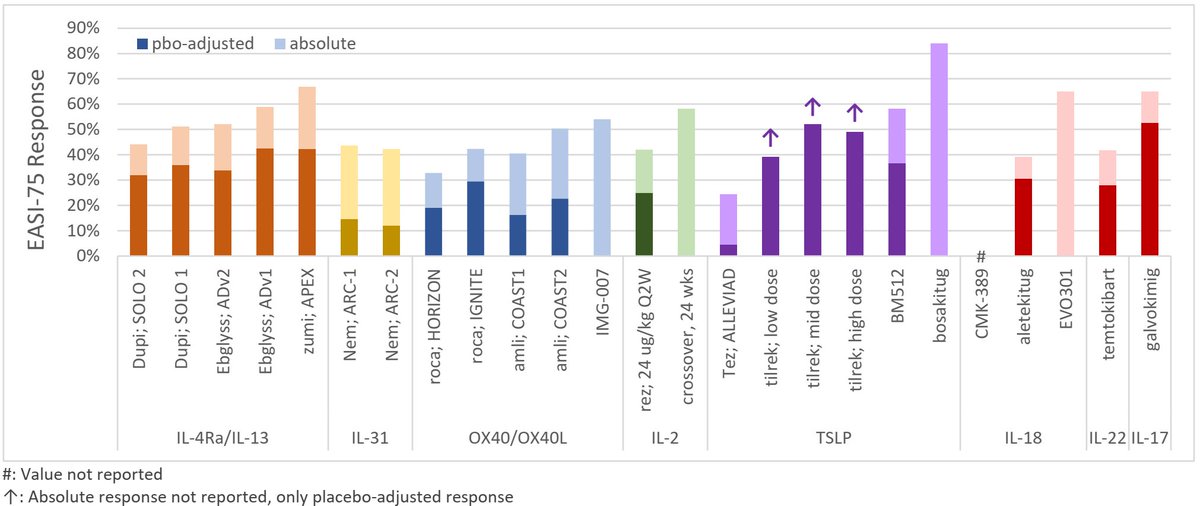
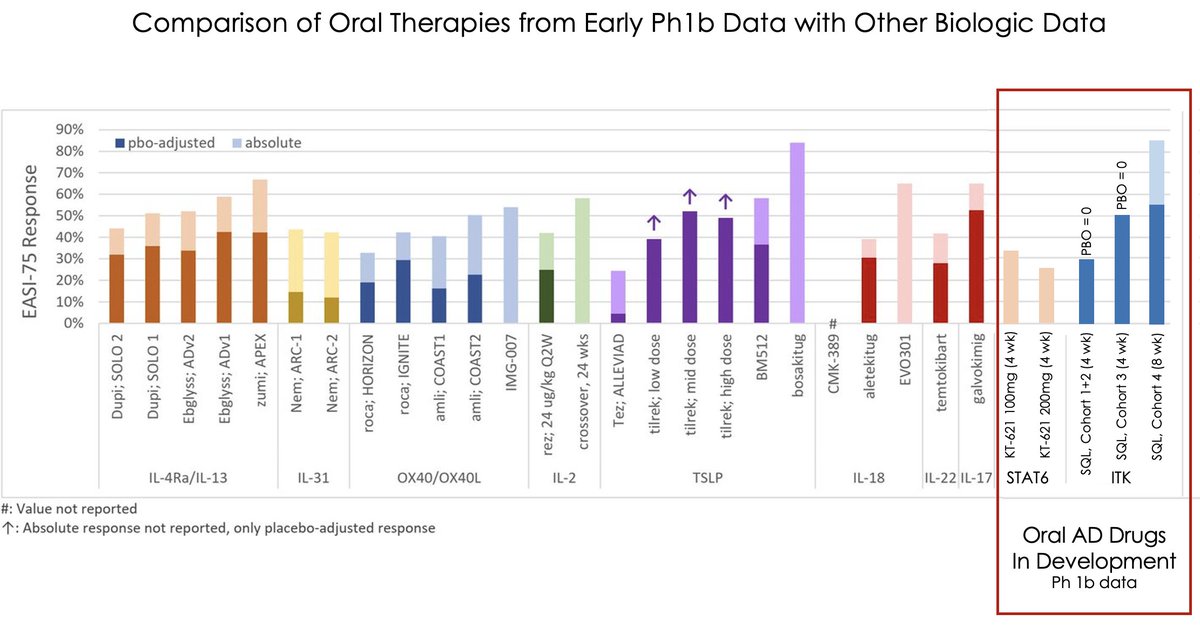
Atopic dermatitis landscape from Wedbush. Looks like there are two parallel vectors: lower injection frequency ( $APGE ) and combining new mechanisms with IL13/IL4R. So far $JNJ's IL13+IL31 failed (the only one to be directly compared to dupi) while $PFE's IL13+TSLP and $UCB's IL13+IL17A/F demonstrated a 50% pbo-adjusted EASI75 but without a dupi comparator arm (historical EASI75 of ~35%). IL13+OX40 will be an interesting one but class has a safety overhang.
Ohad Hammer tweet media
English
9
12
71
12.1K
In Honour Of Thomas W Phelps
In Honour Of Thomas W Phelps@HOThomasWPhelps·
Added $KYMR KT-621 (STAT6 degrader, N=22 total) + $CRVS #soquelitinib (ITKi, N=48 total) orals to Wedbush atopic dermatitis biologics $SNY $REGN $NKTR $EVMN $APGE $ACRS $AMGN $LLY Note: 4 wk and 8 wk treatment for orals only, Ph 1b data Both currently in Ph 2b AD trials
In Honour Of Thomas W Phelps tweet media
English
2
6
57
7.8K
Diego
Diego@helinhomusk·
@ohadhammer $ACRS Bosakitug's EASI-75 response is 94%, not mid-80% as shown in the chart. Aclaris is currently the most promissing company in the Biotech sector. Great pipeline. Major catalysts in 2026. Extremely undervalued.
Diego tweet media
English
1
0
1
601
In Honour Of Thomas W Phelps
In Honour Of Thomas W Phelps@HOThomasWPhelps·
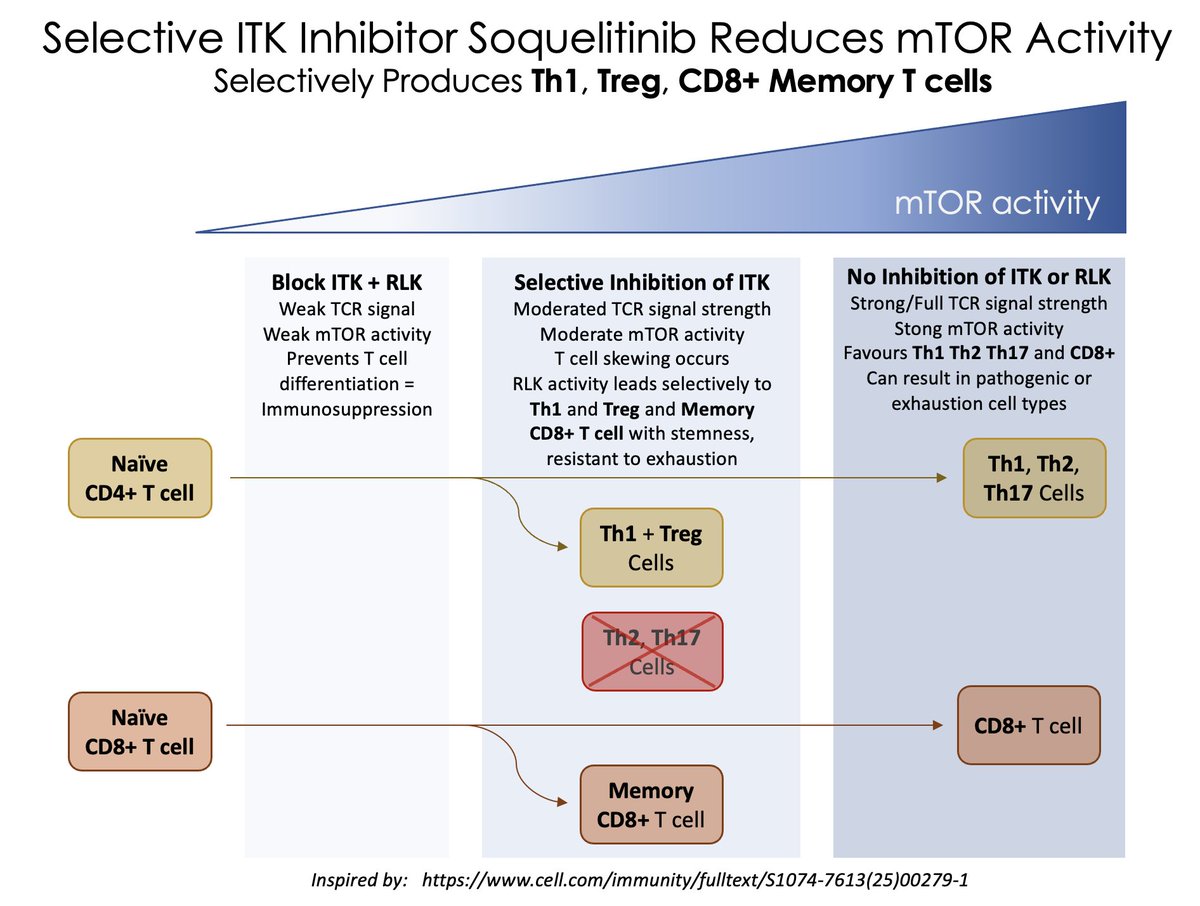
$CRVS $ACRS New paper may be useful in thinking about #ITK inhibition because it frames memory CD4 T-cell recall as a two-layer system: 1. Pre-wired memory state Memory cells already have more accessible chromatin near rapid-recall genes 2. Activation-execution layer On re-stimulation, still requiring inducible transcriptional machinery to actually turn those genes on fast. Paper identifies key memory-associated TF networks such as #MAF, #PRDM1, #RUNX2, #SMAD3, and #KLF6 as important determinants of rapid recall. ITK sits mainly in that 2nd execution layer. ITK inhibition would reduce the cell’s ability to execute a full rapid recall response after TCR re-stimulation. Paper’s model implies the distinction clearly: Memory establishment / maintenance = partly encoded in chromatin and longer-lived TF networks Recall execution = still needs acute TCR signaling, where ITK is upstream and influential ITK inhibition does not primarily “delete” memory T cells; it likely makes them ineffective/worse at cashing in their epigenetic preparedness when they see antigen again. ITK inhibition should translate into: 1. less AP-1/NF-κB-driven inflammatory transcription 2. less burst cytokine production as a result of #1 3. weaker proliferation/survival signaling after re-stimulation 4. stronger suppression of inflammatory CD4 subsets than of regulatory programs (avoid immunocompromisation) 5. tendency in CD8 systems to favor memory-like over highly terminal effector states (over longer time frames) Based on the role of ITK in T-cells and this paper’s framework, ITK is not the enzyme that builds the memory chromatin scaffold, but it is a major upstream "gatekeeper" for using that scaffold during recall of memory T-cells which is especially important in autoimmune responses. So an ITK inhibitor like $CRVS #soquelitinib would chiefly dampen reactivation amplitude and inflammatory recall output, especially in memory/effector CD4 T cells. However the effect will be different for each T-cell subtype based on presence of a redundant enzyme TXK (RLK) found in Th1, CD8 and Tregs and thus selective ITK inhibition would repressing activated memory CD4+ Tcells Th2 and Th17: Repression of T-cells by selective ITK only inhibition: Th2 > Th17 >> spared Th1 > CD8+ memory formed > Treg induction via switch from Th17 fate.
In Honour Of Thomas W Phelps tweet mediaIn Honour Of Thomas W Phelps tweet media
Waggoner Lab@LabWaggoner

Excellent new paper @CellReports from @CincyImmunology @CincyMSTP @CincyResearch #Miraldi @ArtemBarski @Kottyan_Lab Gene regulatory network determinants of rapid recall in human memory CD4+ T cells sciencedirect.com/science/articl…

English
3
6
52
5.7K
In Honour Of Thomas W Phelps
In Honour Of Thomas W Phelps@HOThomasWPhelps·
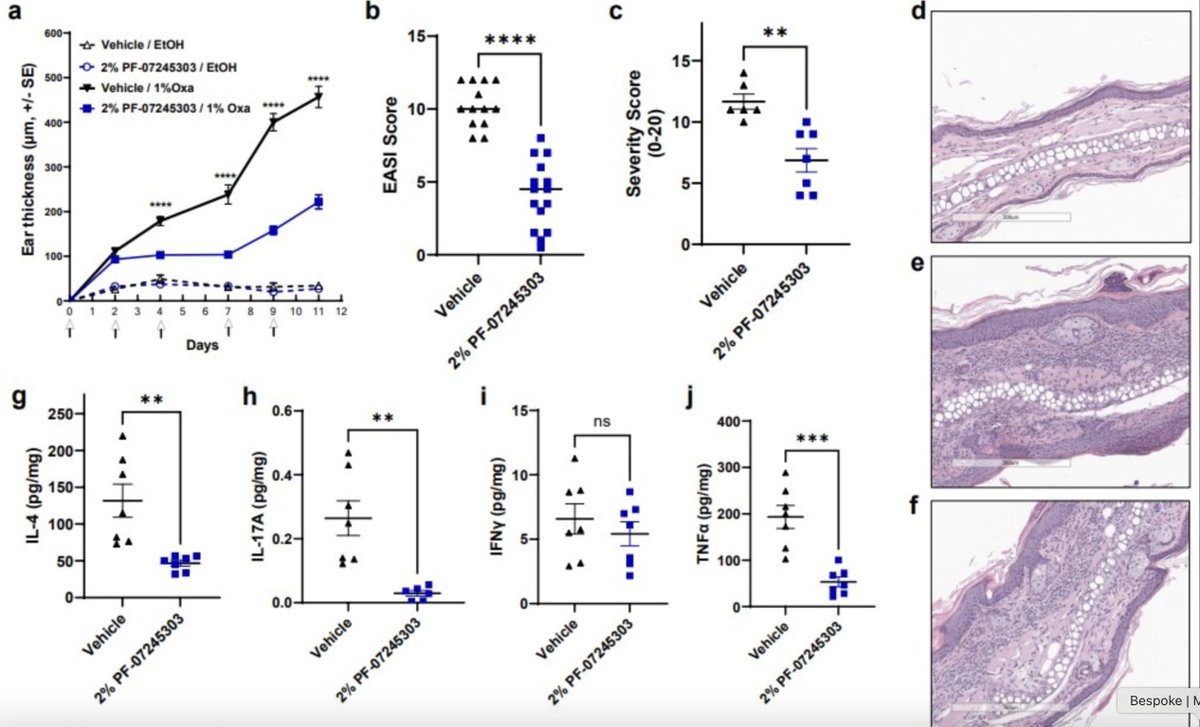
New paper from $PFE shows PF-07245303, a potent inhibitor of #ITK + TRK kinases capable of inhibition TCR cytokine production from CD4 + CD8 T cells Validate $CRVS approach + ITK as target in AD Similar to #soquelitinib, $PFE compound shows potent reduction in IL-4, IL-17A, TNF-a, but IFNg unchanged showing Th1 skewing. $PFE compound is a topical treatment in dev for AD $CRVS SQL is oral therapy in Ph2b trial for AD
In Honour Of Thomas W Phelps tweet media
Waggoner Lab@LabWaggoner

Discovery of an ITK and TRK kinase inhibitor for the potential topical treatment of atopic dermatitis @NatureComms @pfizer nature.com/articles/s4146…

English
3
3
54
5K
financebully
financebully@financebully·
@HOThomasWPhelps sorry to hear about your mom. in addition to our love for biotech, we also have this in common. my mom was diagnosed with tnbc in '09 😔 - hoping your mom beats it. 🫂
English
1
0
0
306
In Honour Of Thomas W Phelps
In Honour Of Thomas W Phelps@HOThomasWPhelps·
Alot was said of me stopping posting on X and it is sad and disappointing that individuals have made numerous false claims about a number of things regarding myself. The fact of that matter is that for personal reasons including my mother being diagnosed with and having surgery for breast cancer has been a large distraction for myself. This clearly has nothing to do with any of my posts, investments, thoughts on science, data, etc, etc, etc, but rather is just life rearing up its head and being a significant and important situation that required attention. That being said, I am likely to have long breaks between posts, but will share science on ITK or STAT6 or IL-18 or other anything if something seems interesting and people may learn from, but I will not be making regular posts.
English
19
0
101
3.1K
In Honour Of Thomas W Phelps
In Honour Of Thomas W Phelps@HOThomasWPhelps·
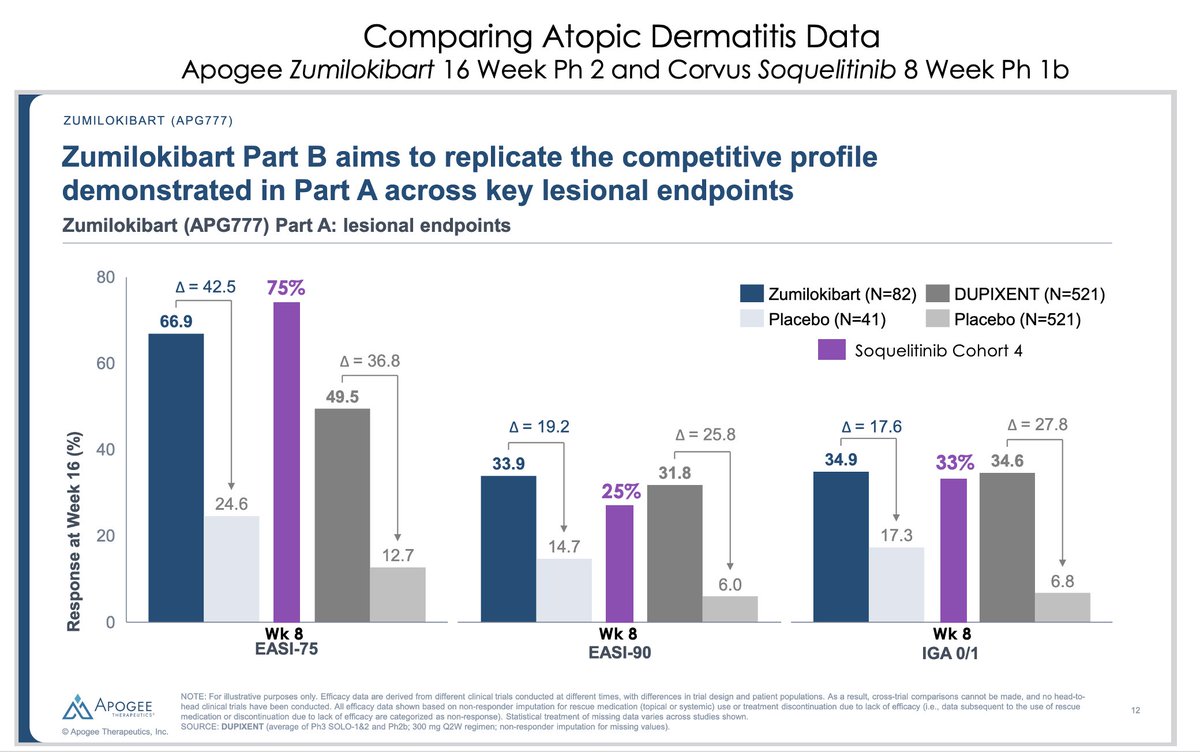
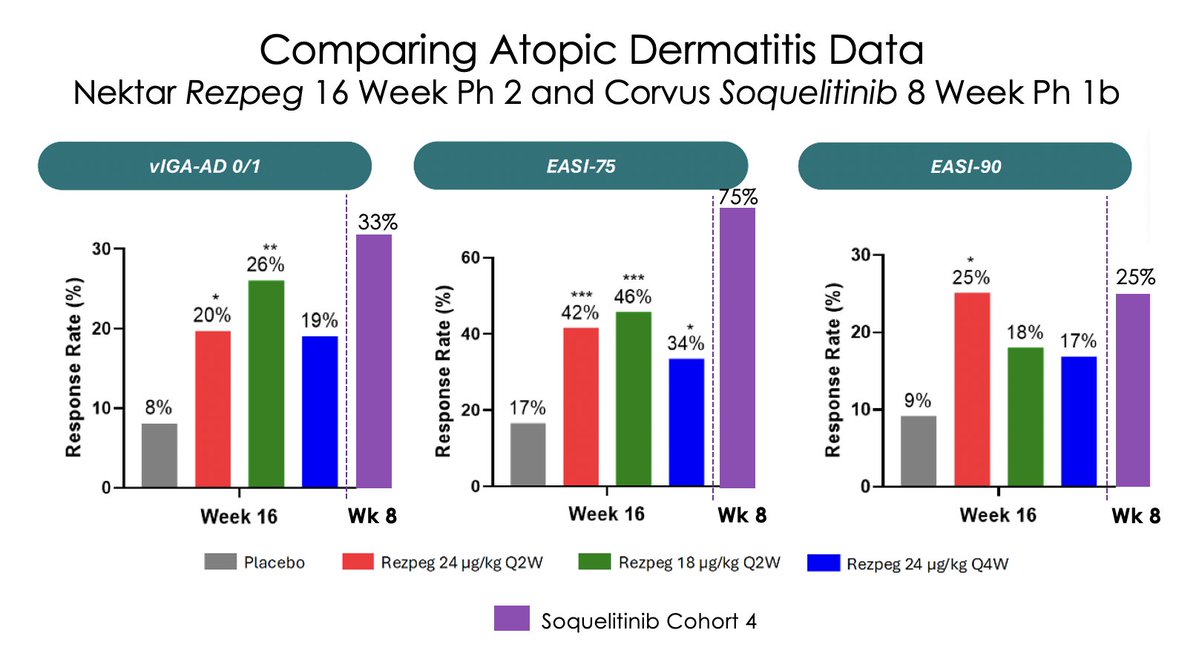
Visual $CRVS early 8wk Ph1b data w/ oral ITKi #soquelitinib compared to recent 16wk Ph2 AD data: $APGE #Zumilokibart $NKTR #Rezpeg Caveats: Cross-trial comparison Trials had very different inclusion/exclusion criteria Just visual summary as SQL now in Ph2b Not picking winners
In Honour Of Thomas W Phelps tweet mediaIn Honour Of Thomas W Phelps tweet media
In Honour Of Thomas W Phelps@HOThomasWPhelps

🚨 $CRVS Ph 2 atopic dermatitis trial design sets up #soquelitinib to be first line therapy in AtD and used in relapsed patients. $CRVS requiring enrolled patients in upcoming Ph 2 to have failed either topical or systemic therapy i.e., #Dupixent or #JAK inhibitor. Very strong indication of what $CRVS likely seeing in Cohort 4, data in Jan. No other atopic dermatitis trial has ever been designed in this way taking on the toughest patients w/ the most severe disease that failed other therapies. Trials typically require biologic naive patients, very very different trials. x.com/HOThomasWPhelp…

English
6
7
63
10.2K
In Honour Of Thomas W Phelps
In Honour Of Thomas W Phelps@HOThomasWPhelps·
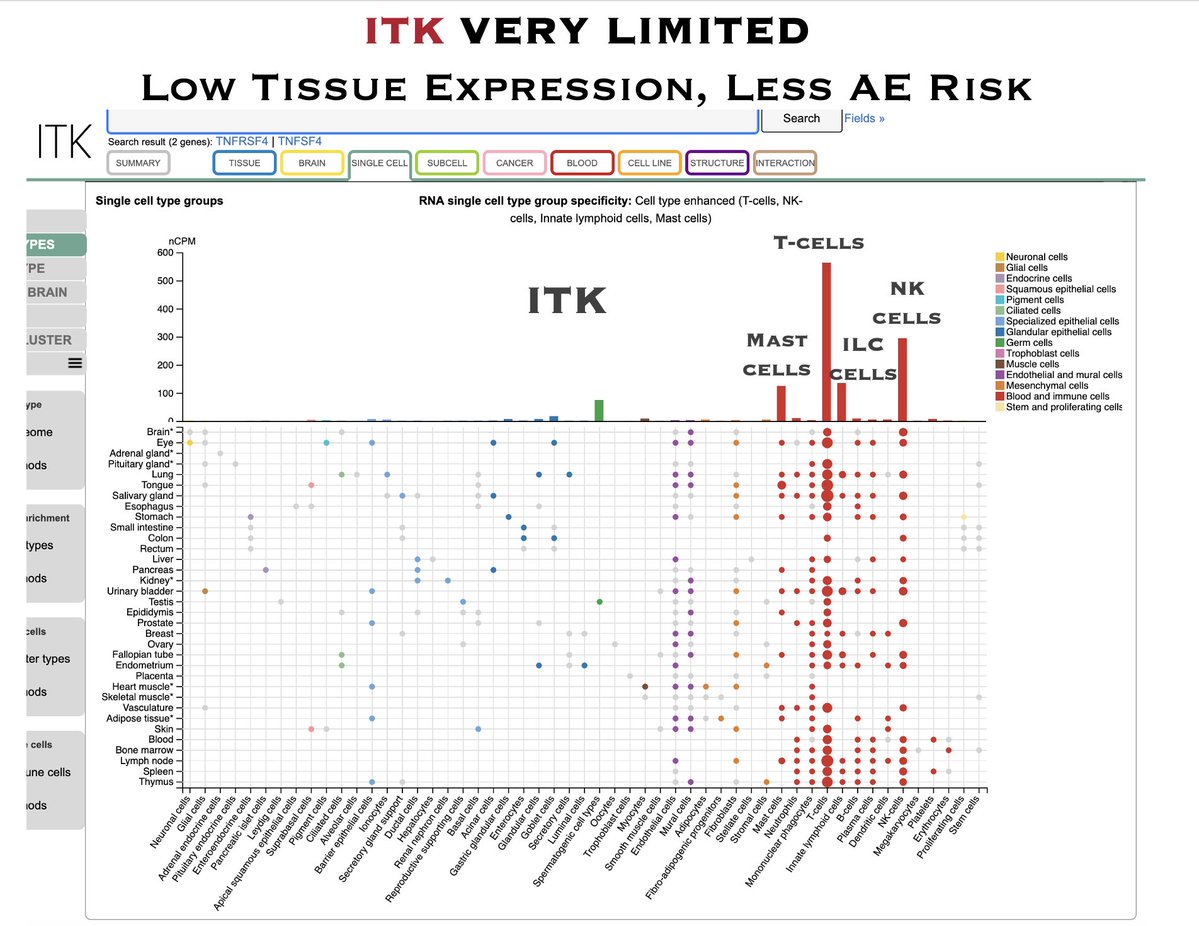
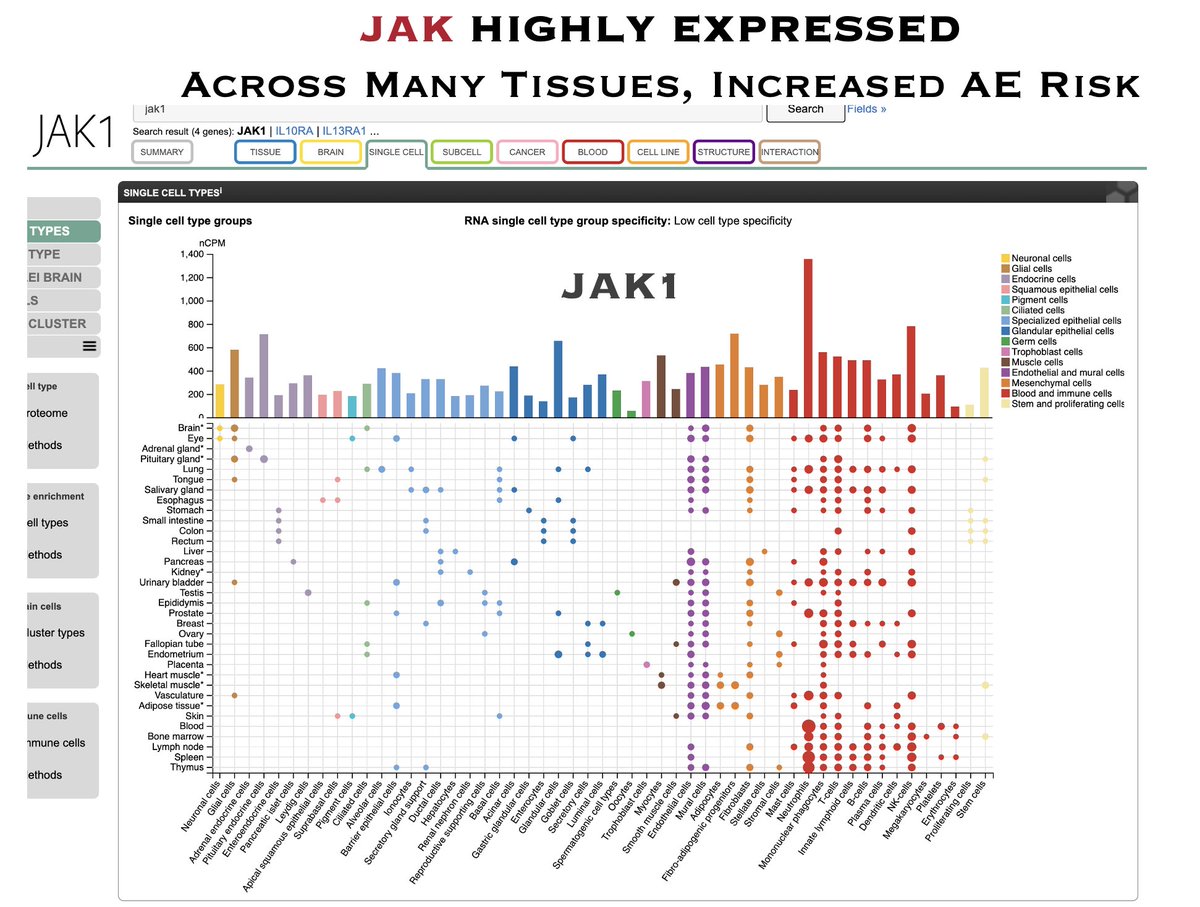
For comparison, the tissue distribution of ITK and JAK1: $CRVS #soquelitinib is a highly selective ITK inhibitor. ITK has limited tissue distribution, primarily T-cells, NK-cells, ILC and Mast cells, high specificity + limited tissue mostly immune cells contributes to good safety. versus $ABBV #Rinvoq #upadacitinib JAK1 inhibitor. JAK1 is much more widely expressed, found in most tissues has higher or increased AE risk profile due to non-immunological effects
In Honour Of Thomas W Phelps tweet mediaIn Honour Of Thomas W Phelps tweet media
English
0
1
14
452
tradingbiotech
tradingbiotech@tradingsssss·
2-3 month dosing periods is more than enough to mitigate any liver risk that hasn't been seen so far If we didn't have any dosing data past that, then I'd have some caution with liver risk, but we do You have immunocompromised PTCL patients and ALPS adolescent patients taking the drug for more than a year at 200mg BID and have 5-7 month data on PTCL patients at 400 and 600mg BID!!!!
English
3
0
5
292
In Honour Of Thomas W Phelps
In Honour Of Thomas W Phelps@HOThomasWPhelps·
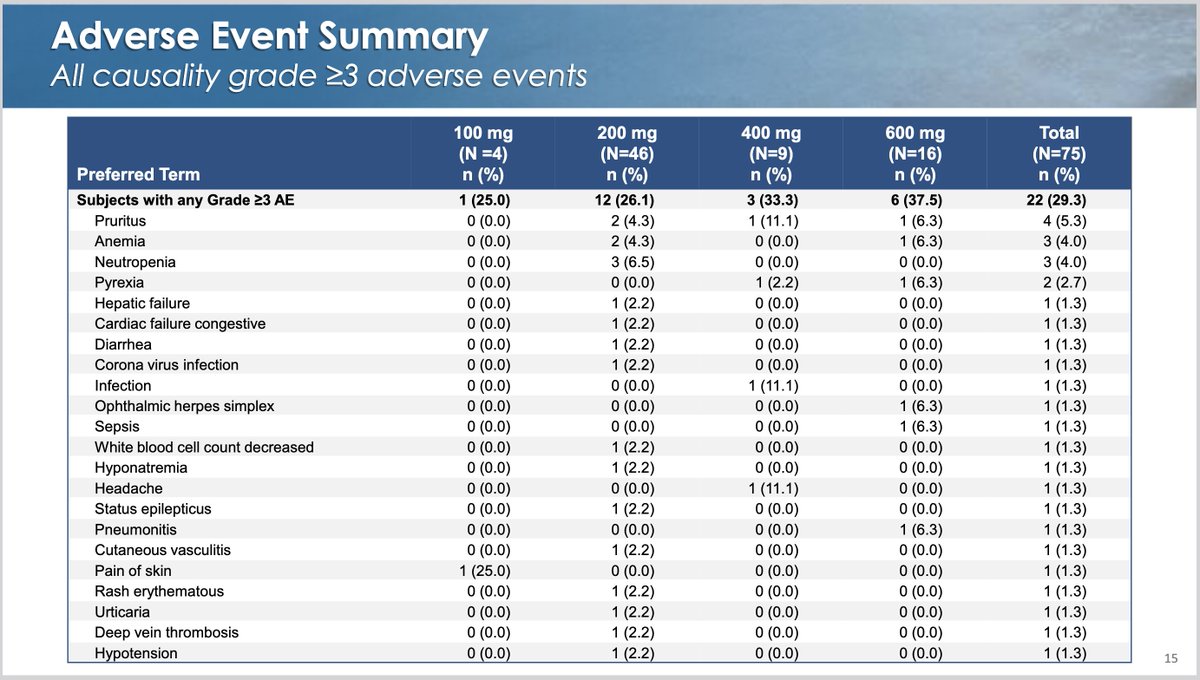
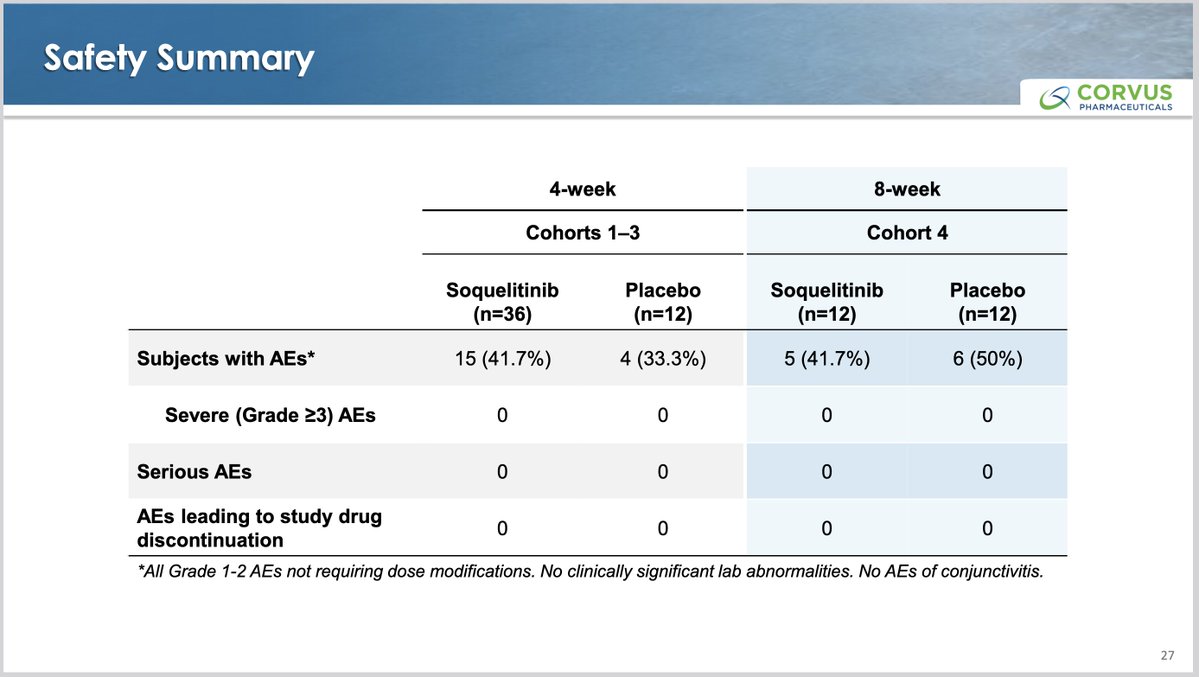
We will see with more data, but so far 14,000 patient days with $CRVS Soquelitinib, 75+ patients with T-cell lymphomas and very frail patients and healthier 48 patients with autoimmune AD and not major signals. Also PTCL Ph3 and ALPS Ph2 data have had safety checks as trials progress and no signals either. Moving ALPS down to pediatrics is plan, so that would indicate quite good safety.
English
2
3
26
994
In Honour Of Thomas W Phelps
In Honour Of Thomas W Phelps@HOThomasWPhelps·
Based on the data, research and comments from Corvus it has to do with 1. ITK is downstream of TCR signaling, if you target ZAP70 which is a bottleneck upstream it is too immunosuppressive, but further down the signaling other pathways branch off. 2. T-cells redundancy of ITK and RLK (TXK) 3. soquelitinib takes advantage of that by preferentially targeting ITK over RLK with >100:1 high selectivity 4. SQL only targets kinase activity leaving scaffolding/adapter protein function so other T-cell pathways can still stay active, so in effect kinase inhibition here acts as an attenuator. In fact "so important is the scaffold function of ITK that knocking it out results in the spatiotemporal disruption of 14 of the 16 components of the TCR signalling complex at the interface with the APC" so not all T-cell functions are completely knocked out, see paper: journals.plos.org/plosone/articl… 5. SQL occupies ITK active site very quickly, blood plasma levels of SQL drop quickly after binding and this limits other off-target activity. Drug is cleared mostly in 4-6 hours, but occupancy of ITK continues, for oncology BID necessary, but based on this profile and efficacy data from Cohort 2 QD dosing for AD should be fine. Note 2 of 3 active drug arms in Ph2b AD trial are QD dosing.
In Honour Of Thomas W Phelps tweet media
English
1
2
22
1.1K