@HSCQI retweetledi

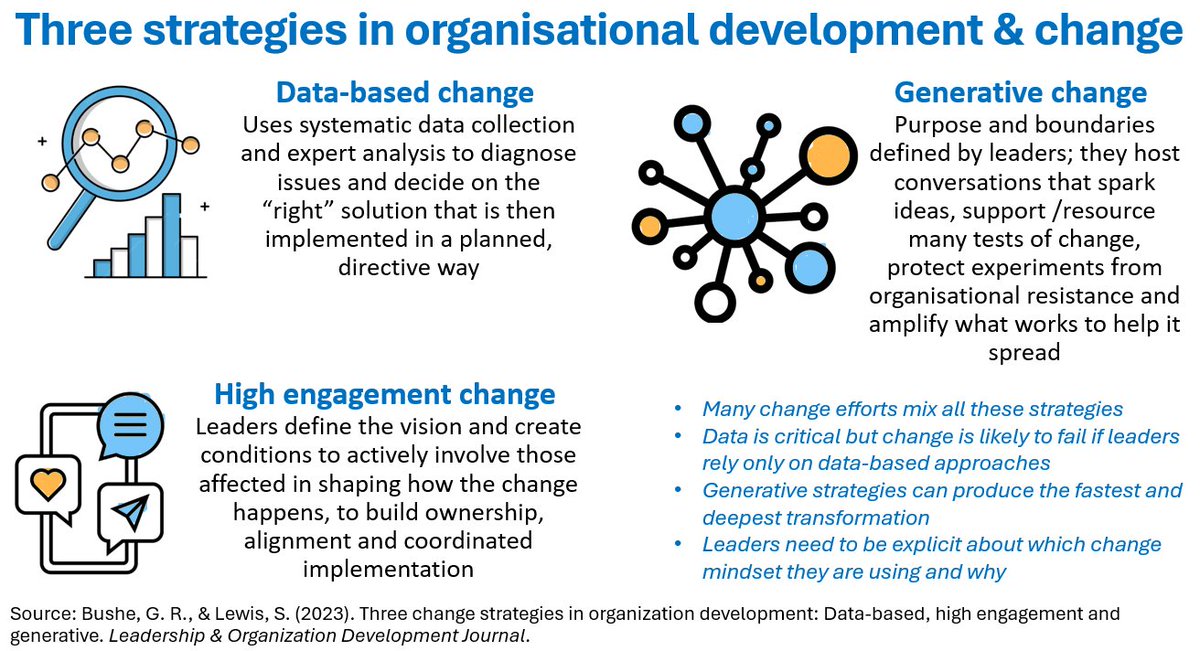
Three different strategies for leading change in organisations: data-based, high engagement & generative:
1) Data-based change: Leaders or experts diagnose the problem using data to decide the “right” solution & roll it out. Fits best when there’s one clear answer, stable situation & you need tight coordination & control (eg, standardised process redesign or compliance project). Implementation is directive in nature.
2)High engagement change: Leaders already know the direction, but actively involve many people in shaping how to get there. Builds ownership, taps local knowledge, & increases likelihood that a major change (eg., a big IT rollout or operating model shift) is accepted & implemented well.
3) Generative change: Leaders frame a clear purpose (e.g. “‘safe, compassionate care with less stress for people who use services & colleagues”), set boundaries, then invite people across the system to launch many small experiments or tests of change & “learn as we go.” Works best when there are many interconnected, competing factors, the situation is unpredictable & there is no single knowable “right” solution.
From a paper by Gervase Bushe & Sarah Lewis.
Most change efforts mix these strategies, often unconsciously. Data is critical to effective change but data-based change that neglects human participation is highly likely to fail.
High engagement change & generative change use many of the same large-group change methods but are fundamentally different. High engagement change uses group events for leaders to listen & create proposals for to choose from or to produce sub-decisions & action ("You said, we did"). By contrast, generative change events are used to stimulate & launch numerous change activities with the intent of lots of people engaged in trying things out & to “learning as we go.” High engagement starts with a leader-led vision (what things will be like once the change is complete). Generative change starts with purpose (what the organisation is trying to do every day). The authors say that vision-led change risks shutting off potential innovations that may emerge when we start with purpose.
Generative change can produce deeper & faster transformation than the other strategies but requires leaders to cede some direct control in favour of self-organisation & emergence.
Read more: b-m-institute.com/wp-content/upl…
English