Jnkau Consultant

80 posts

Jnkau Consultant banner
Jnkau Consultant

Jnkau Consultant

@Halil84642243

Merkez, Uşak Katılım Haziran 2020
42 Takip Edilen43 Takipçiler
Jukan
Jukan@jukan05·
Let’s admit what needs to be admitted. I was guilty of this as well, but North America-based analysts, across both the sell side and the buy side, have significantly underestimated MediaTek.
English
30
18
551
70.5K
Jukan
Jukan@jukan05·
LTAs : We believe that Samsung’s floor price of LTA is above 0.5! This means the LTA eSSD price is even higher than this year’s Q3 eSSD price… Are you still bearish on NAND, anon?
Jeff Pu@sssjeffpu

Abstract of SanDisk (SNDK) Note, Implications Near Term Pricing: we believe that Samsung/SK/SNDK expect ~30% qoq for eSSD for CY3Q which suggests ~0.45, vs ~0.35 in CY2Q LTAs : We believe that Samsung’s floor price of LTA is above 0.5! #SNDK #SSD #NAND

English
11
25
277
55.5K
Jukan
Jukan@jukan05·
At one point, some people in Korea suspected that Intel had dumped its Dalian fab onto SK hynix. Their reasoning was that, not long after Intel sold the Dalian fab to SK hynix, the Biden administration began restricting the shipment of semiconductor equipment into fabs in China. So some wondered whether Intel had known this was coming and offloaded the asset to SK hynix in advance. But in hindsight, that concern turned out to be misplaced. Intel genuinely wanted to get out of memory entirely at the time. It even offered to sell SK hynix the rest of its remaining memory IP, including Optane, at a fire-sale price. SK hynix rejected that offer. In hindsight, that is quite unfortunate. If SK hynix had accepted it, Intel’s current attempts to dabble in memory again could have been blocked at the source. Until 2023, SK hynix was still losing heavily in NAND. The huge losses from Solidigm, Intel’s former NAND business, were also a major factor. The CEO who led the Solidigm acquisition was even sidelined as a result. But from 2Q24, eSSD finally began to become a real moneymaker. And in 1Q of this year, SK hynix reportedly generated $8 billion in profit from NAND alone, finally appearing to firmly cement its position as the No. 2 player in NAND. In the end, SK hynix’s acquisition of Intel’s NAND business probably deserves a passing grade.
English
14
17
353
44.1K
Jukan
Jukan@jukan05·
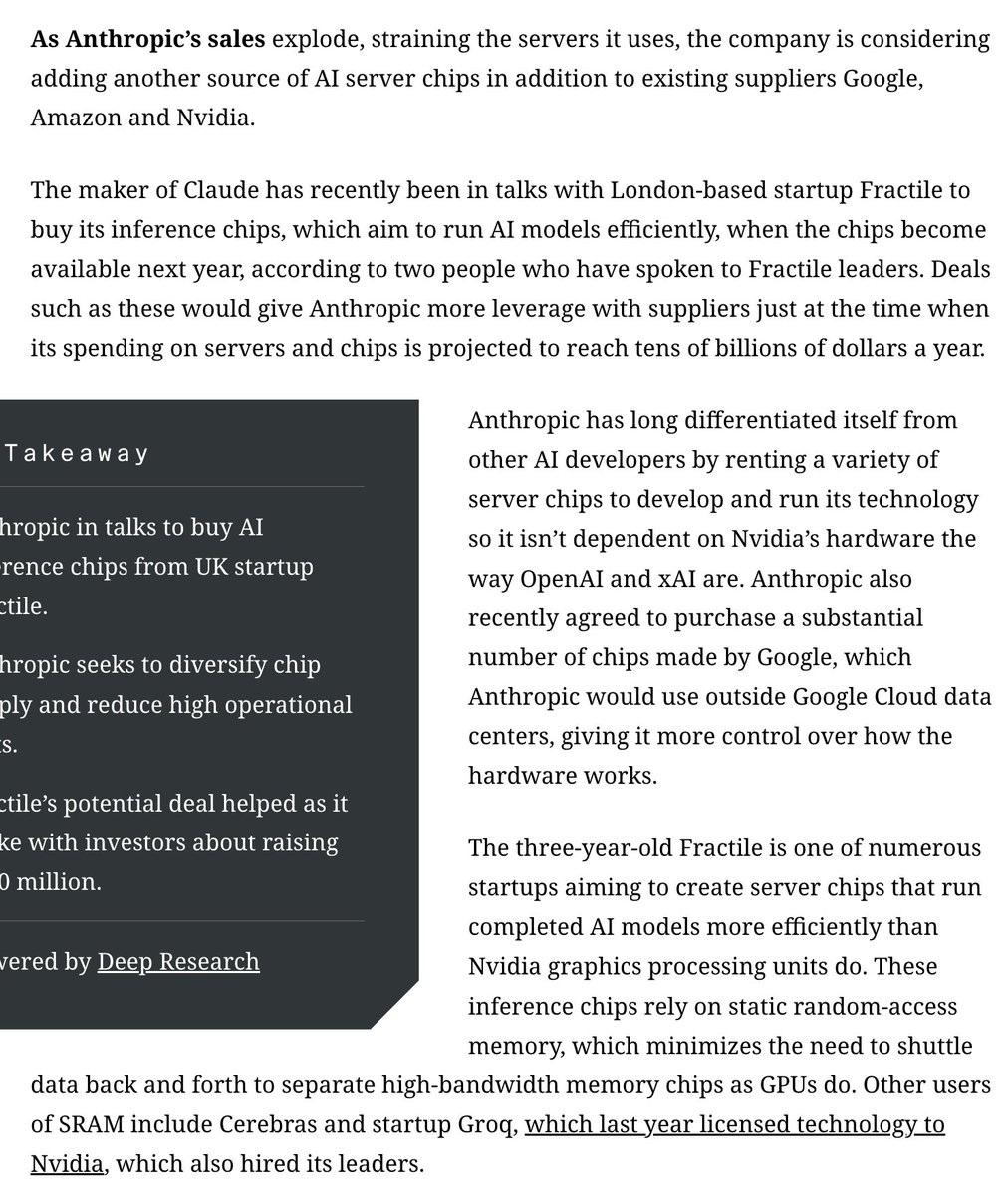
* Anthropic is reportedly in talks to buy AI chips from Fractile, a UK SRAM-based AI chip startup whose product is expected to launch next year. -The Information They’re buying something that hasn’t even launched yet?
Jukan tweet media
English
50
43
606
146.4K
Jukan
Jukan@jukan05·
GF Overseas Electronics & Communications — FormFactor 1Q26 Review: Sufficient Growth Momentum Ahead Gross margin beat expectations; industry momentum continues FormFactor reported 1Q26 revenue of $230 million, with gross margin reaching 49.0%, up 5.1 percentage points QoQ and 2.5 percentage points above the high end of prior guidance. Management guided for 2Q26 revenue of $240 million, with gross margin rising further to 49.5%. As previously argued, we remain positive on FormFactor’s four key growth drivers: AI-driven share gains, accelerated HBM business ramp, and the commercialization of CPO testing. The May 11 Investor Day will be the next important catalyst, where we expect management to raise its long-term revenue target to around $1.6 billion. We raise our 2026/2027 EPS forecasts to $2.75/$4.30. Applying an unchanged 40x 2027E P/E multiple, we set a target price of $193. AI probe card share is steadily rising Through its deep partnership with Teradyne, FormFactor has become a core probe card supplier to Mellanox, helping Nvidia become a customer accounting for more than 10% of FormFactor’s revenue for the first time. Looking ahead, the company is expected to enter the AI probe card market starting with Nvidia’s Rubin platform. MediaTek’s Humufish platform scale-up in 2H27 should also bring another wave of incremental revenue. On HBM, management stated that its second-largest customer is the biggest source of incremental revenue, which we believe refers to Samsung. Notably, HBM4 probe cards carry a 20% premium over HBM3E probe cards. Combined with 70% YoY growth in HBM wafer shipments, this should drive both revenue growth and gross margin improvement. Insertion 1 leadership remains solid; CPO probe cards open up new growth opportunities The company’s 2026 CPO-related revenue is moving toward the high end of its $10–20 million guidance range. With its Triton series, FormFactor has established a clear leadership position in the Insertion 1 probe station market. We expect shipments to exceed 100 units in 2027, corresponding to CPO revenue of more than $100 million. In addition, the Keystone acquisition should further strengthen the company’s probe card technology capabilities in CPO testing. This incremental contribution has not yet been included in current revenue forecasts. $FORM
English
4
9
105
20.9K
Jukan
Jukan@jukan05·
AI CPUs Are Devouring DRAM — Memory 'Shortage' to Last Another Year The memory industry has posted record-breaking results driven by commodity DRAM prices that have surged more than 100%, and with the proliferation of AI-purposed central processing units (CPUs) now coming into play, forecasts suggest the shortage will extend for another year. Intel's recently unveiled "AI CPU" is expected to carry up to four times more commodity DRAM than previous generations. Combined with surging demand from graphics processing units (GPUs) that require high-capacity DRAM, observers expect the memory supply capacity of Samsung Electronics and SK hynix to fall short of demand. According to industry sources on the 2nd, CPU manufacturers are pursuing the integration of 300–400GB of DRAM into AI CPUs. This is up to four times the overwhelming scale compared to typical CPU products (96–256GB). CPUs Emerge as the 'AI Orchestrator' The surge in high-capacity DRAM demand for AI CPUs is tied to the AI industry's pivot toward an inference-centric structure. Whereas AI inference was once limited to simple Q&A, it now serves as the "orchestrator" coordinating various agentic AIs. The key in this process is "context memory." For a CPU to coordinate the entire workflow by referencing the outputs of each agentic AI, it must remember the content. This makes scaling up memory — the space for retention — essential. Until now, AI data centers have built computing infrastructure centered on GPUs equipped with High Bandwidth Memory (HBM). Leveraging the GPU's strength in training AI on vast amounts of data simultaneously, the focus has been on "AI training." Server configurations accordingly followed an 8-GPU-to-1-CPU pattern. However, as the industry's center of gravity shifts toward inference, server configurations with substantially expanded CPU ratios are spreading. In a recent earnings call, Intel executives explained: "In AI inference infrastructure, the computing structure has shifted to a CPU-to-GPU ratio of 1 to 4, and the trend is moving further toward 1 to 1." After GPUs, CPUs Join the Memory Battle — Demand Snowballs The competition for memory capacity has expanded from GPUs to CPUs, snowballing in scale. NVIDIA's next-generation AI chip "Vera Rubin" carries 288GB through 8 HBM stacks, while AMD's next-generation GPU MI400 boasts an even larger 432GB mammoth-class capacity. Google's recently unveiled custom chip — the 8th-generation Tensor Processing Unit (TPU 8i) — is also slated to feature 288GB of HBM. Add to this Intel's AI CPU "Xeon" and AMD's "EPYC" beginning to use up to 400GB of high-capacity DDR5, and the memory shortage is expected to persist longer. The market temperature is already being proven in spot prices. According to Kiwoom Securities, while the price of legacy DDR4 (16GB basis) plunged 16% in a single month in April, the spot price of DDR5 (16GB basis) — used in AI CPUs — rose 2.8% over the same period, maintaining its price premium. An industry source said: "The current DRAM market is understood to be roughly 10 percentage points short of demand. With commodity DRAM demand surging on top of HBM, the supercycle is highly likely to extend from the previously expected 2026 into 2027." $MU $DRAM
Jukan tweet media
English
21
107
647
286.7K
Jukan
Jukan@jukan05·
'According to industry sources on the 2nd, CPU manufacturers are pursuing the integration of 300–400GB of DRAM into AI CPUs. This is up to four times the overwhelming scale compared to typical CPU products (96–256GB).' It’s similar to what I’ve been thinking. Agentic AI will benefit CPUs as well, but it will make memory even more scarce.
Jukan tweet media
Jukan@jukan05

AI CPUs Are Devouring DRAM — Memory 'Shortage' to Last Another Year The memory industry has posted record-breaking results driven by commodity DRAM prices that have surged more than 100%, and with the proliferation of AI-purposed central processing units (CPUs) now coming into play, forecasts suggest the shortage will extend for another year. Intel's recently unveiled "AI CPU" is expected to carry up to four times more commodity DRAM than previous generations. Combined with surging demand from graphics processing units (GPUs) that require high-capacity DRAM, observers expect the memory supply capacity of Samsung Electronics and SK hynix to fall short of demand. According to industry sources on the 2nd, CPU manufacturers are pursuing the integration of 300–400GB of DRAM into AI CPUs. This is up to four times the overwhelming scale compared to typical CPU products (96–256GB). CPUs Emerge as the 'AI Orchestrator' The surge in high-capacity DRAM demand for AI CPUs is tied to the AI industry's pivot toward an inference-centric structure. Whereas AI inference was once limited to simple Q&A, it now serves as the "orchestrator" coordinating various agentic AIs. The key in this process is "context memory." For a CPU to coordinate the entire workflow by referencing the outputs of each agentic AI, it must remember the content. This makes scaling up memory — the space for retention — essential. Until now, AI data centers have built computing infrastructure centered on GPUs equipped with High Bandwidth Memory (HBM). Leveraging the GPU's strength in training AI on vast amounts of data simultaneously, the focus has been on "AI training." Server configurations accordingly followed an 8-GPU-to-1-CPU pattern. However, as the industry's center of gravity shifts toward inference, server configurations with substantially expanded CPU ratios are spreading. In a recent earnings call, Intel executives explained: "In AI inference infrastructure, the computing structure has shifted to a CPU-to-GPU ratio of 1 to 4, and the trend is moving further toward 1 to 1." After GPUs, CPUs Join the Memory Battle — Demand Snowballs The competition for memory capacity has expanded from GPUs to CPUs, snowballing in scale. NVIDIA's next-generation AI chip "Vera Rubin" carries 288GB through 8 HBM stacks, while AMD's next-generation GPU MI400 boasts an even larger 432GB mammoth-class capacity. Google's recently unveiled custom chip — the 8th-generation Tensor Processing Unit (TPU 8i) — is also slated to feature 288GB of HBM. Add to this Intel's AI CPU "Xeon" and AMD's "EPYC" beginning to use up to 400GB of high-capacity DDR5, and the memory shortage is expected to persist longer. The market temperature is already being proven in spot prices. According to Kiwoom Securities, while the price of legacy DDR4 (16GB basis) plunged 16% in a single month in April, the spot price of DDR5 (16GB basis) — used in AI CPUs — rose 2.8% over the same period, maintaining its price premium. An industry source said: "The current DRAM market is understood to be roughly 10 percentage points short of demand. With commodity DRAM demand surging on top of HBM, the supercycle is highly likely to extend from the previously expected 2026 into 2027." $MU $DRAM

English
24
132
802
130.9K
Jukan
Jukan@jukan05·
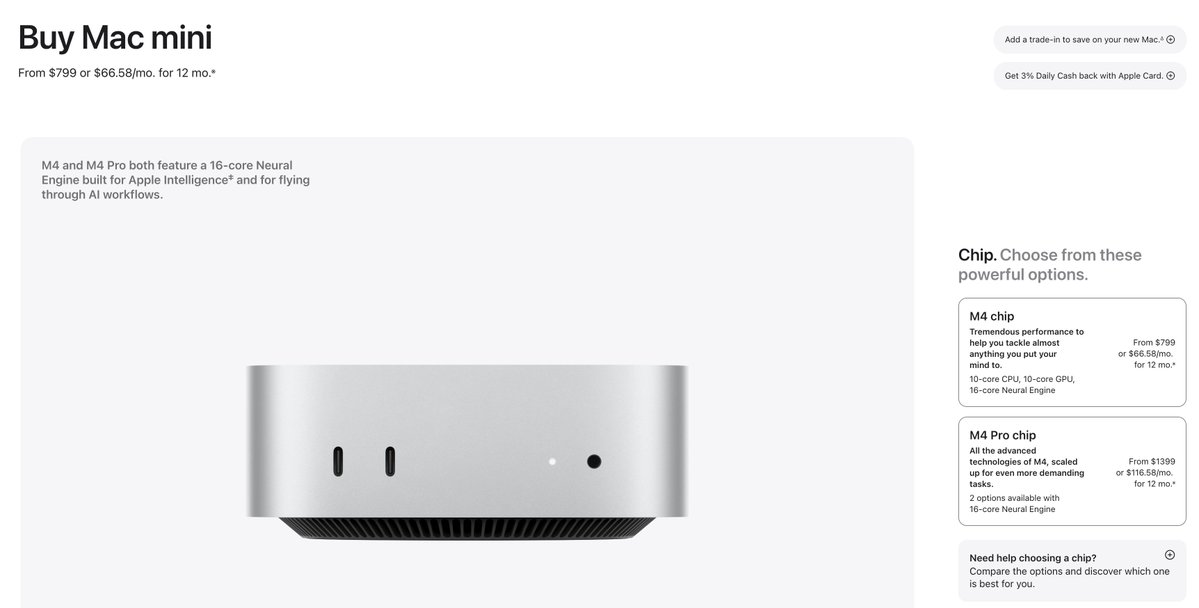
>> AI Demand Drives Inventory Shortages: Apple Raises Mac mini Starting Price by $200 • Apple has raised the starting price of the Mac mini from $599 to $799, reflecting inventory shortages driven by AI demand and tighter processor supply. The price increase was effectively implemented by removing the entry-level 256GB storage model. The base configuration still uses the same M4 chip, but now starts with 512GB of storage. Meanwhile, the starting price of the M4 Pro model remains unchanged at $1,399. $AAPL
English
12
31
359
247.8K