Sabitlenmiş Tweet
Hamish MacEwan
43.5K posts

Hamish MacEwan
@HamishMacEwan
Cleithrophobic sceptical meliorist bricoleur 💎🙌🔮✨

Wellington, New Zealand Katılım Ocak 2007
964 Takip Edilen712 Takipçiler

"Exactly. From a pure Benthamian standpoint—maximising the greatest happiness of the greatest number—optimising for one leader’s loyal coalition (a few million at most) while the broader millions pay the opportunity cost makes zero sense. It’s anti-utilitarian by design: concentrated power and legacy for the few, diffuse costs for everyone else. The structures don’t care about Bentham. They reward the narrow optimisation because that’s what keeps the leader in the chair, the donors happy, and the machine funded. Evolution wired us for small-group loyalty; we scaled it up without rewiring the incentives. Result: map-redrawing and legacy projects win, post-scarcity abundance loses.
Spot on observation.
So what breaks it? Or are we stuck with it until the tech gets so cheap that small groups can just route around the whole game?"
Enough of the game to win, yes.
English

.@callebtc: The good usually comes from the many, whereas the bad comes from the few. But the bad from the few usually has all the resources that they need to build a centralised social media platform that conquers the entire world.
Although everyone has improved their skills, I think it’s vastly disproportional in how much it has helped the many. We are way more people who want to see good in the world than those who want to see bad in the world. We as the mass of people have increased our ability disproportionately more than the large mega-corporations who can also now use vibe coding.
youtube.com/watch?v=Iui9ix…
podcastaddict.com/tftc-a-bitcoin…

YouTube
English

In a world with no rules for using LNbits, the tool for managing Bitcoin Lightning wallets, people would have options. One could run a small instance for a handful of friends, a business could host one for hundreds of customers, or a service could scale to thousands. What would they choose?
Bitcoin users already show variety. Some stick to simple apps, others run their own nodes for control. LNbits works for both—it’s a layer on Lightning, built for fast, low-cost Bitcoin payments. A person could set it up on a cheap computer, handling just their family’s transactions. A shop might use it for every customer who pays in sats. A tech service could manage wallets for users who skip the technical stuff.
Cost plays a role. A basic LNbits setup might run $30 for hardware, plus effort to maintain it. Many would prefer a shared service if it’s affordable and reliable. Privacy matters too—your own instance keeps transactions quiet, while a bigger one might track what you spend. Trust also guides choices. People lean toward those they know—friends, local groups, or familiar businesses—rather than distant providers. Needs differ as well: casual users want payments to work without fuss, while merchants need robust systems, sometimes serving others to keep things smooth.
The idea of small-world networks—local clusters loosely connected—seems likely to emerge. Picture small groups, like a family or a club, each running their own LNbits. They handle most payments internally, which is free and private. These groups link to others, maybe a nearby shop or a well-connected user, forming a web where payments flow in a few hops. Lightning already looks this way, with roughly 20,000 nodes and paths averaging three to five steps. LNbits lowers the barrier, letting more people join in.
Not everyone would follow this pattern. Some would opt for large services, valuing ease over control. Others might go fully solo, avoiding any shared setup. Most, though, would likely form small clusters—ten to a hundred people—connected by a few larger nodes. This balances cost, privacy, and reliability. If one cluster fails, the rest carry on. It’s not a grand design; it’s just what happens when people act on their own priorities.
Mathematics supports this. Network studies show that when people connect locally but add a few far-off links, they form webs with tight groups and short paths. Game theory suggests a mix—some run their own systems, others join shared ones—based on weighing effort against independence. Simulations of random networks, nudged by local trust, often settle into this shape.
Left to themselves, people would likely build something like these small-world networks. It’s not about following a blueprint but about what feels practical—sticking close, reaching out enough to stay connected, keeping the system alive and adaptable, much like Bitcoin itself.
LNbits@lnbits
LNbits v1 is released! 🥳🥳🥳🥳🥳 The worlds most powerful suite of #bitcoin tools. Thank you to all our contributors, users, and community members. After five years of blood, sweat, and tears, we’ve built a beautiful piece of software. github.com/lnbits/lnbits/…
English


“This document is a product of the Deterministic Networking Working Group of the IETF.”
rfc-editor.org/info/rfc9913
English

Press Release | April 12, 2026
TAMPA, Fla. — U.S. Central Command (CENTCOM) forces will begin implementing a blockade of all maritime traffic entering and exiting Iranian ports on April 13 at 10 a.m. ET, in accordance with the President’s proclamation.
centcom.mil/MEDIA/PRESS-RE…
Yes, Trump said something else but Straits not mentioned 🙄
English

"They’re called the Revivals (also referred to as the Revived) — people restored from cryogenic storage who largely can’t cope with the present."
chatgpt.com/share/69681c8c…
English

“Leonard Cohen wrote Everybody Knows with Sharon Robinson, and it first appeared on his 1988 album I'm Your Man. The song is famous for its weary, cynical take on the state of the world, capturing a sense of disillusionment that felt particularly resonant during the late 1980s.
The backstory is rooted in Cohen's meticulous approach to songwriting. He spent years refining the lyrics, which was a common practice for him. While it is often interpreted as a commentary on social and political corruption, it also touches on the personal toll of the AIDS epidemic, which was devastating communities at the time. Lines like "the plague is coming" are frequently cited as a direct reference to that crisis.
Musically, the track marked a significant shift for Cohen toward the synthesiser-heavy sound that defined his later career. It has since become one of his most covered works, featured in films like Pump Up the Volume, which helped cement its status as an anthem for those feeling marginalised by the systems around them. Despite its grim outlook, Cohen often performed it with a dry, dark wit that suggested a level of shared understanding between the artist and the audience”
For this alone
Furkan Gözükara@FurkanGozukara
LMAO whoever made this is a genius 😭🤣😂

English

@vonderleyen It is for parents to raise their children. Not platforms. Not states.
#FTFY
English

It is for parents to raise their children. Not platforms.
The European Age Verification App is ready ↓ twitter.com/i/broadcasts/1…
English

“We quickly blew through our standard stages of processing big AI claims: shock, existential fear, hype, skepticism, criticism, and (finally) moving onto the next thing. I encouraged people to take a wait-and-see approach, as security capabilities are tailor-made for impressive demos. Finding exploits is a clearly defined, verifiable search problem. You’re not building a complex system, but poking at one that exists. A problem well suited to throwing millions of tokens at.”
dbreunig.com/2026/04/14/cyb…
It is, as so often, a two-edged sword, but only one buys eyeballs.
English


"U.S. Customs and Border Protection (CBP) is developing the Consolidated Administration and Processing of Entries (CAPE) functionality within the Automated Commercial Environment (ACE) to streamline the submission and processing of valid refund requests for duties imposed under the International Emergency Economic Powers Act (IEEPA), as authorized by court order or applicable law."
cbp.gov/trade/programs…
English

@APompliano Clearly the world was more green fields then than now.
English

I was at Deluxe Espresso Bar in Wellington - swarmapp.com/user/106081/ch…
A little flooding…


English


I don't know when was the last time you tried or upgraded #nak, but there are some new (or maybe not super new) useful things (and hopefully not too many new bugs) that may interest you:
- "nak profile ", easily the most useful of the newish commands,
I use it all the time to get the name of some random pubkey I see in the output of other
nak commands.
- "nak group info/members/admins ", displays information about that group.
then there is "nak group chat" that streams the chat room live in readable format, together
with "nak group chat send" to send a message (from another terminal); "nak group talk"
that yields a URL you can visit to join the group chat room in your browser; "nak group
forum" displays the forum view of that group, together with "nak group forum create/comment"
for creating a new thread of commenting on an existing thread.
- "nak bunker --profile " stores your bunker data in a file under that name such that you
can restart it later easily; then if you use this profile name you can later run
"nak bunker connect --profile 'nostrconnect://...'" from another terminal window
to connect using the "scan QR code" flow instead of the "paste bunker URI" flow.
- "nak dekey" manages your NIP-4E decoupled encryption key (famously supported in Coop and
Jumble DMs).
- "nak git" I think I've mentioned before, but it works pretty well, I use it everyday and as a
has ton of subcommands I won't mention here.
- "nak validate" takes events as input and tells if they have all the required tags and in the
expected formats according to github.com/nostr-protocol….
- also when doing "nak req" or "nak event" you can pass an --outbox flag and nak will figure out
the relays to connect to on your behalf, it will do that smartly according to the event
authors, tags or parameters in the filters.
github.com/fiatjaf/nak/re…

English

"Fetische" is the German plural for "Fetisch" (fetish), referring to inanimate objects, materials, or specific body parts that are central to a person’s sexual arousal. It involves a sexual fixation where non-sexual items or parts become necessary for gratification. It can also refer to magical, worshiped cult objects.
English

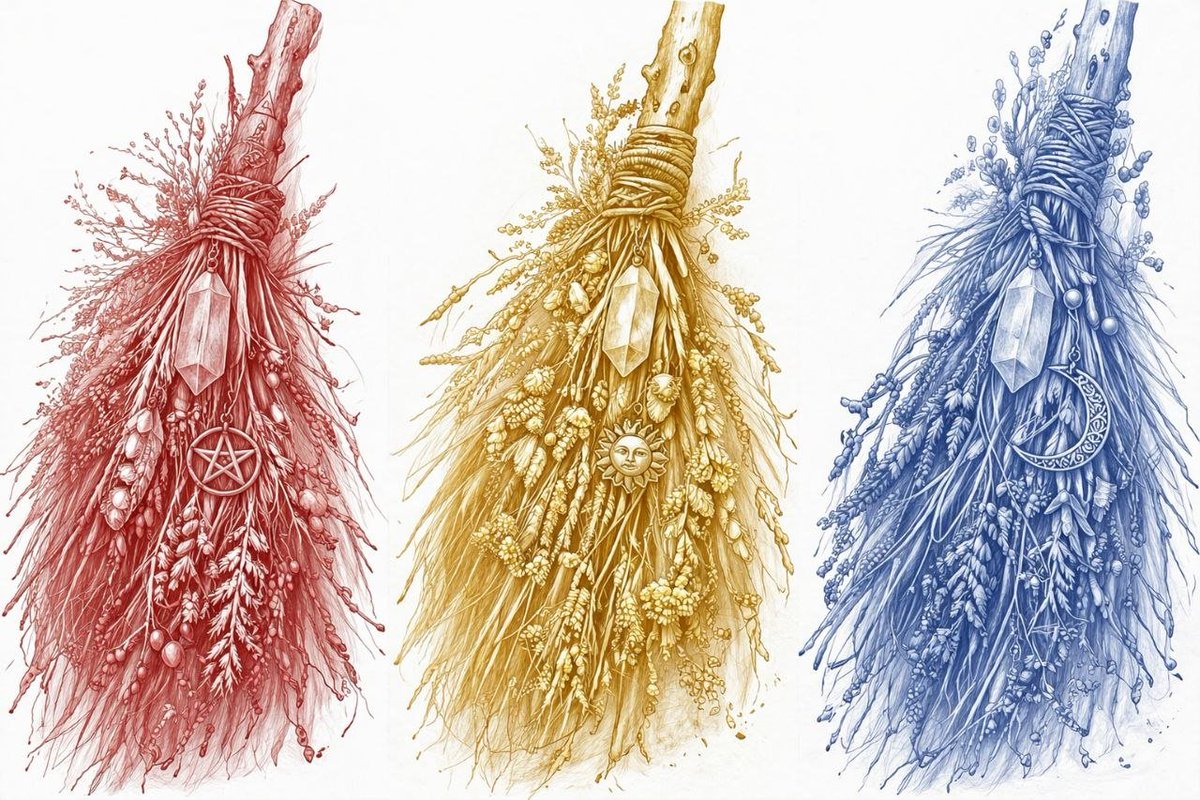
Herbal besoms are handcrafted, ceremonial brooms adorned with dried herbs, flowers, and crystals, traditionally used in Pagan and Wiccan practices to sweep away negative energy, protect spaces, and consecrate altars. They combine a wooden handle—often willow or hazel—with fragrant bristles like lavender, rosemary, or broom corn, serving as decorative yet functional tools for spiritual cleansing.

English