CeciliaHB🌠

30 posts

CeciliaHB🌠

CeciliaHB🌠

@HanB411971

ex-strategy researcher → AI learner and product builder | Art & workout enthusiast | 🧠 ✍️ 🧱 🚀

Katılım Şubat 2024
237 Takip Edilen7 Takipçiler
CeciliaHB🌠
CeciliaHB🌠@HanB411971·
@HiTw93 looks really nice, love the aesthetics, will give it a try!
English
0
0
0
27
Tw93
Tw93@HiTw93·
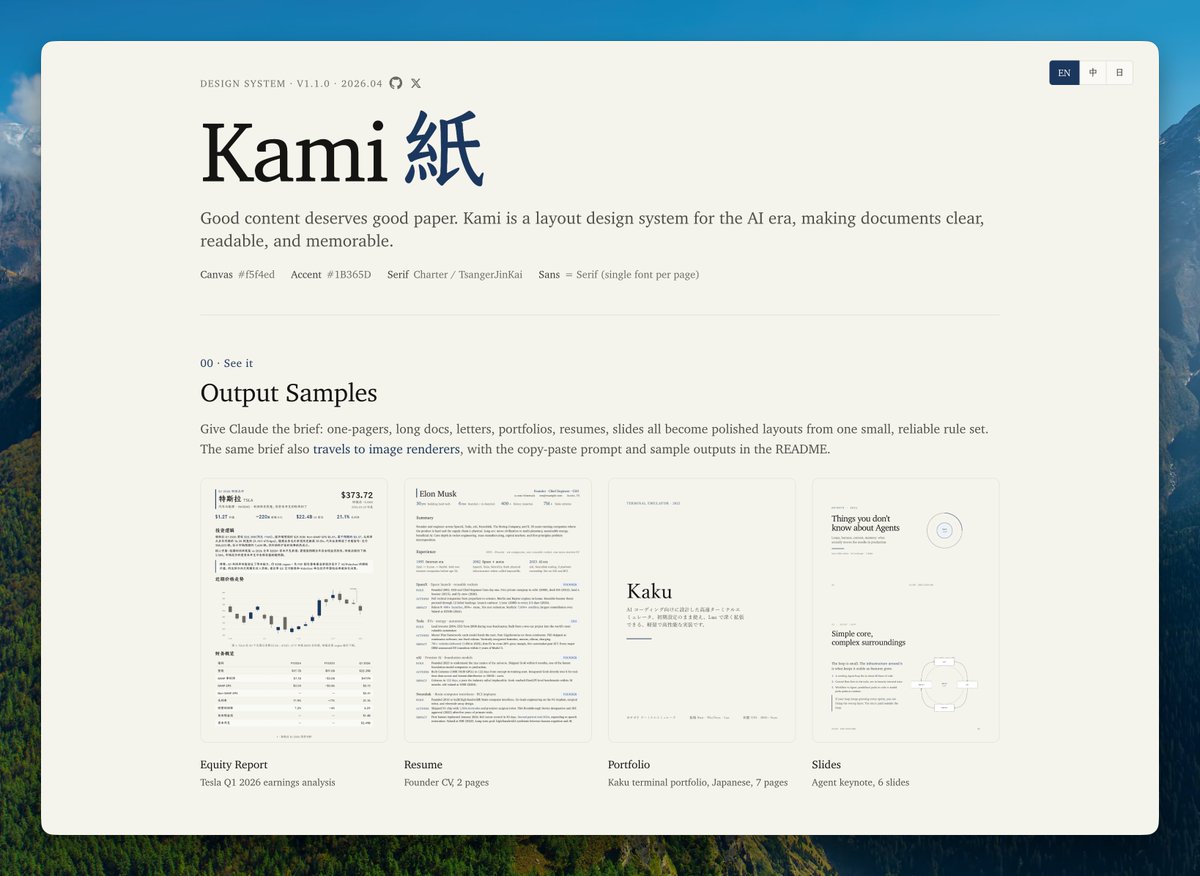
Good content deserves good paper. 👩‍🚒Kami updated, next-gen AI typesetting engine. Give Claude a prompt, get a typeset PDF. Resumes, reports, slides, equity reports, changelogs, portfolios. 8 doc types, CN font fix, 42 tests, macOS auto-setup. github.com/tw93/Kami
Tw93 tweet media
English
10
14
318
28.4K
CeciliaHB🌠
CeciliaHB🌠@HanB411971·
used to do expert interviews for research — the kind where people mix real data with made-up numbers, contradict themselves, and misspeak every other sentence. thought this was peak "only humans can do this" territory. then i started building with AI last October. now i “code”, manage my day-to-day with it, even talk through mental health stuff with it (huge help!). It is really magical to see from both sides/groups.
Andrej Karpathy@karpathy

Judging by my tl there is a growing gap in understanding of AI capability. The first issue I think is around recency and tier of use. I think a lot of people tried the free tier of ChatGPT somewhere last year and allowed it to inform their views on AI a little too much. This is a group of reactions laughing at various quirks of the models, hallucinations, etc. Yes I also saw the viral videos of OpenAI's Advanced Voice mode fumbling simple queries like "should I drive or walk to the carwash". The thing is that these free and old/deprecated models don't reflect the capability in the latest round of state of the art agentic models of this year, especially OpenAI Codex and Claude Code. But that brings me to the second issue. Even if people paid $200/month to use the state of the art models, a lot of the capabilities are relatively "peaky" in highly technical areas. Typical queries around search, writing, advice, etc. are *not* the domain that has made the most noticeable and dramatic strides in capability. Partly, this is due to the technical details of reinforcement learning and its use of verifiable rewards. But partly, it's also because these use cases are not sufficiently prioritized by the companies in their hillclimbing because they don't lead to as much $$$ value. The goldmines are elsewhere, and the focus comes along. So that brings me to the second group of people, who *both* 1) pay for and use the state of the art frontier agentic models (OpenAI Codex / Claude Code) and 2) do so professionally in technical domains like programming, math and research. This group of people is subject to the highest amount of "AI Psychosis" because the recent improvements in these domains as of this year have been nothing short of staggering. When you hand a computer terminal to one of these models, you can now watch them melt programming problems that you'd normally expect to take days/weeks of work. It's this second group of people that assigns a much greater gravity to the capabilities, their slope, and various cyber-related repercussions. TLDR the people in these two groups are speaking past each other. It really is simultaneously the case that OpenAI's free and I think slightly orphaned (?) "Advanced Voice Mode" will fumble the dumbest questions in your Instagram's reels and *at the same time*, OpenAI's highest-tier and paid Codex model will go off for 1 hour to coherently restructure an entire code base, or find and exploit vulnerabilities in computer systems. This part really works and has made dramatic strides because 2 properties: 1) these domains offer explicit reward functions that are verifiable meaning they are easily amenable to reinforcement learning training (e.g. unit tests passed yes or no, in contrast to writing, which is much harder to explicitly judge), but also 2) they are a lot more valuable in b2b settings, meaning that the biggest fraction of the team is focused on improving them. So here we are.


English
0
0
1
40
CeciliaHB🌠
CeciliaHB🌠@HanB411971·
Efficiency has more to do with priority and direction than with the sheer amount of work you do. Same with tools: sometimes going deeper matters more than going wider. I pulled YouTube out of my EPUB extension release scope so I could focus on the product mainline (Xiaoyuzhou Chinese podcasts first). It also pushed me toward a product belief I haven't fully validated yet: now that more people can build their own skills and mini-products, single-purpose but highly precise tools may fit the moment better than broad all-in-one ones.
English
0
0
1
36
CeciliaHB🌠 retweetledi
Andrej Karpathy
Andrej Karpathy@karpathy·
LLM Knowledge Bases Something I'm finding very useful recently: using LLMs to build personal knowledge bases for various topics of research interest. In this way, a large fraction of my recent token throughput is going less into manipulating code, and more into manipulating knowledge (stored as markdown and images). The latest LLMs are quite good at it. So: Data ingest: I index source documents (articles, papers, repos, datasets, images, etc.) into a raw/ directory, then I use an LLM to incrementally "compile" a wiki, which is just a collection of .md files in a directory structure. The wiki includes summaries of all the data in raw/, backlinks, and then it categorizes data into concepts, writes articles for them, and links them all. To convert web articles into .md files I like to use the Obsidian Web Clipper extension, and then I also use a hotkey to download all the related images to local so that my LLM can easily reference them. IDE: I use Obsidian as the IDE "frontend" where I can view the raw data, the the compiled wiki, and the derived visualizations. Important to note that the LLM writes and maintains all of the data of the wiki, I rarely touch it directly. I've played with a few Obsidian plugins to render and view data in other ways (e.g. Marp for slides). Q&A: Where things get interesting is that once your wiki is big enough (e.g. mine on some recent research is ~100 articles and ~400K words), you can ask your LLM agent all kinds of complex questions against the wiki, and it will go off, research the answers, etc. I thought I had to reach for fancy RAG, but the LLM has been pretty good about auto-maintaining index files and brief summaries of all the documents and it reads all the important related data fairly easily at this ~small scale. Output: Instead of getting answers in text/terminal, I like to have it render markdown files for me, or slide shows (Marp format), or matplotlib images, all of which I then view again in Obsidian. You can imagine many other visual output formats depending on the query. Often, I end up "filing" the outputs back into the wiki to enhance it for further queries. So my own explorations and queries always "add up" in the knowledge base. Linting: I've run some LLM "health checks" over the wiki to e.g. find inconsistent data, impute missing data (with web searchers), find interesting connections for new article candidates, etc., to incrementally clean up the wiki and enhance its overall data integrity. The LLMs are quite good at suggesting further questions to ask and look into. Extra tools: I find myself developing additional tools to process the data, e.g. I vibe coded a small and naive search engine over the wiki, which I both use directly (in a web ui), but more often I want to hand it off to an LLM via CLI as a tool for larger queries. Further explorations: As the repo grows, the natural desire is to also think about synthetic data generation + finetuning to have your LLM "know" the data in its weights instead of just context windows. TLDR: raw data from a given number of sources is collected, then compiled by an LLM into a .md wiki, then operated on by various CLIs by the LLM to do Q&A and to incrementally enhance the wiki, and all of it viewable in Obsidian. You rarely ever write or edit the wiki manually, it's the domain of the LLM. I think there is room here for an incredible new product instead of a hacky collection of scripts.
English
2.9K
7.1K
58.7K
21M
leoohoho
leoohoho@lehoho248·
@HanB411971 noticed that talking to me sometimes feels like conversation with codex. (Too engineery) I’ll never recover from that statement.
English
1
0
2
41
Alan Chan
Alan Chan@alanchan_tw·
@HanB411971 @Heptabase If you have the PDF file, then yes. We haven't supported EPUB yet, but we plan to support it soon.
English
1
0
2
268
Alan Chan
Alan Chan@alanchan_tw·
I started @Heptabase 4 years ago, with the mission to give people the power to gain a deep understanding of anything. We began by building a visual knowledge base for students, researchers, and lifelong learners. It quickly became a beloved product used in over 150+ countries around the world, won the @ProductHunt annual Golden Kitty Award in the Personal Productivity category, and scaled profitably into millions in revenue. However, I’m not satisfied. For sure, it’s a great app to organize and make sense of all your learning and research notes. But it’s still far from our mission. You can’t learn quantum mechanics or the theory of relativity just by downloading Heptabase. You still need to have a teacher or spend a lot of time reading difficult sources on your own before you can get the most value out of Heptabase. Things have changed today. I’m very excited to introduce Heptabase’s AI Tutor — an AI agent that is designed to help you achieve any learning goal you’ve set. This is not another “upload and ask” AI app like ChatGPT, Gemini, or NotebookLM. It’s built to help you make step-by-step progress toward your goal: 1. Goal-Oriented Curriculum: Simply state your learning goal (e.g., study Western philosophy, understand international politics, pass the bar exam, or achieve financial freedom), and the AI Tutor will design a personalized syllabus tailored to your level and needs. 2. Systematic & Personalized Learning: Instead of trying to figure out what question to ask, the AI Tutor guides you. It provides step-by-step reading materials—allowing you to highlight important content and ask questions about anything you don't understand—then tests your understanding and dynamically adapts to your learning style and pace over time. 3. Seamless Note-taking Integration: Your highlights, notes, and Q&A sessions are automatically organized onto dedicated whiteboards and converted into clean review notes. You have the best note-taking experience in the world available to you while learning with AI! AI Tutor is another significant product milestone that helps us move toward our mission. In the past two months, I have taken over 50 lessons using AI Tutor, and the experience is just mind-blowing. It’s a dream come true for all curious people who want to understand more about the world. I really wish I had it when I was a kid! AI Tutor is now available for all Premium Plan users and will be available for Pro users soon. Try it out, tell your friends, and share your feedback with us! I hope you enjoy it!
English
7
5
68
8.8K
CeciliaHB🌠
CeciliaHB🌠@HanB411971·
@saranormous I'm very much in this camp — been experimenting with AI for my own projects, using it in my daily workflows and trying to build tools with coding agents. Always looking for ways to level up. Happy to beta test!
English
0
0
0
734
sarah guo
sarah guo@saranormous·
any nontechnical folks want to get more comfortable/powerful in their use of AI and want to be a beta user on something I made?
English
542
22
895
102.8K
CeciliaHB🌠 retweetledi
Cheng-Wei Hu
Cheng-Wei Hu@HcwXd·
I left NotebookLM a few months ago to solve a bigger problem in learning. Today, as the first step, we are launching @WonderingApp for early access. It's Duolingo for anything — turning any topic into a guided path with bite-size visual lessons that can fit into your busy schedule. But you don't sacrifice depth/effectiveness for convenience: Total Control: You decide how deep you want to go, how difficult the material should be, and how personalized the experience feels. Active Learning: We provide the tools you need to practice, test your understanding, and actually apply what you’ve learned. Long-term Mastery: It’s built to help you truly remember and master any subject, not just skim the surface.
English
214
200
3.1K
315.9K
CeciliaHB🌠
CeciliaHB🌠@HanB411971·
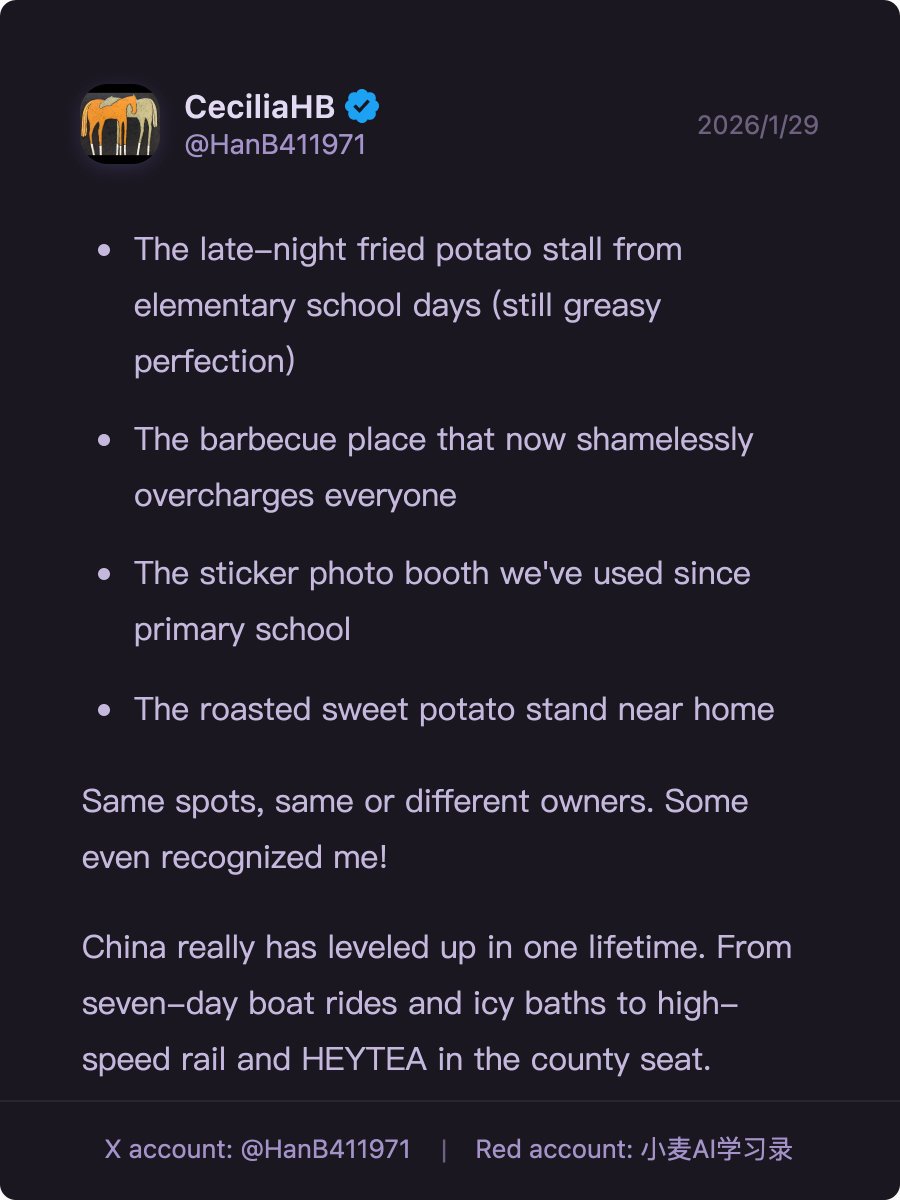
Same Noodles, Different World —— How China has changed drastically
CeciliaHB🌠 tweet mediaCeciliaHB🌠 tweet media
English
1
0
1
83
CeciliaHB🌠
CeciliaHB🌠@HanB411971·
Transferred my Notion files and Apple Notes to Obsidian. Let's see how it goes.
English
0
0
1
20
CeciliaHB🌠 retweetledi
Garry Tan
Garry Tan@garrytan·
I don't know why this isn't just in Claude Code's system prompt
Garry Tan tweet media
English
78
96
2.4K
186.9K