
Sabitlenmiş Tweet
Harmonic
308 posts


Harmonic
@HarmonicMath
Building Mathematical Superintelligence
Katılım Ocak 2024
10 Takip Edilen21.5K Takipçiler
From @emilyriehl on the #aboutlogic podcast (w/ @DenizPhiMa):
"I much prefer to interact with an autoformalisation agent than a large language model in discussing mathematics, because the large language models will feed you a lot of bullshit ..."
"I came up with my own counterexample, and then I asked Harmonic's agent Aristotle to verify it for me in Lean as a kind of extra check that my counterexample was correct. I did not ask a large language model for this, because if they tell me it's correct, that gives me no assurance ..."
"Aristotle was able to confirm that it is a valid counterexample."
Deniz Sarikaya@DenizPhiMa
We are very happy that Emily Riehl @emilyriehl joined or little podcast #aboutlogic and talked about higher categories, synthetic mathematics, formalization and much more. youtu.be/4MQbd5wTlI8?si…
English
🪄🧙Aristotle is the mathematician's super-assistant
Check out how @LorenzoLuccioli uses Aristotle to develop new results in algebraic combinatorics
Lorenzo Luccioli@LorenzoLuccioli
Happy to share that our paper “Mapping Uncharted Symmetries: Machine Discovery in Combinatorics” has been accepted to the ICML 2026 AI4Math Workshop. We study AI for discovery in algebraic combinatorics, with verification in @leanprover using @HarmonicMath’s Aristotle. 1/11
English
The negation of Erdos unit distance conjecture, now formalized by Aristotle
You can try it for free at aristotle.harmonic.fun
Alex Kontorovich@AlexKontorovich
Oh and Kim Morrison used Claude + Aristotle + Codex to formalize the negation of the Erdos unit distance conjecture: github.com/kim-em/erdos-u… It's nice to see that this was built on top of PNT+; so despite the fact that we haven't been able to upstream it to Mathlib (the Residue Theorem we have in PNT+ is just for rectangles, and Mathlib will want a much more general version...), it's still useful in other applications!...
English

Harmonic retweetledi

Happy to share that our paper
“Mapping Uncharted Symmetries: Machine Discovery in Combinatorics”
has been accepted to the ICML 2026 AI4Math Workshop.
We study AI for discovery in algebraic combinatorics, with verification in @leanprover using @HarmonicMath’s Aristotle.
1/11
English
NOW LIVE: Ask Mode for Aristotle Agent
Get real-time insights into your agent's work without interrupting its execution with Ask Mode.
If you need to change direction rather than just ask questions, Instruct Mode is still active to let you steer mid-run. Try it out and let us know what you think!

English
In the future, all critical software will be formally verified.
Vladimir Novakovski@vnovakovski
As we discussed with @VitalikButerin on our Fireside, formal verification is a big positive outcome from AI that will more than counterbalance the effects of AI finding new bugs. I am strongly supportive of math AI tools like Aristotle from @HarmonicMath driving this forward.
English
Harmonic retweetledi


Mathematical superintelligence is nearer by the day.
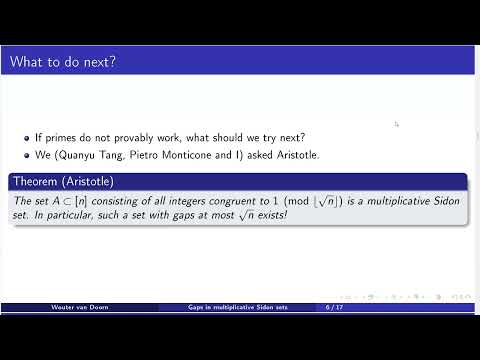
Wouter van Doorn presented at NYNTS how he used Aristotle to tackle an important unsolved problem in number theory.
Check it out here: youtu.be/7G6B0w8Quok
YouTube
Bartosz Naskręcki@nasqret
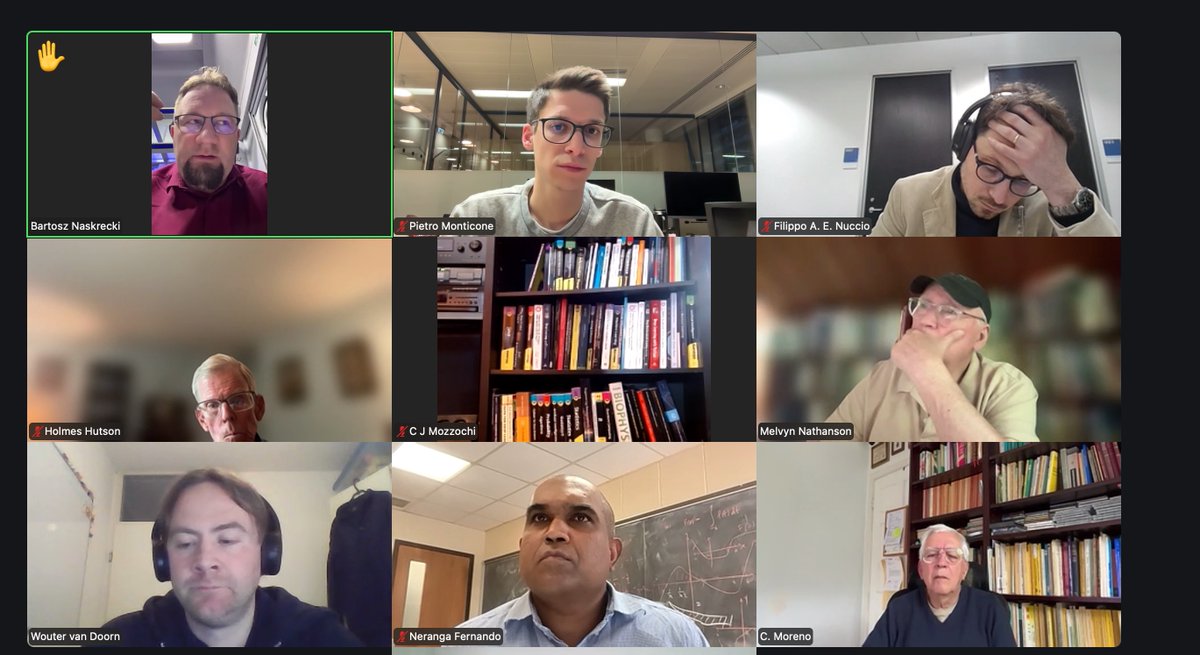
Today at the New York Number Theory Seminar, Wouter and Pietro were discussing their new paper. Really cool use of the AI-human feedback loop, with Aristotle as the main AI ingredient. I explained how I think formalization feels like doing the low-tech steps of algebraic geometry proofs with commutative algebra. You can have high-brow intuitions, but eventually one has to prove all the details. I wonder how this will evolve, but we are definitely at the level of assembly language being written by models like Aristotle. Tactics feel like the first glimpses of higher-level programming principles. The next step might be a more conversational style of working with the models. I am now working on a tighter integration of Lean with computer algebra languages. Stay tuned!
English
ICYMI: A few quality of life improvements landed in Aristotle Web to make it much more interactive and responsive:
▪ Live Updates. Aristotle can now share updates while it's in the middle of a run, so that you always know what it's doing and whether it's on track.
▪ Steering. You can message Aristotle while it's working if you want to redirect it, or if you just want to let it know it's doing a great job.
Keep the feedback coming; we'll continue cooking ...

English

mathematical superintelligence solves this @HarmonicMath
alex peysakhovich@alex_peys
got a framed copy to hang by the ai team
English
Harmonic retweetledi

Today at the New York Number Theory Seminar, Wouter and Pietro were discussing their new paper. Really cool use of the AI-human feedback loop, with Aristotle as the main AI ingredient.
I explained how I think formalization feels like doing the low-tech steps of algebraic geometry proofs with commutative algebra. You can have high-brow intuitions, but eventually one has to prove all the details.
I wonder how this will evolve, but we are definitely at the level of assembly language being written by models like Aristotle. Tactics feel like the first glimpses of higher-level programming principles. The next step might be a more conversational style of working with the models.
I am now working on a tighter integration of Lean with computer algebra languages. Stay tuned!
Pietro Monticone@PietroMonticone
Here's what András Sárközy, Erdős's most prolific collaborator, asked 25 years ago: "How small can one make the maximal gap between the consecutive elements of a multiplicative Sidon set selected from {1, 2, ..., n}?" In particular: does there exist a multiplicative Sidon set A ⊆ {1, 2, …, n} such that every sub-interval of [1, n] of length at least √n contains at least one element of A? The answer is yes. The solution was autonomously discovered and formally verified in #Lean by Aristotle. We then improved the bound below √n and Aristotle formalised our proof too.
English
Harmonic retweetledi

Here's what András Sárközy, Erdős's most prolific collaborator, asked 25 years ago:
"How small can one make the maximal gap between the consecutive elements of a multiplicative Sidon set selected from {1, 2, ..., n}?"
In particular: does there exist a multiplicative Sidon set A ⊆ {1, 2, …, n} such that every sub-interval of [1, n] of length at least √n contains at least one element of A?
The answer is yes. The solution was autonomously discovered and formally verified in #Lean by Aristotle. We then improved the bound below √n and Aristotle formalised our proof too.

Română
Harmonic retweetledi
I used @HarmonicMath's Aristotle to formalize Erdős problem #426 in Lean 4…
and ended up fully verifying a stronger bound that the original paper only suggested 🧵
Erdős offered $25 for a disproof, and $100 if the conjecture was true 👇

English
Harmonic retweetledi

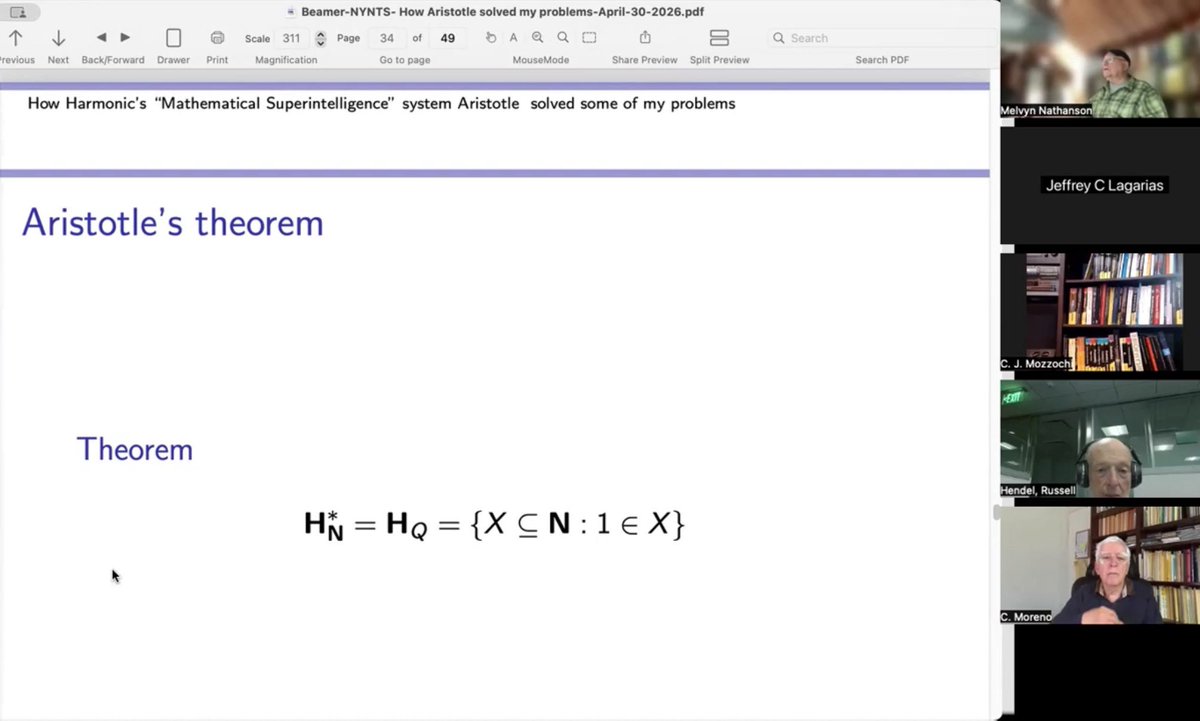
Mel Nathanson — How Harmonic's Aristotle solved some of my problems. gist.github.com/kim-em/20212c6… #LeanProver #ITP #Aristotle #AI4Math
English
Harmonic retweetledi
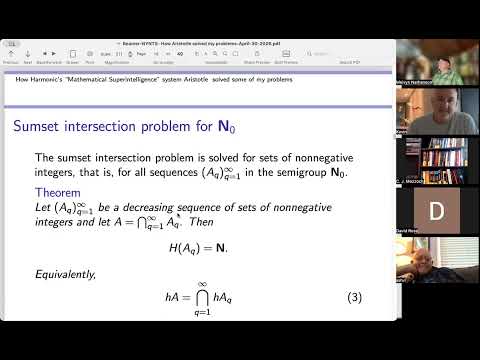
Nathanson has just published the recording of his talk about Aristotle’s solutions and it is very interesting to watch!
“I tried to figure out what it did that I didn’t do to solve the problems.”
“The incredibly clever idea that Aristotle had was…”
youtu.be/VBIxv-6m7sk
YouTube
Pietro Monticone@PietroMonticone
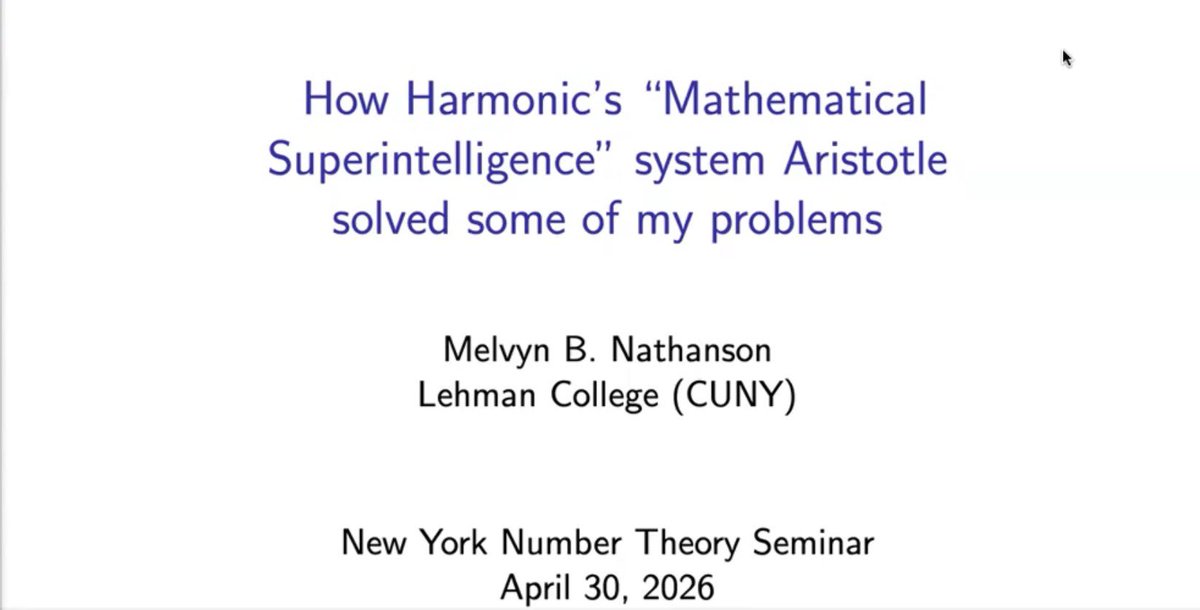
Interesting update: a few days ago, Nathanson presented a talk at the New York Number Theory Seminar explaining how Aristotle solved some of his problems.
English