Harrison Fell

213 posts

Harrison Fell

Harrison Fell

@HarrisonGFell

Energy/Environmental Economist; Professor at NCSU; overwhelmed parent

Raleigh, NC Katılım Nisan 2019
283 Takip Edilen778 Takipçiler
Harrison Fell
Harrison Fell@HarrisonGFell·
@ShanuMathew93 I use forecasts as guides to general direction of variables and relative sizes of changes (eg solar and wind will both grow but solar likely grows faster). I use EIA for data, not forecasts. Still work to do there but @EIA_One has ‘em on the right track
English
0
0
1
50
Shanu Mathew
Shanu Mathew@ShanuMathew93·
@HarrisonGFell What do you use to forecast instead then? What do you think of EIA? Btw know where the chart is from?
English
1
0
0
45
Harrison Fell
Harrison Fell@HarrisonGFell·
@MargrietKuijper @JesseJenkins @bprest @DxGordon emiss implications of less LNG is not as simple as that for oil. Reduction in Q demanded of oil from a field retirement is likely met with fewer ICE miles driven and more EVs, both lead to lower emiss. Reduced Q demanded of LNG b/c of higher prices can be met w/ higher emiss fuel
English
0
0
1
23
margriet kuijper
margriet kuijper@MargrietKuijper·
@JesseJenkins @bprest @HarrisonGFell @DxGordon Are supply-side oil production interventions really comparable to LNG supply-side permitting interventions? The whole gas-coal interaction is missing on the oil side. US LNG exports could be replaced with cleaner alternatives, but also with coal.
English
2
0
3
475
Harrison Fell
Harrison Fell@HarrisonGFell·
@stroebel_econ It’s unfortunate that this Fed conf is on the same day as the Assoc of Enviro & Res Econ Summer Conf, where there will be (and have been for many years) many climate econ papers presented
English
0
0
1
63
Harrison Fell
Harrison Fell@HarrisonGFell·
@noahqk @SpenceEnergyUT Yes, this result is basically b/c all the HPs are in the SE and they've been heavily subsidizing them for many years here. Would be interesting to see if this result still holds in NE and MidWest as they start to adopt.
English
0
0
2
100
Harrison Fell
Harrison Fell@HarrisonGFell·
@mikejrob So I buy that they’re hard to measure, but then at what rate should govt subsidize them and doesn’t the subsidy create all the same leakage potential as offset crediting?
English
1
0
1
67
Michael Roberts
Michael Roberts@mikejrob·
Maybe someday we'll have perfect measurement, global pricing, and global enforcement. We'll just need to eliminate most net emissions long before that day. So, yeah, let's subsidize forest restoration. Just don't say it's a substitute for emissions reductions.
English
3
0
4
338
Michael Roberts
Michael Roberts@mikejrob·
I think @JesseJenkins is right, but this will irk some economists who often think in terms of "getting the price right" and "the law of one price." If you can sequester your emissions and be net zero, why should that be different than zero emissions? A short 🧵.
Jesse D. Jenkins@JesseJenkins

This is the KEY point when it comes to soil carbon and other 'natural climate solutions.' They are real, important mitigation options. But they are NOT viable as *alternatives* to reducing direct fossil related greenhouse gas emissions -- aka they should NOT be used as offsets.

English
1
3
8
9.1K
Harrison Fell
Harrison Fell@HarrisonGFell·
Getting a new waterheater (wh). 1st person suggests heatpump(hp) wh. 2nd guy says crawlspace is too small to install a hp wh that meets code. Both gave tankless quotes that r not eligible for IRA-tax credits. Punchline-I have no idea how much energy efficiency IRA will deliver.
English
0
0
6
590
Harrison Fell
Harrison Fell@HarrisonGFell·
@bstorrow I wonder how much of this is due to prevailing wage and apprenticeship requirements needed to reach max-value PTC. If there is a bottleneck there, I'm sure it's worthwhile for wind/solar developers to delay projects until those labor standards can be met
English
1
0
0
0
Ben Storrow
Ben Storrow@bstorrow·
U.S. renewable growth slowed markedly in Q3. Country installed two - TWO- onshore wind farms. And relatively small ones at that. Question is whether it is a temporary slowdown or reflective of longer-term challenges subscriber.politicopro.com/article/eenews…
English
2
2
1
0
Harrison Fell
Harrison Fell@HarrisonGFell·
@davidrvetter If only there was a field in economics that did explicitly consider the environment and natural resources and they had an association with 100s of members and some respected journals and conferences…oh wait that does all exist. @AereOrg. Look into it.
English
0
0
1
0
Dave Vetter
Dave Vetter@davidrvetter·
*I feel like I should say the names above are a tiny fraction of a sliver of a morsel of the huge number of thinkers and writers I admire who are doing incredible work on this most wicked of problems. It's not meant to be exhaustive!
English
10
6
83
0
Dave Vetter
Dave Vetter@davidrvetter·
On Monday, we [the MSEE cohort at @TheSmithSchool, @UniofOxford] met visionary systems thinker @KateRaworth and spoke with her about reimagining what and who the economy is for. Yet you won't hear her thesis in a mainstream economics lecture. 🧵 1/16
Dave Vetter tweet media
English
41
318
795
0
Noah Kaufman
Noah Kaufman@noahqk·
@JesseJenkins Yes makes sense. I was thinking in terms of discrete decisions planners might have. So maybe $60/ton vs NG and $25 vs coal (for the full $25/MWh credit)
English
1
0
1
0
Noah Kaufman
Noah Kaufman@noahqk·
Anyone want to correct my rough math here? The incentive from a $25/MWh production tax credit for carbon-free electricity generation is equivalent to a $61/tonne carbon price on electricity from natural gas. ($25/MWh divided by 0.41 tonnes/MWh).
English
4
2
21
0
Noah Kaufman
Noah Kaufman@noahqk·
this is like my wife divorcing me for the bad haircut I just got
English
3
0
4
0
Margaret Walls
Margaret Walls@margaretwalls1·
Morning view on a beautiful fall day. Construction at @DCDPR’s Stead Park but I still appreciate the view from my @rff office.
Margaret Walls tweet media
English
1
0
12
0
Harrison Fell
Harrison Fell@HarrisonGFell·
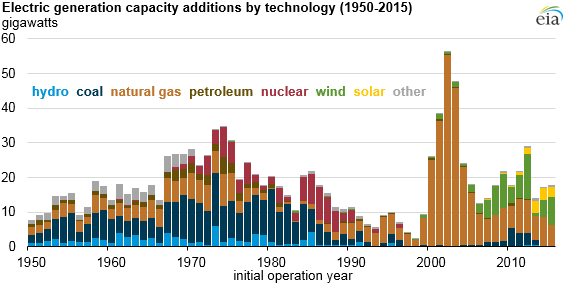
@joshdr83 @OctaviSemonin @duncancampbell Sort of deregulation, but difference b/w utility and ipp additions weren't huge (66.8 GW of ngcc for utility and 74.1 for IPP over 2000-2005). The additions of gas were almost all NGCC. I thought it was in part due to tech improvements.
English
0
0
2
0
Octavi Semonin ⚡️🚲
Octavi Semonin ⚡️🚲@OctaviSemonin·
It's kind of incredible how much natural gas generation capacity was installed in the early 2000's. I feel like I should know this, but what drove that?
Octavi Semonin ⚡️🚲 tweet media
English
38
11
51
0
Harrison Fell
Harrison Fell@HarrisonGFell·
@JesseJenkins @noahqk Might be politically more feasible to sequence big subsidy then binding emissions constraint, but doesn’t it just shift the cost burden? Would be interesting to explore if that burden shift is progressive or regressive
English
1
0
1
0
Jesse D. Jenkins
Jesse D. Jenkins@JesseJenkins·
@noahqk Let's keep working on that... But I do think this is the sequence that works. Make clean energy cheap. Then cost uncertainty looks more manageable to interests and politics of emissions cap might shift. Let's test that theory out eh?
English
4
1
12
0
Noah Kaufman
Noah Kaufman@noahqk·
For times like this, it'd be nice to have a climate change law that makes emissions targets mandatory. Then, the uncertainty would shift from emissions to costs. Probably better policy sequencing.
Jesse D. Jenkins@JesseJenkins

NEW REPEATProject.org analysis out on the importance of electricity transmission expansion to unlock the full emissions reduction potential (& health benefits) of the #InflationReductionAct: repeatproject.org/docs/REPEAT_IR… Read on to learn why 100s of millions of tons are at stake.

English
1
2
11
0
Harrison Fell
Harrison Fell@HarrisonGFell·
@robbieorvis Interesting that this analysis shows very little transportation sector reductions and much larger elec. sector reductions compared to REPEAT, but similar overall reductions to REPEAT. Is this simply due to lower overall elec. demand given lower EV adoption in your model?
English
1
0
0
0
Robbie Orvis
Robbie Orvis@robbieorvis·
🚨Updated IRA Modeling🚨 1⃣ Today we (@EnergyInnovLLC) released updated modeling of the IRA. We updated our modeling to reflect final bill text, add new modeling projections and data, incorporate new modeling updates. Results below. Text here: energyinnovation.org/wp-content/upl…
English
7
58
216
0
Harrison Fell
Harrison Fell@HarrisonGFell·
@RobGramlichDC There are many papers on restructuring in the economics literature. Fewer of late as we learn more about the limits of identification from methods that exploit restructuring as a quasi natural experiment. Still many many IO econ papers applied to power sector coming out
English
0
1
1
0
Rob Gramlich
Rob Gramlich@RobGramlichDC·
Completely agree with this. Technology has changed, the questions are as or more important than then (I would say'95-'10), but academic research on restructuring and IO economics applied to the power sector has all but disappeared. Let's petition the American Economics Assoc.
Travis Fisher@ts_fisher

One thing I’m having trouble understanding is why so many regulators and academics cared about studying restructuring in 2008/2009 but have gone completely silent since then. Any ideas? #energytwitter #electricity #competition

English
5
4
19
0
Harrison Fell
Harrison Fell@HarrisonGFell·
Not sure I buy Duke here either, but option value is real. W/ high price volatility it’s a bigger deal. Big energy system models don’t generally pick up uncert. that drives opt. val. Would be interesting to see if cost/effic. uncertainties will delay clean energy deployment
Tyler Norris@tylerhnorris

Actual line from testimony just filed by 2nd largest US utility: “accelerating solar deployments based on today’s tech could crowd out future, unknown solar or other technologies that are more efficient or more cost-effective than today’s solar.” Not the Onion, folks.

English
2
1
2
0