Harvard FAS CAMLab

217 posts

Harvard FAS CAMLab banner
Harvard FAS CAMLab

Harvard FAS CAMLab

@HarvardCAMLab

Transporting audiences beyond the here and now, CAMLab uses digital technologies to stage cultural history.

Cambridge, MA Katılım Şubat 2025
13 Takip Edilen44 Takipçiler
Sabitlenmiş Tweet
Harvard FAS CAMLab
Harvard FAS CAMLab@HarvardCAMLab·
Hello X! We are Harvard FAS CAMLab #HarvardCAMLab 🏛Integrating humanistic inquiry with cutting-edge technology and design, CAMLab explores innovative, interdisciplinary ways of showcasing art and culture through multimedia storytelling. 💡More info: camlab.fas.harvard.edu
English
2
0
7
1.2K
Harvard FAS CAMLab
Harvard FAS CAMLab@HarvardCAMLab·
CAMLab is pleased to announce our next VS in Dialogue lecture: “Shanghai on the Edge: Resilience and ‘Spontaneity’ in Chinese Urbanism.” “Removing Boundaries” is reshaping Chinese cities—but is tearing down walls really the path to livability? Join us as Huichao Luo presents a special lecture grounded in research on Shanghai’s spatial evolution. ⏰ June 5 (Friday), 12:00–1:30 PM EST 📍 CAMLab Cave, Lower Level, 485 Broadway, Harvard University, Cambridge, MA 🌍 Language: English 🎫 Free and open to the public. Only 20 spots available—register via: docs.google.com/forms/d/e/1FAI… In the current wave of Chinese urban renewal, “Removing Boundaries” has become a dominant strategy. There is a palpable urgency to tear down walls and partitions in cities, fueled by the belief that spatial exclusion and urban placelessness will vanish once physical barriers are removed. But is this rush to deconstruct truly the path to creating a more livable environment overall? This seminar argues that the “boundary”—exemplified by walls—is not merely a physical obstruction but a profound cultural archetype with deep-seated continuity in the Chinese urban tradition. Drawing upon research into Shanghai’s spatial evolution and design practices, this study moves beyond a reductive understanding of boundaries. By decoding how they act as regulators of spatial order, it re-examines the unique resilience of the Chinese city and uncovers the “spontaneous” characteristic that thrives behind the boundaries we are so quick to destroy. Huichao Luo is currently a visiting student at Harvard FAS CAMLab and a PhD candidate in Architecture at Shanghai Jiao Tong University. She holds both Bachelor’s and Master’s degrees in Architecture from the University of New South Wales. Her research focuses on boundary and spatial theory, colonial urbanism, spatial governance, and urban morphology. #HarvardCAMLab #AcademicTalk #Cambridge #HarvardUniversity #VSinDialogue
Harvard FAS CAMLab tweet media
English
0
0
0
24
Harvard FAS CAMLab
Harvard FAS CAMLab@HarvardCAMLab·
The CAMLab Lecture Series is pleased to welcome Professor Zhigang Wang (Academy of Arts & Design, Tsinghua University)—new media artist, scholar, and visual director—for "Narrative Experience Design for Cultural Heritage," an engaging lecture on digital heritage. For too long, the heritage field has conflated technology with transmission—digitizing symbols while severing them from their cultural core. Professor Wang’s practice challenges this assumption. Through a “Culture–Narrative–Technology” framework, his work bridges antiquity and the present, generating meanings that resonate with contemporary audiences rather than freezing the past in pixels. The talk will explore four of Professor Wang’s signature projects—from "House of Heaven" and "Return to Haiyantang" to "The Skeleton Fantasy Show" and "Longitude and Latitude"—demonstrating how narrative logic, rather than digital tools alone, can activate cultural heritage and bring it to life in meaningful ways. 📅 Friday, May 15, 2026, at 3:00 – 5:00 PM EST 📍 Room 422, 485 Broadway, Harvard University, Cambridge, MA 🌍 Language: English ✨ Free & Open to the Public. Seating is limited—RSVP required. Please sign up through: forms.gle/LoGR9tLYHP88xS… #HarvardCAMLab #DigitalHeritage #NewMediaArt #ChineseArt #CulturalHeritage #LectureSeries #CambridgeMA
Harvard FAS CAMLab tweet media
English
0
4
5
1.4K
Harvard FAS CAMLab
Harvard FAS CAMLab@HarvardCAMLab·
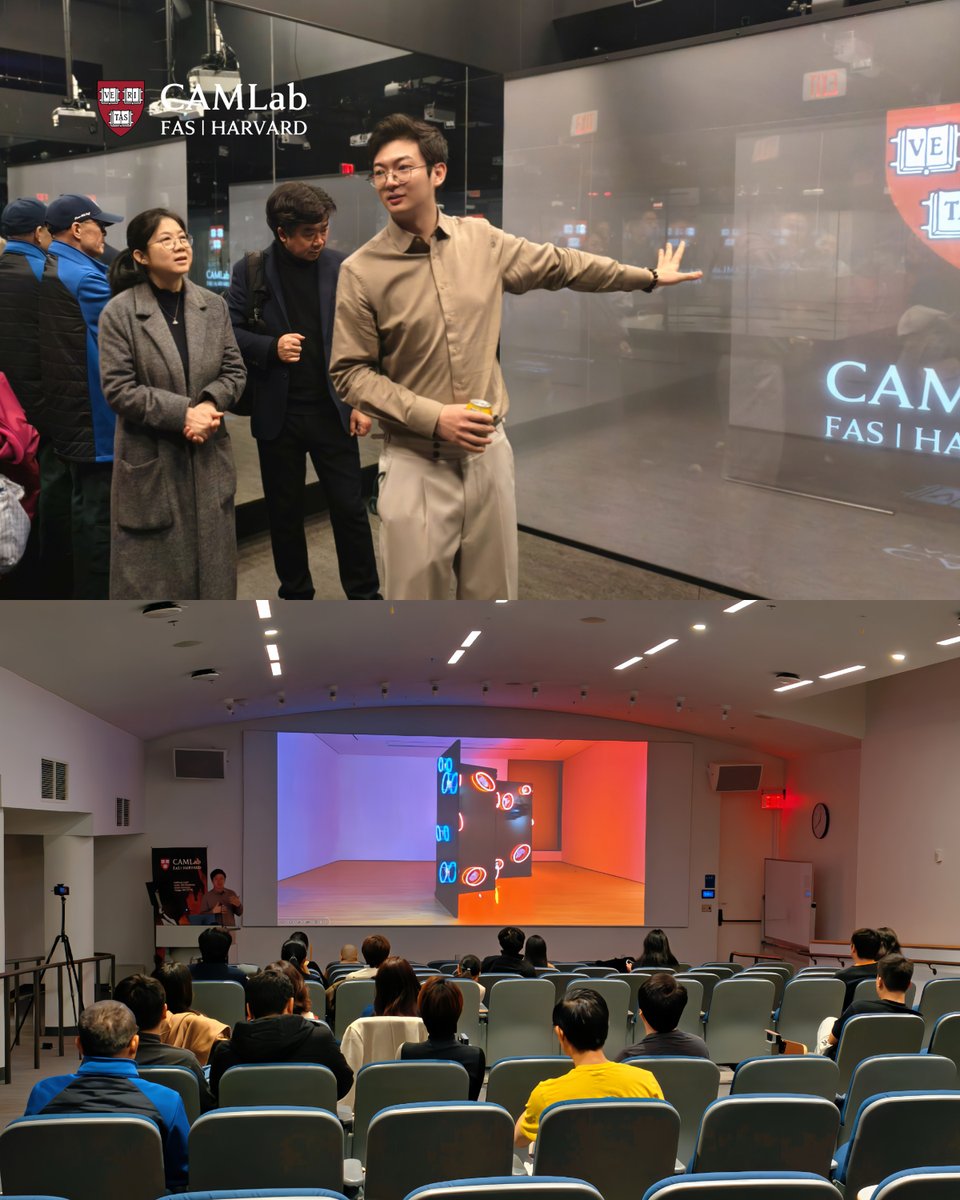
On April 17, Yan Xiangqi (CAMLab Visiting Scholar 2025–26; Associate Professor, Hunan University) gave a wide-ranging talk on how urban locality is reconfigured in the digital age. Starting from Yi-Fu Tuan's Space and Place, Prof. Yan traced traditional locality's five dimensions and argued that the model is becoming obsolete. Changsha—from the 1938 fire to over-commercialized historic districts and “Super Wenheyou”—illustrates dis-anchored locality. He proposed shifting from a “space–place” binary to a “human–media–place” ternary loop. Drawing on Nick Couldry & Andreas Hepp's deep mediatization theory, he argued media now structurally constitute place, not merely represent it. He introduced “digital authenticity” and a connectivity-centered framework for public space (physical, visual/perceptual, social, digital), integrating Manuel Castells’ “space of flows” with Mai Khanh Tran and others’ hybridity research. Using Changsha's Xiwenmiao Historic District, he showed how connectivity mapping identifies spatial fractures. “Light-touch” strategies replace demolition, with five “relational media” types—trace, invitation, translation, traversal, reflux—shifting urban design from “scenic engineering” to “relationship engineering,” turning historic districts into synchronic fields of meaning. CAMLab extends its sincere gratitude to Associate Professor Yan Xiangqi for his brilliant lecture and to all participants for their enthusiastic engagement. Stay tuned for upcoming events.
Harvard FAS CAMLab tweet mediaHarvard FAS CAMLab tweet media
English
0
0
0
19
Harvard FAS CAMLab
Harvard FAS CAMLab@HarvardCAMLab·
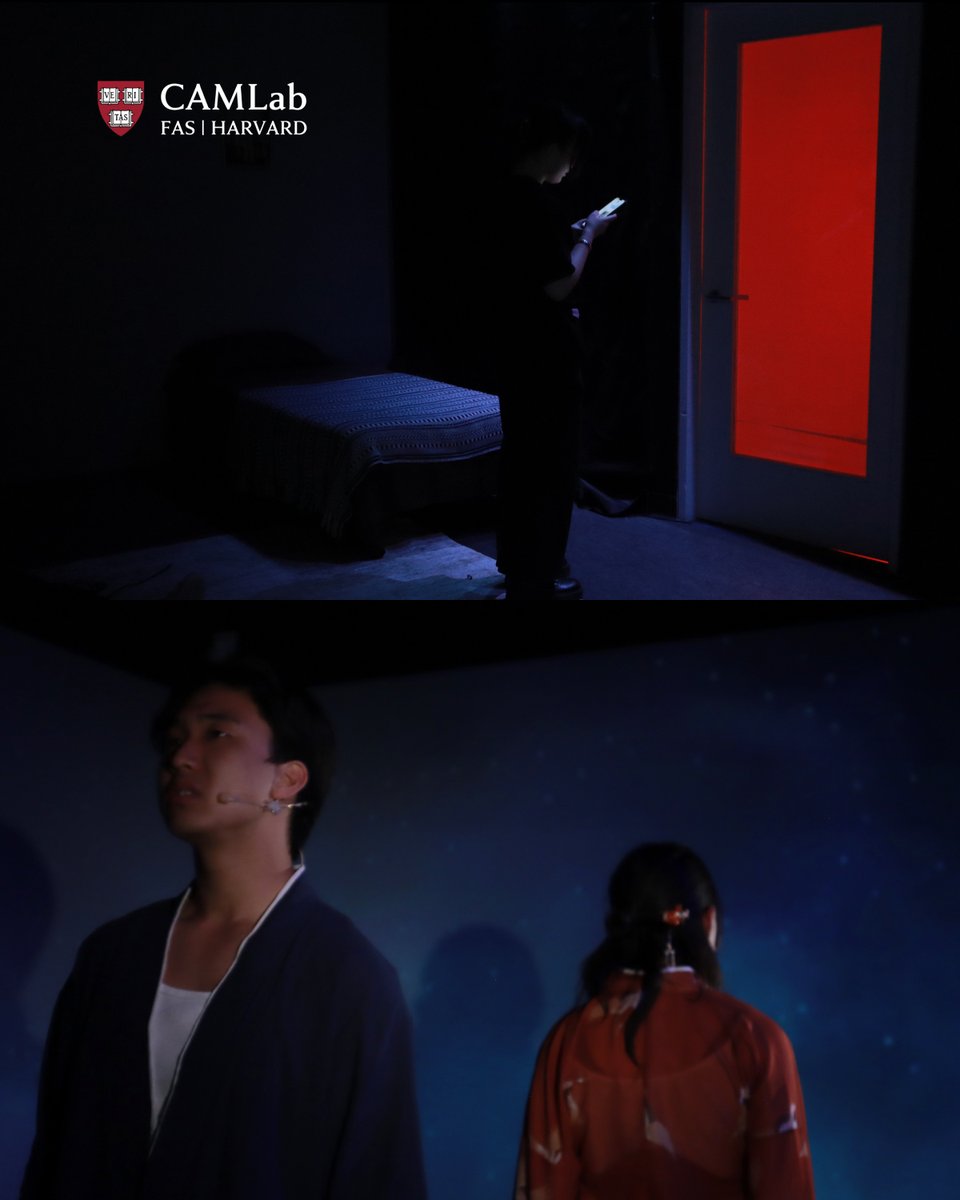
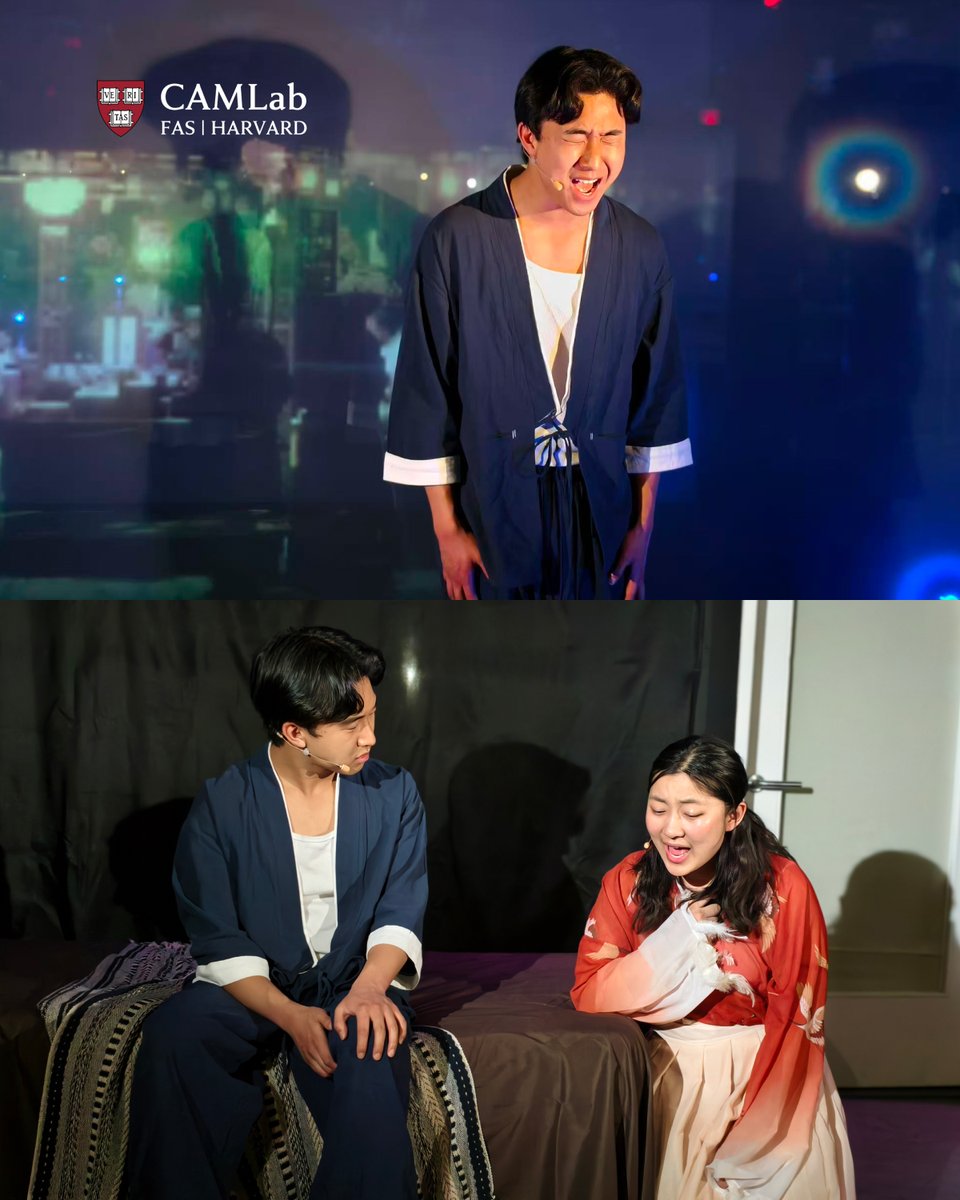
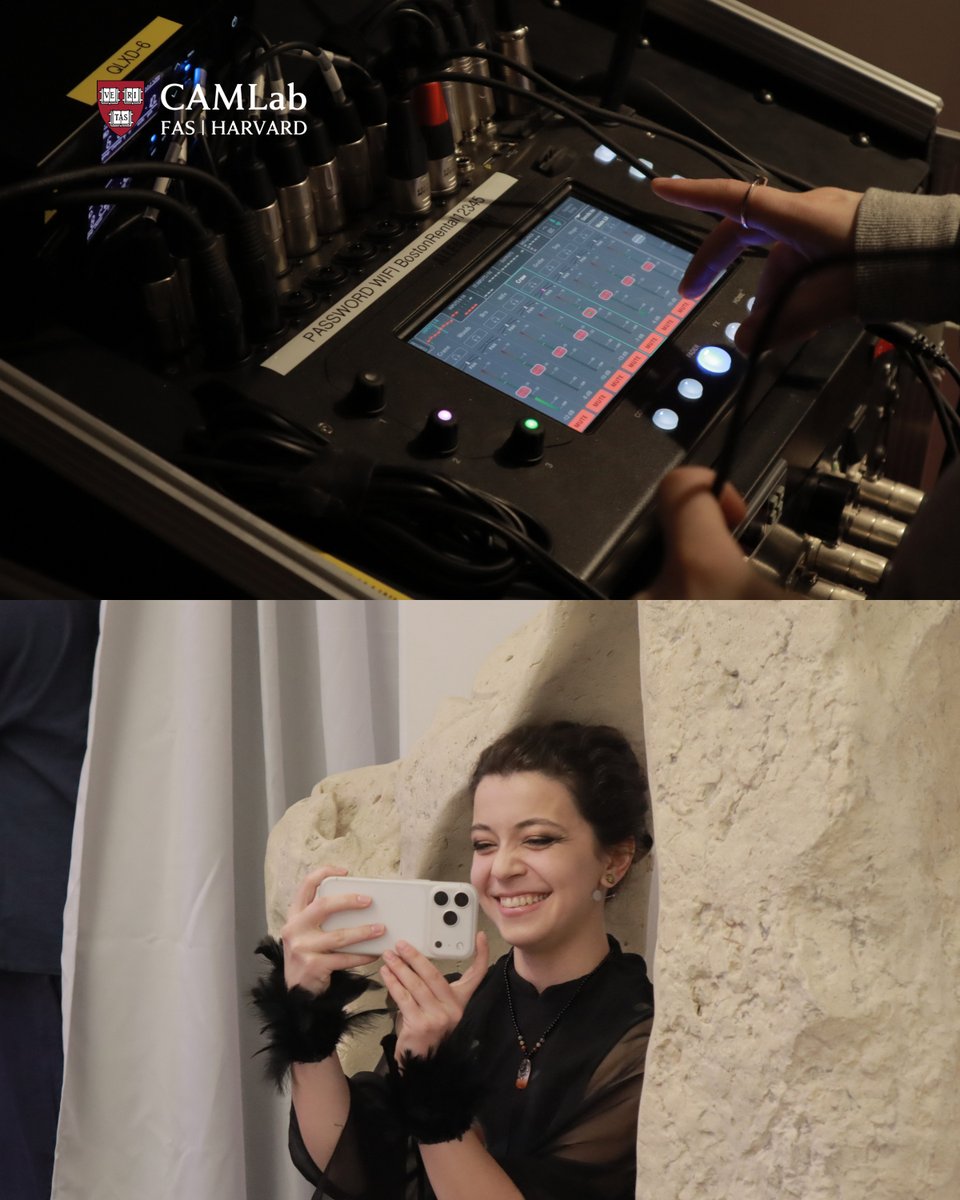
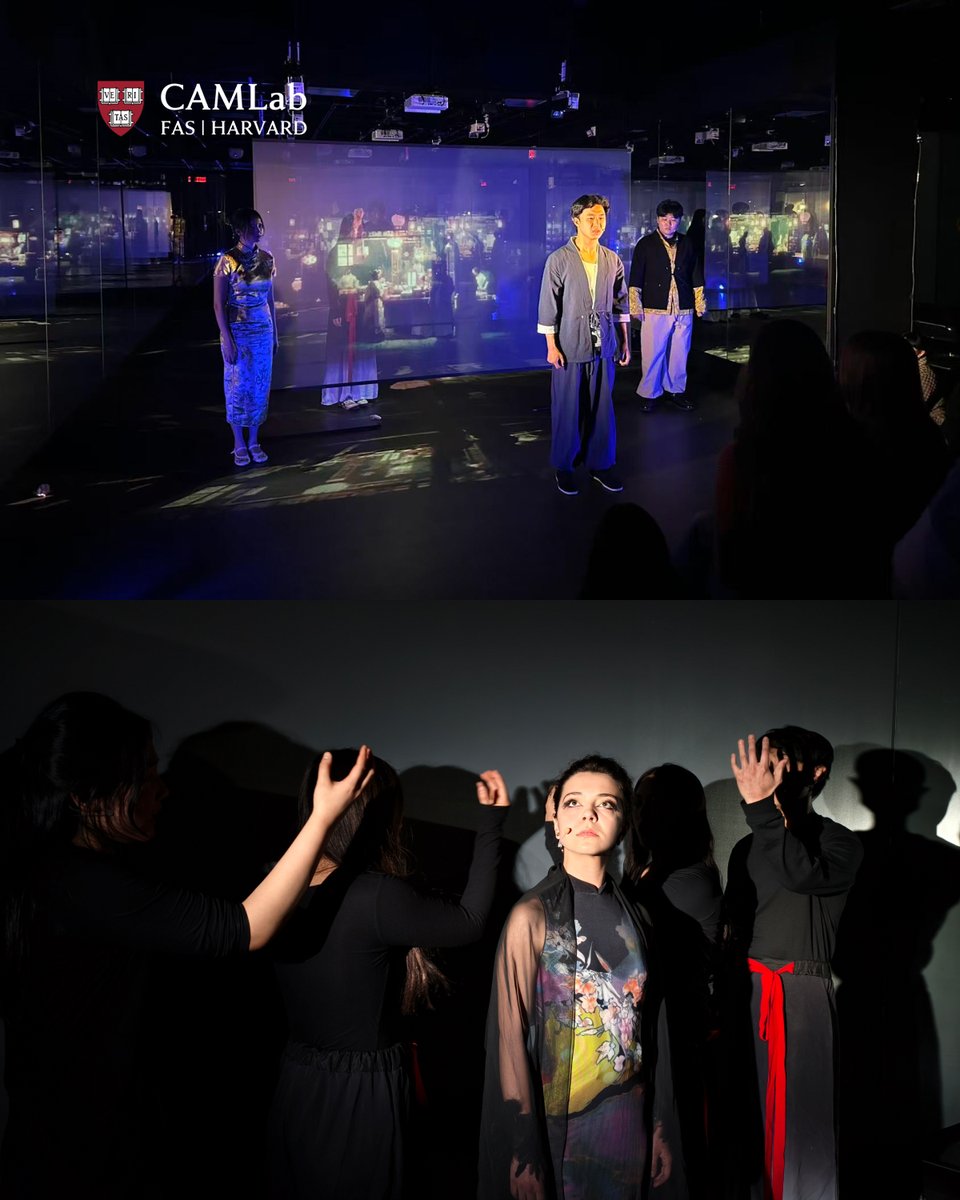
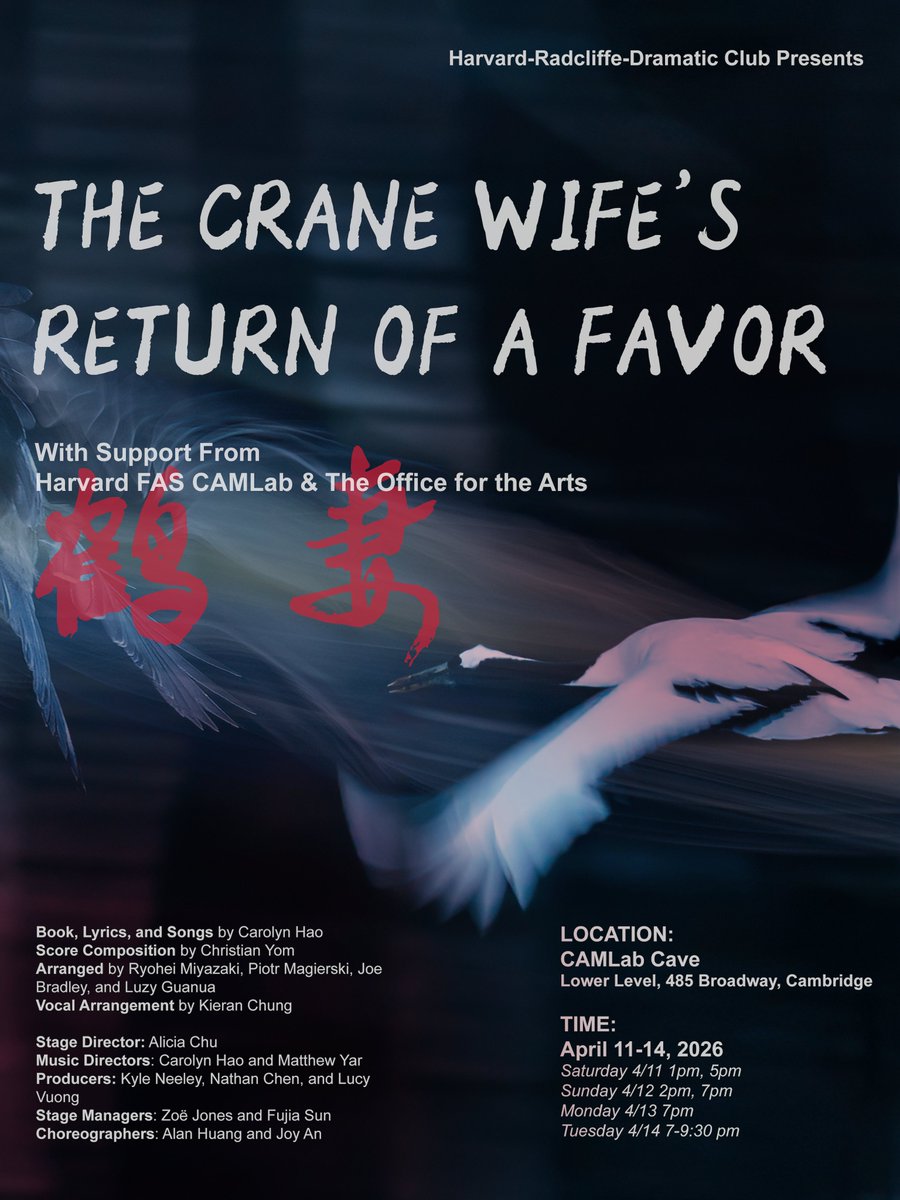
From April 11–14, 2026, the immersive musical "The Crane Wife’s Return of a Favor" concluded its successful run at CAMLab Cave. Presented by the Harvard-Radcliffe Dramatic Club (@hrdctheater) and supported by Harvard FAS CAMLab, with additional support from the Office of the Arts (@harvardarts), the four-day event drew audiences from across the Harvard community and beyond, offering a compelling fusion of cross-cultural storytelling and contemporary performance. Adapted from East Asian folklore, the musical reimagines the tale within the historical context of Qing Dynasty Manchuria, exploring the paradox of gratitude and concealment. As a contemporary folk musical, "The Crane Wife" weaves together Eastern and Western musical languages. Written by Carolyn Hao ’26 with music by composer Christian Yom and collaborators, the production builds its narrative through the interplay of melody and rhythm. As a highlight event at CAMLab Cave, "The Crane Wife" pushed the boundaries of experimental performance, bringing an ancient Asian legend into a contemporary academic setting through the intersection of audience, space, text, and sound. This student-led, cross-disciplinary collaboration reflects the vitality of arts practice at Harvard and embodies CAMLab’s ongoing commitment to transmedia experimentation and cultural storytelling. CAMLab extends its gratitude to the performers, production team, and all who joined us. Stay tuned for more upcoming programs. #CAMLab #HarvardArts #ImmersiveTheater #ExperimentalPerformance
Harvard FAS CAMLab tweet mediaHarvard FAS CAMLab tweet mediaHarvard FAS CAMLab tweet mediaHarvard FAS CAMLab tweet media
English
0
0
1
36
Harvard FAS CAMLab
Harvard FAS CAMLab@HarvardCAMLab·
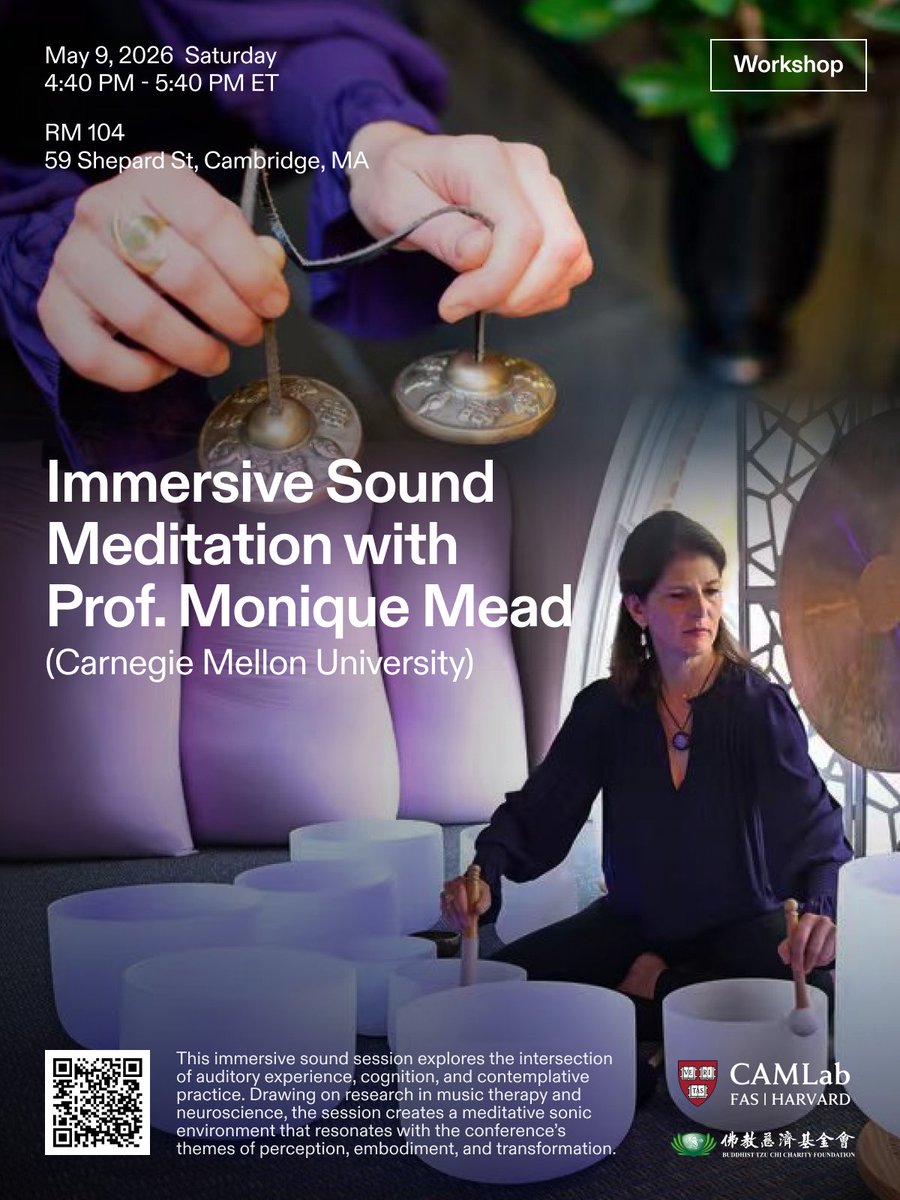
Following the close of the Tzu Chi Global Symposium for Common Goodness co-organized by the Buddhist Tzu Chi Charity Foundation (@TzuChiUSA), we warmly invite you to an immersive sound meditation session with Prof. Monique Mead from Carnegie Mellon University, as part of the “Journey to Enlightenment” program series. The session offers a space for rest, reflection, and attentive listening within the pace of contemporary life. Grounded in research in music therapy and neuroscience, the session explores how sound can support the body’s natural capacity for balance. Through sustained tonal vibrations, participants are gently guided toward states of deep relaxation across physical, cognitive, and emotional dimensions. As the session unfolds, attention softens, and the mind settles into quieter states. Some experience a meditative stillness, while others notice subtle emotional shifts—each response emerging differently through individual processes of listening and perception. No prior experience is needed. Designed as a receptive practice, the session requires nothing more than listening. Whether fully awake or at rest, each mode of engagement is equally welcome. We look forward to this shared moment of listening, rest, and quiet presence. 📅 Saturday, May 9, 2026, 4:40–5:40 PM 📍 RM 104, Harvard Student Organization Center at Hilles (SOCH) 👉 Seats are limited. RSVP via forms.gle/Lsrhr2rDfhBfas… #SoundBath #SoundStudies #ContemplativePractice #MusicTherapy #Neuroscience
Harvard FAS CAMLab tweet media
English
0
0
0
53
Harvard FAS CAMLab
Harvard FAS CAMLab@HarvardCAMLab·
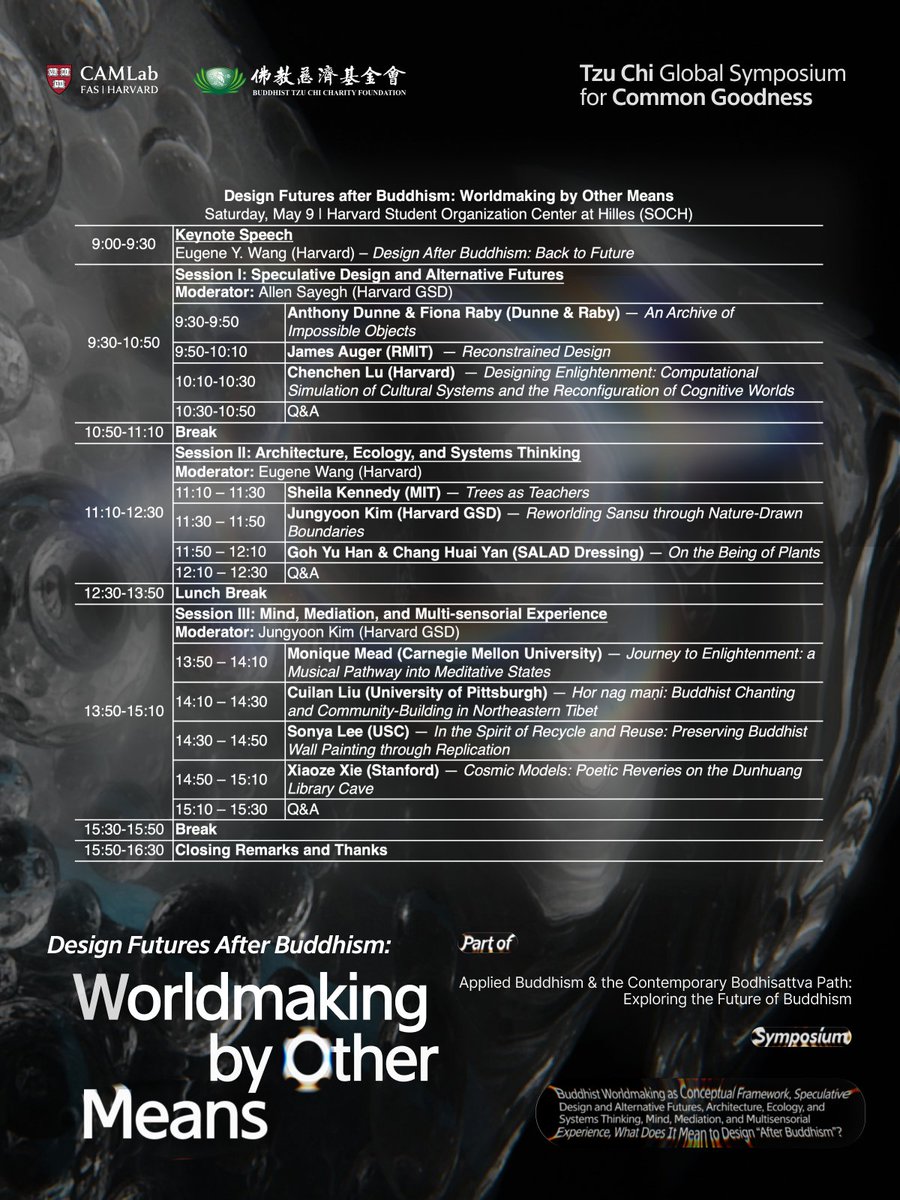
Tzu Chi Global Symposium for Common Goodness | Day 3 Saturday, May 9, 2026, 9:00 AM–4:30 PM Design Futures after Buddhism: Worldmaking by Other Means As the final day of the Tzu Chi Global Symposium for Common Goodness, co-organized by Harvard FAS CAMLab and the Tzu Chi Foundation, the symposium convenes leading voices across design, architecture, art, technology, and the humanities. It considers how design, now operating at planetary and computational scales, calls for new frameworks to address interdependence, temporality, and distributed agency. This program positions Buddhism not as a religious or aesthetic tradition, but as a historically deep mode of relational thinking. Long before the emergence of modern design disciplines, Buddhist practices engaged worldmaking through spatial circulation, ritual technologies, temporal modeling, ethical systems, and perceptual training. Structured across three sessions—"Speculative Design and Alternative Futures"; "Architecture, Ecology, and Systems Thinking"; and "Mind, Mediation, and Multi-sensorial Experience"—the symposium examines how these modes of thought are reactivated, transformed, or contested under conditions of technological acceleration and ecological entanglement. Through speculative, critical, and practice-based approaches, Day 3 explores alternative frameworks for designing futures—worldmaking by other means. We warmly invite you to join us for a day of dialogue, reflection, and shared inquiry. 📍 Harvard Student Organization Center at Hilles (SOCH), Lower Level, Cinema 👉 RSVP required. Seating is limited—please register through forms.gle/U7kU16xH5Kwem8… 🌐 Livestream available via url.tzuchi.org/s/B1BJKj #AcademicSymposium #BuddhistStudies #DesignFutures #HumanitiesResearch #InterdisciplinaryResearch
Harvard FAS CAMLab tweet mediaHarvard FAS CAMLab tweet media
English
0
0
0
38
Harvard FAS CAMLab
Harvard FAS CAMLab@HarvardCAMLab·
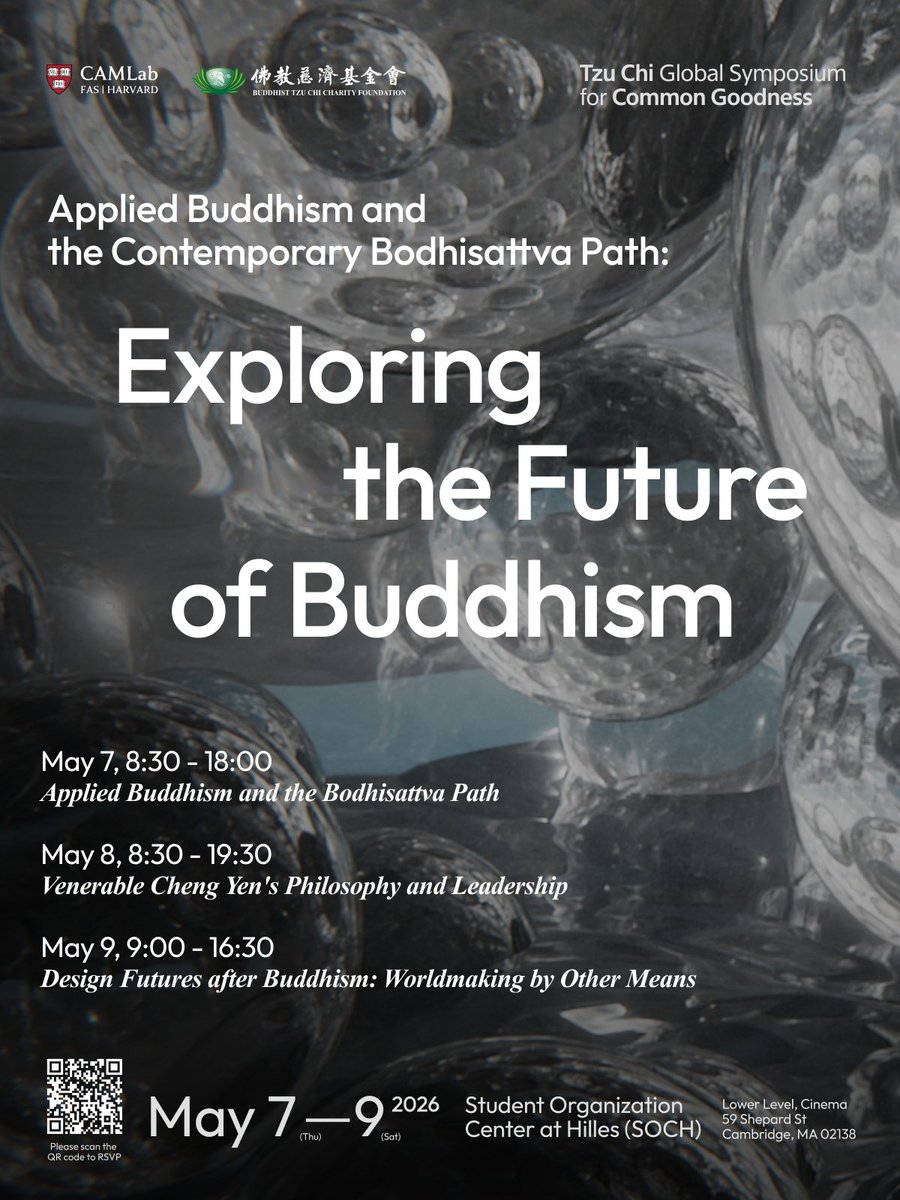
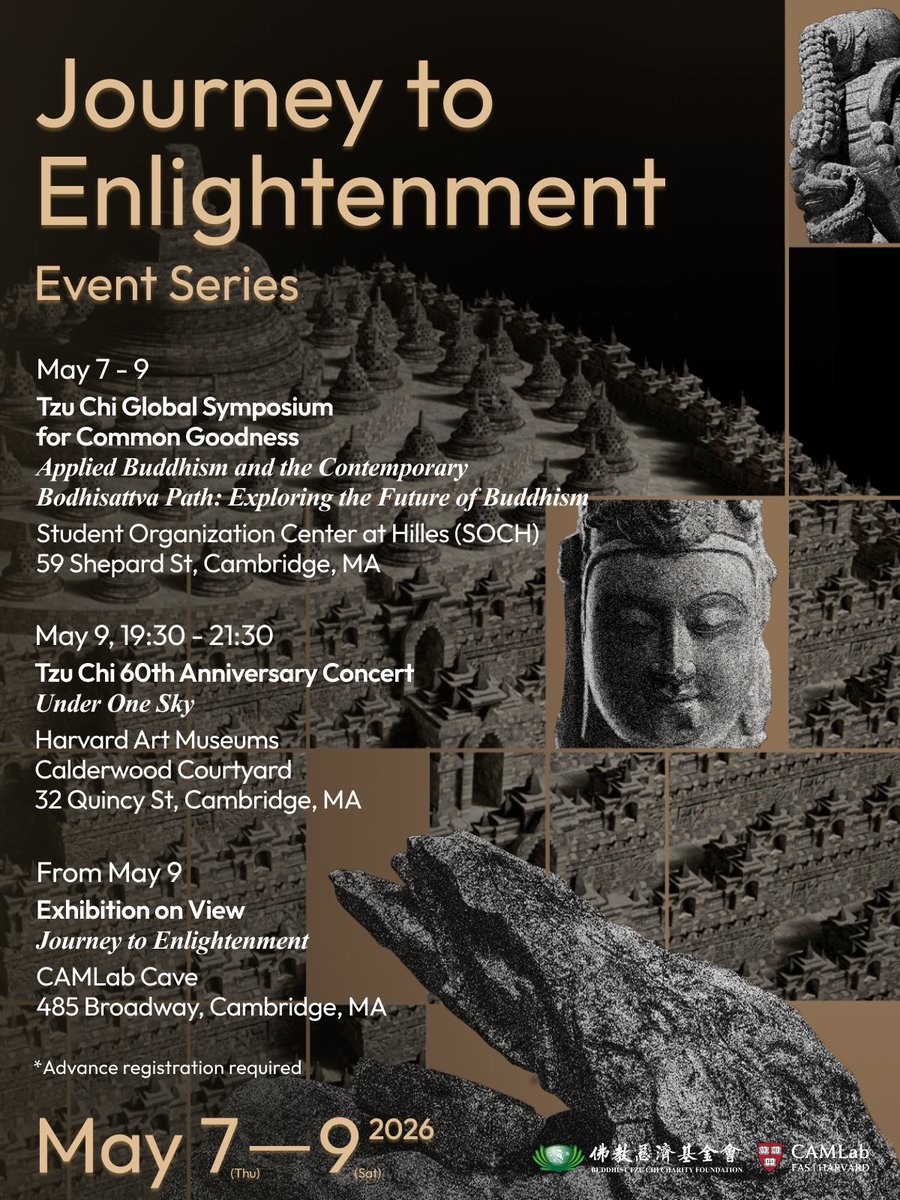
This May, we are honored to host the Tzu Chi Global Symposium for Common Goodness, co-organized by the Buddhist Tzu Chi Charity Foundation (@TzuChiUSA ) and Harvard FAS CAMLab. Convening under the theme “Applied Buddhism and the Contemporary Bodhisattva Path: Envisioning the Future of Buddhism,” the symposium brings together diverse voices to reflect on Buddhism’s evolving role in the world today. Bringing together close to 50 scholars, religious practitioners, and humanities experts from 7 countries and regions, the symposium offers a dynamic platform for academic exchange through 9 presentation sessions and 3 roundtable discussions. Through these exchanges, participants will critically examine how Buddhist ethics and practices are translated into lived experience today—from forms of compassionate action and leadership to speculative approaches that imagine alternative futures shaped by Buddhist thought. Rather than revisiting established frameworks, the conversations aim to rethink how these traditions continue to shape intellectual inquiry, cultural production, and social engagement in the present. Thursday, May 7 Applied Buddhism and the Bodhisattva Path Friday, May 8 Venerable Cheng Yen’s Philosophy and Leadership Saturday, May 9 Design Futures after Buddhism: Worldmaking by Other Means 📍 Harvard Student Organization Center at Hilles (SOCH), Lower Level, Cinema, 59 Shepard St, Cambridge, MA 👉 RSVP required. Seating is limited—please register through forms.gle/U7kU16xH5Kwem8…
Harvard FAS CAMLab tweet media
English
0
0
0
31
Harvard FAS CAMLab
Harvard FAS CAMLab@HarvardCAMLab·
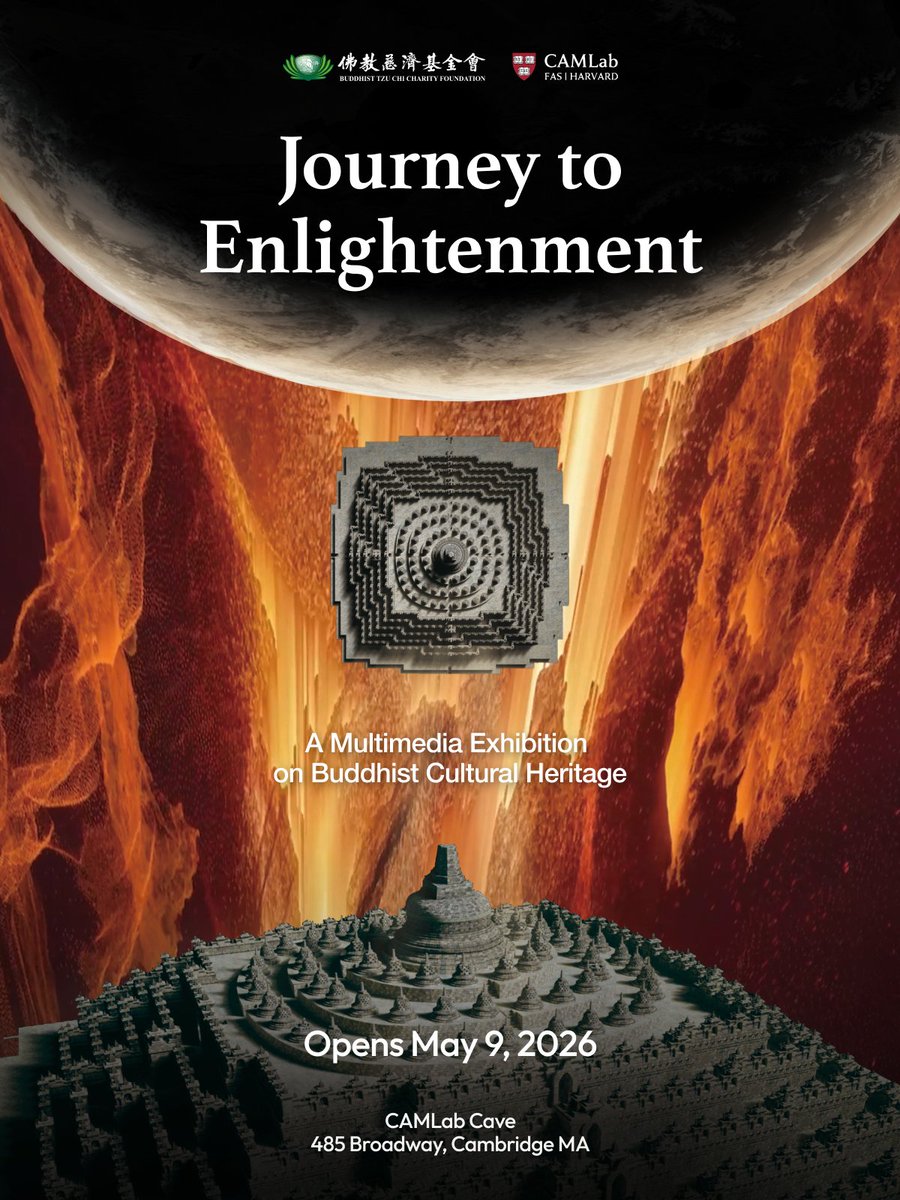
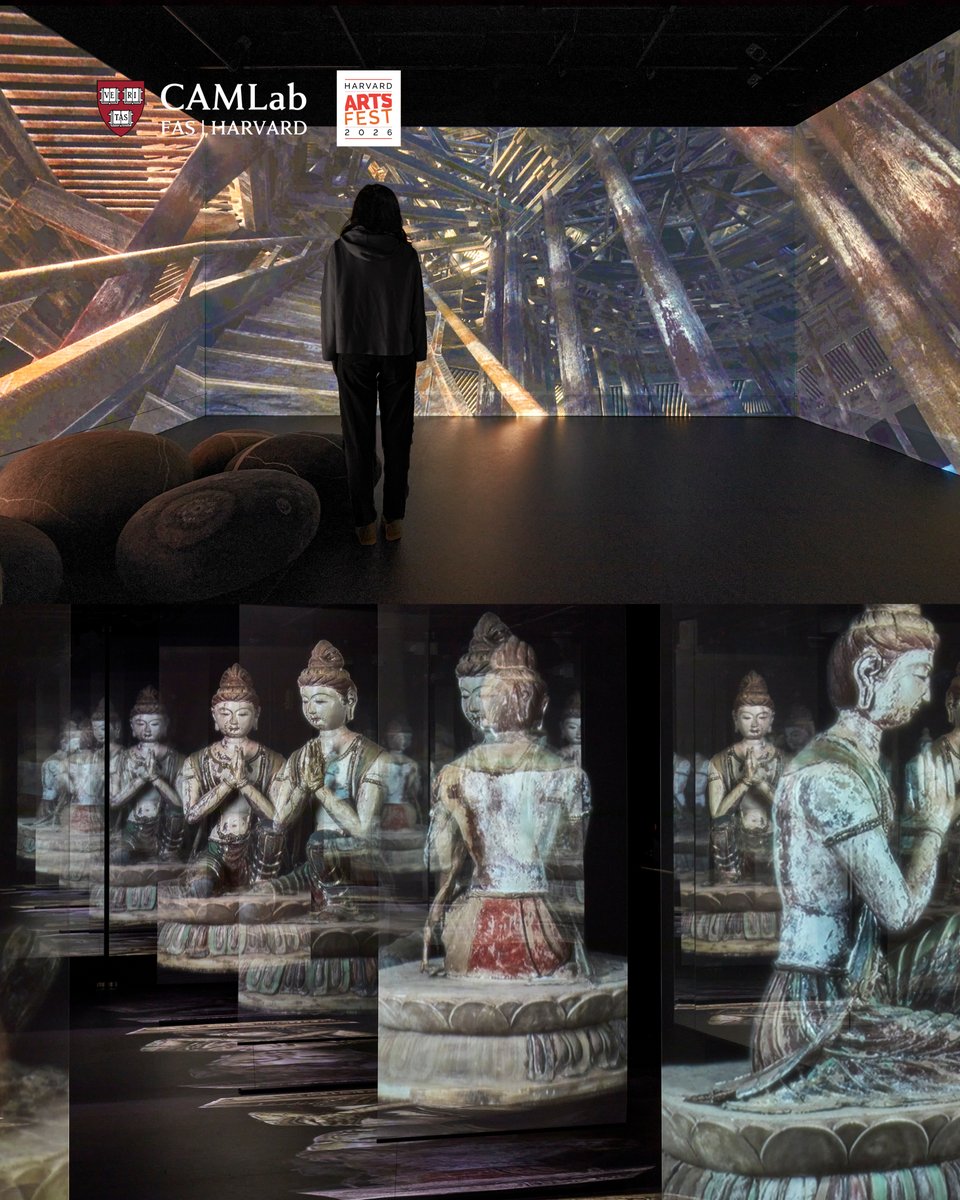
Harvard FAS CAMLab is thrilled to announce "Journey to Enlightenment," a multimedia exhibition on Buddhist Cultural Heritage, co-curated with the Tzu Chi Foundation (@TzuChiUSA). Opening to the public on May 9, 2026, at Harvard University, the exhibition is presented in celebration of the Foundation’s 60th anniversary. This immersive, research-driven project is accompanied by a series of programs, including an international symposium and live performances, tracing over 2,500 years of Buddhist history—from its origins in sacred sites to its continued expression in contemporary humanitarian practice. Bringing together art history, religious studies, and digital media as intersecting fields of inquiry, the exhibition reinterprets major Buddhist heritage sites through immersive projection, spatial audio, and virtual reconstruction. These environments invite visitors to move beyond observation, engaging cultural heritage as an experiential and interpretive process. In this reconfiguration, historical sites emerge not as static monuments, but as dynamic spaces of cultural memory, ethical reflection, and embodied sensory engagement—offering new ways to understand consciousness, interdependence, and the shaping of human experience. Bridging past and present, the exhibition proposes a renewed approach to cultural heritage: one that is navigated, inhabited, and continuously reimagined. 🗓️ On view starting May 9, 2026. Advanced registration required. Link in bio for further details. 📍 CAMLab Cave, 485 Broadway, Cambridge, MA 02138
Harvard FAS CAMLab tweet media
English
0
0
0
32
Harvard FAS CAMLab
Harvard FAS CAMLab@HarvardCAMLab·
Harvard FAS CAMLab is pleased to present "Journey to Enlightenment," a multi-day program co-organized with the Tzu Chi Foundation (@TzuChiUSA), bringing together an international symposium, immersive exhibition opening, and live concert in a shared exploration of cultural heritage and contemporary thought. Thursday–Saturday, May 7–9: Tzu Chi Global Symposium for Common Goodness Convening scholars and practitioners from across disciplines and regions under the theme “Applied Buddhism and the Contemporary Bodhisattva Path,” the symposium examines how Buddhist thought continues to inform contemporary ethical, social, and intellectual frameworks. Saturday, May 9: Concert – “Under One Sky” A live performance featuring musicians from the Silk Road Ensemble, interweaving diverse musical traditions and exploring resonance across cultures and sonic lineages. From Saturday, May 9: Exhibition on View – “Journey to Enlightenment” A research-driven exploration of Buddhist cultural history through interdisciplinary perspectives spanning art history, religious studies, and media studies. Taken together, these events offer a multi-layered framework for engagement—moving across thinking, making, and listening as complementary modes of cultural experience. Rather than being separate, scholarship, exhibition, and performance are brought into dialogue, allowing ideas to move across different ways of experiencing and understanding culture. Advance registration required. Further details for each event will be released in the following days—stay tuned!
Harvard FAS CAMLab tweet media
English
0
0
0
29
Harvard FAS CAMLab
Harvard FAS CAMLab@HarvardCAMLab·
Next week, we are pleased to present four multimedia installations at CAMLab Cave as part of this year’s Harvard Arts Festival, inviting audiences to experience cultural and historical worlds across time and space. Cave Dance — Activating static mural depictions through machine learning to reanimate millennia-old celestial dancers. Embodied Architecture — Unfolding the cultural logic of medieval Chinese carpentry and its embedded ritual practices through the eleventh-century Yingxian Pagoda. Shadow Cave — Retelling a foundational Buddhist myth through multimedia installation, bridging ancient icon-making traditions with contemporary cross-cultural perception. Digital Luoyang — Reconstructing the sixth-century Luoyang urban landscape through archaeological and archival research. 📅 Sunday, May 3, 2026, 2:00 - 5:00 PM EST This event is part of the Harvard Arts Festival, an annual four-day celebration presented by the Office for the Arts at Harvard, featuring over 150 events across the university.
Harvard FAS CAMLab tweet mediaHarvard FAS CAMLab tweet mediaHarvard FAS CAMLab tweet media
English
0
0
0
14
Harvard FAS CAMLab
Harvard FAS CAMLab@HarvardCAMLab·
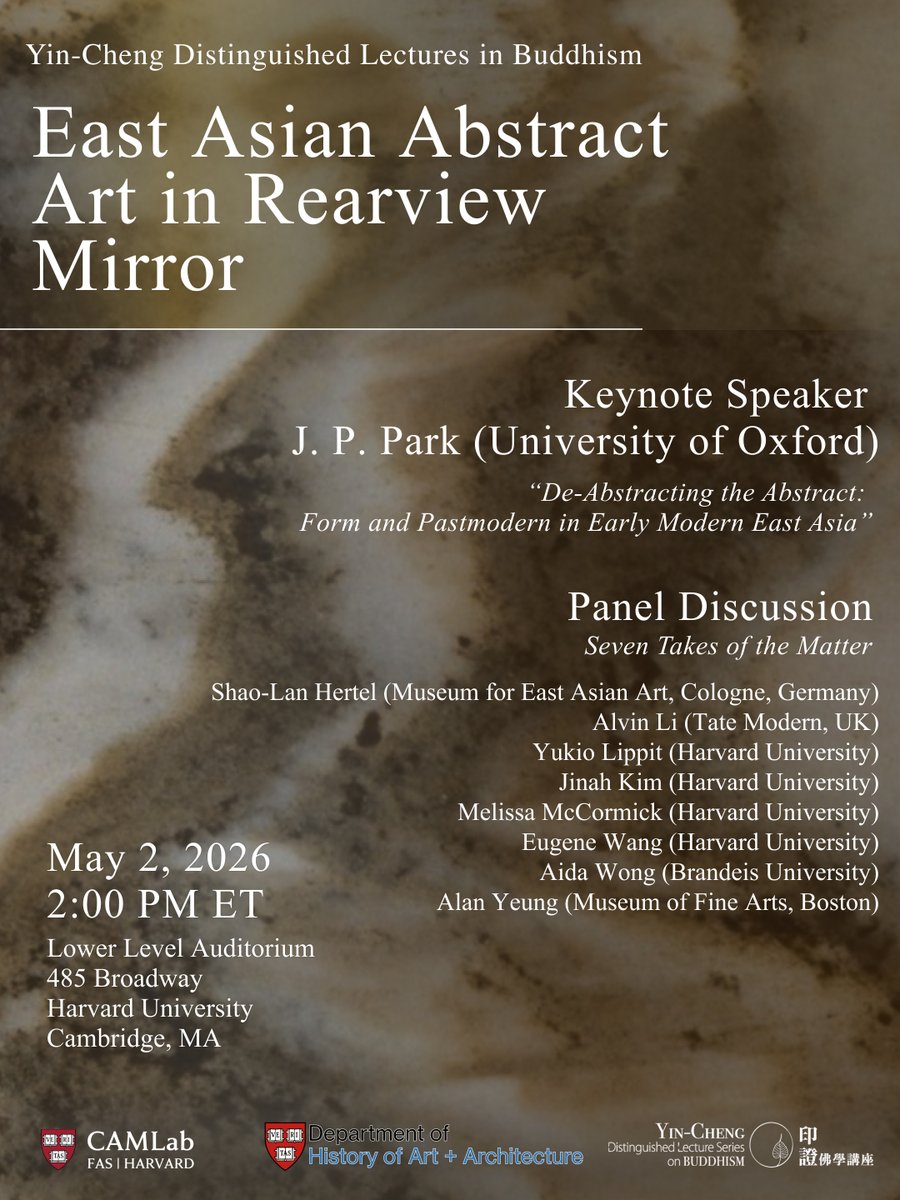
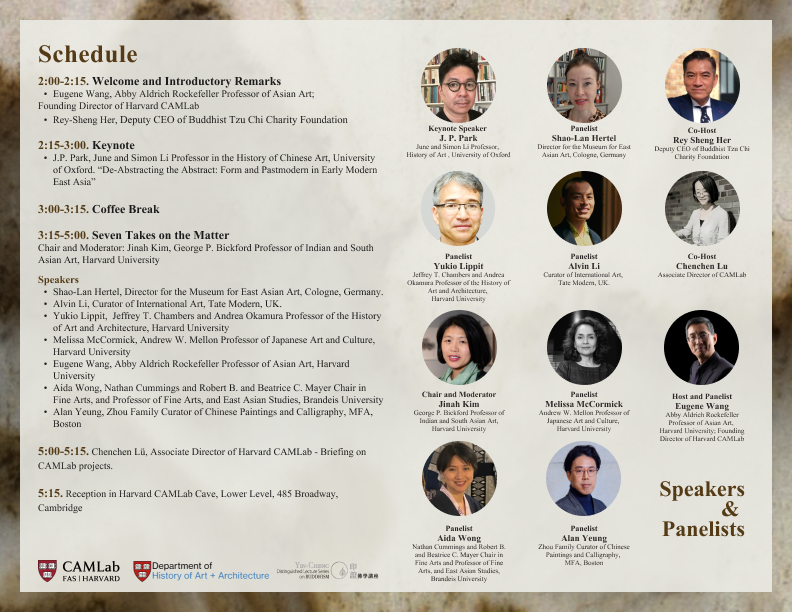
Harvard FAS CAMLab is pleased to announce this year’s Yin-Cheng Distinguished Lecture, co-organized by Harvard FAS CAMLab and the Department of History of Art and Architecture at Harvard University. Join us for an afternoon of scholarly exchange exploring new perspectives on abstraction, materiality, and global art history. East Asian Abstract Art in Rearview Mirror 📅 Saturday, May 2, 2026, 2:00 PM EST 📍 Lower Level Auditorium, 485 Broadway, Harvard University, Cambridge, MA 🎟️ Free and open to the public This year’s lecture will be delivered by J. P. Park (University of Oxford), June and Simon Li Professor in the History of Chinese Art, whose research focuses on transcultural artistic exchange and the historiography of East Asian art. This lecture reconsiders modernism beyond its conventional Euro-American framing, proposing the concept of the “pastmodern” to foreground early modern East Asian practices that anticipate key strategies of modern and contemporary art. From performative production and ecological material approaches to minimalist abstraction and inquiries into presence and absence, these practices challenge linear narratives and binary frameworks of East and West, past and present. The program also features “Seven Takes on the Matter,” a panel discussion moderated by Jinah Kim (Harvard University), with Shao-Lan Hertel (Museum for East Asian Art, Cologne), Alvin Li (Tate Modern), Yukio Lippit (Harvard University), Melissa McCormick (Harvard University), Eugene Wang (Harvard University), Aida Wong (Brandeis University), and Alan Yeung (Museum of Fine Arts, Boston). This event is part of the Yin-Cheng Distinguished Lectures in Buddhism, supported by the Tzu Chi Foundation. We look forward to welcoming you to an engaging afternoon of dialogue and reflection.
Harvard FAS CAMLab tweet mediaHarvard FAS CAMLab tweet media
English
0
0
0
27
Harvard FAS CAMLab
Harvard FAS CAMLab@HarvardCAMLab·
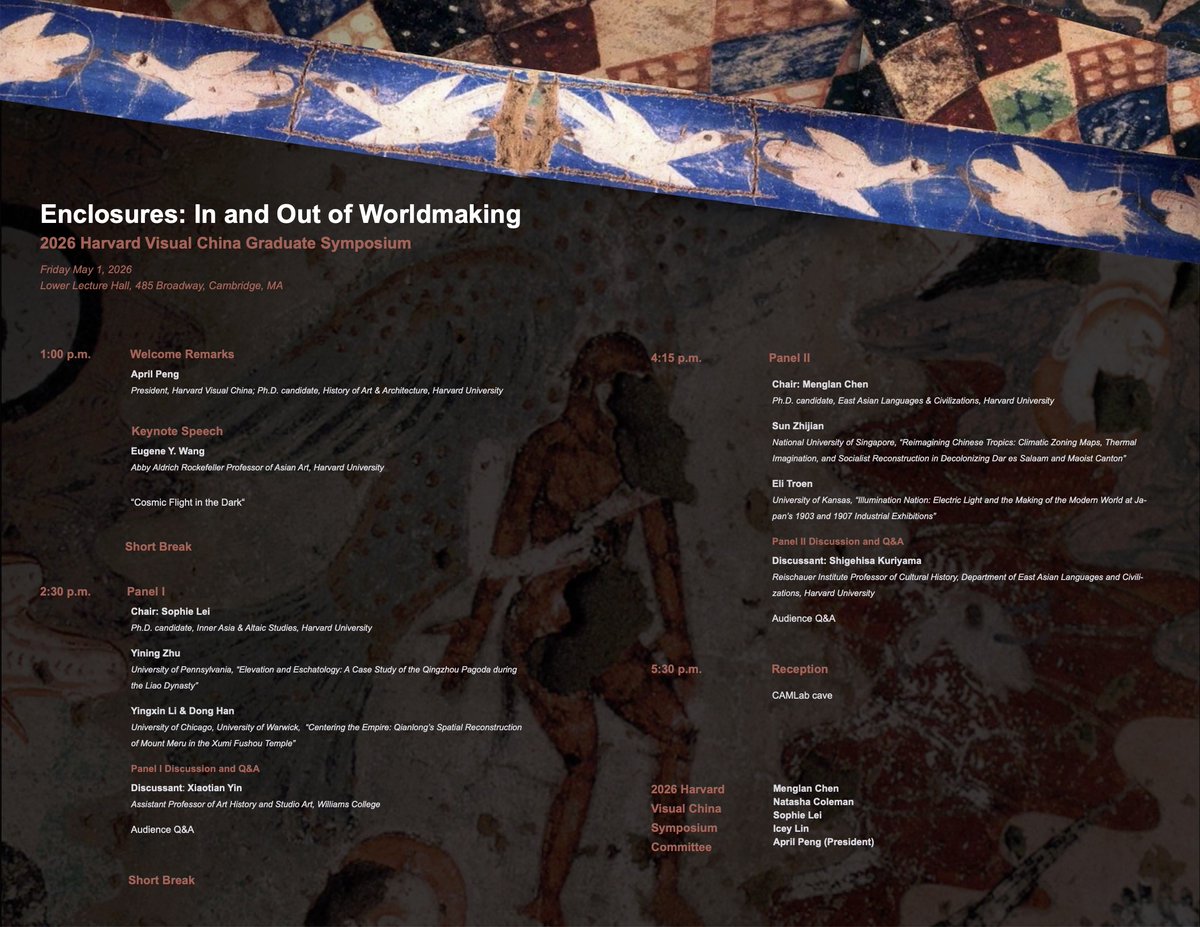
HVC Graduate Symposium returns this May, bringing together international scholars to explore how images and architecture construct worlds across East Asian art. Register today through: harvardvisualchina.com/hvc-2026-sympo… 🎙️ Enclosures: In and Out of Worldmaking 🗓️ Friday, May 1, 2026, 1:00 - 5:30pm EST, followed by reception 📍Lower Lecture Hall, 485 Broadway, Harvard University, Cambridge, 02138 Throughout history, the meeting of images and architecture has generated spaces of imagination, devotion, and meaning. From murals and sculpture ensembles in Buddhist cave temples to digital projections and immersive installations, images and architecture have long collaborated in the making of worlds. Yet the relationship between images and architecture in artistic worldmaking is anything but monolithic. Architecture does not merely contain or frame images, but situates and conditions their visual expressions and interpretations. Conversely, images transform the built environments that hold them, reconfiguring space into realms of vision, ritual, and belief. Harvard Visual China's 2026 Graduate Symposium presents two panels on how images and architecture in Chinese and East Asian art at large construct, sustain, and reimagine worlds. The symposium will also feature a keynote speech delivered by Professor Eugene Y. Wang, Abby Aldrich Rockefeller Professor of Asian Art at Harvard University. This event is generously sponsored by the Department of History of Art & Architecture and the Abby Aldrich Rockefeller Innovation Fund at Harvard University, Harvard FAS CAMLab, and the Yin-Cheng Distinguished Lecture Series. Harvard Visual China (HVC) is a student organization at Harvard University dedicated to the study of Chinese art and culture.
Harvard FAS CAMLab tweet mediaHarvard FAS CAMLab tweet media
English
0
0
0
33
Harvard FAS CAMLab
Harvard FAS CAMLab@HarvardCAMLab·
How can “compassion” be encoded within systems of knowledge? As part of the 2026 CAMLab Spring Lecture Series, we are delighted to welcome Ven. Miao Guang for the lecture “Encoding Compassion: Humanistic Buddhism, Dictionaries, and Interreligious Knowledge Structures.” The talk introduces the role of translation and digital organization in shaping contemporary approaches to Buddhist knowledge and interreligious dialogue. This lecture explores the Fo Guang Dictionary of Buddhism as a Humanistic Buddhist knowledge structure that encodes compassion through translation and digital organization. By examining how Buddhist concepts are defined and relationally linked, it asks how dictionaries can function as ethical infrastructures for interreligious understanding in a divided world. Bringing together perspectives on language, knowledge systems, and cultural transmission, the lecture reflects on how structures of meaning are formed, mediated, and shared across traditions. Ven. Miao Guang is Deputy Chancellor of the FGS Institute of Humanistic Buddhism and Director of the Fo Guang Dictionary Translation Project. 📍 Room 422, 485 Broadway, Cambridge, MA 📅 Thursday, April 23, 2026 🕕 6:00–7:00 PM EST #HarvardCAMLab #HumanisticBuddhism #DigitalHumanities #VenMiaoGuang #BuddhistStudies
Harvard FAS CAMLab tweet media
English
0
0
0
13
Harvard FAS CAMLab
Harvard FAS CAMLab@HarvardCAMLab·
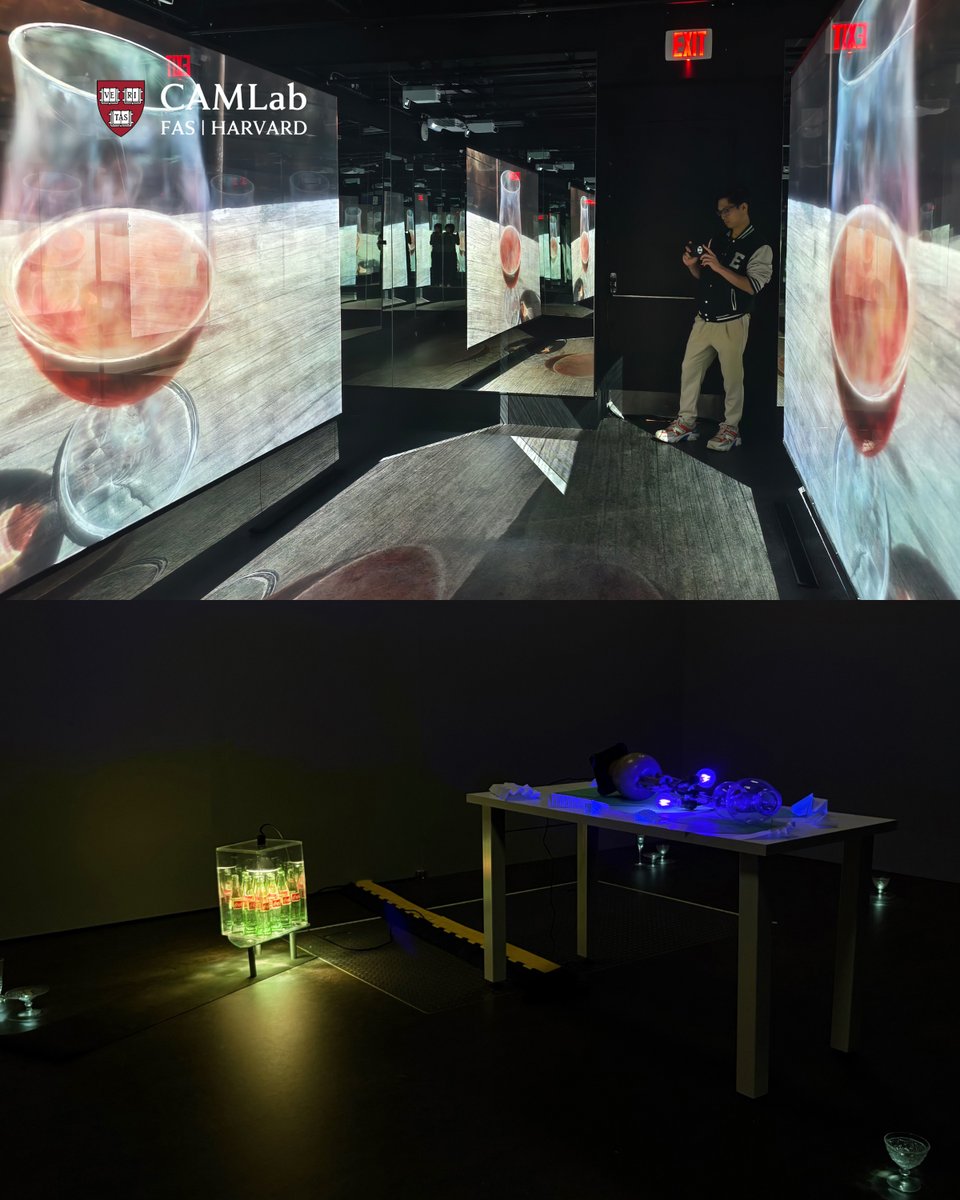
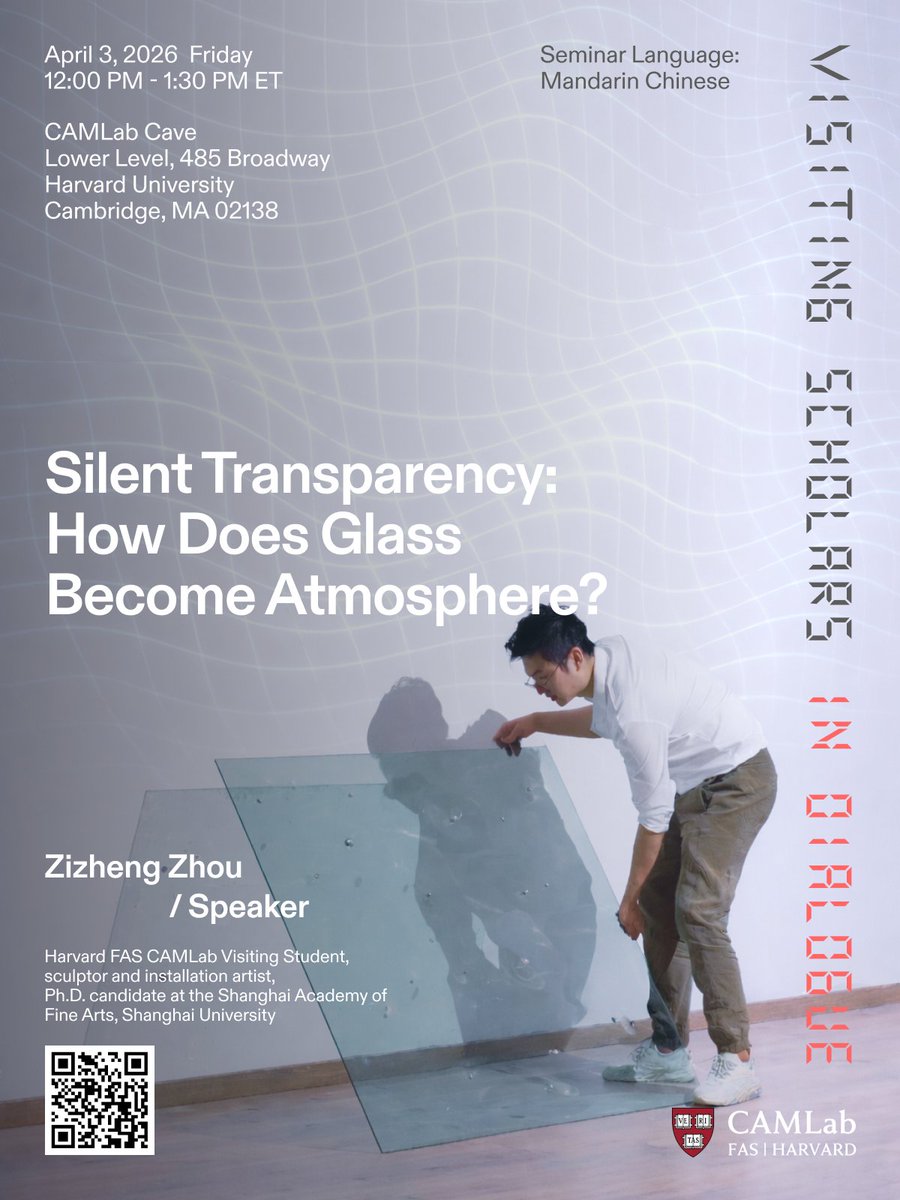
On April 3, CAMLab Visiting Student Zhou Zizheng led us through a meditation on glass that unsettled everything we thought we knew about "transparency." Beginning with modern sculpture—from Rodin to Tatlin—he showed how transparency has never been a fixed property, but a shifting state between ideal and real, concept and experience. Glass, then, is not simply something to see through. It organizes perception without ever fully revealing itself. Turning to Chinese history, Zhou argued for reading glass through Chinese ways of seeing. At the Corning Museum and Harvard Art Museums, ancient bi discs and inlaid mirrors tell a story of jade imitation, milky textures, and religious vision—never just material, but a vessel for cultural experience. From this ground, Zhou returned to his own practice: works like Cosmic Lake Rock and Endless Blue demonstrate how glass becomes a method for generating atmosphere, orchestrating light and space rather than merely occupying it. The event concluded with Unimaginable, his pop-up exhibition at CAMLab Cave where 3D scanning's "failures" facing transparent glass become generative. In a mirrored room with four transparent screens, the encounter between glass and machine vision transforms into a meditation on faith, data, and being—guided by the Buddhist concept of liuli. Our thanks to Zhou and all the participants who joined us. Stay tuned for more to come! #HarvardCAMLab #GlassArt #ContemporaryArt #ChineseArtHistory #MaterialCulture #DigitalArt #BuddhistArt #AtmosphereArt
Harvard FAS CAMLab tweet mediaHarvard FAS CAMLab tweet mediaHarvard FAS CAMLab tweet mediaHarvard FAS CAMLab tweet media
English
0
0
0
19
Harvard FAS CAMLab
Harvard FAS CAMLab@HarvardCAMLab·
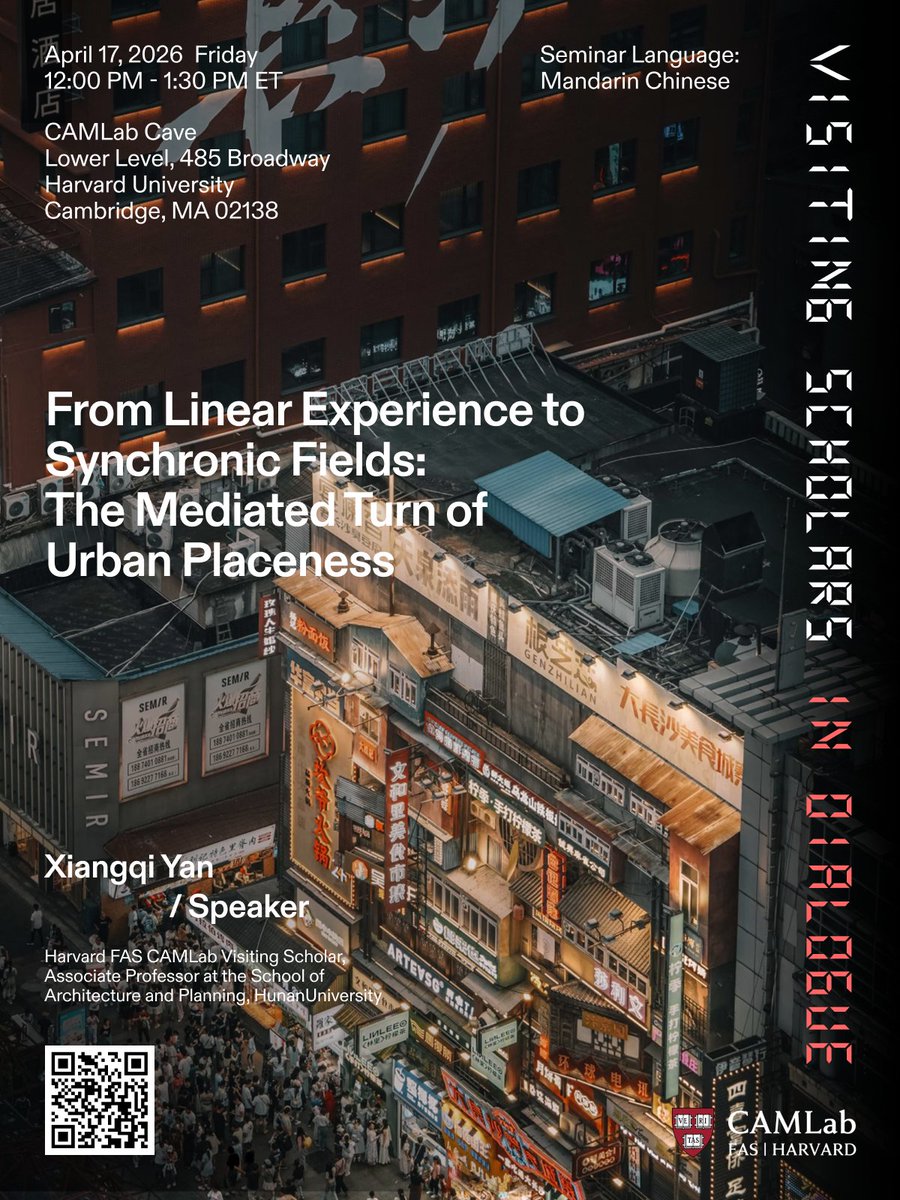
CAMLab is pleased to host a special lecture by Visiting Scholar Prof. Xiangqi Yan: “From Linear Experience to Synchronic Fields: The Mediated Turn of Urban Placeness.” How do you design public space when meaning itself is flowing? ⏰ April 17 (Friday), 12:00 PM – 1:30 PM EST 📍 CAMLab Cave, Lower Level, 485 Broadway, Harvard University, Cambridge, MA 🌍 Language: Chinese 🎫 Free and open to the public. Only 20 spots available—register today via: docs.google.com/forms/d/e/1FAI… In the contemporary context of deeply pervasive digital media, traditional notions of placeness—grounded in linear temporal accumulation and stable narrative structures—are increasingly being displaced by de-anchored systems of signs, placing urban placeness under a condition of deconstruction. Against this backdrop, trans-localism, through a critical re-recognition and repositioning of the role of media, shifts the framework from a “space–place” paradigm to a “space–media–place” system. This approach constructs a media-mediated “synchronic field,” through which the city may reclaim its sense of placeness. The lecture further identifies four-dimensional anchoring mechanisms within such synchronic fields and proposes a media-informed design methodology for urban public space, aiming to reestablish the city as a continuously generative super-medium of meaning. Xiangqi Yan is currently a Visiting Scholar at the Harvard FAS CAMLab (2025–2026) and Associate Professor at the School of Architecture and Planning, Hunan University. His primary research focuses on dynamic urban design methods for existing spaces, as well as the conservation, renewal, and planning of historic urban areas. #HarvardCAMLab #AcademicTalk #Cambridge #HarvardUniversity #VSinDialogue
Harvard FAS CAMLab tweet media
English
0
0
0
26
Harvard FAS CAMLab
Harvard FAS CAMLab@HarvardCAMLab·
Join us at CAMLab Cave for “The Crane Wife’s Return of a Favor,” a contemporary folk musical adaptation. Presented by the Harvard–Radcliffe Dramatic Club, with support from Harvard FAS CAMLab and the Office of the Arts, the production brings a traditional tale into dialogue with contemporary performance, music, and storytelling. Written by Carolyn Hao ’26, the musical reimagines the classic story of a crane who takes human form to repay a debt, concealing her true nature in her longing to be loved. As her fate becomes intertwined with that of a devoted woodsman, a desperate brother and his wife, and a pair of watchful narrators, the story unfolds across shifting perspectives—tracing how secrecy, obligation, and desire shape human action. Both intimate and allegorical, the work reflects on themes of sacrifice, morality, and the cost of human folly. Featuring an original score by Christian Yom and a collaborative creative team of composers, directors, and performers, the production transforms CAMLab Cave into an immersive theatrical space where music, narrative, and movement converge. 📍 CAMLab Cave, Lower Level, 485 Broadway, Cambridge, MA 📅 April 11–14, 2026 Saturday, April 11: 1:00–3:30 PM; 5:00–7:30 PM Sunday, April 12: 2:00–4:30 PM; 7:00–9:00 PM Monday, April 13: 7:00–9:30 PM Tuesday, April 14: 7:00–9:30 PM Tickets available at cranewifeatharvard.com/tickets. We look forward to welcoming you to this event and sharing an evening of storytelling, music, and theatrical performance!
Harvard FAS CAMLab tweet media
English
0
0
0
30
Harvard FAS CAMLab
Harvard FAS CAMLab@HarvardCAMLab·
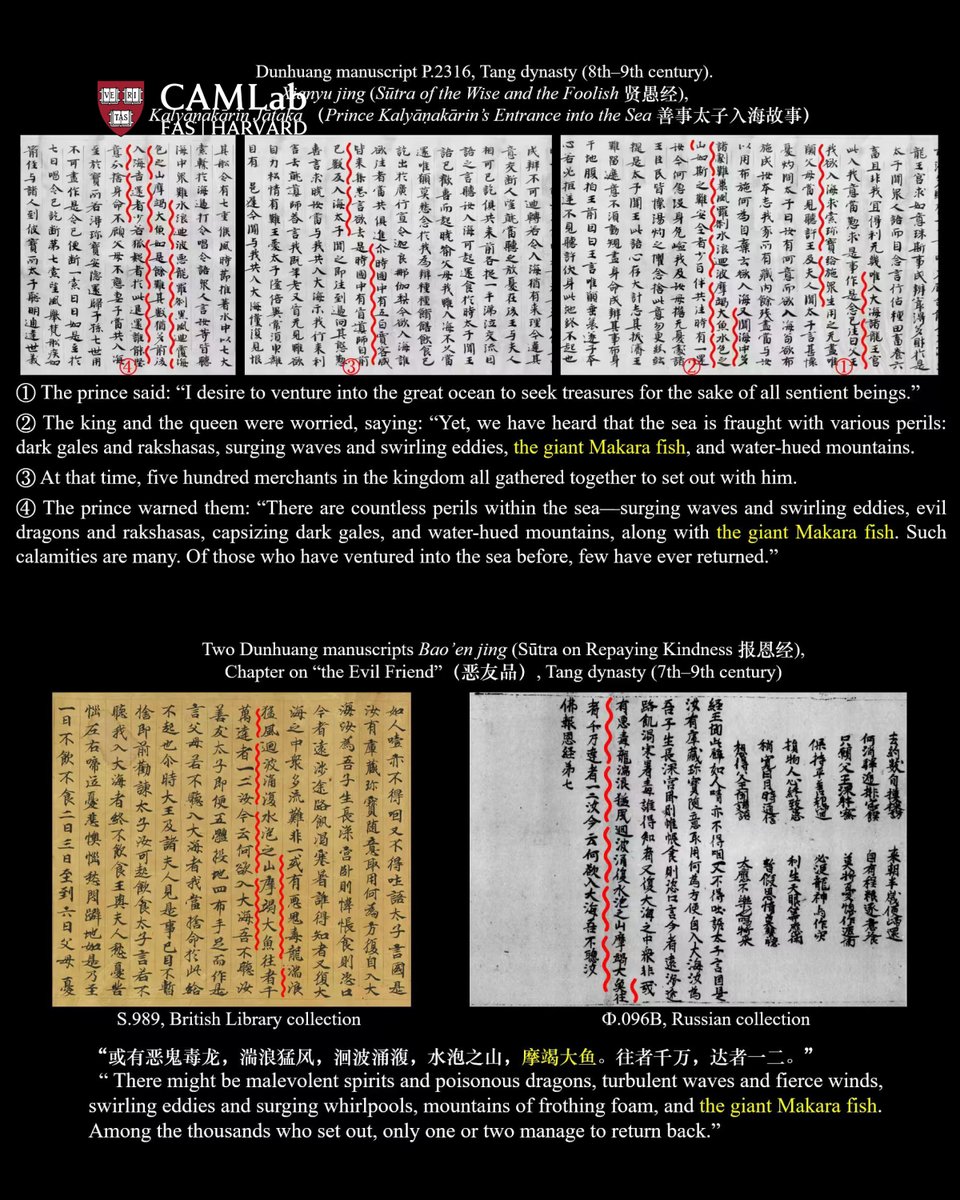
On March 27, Wu Wanni, PhD candidate at Peking University and CAMLab visiting student, delivered a fascinating lecture tracing the remarkable journey of a Tang dynasty porcelain motif across cultures and centuries. Beginning with a Changsha ware plate from the Belitung shipwreck, she showed how the image of a makara swallowing a boat originated in Indian Buddhist tales of merchants at sea. Through Chinese translation and adaptation, the creature gradually merged with local “giant fish” traditions, and the narrative settled into a familiar pattern: embarkation, disaster, divine invocation, and rescue. Over time, the motif shed its religious context to become a secular symbol of maritime danger. Wu then followed the image into the 9th–10th century Arab world, where seafaring stories preserved its protective meaning while losing its Buddhist framework. This cultural translation, combined with Changsha’s international communities and established trade networks, created the conditions for these plates to flourish as export goods. The final design—pairing mythical creatures with contemporary ships—captures a pivotal moment when China balanced foreign influence with local tradition. Thank you to Wu Wanni for this insightful lecture, and to everyone who joined us. Stay tuned for more CAMLab academic events. #HarvardCAMLab #ArtHistory #BuddhistArt #MaritimeHistory #TangDynasty #GlobalArtHistory #CulturalExchange
Harvard FAS CAMLab tweet mediaHarvard FAS CAMLab tweet mediaHarvard FAS CAMLab tweet media
English
0
1
1
108
Harvard FAS CAMLab
Harvard FAS CAMLab@HarvardCAMLab·
How does glass become atmosphere? What happens when glass shifts from object to experience? Harvard FAS CAMLab is pleased to present an upcoming pop-up exhibition and a Visiting Scholars in Dialogue event exploring the transformative possibilities of glass and digital media through the lens of “Chinese material atmosphere.” Exhibition: April 3–5, 2:00–5:00 PM EST (immersive installation every 30 minutes) Visiting Scholars in Dialogue: April 3, 12:00–1:30 PM EST Location: CAMLab Cave, Lower Level, 485 Broadway, Harvard University, Cambridge, MA Language: Chinese The exhibition is free and open to the public. The dialogue session is limited to 20 participants; registration is available through: docs.google.com/forms/d/e/1FAI… “Inconceivable” is a personal art project by Zhou Zizheng. Engaging glass as a material context and drawing on art history and cultural studies, the work uses technology as a methodological pathway to address perception and modes of being elicited by transparency. Presented as a digital video across four transparent screens, the piece transforms the interplay between glass and machine vision into a perceptual and cultural experience, establishing a mode of penetrative viewing. This lecture takes artistic practices in glass and digital media as its point of departure, situating them within broader discussions of creative methods and spatial experience. From an interdisciplinary perspective, it introduces the concept of “Chinese material atmosphere,” drawing on selected works from the speaker’s practice to explore how such an atmosphere emerges in glass and how it relates to its cultural origins. In dialogue with Buddhist visual traditions, the talk also reconsiders the historical meanings of liuli and glass. Responding to the theme of the exhibition “Inconceivable,” the lecture further reflects on how contemporary art can open new experiential forms and imaginative spaces between material culture and media technologies. Zizheng Zhou is a sculptor and installation artist. He is currently a Visiting Student at Harvard FAS CAMLab (2025–2026) and a Ph.D. candidate at the Shanghai Academy of Fine Arts, Shanghai University. #HarvardCAMLab #AcademicTalk #MediaArt #ContemporaryArt #DigitalHumanities #HarvardUniversity
Harvard FAS CAMLab tweet mediaHarvard FAS CAMLab tweet media
English
0
0
0
27
Harvard FAS CAMLab
Harvard FAS CAMLab@HarvardCAMLab·
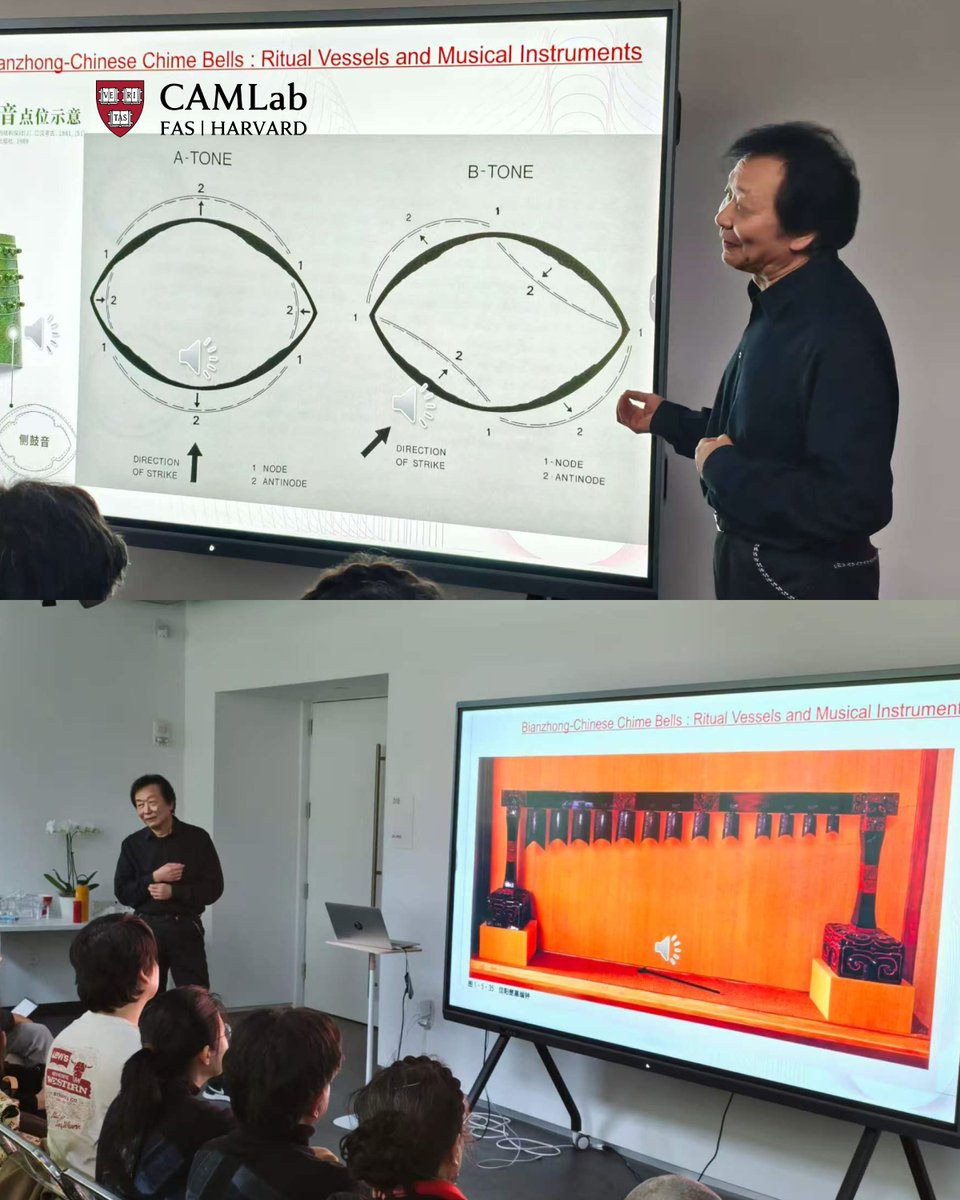
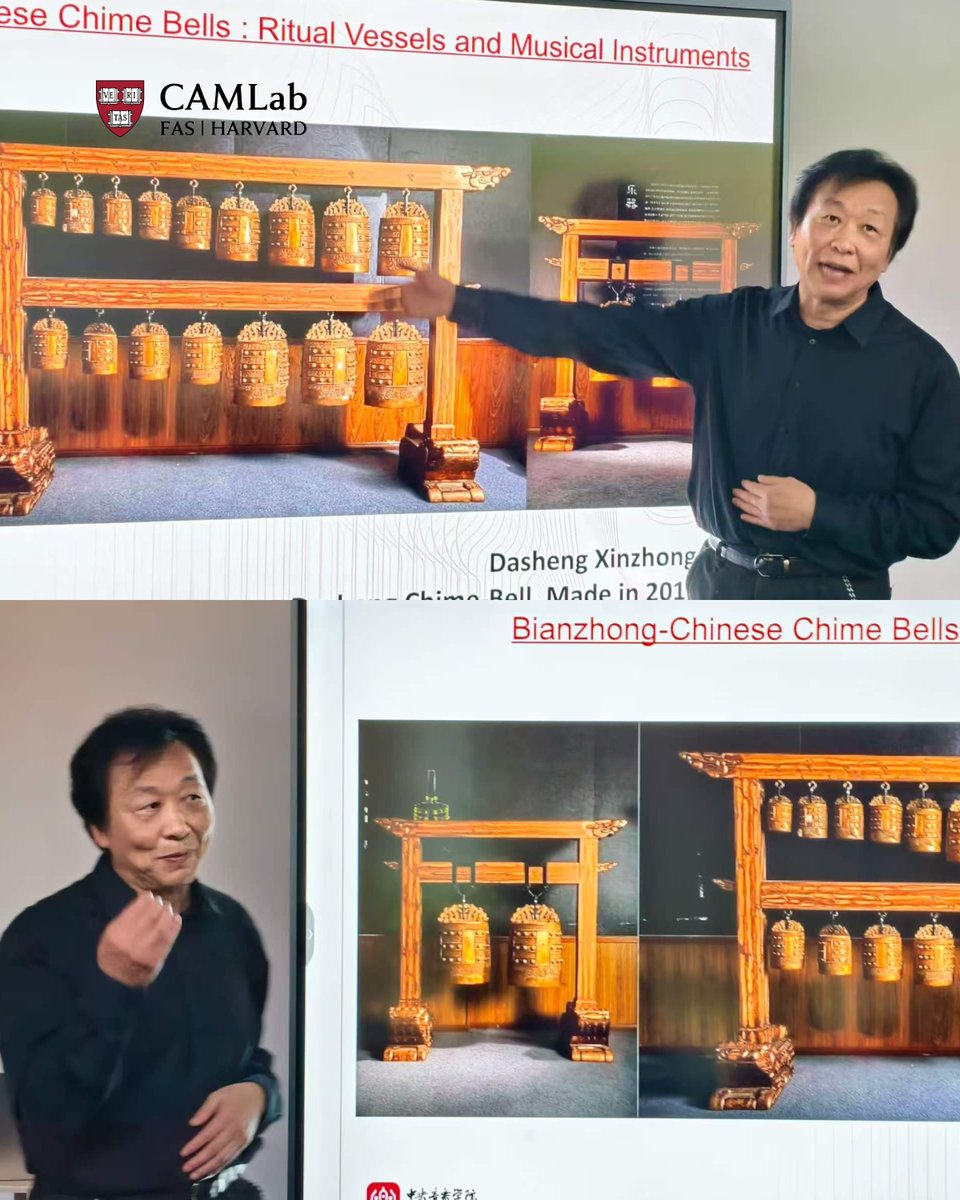
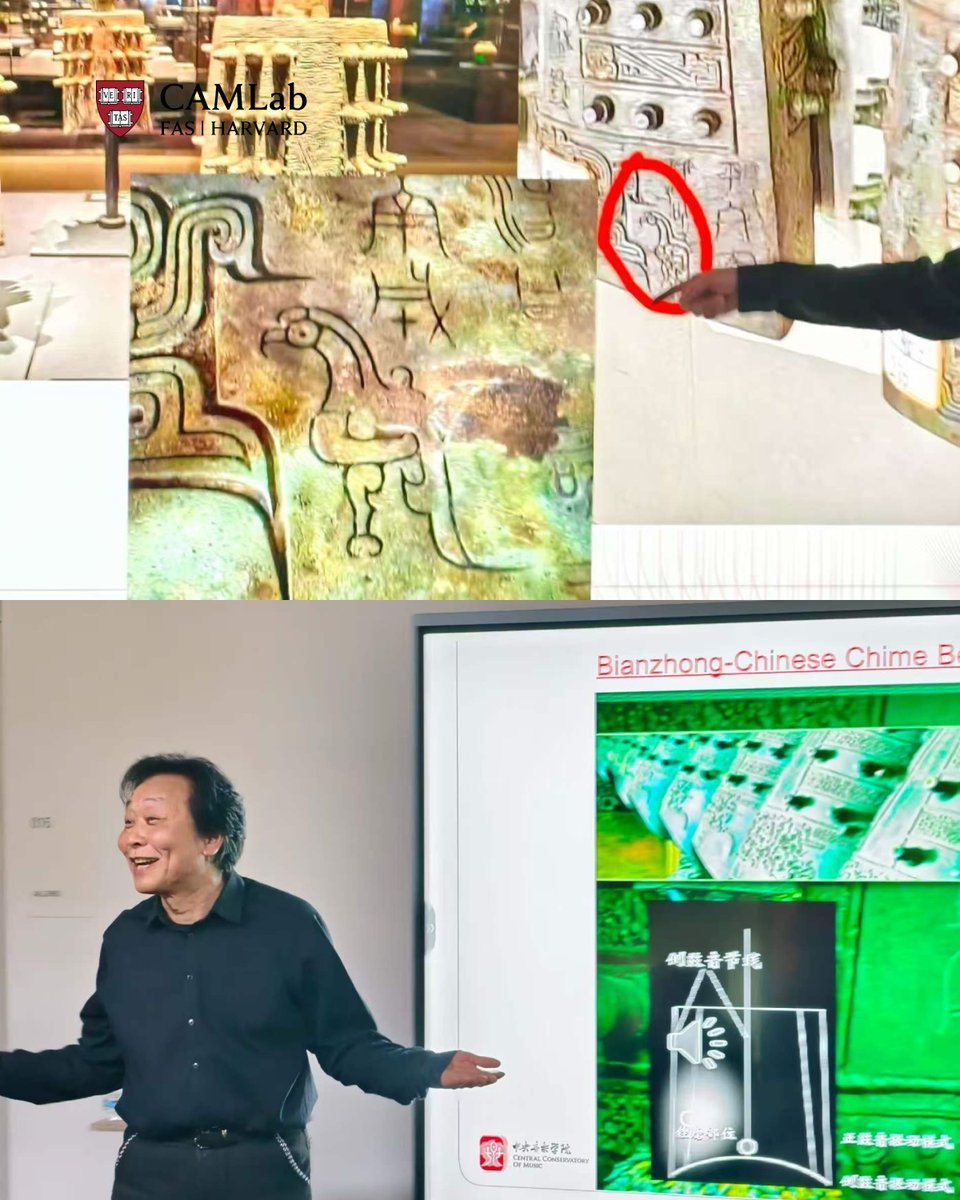
On March 5, CAMLab welcomed Professor Youping Li, renowned music historian and Distinguished Professor at the Central Conservatory of Music, for a lecture titled “Bianzhong - Chinese Chime Bells: Ritual Vessels and Musical Instruments.” The lecture explored how ancient Chinese bronze chime bells (bianzhong) reveal the deep connections between music, ritual, and technological ingenuity in early Chinese civilization. Professor Li discussed the role of bianzhong within China’s classical “li-yue” (ritual and music) system and highlighted the remarkable sophistication of early Chinese acoustics and metallurgy, exemplified by the Marquis Yi of Zeng bell set discovered in 1978. A key focus of the lecture was the acoustic phenomenon of “two tones from a single bell,” produced by striking different points on the bell’s carefully engineered surface. Placing bianzhong within a broader global perspective, the lecture reflected on how this millennia-old instrument continues to resonate beyond China, illuminating its enduring significance in the cultural dialogue of world civilizations. A heartfelt thank you to Professor Youping Li and to everyone who joined us for this inspiring seminar. #ChineseMusic #Bianzhong #RitualMusic #MusicHistory #CulturalHeritage #HarvardCAMLab
Harvard FAS CAMLab tweet mediaHarvard FAS CAMLab tweet mediaHarvard FAS CAMLab tweet media
English
0
0
0
24
Harvard FAS CAMLab
Harvard FAS CAMLab@HarvardCAMLab·
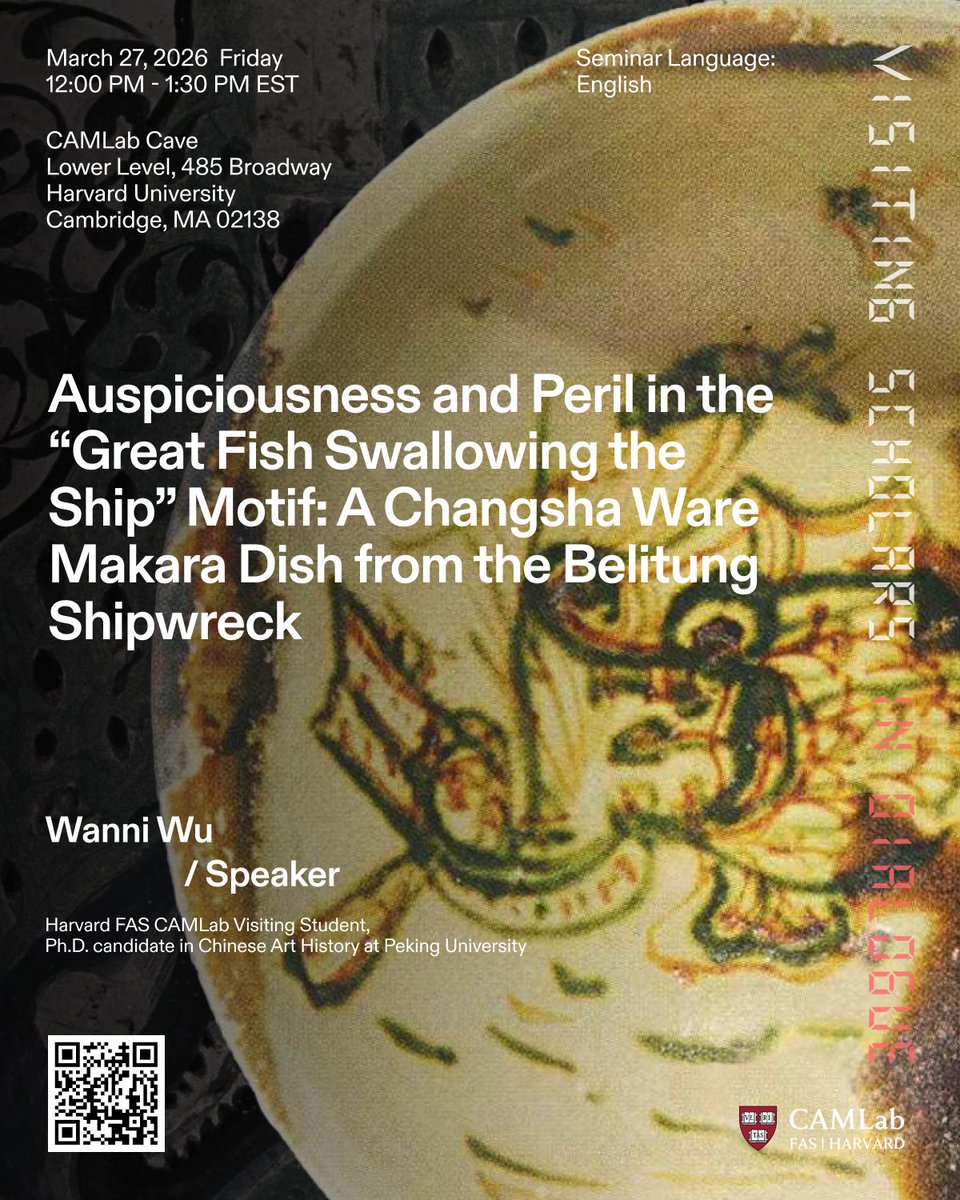
Harvard FAS CAMLab is pleased to announce an upcoming VS in Dialogue lecture: “Auspiciousness and Peril in the ‘Great Fish Swallowing the Ship’ Motif: A Changsha Ware Makara Dish from the Belitung Shipwreck.” In this talk, CAMLab Visiting Student Wanni Wu explores how a single ceramic object can illuminate the intersection of Buddhist textual transmission and Indian Ocean trade networks. ⏰ March 27 (Friday), 12:00 PM – 1:30 PM EST 📍 CAMLab Cave, Lower Level, 485 Broadway, Harvard University, Cambridge, MA 🌍 Language: Chinese 🎫 Free and open to the public. Only 20 spots available—register today via: docs.google.com/forms/d/e/1FAI… A Changsha export dish from the Belitung shipwreck depicts a makara swallowing an Arab vessel. This motif derives from the Indian Buddhist narrative of the “Five Hundred Merchants at Sea,” which developed a structure of setting sail, encountering peril, invoking the sacred, and deliverance. In Chinese translations, the devouring creature became the makara, a visual signifier of maritime danger appearing in Guanyin rescue tales and Jātakas. As maritime trade expanded, this sacred motif entered commercial production. Its presence on Changsha ceramics reflects both cross-cultural transmission across the Indian Ocean and responsive craft production to market demand. The juxtaposition of a conventional makara and a naturalistic Arab vessel on a single dish reveals the coexistence of inherited religious symbolism and emerging commercial dynamics in early premodern China. Wanni Wu is currently a Ph.D. candidate in Chinese Art History at Peking University and a visiting student at the Harvard FAS CAMLab (2025–2026). Her research focuses on Buddhist art in middle-period China and cross-cultural artistic exchanges along the Silk Road. #HarvardCAMLab #AcademicTalk #Cambridge #HarvardUniversity #VSinDialogue
Harvard FAS CAMLab tweet media
English
0
0
0
171