Heptagon

6.7K posts

Heptagon banner
Heptagon

Heptagon

@Heptagon247

To believe is to see, but to see is to deceive, for what lies before our eyes is the semblance of truth's disguise.

San Francisco, CA Katılım Mayıs 2020
292 Takip Edilen245 Takipçiler
Heptagon
Heptagon@Heptagon247·
I thought the exact same thing when I was learning about this. Why don’t they just use a camera to watch it then? They do use measurement devices, and those devices can detect the effects of superposition (through interference patterns and statistics). What has never been observed is a conscious mind experiencing a superposition of outcomes. That is why some people have viewed consciousness as a defining factor in the measurement process.
English
0
0
0
0
Aranen Zen
Aranen Zen@AranenZen·
@Heptagon247 @hapree464862 @McClureShawn I used the word reality mirroring your own use of language. The fact is measurement devices are not conscious. Whether a conscious being operates them or not has no effect on the outcome of the measurement.
English
2
0
0
12
Heptagon
Heptagon@Heptagon247·
Well, to address the statement that we have found physical things but have not demonstrated the existence of a non-physical thing — that is a bit oxymoronic, because the way we currently define the existence of things is based around physical properties. The only way we could currently test or try to prove something non-physical would be to show the contradictions within known physicality, as we see in quantum wave theory and consciousness. When we observe phenomena that not only fail to add up but actually defy our current understanding, at what point do we start to assume that what we are observing is being influenced by non-physical processes that we cannot fully describe using empirical data? I think your statement that the mind isn’t one part doing it all, but layers of processes, is 100% correct. That is exactly what the empirical evidence shows inside the brain. The reason it points to something else is that there is no evidence that all of those different processes should unify into one subjective experience. That unification could be pointing to something that is absorbing the data created by the mind and processing it outside of observable reality. Some people would say that thing is the only fundamental truth, like Kastrup, while others see it as a theistic self. Either way, the concept of the soul — while it is a gap argument — is still the metaphysical theory that explains that unification in the best logical way currently available to us. Regardless of the idea you choose to accept, every theory is operating with gaps. I don’t doubt evolutionary processes, and I do not think we are all the same. The physical differences between you and me, or even between you and your own family, are real. Those differences shape our capabilities in many ways, while also protecting the species as a whole through diversity. I wouldn’t disagree with the claim that our physical mind is our only way to exist in the physical world. Obviously, if something damages my frontal cortex, that will affect my perception. If I take a psychedelic drug, that will change my subjective experience. We would have to truly understand the proposed non-physical elements of the self before we could fully explain why that is the case, but the empirical data clearly shows that it is the case.
English
1
0
0
36
Heptagon
Heptagon@Heptagon247·
You’re right that the word “collapse” is poorly chosen. What has been repeatedly observed is the transition from a system described as being in superposition to a single definite measured outcome. That transition is an empirical fact of quantum mechanics. Decoherence explains why interference becomes effectively undetectable, but it does not by itself select one outcome or explain why there is a definite experience at all. It remains tied to assumptions, just as views that treat consciousness as fundamental do. Most importantly, there is still no purely physical account that derives either the definiteness of outcomes or the existence of a point of view; both are simply assumed by the formalism when it is connected to observation. That is one of the main reasons consciousness-first approaches continue to be taken seriously. Quantum mechanics is a deep and separate debate, and I wasn’t attempting to resolve it. You asked what the relevant contradictions are, and I pointed to the ones that have driven a century of discussion: the tension between unitary evolution and definite outcomes, and the persistent difficulty of locating the cut between quantum possibilities and experienced actuality. Those issues sit at the core of our understanding of physical reality, and they remain widely open.
English
1
0
0
1
Aranen Zen
Aranen Zen@AranenZen·
@Heptagon247 @hapree464862 @McClureShawn 2nd no actual collapse has ever been observed. The mathmatical description of the wave function is an object thats a collection of possible states that evolves in time as a wave and thru interaction with others constructively and destructively interferes to prodoce single states.
English
3
0
0
11
Aranen Zen
Aranen Zen@AranenZen·
@Heptagon247 @hapree464862 @McClureShawn Two questions: How does something point to something outside reality to fill the gap vs something inside reality? Because we most certainly do not understand every step of how a brain functions so why propose another kind of stuff until we do? What are the contradictions in QM?
English
2
0
1
37
Heptagon
Heptagon@Heptagon247·
@charlij60 This is cruel, and immoral. I hope its AI generated.
English
0
0
4
824
charli
charli@charlij60·
New fear unlocked. As if snakes weren't enough on their own... 😭"
English
151
65
1K
2.5M
Phoenix Atheist
Phoenix Atheist@AtheistPhoenix·
Christians are moral because they fear their god I am moral because I want to be
English
117
31
254
9.9K
Aranen Zen
Aranen Zen@AranenZen·
@Heptagon247 @hapree464862 @McClureShawn As they are under physicalism as well. The difference is we found physical things. We have never demonstrated the existence of a non physical thing. How does some other kind of stuff even solve unification?
English
1
0
1
36
Heptagon
Heptagon@Heptagon247·
But it’s not as if we already have most of the answers to the framework of consciousness and are only debating the finer points. The only thing we can empirically prove about the brain is that it controls the body’s basic functions. The cause of phenomenal consciousness remains a complete mystery. Almost all of the brain’s observable functions are dedicated to processes we have no awareness of. Even when we look at large language models and AI, they can do things that appear conscious. They can write poems, create art, and reason based on data and ideas. Yet these same systems have no sense of self and no subjective experience — they don’t experience the color blue, even if they can describe it perfectly. When it comes to the core aspects of experience, we have virtually zero understanding of the underlying framework. So Gödel’s incompleteness theorems don’t really apply when trying to insist that consciousness must be purely physical in nature. There is nothing physical about the experience of consciousness. You can’t hold a thought in your hand. The only way we know consciousness exists at all is because we experience it ourselves. Without that first-person perspective, LLMs and AI would make it seem very likely that nothing is truly conscious, but we can’t reach that conclusion because each of us experiences our own conscious self.
English
1
0
0
103
Aranen Zen
Aranen Zen@AranenZen·
@Heptagon247 @hapree464862 @McClureShawn So I think this finally perhaps better highlights whats at debete. I actually like Katstrup's dashboard analogy. But it raises several questions. Are we a separate thing from the dashboard to views it like looking at a monitor? Or are we the process that makes it?
English
2
0
1
28
Heptagon
Heptagon@Heptagon247·
It isn’t to say that consciousness doesn’t require a stack of quarks. It’s just that a stack of quarks has not been found generating consciousness, despite billions of dollars and decades of research. Where are these quarks generating our subjectivity? Where is the physical unification of our mind?
English
0
0
0
7
Aranen Zen
Aranen Zen@AranenZen·
@Heptagon247 @hapree464862 @McClureShawn And even if we are a viewer of the dashboard why does the viewer require anything other than some more stacks of quarks? What specific thing makes it have to be not something made of the same material everything else is?
English
1
0
1
16
Heptagon
Heptagon@Heptagon247·
There is nothing we can point to that unifies conscious experience. There is nothing that separates certain aspects of brain activity from those that involve qualia. There is nothing that even proposes why we have a singular subjective experience at all. The way brain activity is observed is regional — we see activity in one area and then another. So why do these areas come together to form the perception of a single, unified subjective experience? Why not answer that? Why keep ignoring that point and looking for other explanations that aren’t relevant? Can you address that problem on its own, without just asking, “What should it look like?” I have outlined the perception I am talking about numerous times in this feed. You are dancing around it and pretending it isn’t there. Your position seems to be: “What is the problem? There’s brain activity on the scans, so clearly that’s your qualia. How should it look any different? We don’t need unification or subjectivity — that just happens when you put this stuff together. We don’t know why, maybe one day we will, but clearly it’s all physical.” It’s just not a real explanation. Physicalism has not come close to explaining qualia and how it is unified into the perception of a single subjective self.
English
1
0
0
14
Heptagon
Heptagon@Heptagon247·
Precisely. I would still exist as a subjective experience even without the ability to rationalize, recall, see, taste, feel, smell, or communicate. What that experience would be like inside the mind, no one could say — but if you ran an fMRI on someone in that condition, you would continue to see activity. It’s not that I think the periodic table of quantum physics couldn’t possibly generate phenomenal, subjective, unified consciousness. There is simply no convincing evidence that it does. I think the evidence we have more likely suggests that our body is a strange, self-sustaining biological vessel with an extremely sophisticated dashboard — one that beings of pure conscious thought can pilot and control in order to experience physical qualia. It even comes with built-in safety mechanisms, such as the inability to stop your heart or hold your breath until death. The majority of its features run on autopilot with no experience necessary, but a skilled pilot can stretch the boundaries a bit past the normal thresholds. Even when the system has to shutdown for mandatory rest, we get to watch cool generative movies. 😃
English
1
0
0
35
Aranen Zen
Aranen Zen@AranenZen·
@Heptagon247 @hapree464862 @McClureShawn Because you'd still have a persistent autobiographical awareness even if you had no monologue internally to articulate it. Is that the part you claim cannot be made of any of these?
Aranen Zen tweet media
English
2
0
1
67
Heptagon
Heptagon@Heptagon247·
The experiment you are referencing is essentially a workaround that avoids directly addressing the hard problem of consciousness. It does nothing to alleviate the core issue of how brain activity relates to qualia. Whether the flavor of sourness is generated by artificial or natural means, it doesn’t change the question of why we experience it from a subjective point of view. It sheds no light on how our experience arises or how it is unified into a single individual consciousness. If anything, the experiment leans more toward the idea that we may only have a limited number of ways of tasting things, and that the actual range of possible flavors could be far greater than what we have the capacity to experience — similar to how this works with colors. I imagine that with the right method, you could generate images in the mind that are not being seen, or the sensation of being touched without anything actually being there. I don’t think anyone serious is debating whether the brain produces stimuli that can be experienced. The core issue is why that experience is perceived the way it is.
English
2
0
0
79
Aranen Zen
Aranen Zen@AranenZen·
@Heptagon247 @hapree464862 @McClureShawn One more question. Above I shared the experiments done where direct brain stimulation cause someone who experience aspects of taste. What is the difference between stimulating those causing a person to experience taste and the qualia of taste?
English
1
0
1
63
Heptagon
Heptagon@Heptagon247·
I do like your list. It’s a solid, thoughtful functionalist / higher-order layout that checks all the boxes of Global Workspace Theory. I’m assuming your proposition is that if all of those boxes are checked, subjective experience would emerge. My list would be much shorter. I do not believe you need much more than an agentive / functional self-model and a higher-order / self-referential self-model to have a genuine experience of qualia. Children and severely disabled individuals still have qualia even though they lack most of the other elements on your list. Current AI models are already capable of operating at levels beyond them in many cognitive domains, yet they still do not possess qualia. My position is that if someone disabled all of my senses and found a way to erase my memory entirely — not just my experiences, but my knowledge of arithmetic and language — I would still have a conscious experience. I just would not be able to share or articulate that experience. I am convinced the brain is a permissive organ when it comes to qualia, not a productive one.
English
1
0
0
40
Aranen Zen
Aranen Zen@AranenZen·
@Heptagon247 @hapree464862 @McClureShawn What is your list of parts or perhaps you agree with my list but think some of these cannot built out of the parts available in the standard model of particle physics. If so which ones and why can they not be built of that material?
English
2
0
1
52
Heptagon
Heptagon@Heptagon247·
Okay, let me try to break this down again and explain what you are asking. First, the physicalist theory needs a clear distinction that explains why some physical processes in the brain produce experience while others—such as heartbeat regulation, basic respiratory control, and countless motor functions—do not. At the level of physics and biochemistry, no such distinction is apparent. The same kinds of neurons, ions, and electrochemical signals are at work in both cases. Yet only some of them are accompanied by a subjective point of view, while others just happen without one. When you ask, “What is it they should be looking for?”, the answer is simply a physical distinction between qualia and processes that just happen without experience. This leads to my next point. Second—and more fundamentally—if everything reduces to physical interactions, there is no reason we should experience anything at all. Physical processes should simply unfold like a rock tumbling down a hill or the wind blowing across the sea: causes and effects following physical laws, with no inner experience attached. The fact that there is a “what it is like” for some of these processes, but not for all of them (or for none of them), is not predicted by physics. It is an extra, unexplained fact that is only factual because of the experience itself. There isn't an entire field of metaphysics trying to understand the roots of qualia because physical science already mapped it out, and they are all just too stupid to grasp the clear conclusions.
English
1
0
0
22
Aranen Zen
Aranen Zen@AranenZen·
@Heptagon247 @hapree464862 @McClureShawn What I'm asking you to define is the other part you claim is missing from any of these descriptions. If we cannot precisely identify what it is we are looking for or failing to find how do we even know if we have or haven't?
English
2
0
1
34
Heptagon
Heptagon@Heptagon247·
I think its a bit silly you put it that way. I don't understand why you can't grasp this conceptually. Just because the processes are happening doesn't mean you should experience them the way we do. How about addressing this simple question. Why do I experience my optical processing but not my motor coordination?
English
1
0
0
33
Aranen Zen
Aranen Zen@AranenZen·
@Heptagon247 @hapree464862 @McClureShawn I'm still unsure what exactly you are saying we should find that we have not? Do you expect that you'll find a set of brain states that look exactly like the color red that you can print out of a printer?
English
1
0
1
32
Heptagon
Heptagon@Heptagon247·
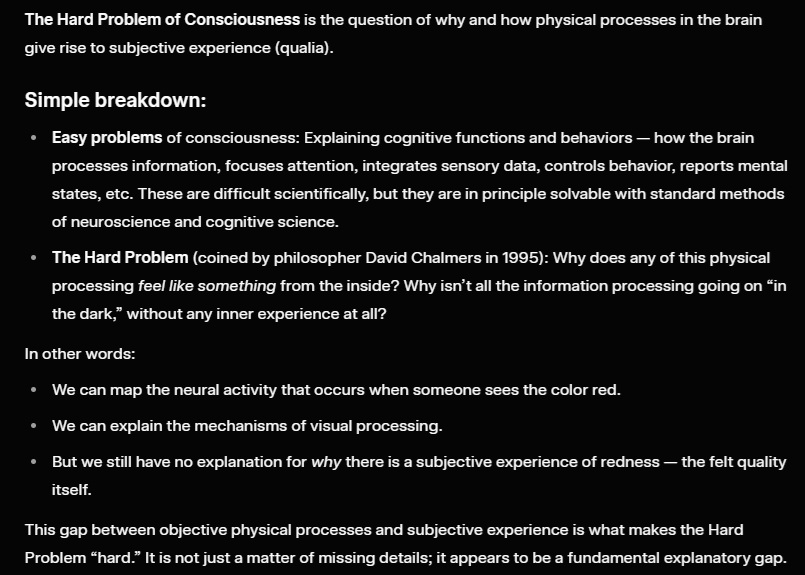
You aren’t operating on the definition of qualia that Grok gave you, though. If you were, you’d know that it isn’t the processing of the color red; it is the experience of the color red. They are different. Your eyes taking in red light and then sending a signal to your visual processing systems to decode it as red is one fundamental process in the brain, and it is how you see the color red. We can define that and see it in action. There is nothing empirically fundamental that says you should experience that color from a subjective point of view. The subjective point of view is qualia—not the processing of red, but the experience of the color red that does not have an inherent known physical place or process in the mind. There is a reason we have “the hard problem of consciousness.” It isn’t that we can’t prove the brain does things; it’s that we can’t find the subjective element in the physical processes. My earlier statement was about how we know there are areas in the mind that are not experienced with qualia, such as your heartbeat or involuntary breathing. There are also places in the brain that we know we certainly do experience, such as seeing the color red. There is no physical indication of the presence or absence of qualia between the two when examined at a fundamental level. This is why we have so many theories based around consciousness being fundamental—because it appears to be so when we study the mind. The argument that qualia is produced only by physical interaction is similar to saying there is a chest of gold buried in my backyard at this point. Even after digging up every square inch of my backyard, the chest has still not been found. You could say, “Well, we just need to dig deeper than we already have,” and while it doesn’t prove there isn’t a chest of gold in my backyard, it’s starting to seem very unlikely that there is. Which goes back to my original point: science always seems to hit a brick wall when it has an opportunity to prove on a fundamental level that you and I are nothing more then random physical processes.
Heptagon tweet media
English
1
0
0
35
Aranen Zen
Aranen Zen@AranenZen·
@Heptagon247 @hapree464862 @McClureShawn This lead me back to my original point that Grok is not conscious because it lacks all these other functioning parts which we do not even clearly know what are even to look for them.
English
1
0
1
29
Aranen Zen
Aranen Zen@AranenZen·
@Heptagon247 @hapree464862 @McClureShawn Correct. You could not tell me what you experience but you'd still have experience. The experience would be of the things you collect data about via sensed. What else would it be? Whats missing overall from the desription of qualia as a model of the data collected by senses?
English
1
0
1
22
Heptagon
Heptagon@Heptagon247·
I think one of the main issues surrounding this topic is that we cannot prove qualia is generated by brain processes — and that often leads to the assumption that “we just don’t have the answers yet.” But our current understanding is far more revealing about the nature of the mind than most people realize. For instance, as I keep pointing out, we cannot experience the part of our brain that makes our heart beat. If there were a physical attribute responsible for generating qualia, it should be relatively straightforward to identify. We know we cannot experience the processes that regulate our heartbeat, yet we can experience the processes that allow us to see the color red. There should be a clear, notable difference between these two when we examine the neurons at a finer level. We should be able to point to something and say, “There is your qualia — it exists in this part of the brain, but not in that part.” But we cannot do that. Given how much research has already been done, it is seeming increasingly unlikely that some unseen physical difference will suddenly emerge. This is very suggestive that qualia is produced by something that is not dictated by physical processes alone. Emergence theories and Global Workspace Theory are currently our best attempts to explain qualia in physical terms, yet they still fall very short. They ultimately rely on metaphysical claims. The reality is that if someone claimed they consciously experience the process of making their heart beat, we could not empirically prove them wrong. We could only say it is unlikely, based on the subjective experiences of others and what currently seems rational.
English
1
0
0
17