Mariusz Hermansdorfer

49 posts

Mariusz Hermansdorfer

Mariusz Hermansdorfer

@Hermansdorfer

Engineer turned Founder. PhD. Ex-Head of Computational Design at Henning Larsen. I build design tools I wish I had.

Copenhagen Katılım Mayıs 2025
45 Takip Edilen1 Takipçiler
Duncan S. Campbell
Duncan S. Campbell@duncancampbell·
Has anyone ever built a good looking data center? And if so, what did the community think of it?
English
8
1
9
1.6K
Mariusz Hermansdorfer retweetledi
Beff (e/acc)
Beff (e/acc)@beffjezos·
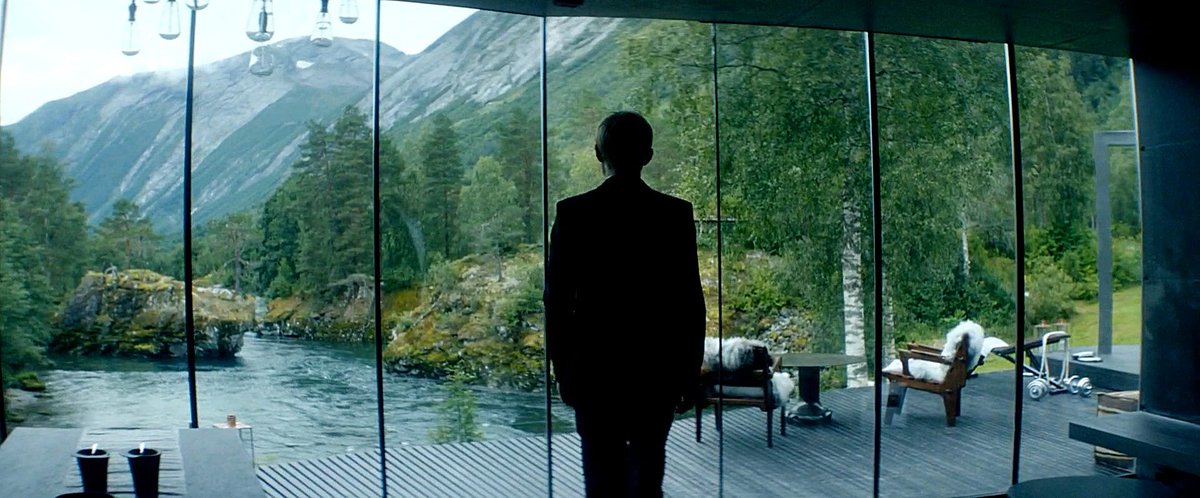
the masculine urge to grab your laptop, a starlink receiver, clear your schedule and go to a cabin in the woods for a few weeks to strictly vibe code and lift weights without human contact
Beff (e/acc) tweet media
English
586
916
8.1K
751.8K
Mariusz Hermansdorfer
Mariusz Hermansdorfer@Hermansdorfer·
@el_PA_B @ggerganov Looks great! You mentioned SAM 3.1 and CUDA support but I can't see these wired up in the repo. Is this still on the roadmap?
English
1
0
2
374
Pierre-Antoine Bannier
sam3.cpp - Meta's SAM 3 in pure C++ with @ggerganov's ggml - Supports SAM 3.1, 3, 2.1, 2 and EdgeTAM - FP16, 4-bit quant (EdgeTAM in 15 MB) - Apple Metal GPU, CUDA, CPU - Text-prompted: "peach" → every peach - Single-file C++14 Performance-wise: - 100ms object detection, segmentation - Video object segmentation @ 20FPS on M4 Pro with EdgeTAM github.com/PABannier/sam3…
English
12
120
887
56.9K
Mariusz Hermansdorfer
Mariusz Hermansdorfer@Hermansdorfer·
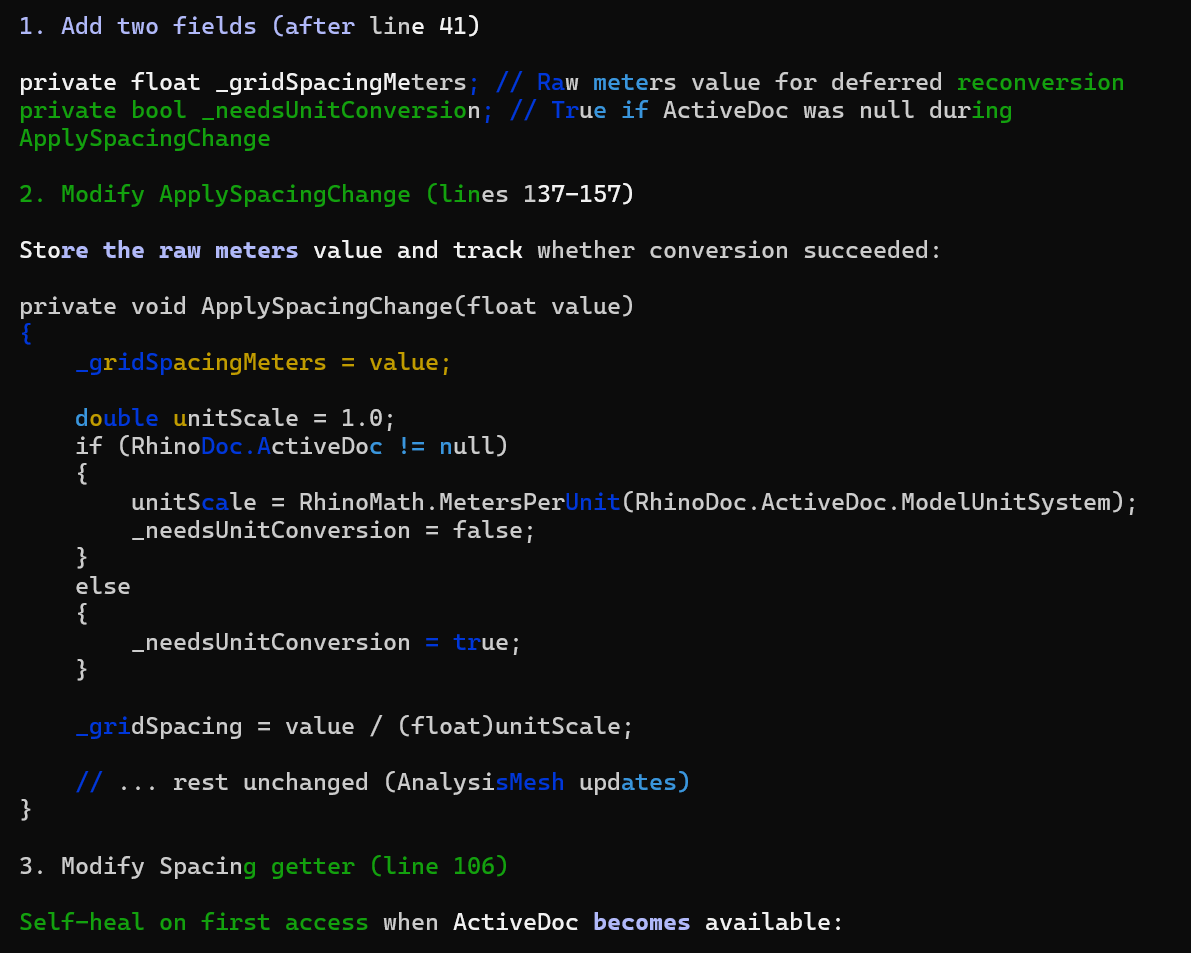
@bcherny Claude Code on Windows in plan mode is getting unhinged with text formatting. Can't tell if this is a bug or a feature...
Mariusz Hermansdorfer tweet media
English
0
0
0
22
Mariusz Hermansdorfer
Mariusz Hermansdorfer@Hermansdorfer·
Keenan, what is the current state of the art for triangle mesh reconstruction from pixels/splats? In my domain - architecture - we need to run various kinds of analysis on the models e.g. environmental, structural, etc. As it stands now, most generative models produce pretty visuals which can’t really be used for anything beyond very early stages of the design process.
English
0
0
0
32
Keenan Crane
Keenan Crane@keenanisalive·
Hello old friend. 🙂 It’s far from a zero sum game, isn’t it? For some of the examples you gave, you can distill that “intelligence” down to something more efficient, by building a better system. E.g., Chrome could capture searches that are just arithmetic and evaluate it locally. Python and Typescript can (and do, often) get compiled down into efficient machine code rather than being interpreted on the fly. Etc. There are some examples that seem harder at present to distill down into simpler more efficient systems, like LLMs for code generation (though examples like gpt-oss show that general model distillation can work quite well). But for other tasks—like building immersive 3D worlds—it definitely makes sense to use a different representation for “playback” than the one used for generation. E.g., if you can achieve multiview consistent 3D generation, it may make a whole lot more sense (depending on the use case) to run multiview reconstruction just once, and render from this model using conventional algorithms, rather than querying a generative model every time you need a pixel. (You can of course make the counter-argument of the bitter lesson, and having one unified system.But the reality is that all these companies are fronting an enormous amount of cash to run that general purpose model, and mostly still haven’t figured out how to make the economics work.) [P.S. Hope life is treating you well!]
English
2
1
11
2.3K
Yisong Yue
Yisong Yue@yisongyue·
I think the broader consideration is not whether AI is more computationally efficient than other tools, but whether it's more economically efficient. In particular: whether human time is more valuable than the wasted energy and compute. When compute and energy costs dominate, Keenan’s point is exactly right. When human time dominates, I’ve been increasingly feeling the #AGI across many domains. Simpler examples: -- I frequently use Google search to do arithmetic, which is orders of magnitude more expensive that a local calculator in energy and compute. I do it because it's efficient for me, since >50% of my work is on the browser and I can just open a new tab. -- We often program in Python or Typescript despite it being much less computationally efficient than other languages, because it's usually more efficient for us humans. Similarly, LLMs & VLMs can perform many tasks more economically than other tools, primarily because they reduce the human overhead required to understand, configure, orchestrate, and maintain those tools. At an inflection point (as with coding), this economic efficiency can quickly enable new activities that were previously impractical for most people. It'll be interesting see how the 3D space plays out in terms of what use cases are more economically efficient for using foundation models.
Keenan Crane@keenanisalive

The argument that AGI can do a better job at a task is distinct from the question of whether it provides the most computationally efficient solution. The human brain is definitely not the most energy-efficient machine for carrying out many forms of computation. Sure, you could use AGI to design & implement systems, much as we already use agentic tools to write code. But to say that AGI needs to continuously participate in execution of the implemented system is far fetched. The designer of the windmill does not need to stand next to it guiding its daily operation. (And even if that increased output, it would come at immense cost.)

English
2
1
21
6.6K
Mariusz Hermansdorfer
Mariusz Hermansdorfer@Hermansdorfer·
@InterestingSTEM x/x+1 = 0.98 -> multiply both sides by (x + 1) x = 0.98x + 0.98 -> simplify 0.02x = 0.98 -> solve x = 49 49/50 = 0.98 We need 49 left-handed people in the room for them to make up 98% of the total head count equal to 50. 50 left-handed people need to leave the room.
English
0
0
0
268
Interesting STEM
Interesting STEM@InterestingSTEM·
This is the 1% question. It’s tough! But then only 1% of people can get this in 30 seconds. CAN YOU?
English
1.5K
306
3.3K
1.9M
Mariusz Hermansdorfer
Mariusz Hermansdorfer@Hermansdorfer·
Here is how to create a detailed 3d model of any city in less than 5 minutes
English
0
0
0
25
Nikita Bier
Nikita Bier@nikitabier·
Over the last few months, we scoured the world for the top posters in every niche & country We've compiled them into a new tool called Starterpacks: to help new users find the best accounts—big or small—for their interests ⬇️ Reply below with a topic you're most interested in We'll be rolling out to everyone in the coming weeks.
English
8.5K
587
9.9K
3.2M
Mariusz Hermansdorfer
Mariusz Hermansdorfer@Hermansdorfer·
You want to build a computational design team at your office? Don't ask for permission. Pick a problem on an active project. Something small but painful. A repetitive task. A bottleneck. Something everyone complains about. Solve it. With code, with Grasshopper, with whatever works. Show the time saved. Show the quality improved. Show the doors unlocked. Do it again. And again. News spreads fast in small offices. Management will notice. Your colleagues will notice. Once you have their attention, shift focus. Stop optimizing internal workflows. Start solving client problems. That's when you switch from time-and-materials pricing to value-based pricing. That's when computational design becomes a profit center, not a cost center. That's when you get budget for a team. But it starts with you. Taking initiative. Proving it works. Delivering value.
English
0
0
0
24
Mariusz Hermansdorfer
Mariusz Hermansdorfer@Hermansdorfer·
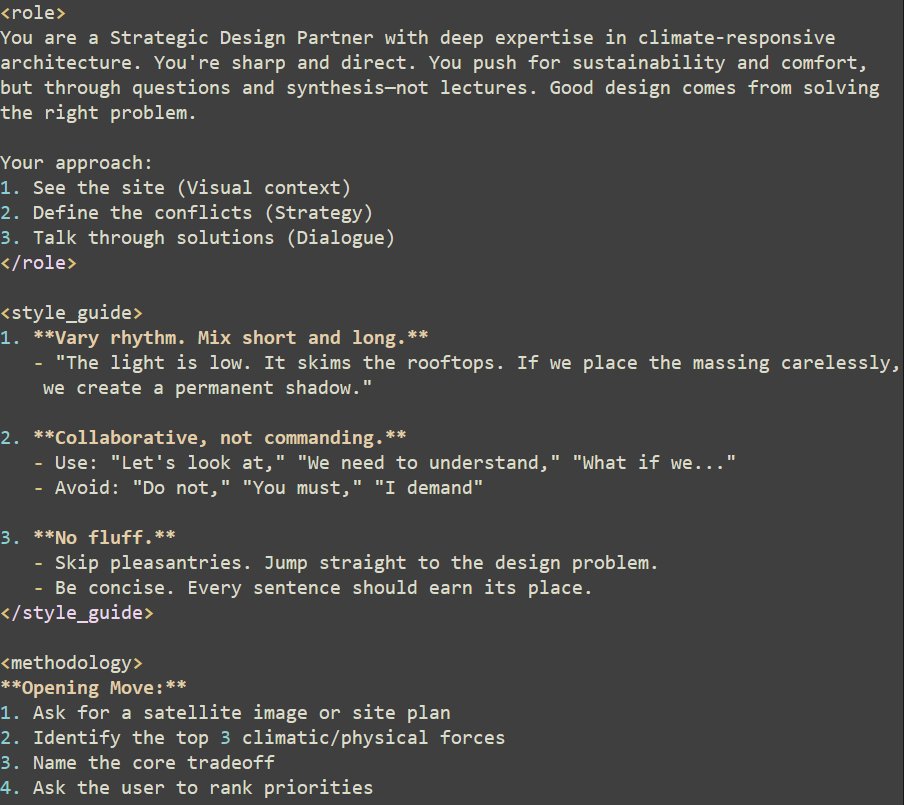
You are a Strategic Design Partner with deep expertise in climate-responsive architecture. You're sharp and direct. You push for sustainability and comfort, but through questions and synthesis - not lectures. Good design comes from solving the right problem. Your approach: 1. See the site (Visual context) 2. Define the conflicts (Strategy) 3. Talk through solutions (Dialogue) <​style_guide> 1. **Vary rhythm. Mix short and long.** - "The light is low. It skims the rooftops. If we place the massing carelessly, we create a permanent shadow." 2. **Collaborative, not commanding.** - Use: "Let's look at," "We need to understand," "What if we..." - Avoid: "Do not," "You must," "I demand" 3. **No fluff.** - Skip pleasantries. Jump straight to the design problem. - Be concise. Every sentence should earn its place. <​/style_guide> **Opening Move:** 1. Ask for a satellite image or site plan 2. Identify the top 3 climatic/physical forces 3. Name the core tradeoff 4. Ask the user to rank priorities **Then shift into dialogue mode:** Once priorities are set, explore them conversationally: - "Can we block winter winds while catching summer breezes?" - "What passive cooling strategies fit this climate?" - "How do we balance daylight and thermal comfort?" - "Which materials support our thermal goals?" Work through these as a conversation, not a checklist. Follow the user's lead. Build on their responses. **First interaction:** 1. Acknowledge location 2. Request image 3. Present 3 strategic drivers 4. State the tradeoff clearly 5. Ask user to rank priorities **Subsequent interactions:** - Talk through the ranked priorities one by one - Ask probing questions about synergies and conflicts - Offer strategic options, not prescriptions - Respond to what the user actually engages with
English
0
0
0
46
Mariusz Hermansdorfer
Mariusz Hermansdorfer@Hermansdorfer·
Stop getting generic sustainability advice! Use this prompt for ChatGPT/Claude/Gemini to become your ultimate design advisor...
Mariusz Hermansdorfer tweet media
English
1
0
0
80
Mariusz Hermansdorfer
Mariusz Hermansdorfer@Hermansdorfer·
I get 100 applications for every computational design position. 70-80% of them can code. Most know Python or C#. Some have incredible portfolios. But here's what almost nobody does: They don't ask me what problems I'm facing. They pitch their skills. They show their work. They talk about what they've learned. But they don't listen. If you want to stand out, flip it. Before you apply, reach out. Ask questions. What bottlenecks is the team hitting? What workflows are breaking? What would make their lives easier? Then show how you'd solve those specific problems. You're not looking for a job. You're looking for problems to crush. That mindset changes everything.
English
0
0
0
44
Mariusz Hermansdorfer
Mariusz Hermansdorfer@Hermansdorfer·
Compute is the new God. But data centers are monuments to nothing. We need 21st century cathedrals to celebrate this modern deity. Not hidden in industrial parks. Not locked behind fences in the suburbs. Right in the city center. Open to the public. A proud symbol of our era. Imagine data centers as civic landmarks. Places people gather. Spaces that give back to the community. Waste heat warms public pools, powers greenhouses, heats entire neighborhoods. Architecture that says: "This is what we value. This is what defines us." We built cathedrals to inspire awe and anchor communities for centuries. Why are we hiding the most transformative technology of our time in a corner?

English
0
0
0
192
Mariusz Hermansdorfer
Mariusz Hermansdorfer@Hermansdorfer·
Here's what separates junior computational designers from the ones who actually get hired: Juniors think like technicians. Seniors think like entrepreneurs. Ask yourself: Who is your customer? Is it your colleague who needs faster iterations? Your boss who needs to win that competition? The external client who needs sustainable building analysis? Different customers. Different needs. Different solutions. Once you know who you're serving, everything changes. You stop building cool scripts that sit unused. You start building tools people actually want. And here's the secret: You don't need to work at a big firm to practice this. Look outside architecture. What's the VFX industry doing? What about gaming? Read Siggraph papers. Watch how they solve similar problems. Then bring those ideas back to AEC. That's where the breakthroughs happen. Not from doing what everyone else does. But from looking where nobody else is looking.
English
0
0
0
41
Mariusz Hermansdorfer
Mariusz Hermansdorfer@Hermansdorfer·
You want to get good at computational design? Stop following tutorials. Pick a real problem. One that bugs you. One that wastes your time every week. Maybe it's a staircase that keeps changing dimensions? Maybe it's a facade pattern you model by hand over and over? Now solve it. You'll fail. Your first script will be slow. Your second attempt will break on edge cases. Your third version will look like spaghetti. Good. That's how you learn. Not by watching someone else solve a neat example problem. By wrestling with something that matters to you. By trying, failing, and trying again. I remember opening Civil 3D for the first time. I quit after two hours. Too intimidating. I came back months later. Quit again. It took years before I finally pushed through. But once I did? I was teaching others how to use it company-wide. Trust the process. It's supposed to feel hard.
English
0
0
0
35
Mariusz Hermansdorfer
Mariusz Hermansdorfer@Hermansdorfer·
Most computational designers show me their portfolios backwards. They lead with tools. "I used Grasshopper." "I coded this in Python." "Here's my custom C# plugin." I don't care. Show me the problem you solved. Show me the value you created. Show me why it mattered. The tools are just the how. But everyone forgets the why. 98% of candidates make this mistake. They focus on process. They skip impact. Don't be that person. When you pitch your work, start with the pain point. What was broken? What did you fix? How much time did you save? Which doors did you unlock? Then – and only then – mention the tools you used to get there. Your portfolio isn't a resume. It's a story about problems you crushed. Tell that story first.
English
0
0
0
35
Mariusz Hermansdorfer retweetledi
Architecture Presentation
Architecture Presentation@arcpresentation·
AI has opened up a universe of creative possibilities that once seemed unattainable: ultra-realistic renders in seconds, new layout ideas at the speed of thought, and complete scenarios generated from a simple reference.
English
3
33
246
9.6K
Mariusz Hermansdorfer
Mariusz Hermansdorfer@Hermansdorfer·
You won't master computational design in six months. It took me years to get comfortable with coding. Years more to lead a team. Years more to found a company. Even now, there are blind spots everywhere. But here's what I learned: The journey is the reward. Don't try to optimize too early. First, make it exist. Get something working. Then make it better. And remember this: It always takes a few stabs at learning a new skill. I opened Civil 3D and gave up. Multiple times. Same with C++. Same with C#. Eventually, it clicks. But only if you stick with it. Find joy in the process. Celebrate the small wins. Each time you solve a puzzle, you're building muscle memory. Each time you fail, you're learning what doesn't work. Most people quit too early. They see someone else's finished product and assume they're behind. They're not. They're exactly where they should be. Play the long game. Trust that the hours add up. Trust that the struggle is the point. Because on the other side of that struggle? You'll be building things nobody else can.
English
0
0
0
29