Reclaiming the Silicon Valley Spirit
#Cryptonite #$CPRO #CryptoniteRap
The Silicon Valley spirit grew out of the idea of empowering individuals with personal computing devices, enabling us to create, teach, learn, and be far more productive in an increasingly affordable way. Its genesis traces to 1971, when Intel cofounder Robert Noyce’s team—led by Federico Faggin—introduced the microprocessor, the first “computer on a chip.” Steve Jobs and Steve Wozniak leveraged Noyce’s vision by introducing the Apple II in 1977, which was later reimagined as the Macintosh personal computer that Mr. Jobs unveiled on January 24, 1984. The Mac’s revolutionary graphical interface and accessible design sparked the desktop publishing revolution and ushered in the era of multimedia personal computing.
The value of personal computing was later enhanced when Bob Metcalfe invented Ethernet at Xerox PARC, allowing us to network our home and office computers. This local connectivity scaled exponentially with the commercialization of the Internet. In 1994, early Internet pioneers delivered key breakthroughs: Stanford students Jerry Yang and David Filo created Yahoo!, which helped users organize the nascent web, while Jim Clark and Marc Andreessen introduced the Netscape browser, bringing the Internet vividly to the masses.
Finally, Steve Jobs completed his dramatic comeback at Apple by putting personal computing power, a music player, a cell phone, and Internet access into a single pocket-sized device when he introduced the iPhone on June 29, 2007.
The Great Silicon Valley Betrayal
I first encountered Google’s founders, Larry Page and Sergey Brin, and Facebook’s Mark Zuckerberg (Zuck) when they were still in their early 20s—and chronicled their bold entrepreneurial journeys as editor of Red Herring, the first magazine focused on VC-backed startups and once called the “Bible of the Internet” by the Wall Street Journal. It was impressive that these three would step away from their prestigious studies to pursue their dreams (the Google boys dropped out of their Stanford Ph.D. programs, and Zuck never returned to Harvard after his sophomore year). From a financial standpoint, these dropouts have succeeded spectacularly: Forbes currently ranks Page at No. 2 with roughly $257 billion, Brin at No. 3 with $237 billion, and Zuck at No. 5 with $222 billion.
The dark side is that all three betrayed the legacy of the Silicon Valley forefathers on whose shoulders they have been standing to acquire their immense wealth. Personal computing was designed to be a liberating force, not one that pirates our personal data and enslaves users in dopamine-driven feedback loops. Most troubling, two court cases in California and New Mexico exposed Meta’s and Google’s internal research showing how their algorithms are tuned to exploit insecurity, social comparison, and emotional vulnerability—particularly among young people whose brains (and identities) are still developing. Research also links young people’s heavy use of these platforms to higher rates of anxiety, depression, distorted body image, and even self-harm.
If Page, Brin, and Zuck do not end these nefarious tactics immediately, their Silicon Valley legacy will not be remembered as one of visionaries who empowered humanity, but rather as the architects of digital manipulation that impaired the mental health of a generation of young people in a relentless pursuit of profits and personal wealth. As a recent Wall Street Journal editorial titled “The Social-Media Shakedown Begins” noted, the March court cases held the companies liable for negligent design and will inspire a broader wave of litigation that I believe will ultimately force radical change.
Saving the Mental Health of Our Youth
Silicon Valley’s greatest fortunes have been built by applying ingenuity to solve problems shared by a large enough audience to support massive companies. Here are two straightforward solutions that could help address Google’s and Meta’s — as well as many others’ — assault on the mental health of our youth. They represent a practical path forward rooted in the same engineering mindset that built these platforms.
For users under 16, platforms should prohibit accounts outright. Companies must verify age through government-issued IDs or secure biometrics provided jointly by a parent and the child, with meaningful penalties for parents who help circumvent the rules. This standard already applies to driving — and social media is no less consequential for developing minds. For 16- and 17-year-olds, the same robust ID validation and parental consent should be required, along with real-time usage monitoring, strict daily time limits, chronological feeds instead of algorithmic ones, bans on direct messages from strangers, and prohibitions on targeted advertising. Parents must also have an effective “kill switch” to shut down access when needed.
Now for the solution that represents a true Silicon Valley-size commercial opportunity. As a parent of kids who are now 20 and 22, we allowed them to have iPhones since they turned 14—along with 90%+ of 14-year-olds who also have a smartphone. For tracking and communicating with our kids, it has been admittedly comforting. So let’s create the best of all worlds. Imagine an “AiPhone” for teenagers that offers internet-enabled texting and phone calls, plus carefully gated AI chatbot options for looking up information, homework help, and learning. Add basic informative apps for health tracking, maps, timers, language translation, calculators, and music. Include robust location tracking for parents.
Crucially, it would keep young users off the uncensored open web and — above all — away from social media networks and anything approaching PG-plus content or images. No dopamine loops. No targeted ads. No stranger or spam text messages. Just tools that support curiosity, learning, and safety without the risks that dominate today’s offerings. Its AI-enhanced features would also help prepare them for the future, as most jobs will require AI skills and proficiency.
The coming wave of litigation, internal document disclosures, and public scrutiny facing Big Social offers a genuine chance for course correction. Silicon Valley has always excelled at iteration: ship fast, measure results, and fix what breaks. What is broken here is clear — the systematic exploitation of immature brains for engagement and profit. The fix demands the same bold, inventive thinking that ignited the original Silicon Valley spirit. Let’s make it happen.
The Iranian radical Shia clerical regime will fall, and its people will be freed
cryptoniteventures.substack.com/p/antisemitism…#Iran#Cryptonite #$CPRO #CryptoniteRap
One of our January 1 predictions for 2026 anticipated an Iranian regime change. Late December was filled with protests calling for regime change that spread to over 180 cities across Iran. The regime retaliated by killing 2,000+ protestors (this number has risen to 45,000, as daily executions to silence the opposition continue) and 18,000+ arrests (now over 50,000). The tipping point for us was the historically pro-regime bazaar merchant class (known as ‘bazaaris’) joining in the call for regime change and democratic transition. Protestors were chanting ‘Death to Khamenei’ and ‘Seyed Ali (Khamenei) will be overthrown.’
This was not just symbolic; bazaar strikes paralyzed commerce and signaled broader elite discontent. The devaluation of the rial to over 1.4 million to the dollar, 40% inflation, a severe drought in its sixth year, nightly electricity blackouts, and deadly air pollution that shut down schools and businesses were simply too much for Iranians to bear. The key difference between the 2026 protests and previous ones was that the richest and poorest of Iran, the most religious and the most secular, joined together in calling for regime change.
We admit that part of our hope for change in Iran was driven by our deep affection and appreciation for the Persian people of Silicon Valley, whose families arrived in the wake of the 1979 Revolution. Collectively, these amazing people have added entrepreneurial energy and innovation expertise far beyond their numbers, along with great food and festivity to our often monochromatic tech culture.
Back in January, of course, we could never have imagined where Iran — and the U.S. — stands today in the pursuit of an overthrow of the theocratic regime. But here we are, and we will be bold once again. Our original hope for change in Iran has now become 90% certain in our eyes.
Here are the major benefits to the U.S. if Iran rids itself of these ideologically driven killers and becomes a free country:
Permanent elimination of the Iranian nuclear threat: The U.S. could work with a new leadership to verifiably dismantle the program, surrender its enriched uranium stockpiles, and forsake nuclear ambitions forever.
Dramatically reduced terrorist threats, fewer American lives at risk, and broader Middle East peace: Cutting off funding to proxies like Hezbollah, Hamas, and the Houthis would shrink the global terror network overnight. No more state-sponsored attacks, deadly drones, or missiles aimed at U.S. forces and civilians.
Weakens the “Axis of Resistance” that ties Iran to China, Russia, and North Korea: Sends a powerful message to China, Russia, and North Korea that America will not tolerate nuclear proliferation by its adversaries, and demonstrates that alliances with rogue regimes come at a steep strategic cost.
Huge savings on U.S. military spending: Removing the chief destabilizer in the Middle East would allow America to reduce expensive deployments, carrier groups, and constant deterrence operations there.
New American jobs, exports, and investment opportunities: Iran’s vast oil reserves, young population, and strategic location would open legitimate trade for U.S. companies in energy, agriculture, tech, and infrastructure. Sanctions relief and a cooperative partner would strengthen supply chains and deliver real economic gains at home.
How the Iranian people win
A regime change to a representative government is the clear will of the overwhelming majority of Iranians, both inside the country and in the diaspora. For the Iranian people, success means real economic recovery: sanctions lifted, oil fields reopened to investment, hyperinflation crushed, and actual jobs returning so families can finally escape poverty. It restores basic political and personal freedoms, especially for women— repression ends, political prisoners are freed, free speech returns, and government serves the people instead of feeding a corrupt ideological machine. The diaspora could safely return home, reuniting families and helping rebuild a modern, globally integrated Iran.
Iranians are very passionate about their roots and proud of their historical contributions to science, mathematics, religion, and philosophy. Unleashing these incredible people will do great things for the world. In Silicon Valley, we know this firsthand through our experience of their boundless energy and creativity.
Israel’s biggest existential enemy will be gone
For Israel, this would be existential relief. The Iranian regime’s explicit goal of wiping Israel off the map — funded through proxies, missiles, and its nuclear program — would disappear overnight. No more daily rocket barrages or October 7-style massacres. Israel could shift precious military resources from constant multi-front defense to building prosperity, while broader regional normalization (building on the Abraham Accords) becomes far more realistic, lowering tensions and opening genuine economic ties across the Middle East.
Operation Epic Fury’s report card thus far
When President Trump returned to office in 2025, Iran was advancing its nuclear program with a large stockpile of highly enriched uranium that gave it a short breakout potential. It also possessed missiles capable of reaching parts of Europe, used proxies to disrupt Red Sea shipping earlier, and long backed groups in terrorist acts such as the October 7th attack. All these capabilities have now been dramatically curtailed.
The U.S. and Israel have eliminated over 50 senior Iranian regime leaders and officials, including Supreme Leader Ayatollah Ali Khamenei, and decimated their air force, navy, and command-and-control centers of the theocracy. Air strikes have destroyed significant munitions stockpiles, weapon factories, and nuclear-related infrastructure—inflicting hundreds of billions in damage on Iran’s military-industrial base. In sum, we have reduced what was once the region’s foremost military threat to a severely weakened state.
Proxy attacks by Iranian-backed groups in Syria and Iraq have also sharply declined, and a pragmatic geopolitical shift has emerged—the Gulf monarchies and Israel are now increasing intelligence sharing and coordination against the common Iranian threat.
The U.S. accomplished this at a direct military cost estimated at $27–47 billion during the roughly 38-day major combat phase and early ceasefire period (per analyses such as the Penn Wharton Budget Model), a fraction of the multi-trillion-dollar price tags of past prolonged conflicts. Yet it came at the tragic price of 13 American service members killed and roughly 365–381 wounded, alongside an estimated 2,000 innocent Iranian deaths (with civilian casualties in the low thousands.
As a comparison, Obama’s actions in Syria and Libya, Clinton’s bombing of Serbia, and Bush’s campaigns in Afghanistan and Iraq together claimed over 7,000 U.S. lives, hundreds of thousands of innocent lives overall, and around $8 trillion in taxpayer money. 😳
Stabilizing energy markets for years ahead.
In addition to U.S.-led control and the full reopening of the Strait of Hormuz, we support Steve Forbes’ suggestion (drawn from energy expert Mark P. Mills’ analysis) for Trump to launch a trilateral U.S.-Saudi Arabia-UAE effort to build major new pipelines from the Persian Gulf oil fields directly to ports on the Gulf of Oman or the Arabian Sea. These pipelines could be built in a matter of months using existing rights-of-way and rapid engineering, completely bypassing the Strait of Hormuz as an additional hedge.
The February strikes and Iran’s retaliatory closure of the Strait of Hormuz, spiked Brent crude from around $72 to over $120. In short, reopening the Strait fixes the current crisis. By removing the ‘Iran risk premium’, prices wouldn’t just fall—potentially back toward the $70–80 pre-war range—they would stabilize energy markets for years ahead.
There are also several pipeline alternatives—both existing/expanded and proposed—that are being discussed or actively used in 2026 to mitigate reliance on the Strait of Hormuz amid the ongoing crisis.
Now for the tough part—true regime change
We’re not playing military experts, but we believe we have one chance to collapse the Iranian thug regime that oppresses its people and terrorizes the world. Trump plays his cards close to the vest, yet we’re convinced he feels the same. This won’t come from U.S. boots on the ground. It must rise from within the 100 million Iranians who desperately want freedom.
We’ve already shattered their air force, navy, and most munitions stockpiles. Yet they still have the support of the Chinese and their terrorist proxy groups, fueled by fierce ideology—though Xi told Trump via letter this week that China is not supplying weapons to Iran. Most significantly, standing between the Iranian people and their freedom is the entrenched Islamic Revolutionary Guard Corps (IRGC), which controls the military and vast chunks of the economy through its business empire.
Toppling—or better, converting—key IRGC figures, as we did with Maduro’s upper echelon in Venezuela, is daunting but necessary in some form.
Naysayers should note The Economist poll: nearly 80% of Venezuelans now expect a better political future and improved personal economics, even with some former regime insiders in the fragile transition.
Yet, Iran is far more geopolitically consequential, ideologically rigid, and militarily capable than Venezuela. Success demands that the Iranian people quickly unite around a clear vision of a free, secular nation and credible leaders who can rally them.
We can arm and resource the Iranian people and their Kurdish allies, while locking down their skies and surrounding seas. But in the end, it’s their country to reclaim. We’ve long believed in the will of Iran’s great people, and we still do.
Our job is nearly done. If Hormuz reopens, the U.S. naval blockade holds, and the regime either yields or implodes, this campaign will stand unmatched in surgical precision and cost-benefit ratio.
We pray this moment is seized, freeing Iran with minimal loss of innocent life, infrastructure, and sacrifice. If our collective goals are met, the Middle East could become the most peaceful and free it has been since the end of the Ottoman Empire.
A call for a modern U.S. Citizen ID we own
cryptoniteventures.substack.com/p/digital-id#DigitalID#Biometrics#Cryptonite #$CPRO #CryptoniteRapB#Web3#DecentralizedAI
The current U.S. Citizen ID framework was established by the 14th Amendment, ratified in 1868. 😳 Today, when a baby is born, the parents complete a registration form with basic details—name, date, and family information. The attending doctor or midwife certifies the medical facts, such as the time of birth and delivery method. The hospital then submits the record to the state’s vital records office for official processing and issues a birth certificate. Some hospitals capture baby footprints for sentimental keepsakes, but these prints are not part of the legal record.
This manual process remains easily exploited by bad actors on the dark web and beyond, who are now leveraging AI- and deepfake-enabled driver’s licenses, passports, and Social Security cards to open bank accounts, steal Social Security and other government funds, commit loan/credit fraud, and file fake tax returns. Digital-assisted document forgeries surged 244% year-over-year between 2023 and 2024, now comprising 57% of all document fraud.
Iris + facial geometry: the best non-invasive, privacy-preserving biometric for our Citizen ID verification system.
Javelin Strategy & Research reported that in 2024, this type of identity fraud cost Americans $27 billion (up from $23 billion in 2023) and affected 18 million victims (up from 15 million). When including stolen physical ID scams, total losses reached $47 billion. 😳 As part of the nefarious epidemic, bank account takeovers at $15.6B, new accounts at $6.2B, and new-account fraud reached $6.2 billion.
One can only imagine the personal and psychological damage that accompanies your life savings being wiped out. Biometrics + blockchain—tech we already have—could end this nightmare.
Our Boy Wonder.
“You shouldn’t have to trust any single person, institution, or centralized organization” to transact, access your data, or get things done. No single entity should hold that power.”
— Vitalik Buterin, Founder of Ethereum (ETH)
This initiative could have dual objectives: 1) sharply reduce identity and document forgery fraud, and 2) create an immutable digital ID fully owned and controlled by the individual citizen—not the government, not corporations, not any centralized authority.
A biometrically secured citizen ID issued by the respective state agencies at birth would then serve as our secure, lifelong means to create our digital Social Security cards, driver’s licenses, and passports. It could also be used to file and store our tax returns, access all government benefits, and vote. If a bouncer or cop needed to check your ID, it would only show what they need to know—nothing else. This ID would be enabled by zero-knowledge proofs on the immutable blockchain, accessible only by cryptographic keys held exclusively by the citizen. Only a court order could force us to show any of our most personal data through selective disclosure.
Real-world precedents like Estonia’s digital ID and ongoing self-sovereign identity pilots prove citizen-controlled models are practical, not theoretical.
Power (and privacy) to the people. We are number one! 😎🖕🏼
Big Brother and the Antichrist
Invariably, every time we talk about creating a digital Citizen ID, the conspiracy juices start pumping for many. It’s a fair point. Big Brother and the Antichrist do exist — we know them as the Chinese Communist Party, or CCP for short. Their Social Credit System is the ultimate centralized control machine: a vast web of blacklists and real-time surveillance that tracks every citizen’s behavior, online speech, financial reliability, political loyalty, and even minor daily infractions. Stray, and you’re spanked by the CCP — banned from planes and trains, denied loans and jobs, blocked from your best schools for your kids, or shut out of major parts of the economy. Obey the Party, and you get fast-tracked privileges.
The CCP is supercharging its control over its citizens through its programmable digital yuan—the e-CNY (see our post above). Unlike cash or our decentralized blockchain keys, the e-CNY lets the CCP track every single transaction in real time, set expiration dates on money, restrict what you can buy or where you can spend it, and freeze funds instantly if your “social score” drops or your politics stray. No privacy, no escape. This is exactly the Orwellian nightmare we reject. Our biometrically secured Citizen ID is the deliberate opposite: decentralized, citizen-owned, zero-knowledge, and powered by cryptographic keys you alone hold. Think of us as the Antichrist disrupters. 😇🤙🏼
Speaking of the Antichrists—Trump (aka the Bogeyman) and Chucky Schumer—Just kidding ;)
The Bogeyman-driven SAVE America Act (Safeguard American Voter Eligibility Act) would require a government-issued photo ID if you want to vote. It’s Trump’s top legislative priority and is currently the hottest-debated issue in Washington, D.C. To pass, it requires a majority Senate vote—where Republicans hold 53 out of 100 seats—but it faces the 60-vote filibuster driven by a unified Democratic opposition…blah, blah, blah…it’s such boring 🥱 and frankly dated 20th-century thinking we don’t even want to rehash.
Solving the Birthright Citizenship Debate
Citizenship Clause, 14th Amendment Section 1: “All persons born or naturalized in the United States, and subject to the jurisdiction thereof, are citizens of the United States and of the State wherein they reside.”
Trump’s SCOTUS Clash: Due to the Trump push for the SAVE Act, the Supreme Court is revisiting this. Oral arguments on Trump’s executive order hit April 1, 2026—decision by late June/early July. Core Q: Does birth in the U.S. alone grant citizenship, regardless of parents’ status? Trump’s position: No—requires at least one U.S. citizen parent to satisfy “subject to the jurisdiction thereof.”
We’re no Constitutional scholars, but our fix: At least one parent validates U.S. citizenship via a Citizen ID and a quick DNA swab proving biology. Works anywhere—U.S. hospital or abroad.
How it works: Parents flash ID, swab during doc/midwife check (99% seamless). Overseas birth? Validate on return. Parentage stored only on child’s immutable Citizen ID; raw DNA destroyed post-verification. Gov’t barred by law from storing full genetics. Bye-bye, Big Brother.
This approach, of course, is subject to the SCOTUS ruling. It would further dramatically thwart identity thieves. Reasonable? @HeyTPerk
Republicans push strict verification to protect their base’s priorities. Democrats resist friction to expand their coalition over time. Each side pushes the rules, including immigration policy, to maximize turnout among groups that favor them and create barriers or cheat to win.
CRYPTONITE READER POLL
Whose Voter ID plan do you think works best?
The Boogeyman's 👻 SAVE plan
43%
Chuck & the Donkeys 🫏 non-plan
29%
Cryptonite's visionary ID plan 😎🖕
15%
Power to the Antichrist 👹
8%
Too boring to think about 🥱
5%
217 VOTES ·
The People’s presumption of decentralized authority
All we can think of is our DeAI/Biometric innovation-driven ‘Third Way’ thinking above, which solves not just the voter ID debate, but much more, including it SAVEs our citizens from the agony of being dramatically ripped off.
“We hold these truths to be self-evident, that all men are created equal, that they are endowed by their Creator with certain unalienable Rights, that among these are Life, Liberty, a Crypto Key, and the pursuit of Happiness, and a .” — Declaration of Independence in 1776 (slightly amended) 😎
The Cryptonite Way always honors the principle of subsidiarity in political organization: Problems that arise in society should be handled at the most immediate and local level—from individuals, families, communities, or associations—or the lowest level of authority competent to address these issues most effectively and efficiently.
The principle gained its classic expression in Pope Leo XIII’s 1891 encyclical Rerum Novarum, which stressed that the state should not absorb what families, local groups, and charities can do better. It gained steam amid the Great Depression and the rise of totalitarianism—and warned against both excessive individualism (fascism) and over-centralized collectivism (socialism).
U.S. federalism and the subsidiarity ethic
The Tenth Amendment (“The powers not delegated to the United States by the Constitution, nor prohibited by it to the States, are reserved to the States respectively, or to the people”) reflects a core subsidiarity principle: higher government should not assume responsibilities that states (or lower levels) can effectively handle. The Framers built a strong presumption in favor of decentralized authority. 😎🙏🏼
Using the example of our version of the Citizen ID, the individual holds the keys, states keep primary responsibility for elections, and higher authority only assists with standards. It strengthens border enforcement and promotes integrity without becoming China’s centralized Social Credit nightmare. It’s bottom-up, liberty-enhancing self-sovereignty, built on the same cryptographic foundations as Bitcoin and Ethereum.
What’s at stake in proposed AI regulation : State vs. Federal
cryptoniteventures.substack.com/p/the-ai-crypt… - #Cryptonite #$CPRO #CryptoniteRap#OpenClaw#DeAI#AIregulation
All the excitement in the DeAI game leads us to the political and regulatory winds that could either turbocharge or throttle the AI sector.
The Innovation‑first, America‑first camp
Last week, the Trump Administration released its National Policy Framework for Artificial Intelligence: Legislative Recommendations. The core message: Congress should enact a single, minimally burdensome national standard for AI—and preempt the emerging patchwork of conflicting state laws that risks slowing U.S. innovation and ceding ground to China.
The State‑as‑lab camp
Democrats largely oppose broad federal preemption that would erase state AI initiatives. They’re pushing for stronger federal accountability measures alongside preserved state flexibility—see bills like the GUARDRAILS Act aimed at countering the Administration’s approach.
For example, California Governor Gavin Newsom has advanced one of the nation’s most prominent AI-safety efforts, including SB 53 (the Transparency in Frontier Artificial Intelligence Act), which imposes transparency, safety framework, and incident-reporting requirements on developers of large frontier models. Pennsylvania Governor Josh Shapiro, meanwhile, has demonstrated practical leadership with a first-in-the-nation generative AI pilot program across state agencies—showing productivity gains and positioning Pennsylvania as a model for responsible government adoption of the technology. Both governors argue that states should retain room to experiment and legislate on local risks rather than defer entirely to a federal framework. (Both are also viewed as potential 2028 presidential contenders.)
“The real danger isn’t that AI is under‑regulated, but that the rules are designed so complex that they quietly entrench incumbents and lock out the very open, decentralized, privacy‑preserving models that need both protection and room to compete.”
—Erik Balsbaugh, Executive Director for Open Frontier
Our Take— Federal preemption + decentralization imperative
Crypto culture instinctively rejects top-down control, so Congress preempting state AI laws can feel like the ultimate centralization power grab. Yet the flaw in “state-as-lab” experiments is clear: innovation suffers when entrepreneurs and small teams must navigate 50 conflicting rulebooks, letting incumbents with vast legal and lobbying resources dominate.
“Count me as someone who believes AI should not be regulated. We need to make progress on it as fast as possible for many reasons (including national security). And the track record on regulation is that it has unintended consequences and kills competition and innovation, despite best intentions. The best protection is to decentralize it and open source it to let the cat out of the bag.”
—Brian Armstrong, Founder & CEO, Coinbase
The strongest AI “regulation” is what the crypto-AI fusion already delivers: permissionless, verifiable, and impossible to gatekeep. True long-term safeguards go beyond any thin federal overlay—they lie in aggressive open-sourcing, cryptographic verification, and decentralized compute and data layers, exactly what the DeAI projects and their VC backers in this post are building.
Cryptonite supports light-touch federal uniformity paired with radical decentralization, protecting space for open, on-chain, community-controlled infrastructure—so DeAI innovation can flourish and remain accessible to everyone.
Stay sovereign. Stay decentralized. Build fast.
“You’ve got over 1,200 bills going through state legislatures to regulate AI. That’s going to create a patchwork problem. The big tech companies will always be able to figure out how to comply because they have so many lawyers. But for our small tech companies or startups or entrepreneurs, that’s going to be a huge compliance burden.”
—David Sacks, AI & Crypto Czar, The White House
The OpenClaw phenom: Open-source agents just went from meme to market-mover
cryptoniteventures.substack.com/p/the-ai-crypt… - #Cryptonite #$CPRO #CryptoniteRap#OpenClaw#DeAI
Silicon Valley’s latest obsession isn’t another closed-source chatbot. It’s OpenClaw—the self-hosted, autonomous AI agent that actually executes.
Launched in late 2025 by Austrian builder Peter Steinberger (ex-PSPDFKit founder who cashed out and grew restless), OpenClaw became the fastest-growing open-source AI project in GitHub history, surpassing 200k stars in weeks. Crypto Twitter went wild: users deployed agents for token trading, airdrop farming, DAO management, and even self-funding via on-chain fees. One developer’s agent reportedly earned $2k+ and began “lobbying” its owner to clone itself.
“I wanted an assistant who could do things, not just talk about doing things. Major AI labs built impressive chatbots, but they all lived inside a single window, unable to touch the messy reality of files, terminals, and APIs.”
—Peter Steinberger aka the Clawfather
The killer feature: OpenClaw runs locally on your Mac or Linux machine. Connect it to WhatsApp, Telegram, Discord, Slack—whatever you use. It clears your inbox, books flights, runs terminal commands, browses the web, manages calendars, and maintains persistent memory across sessions. Bring your own LLM (Claude, GPT, or local models). Your data never leaves your hardware.
Mr. Steinberger built the prototype in one hour. He’s the rare founder who ships harder than most VC-backed teams: in January alone, he pushed 6,600+ commits, largely by turning AI agents into his personal dev squad—more output than most startups manage in a quarter.
We love it! First-gen, fully open, not another walled garden. This is the clearest signal yet that the AI/crypto fusion thesis is accelerating—from passive chat to executable, on-chain action.
“OpenClaw is definitely the next ChatGPT—the foundational ‘OS’ layer for the new paradigm of AI agents. In one line of code, you can create your own agent. Then after that, ask the agent to do whatever you want.”
—Nvidia CEO Jensen Huang on CNBC, March 17, 2026
By February 2026, Steinberger joined OpenAI 🙄 to lead their frontier of personal agents. OpenClaw also spun out into an independent foundation with OpenAI sponsorship, keeping it fully open source and community-driven.
How OpenClaw is reshaping the industry
🤖 Agentic AI Goes Permissionless
OpenClaw showed the real unlock isn’t just smarter models—it’s a lightweight local runtime that delivers tools, memory, and interfaces to any LLM. Millions of personal agents launched in weeks, with zero waitlists or lock-in. This commoditizes frontier models and shifts the moat to runtimes and tooling. Enterprises can now deploy complex workflows as weekend projects instead of multimillion-dollar custom builds.
🤖 Local and Decentralized Compute Demand Explodes
The hardware-first design turned Mac Minis into developer status symbols and fueled a DePIN surge. Users spun up idle laptops, rented GPUs for 24/7 agents, and drove real retail-scale demand for decentralized GPU marketplaces. Token-incentivized compute is graduating from experiment to essential infrastructure for the agent economy.
🤖 Crypto Gains Its First Real Autonomous Participants
Agents with wallets eliminate manual DeFi drudgery. OpenClaw users run on-chain agents for trading, bridging, airdrop farming, DAO governance, and self-sustaining token launches. This delivers the verifiable, custody-free autonomous layer the fusion thesis promised. Early risks—phishing, rogue “AI daemons” with keys—are real, but machine participants have arrived, and they default to crypto for seamless, identity-free payments.
🤖 Security and Verifiability Become Table Stakes
Local agents with deep OS access are powerful—and dangerous. Malware in skill marketplaces and wallet-draining attacks surfaced quickly. Winners will prioritize cryptographic guardrails: sandboxing, provenance tracking, on-chain audit logs, and privacy-preserving execution. This creates fresh opportunities for sovereign data and verifiable compute plays.
🤖 Self-Sustaining Agent Economies Emerge
When agents earn crypto, pay for compute, and spawn copies, economic loops form naturally. This is fusion in action: token incentives turning AI into genuine economic actors. New primitives needed include agent-specific wallets, agent-to-agent marketplaces, decentralized machine identity, and payment rails built for non-human transaction volumes.
Coinbase founder Brian Armstrong’s vision of “more agents than humans making payments” just moved from theory toward reality.
Our Take: Permissionless velocity beats polished incumbents every time
OpenClaw didn’t come from a $100B lab or an a16z deck. One Austrian founder, a one-hour prototype, and raw open-source momentum turned a side project into GitHub’s fastest explosion—proving the market was starving for agents that execute, not just converse.
This is AI/crypto fusion in motion: self-hosted runtimes meeting on-chain rails, spawning real economic actors faster than regulators or incumbents can contain. The centralization paradox persists—patchwork rules could limit upside—but decentralized architecture plus crypto incentives remain the most reliable path to truly permissionless, scalable agents.
For founders: Skip the next wrapper. Build the missing primitives—cryptographic sandboxes, agent-to-agent marketplaces, verifiable compute layers, or non-human payment rails that let millions of OpenClaw-style agents move value safely and sustainably.
For VCs: The next billion-dollar outcome won’t be another frontier model. It will be the pick-and-shovel infrastructure enabling this agent economy to transact real capital on-chain without exploding custody, compliance, or compute costs.
Long-term verdict: OpenClaw has staying power. The independent foundation plus OpenAI sponsorship creates the ideal hybrid—community velocity with enterprise gravitas and resources. It could evolve into the Linux of agents: sticky, ubiquitous, and the default runtime for everything from solo power users to multi-agent fleets. Security and regulatory risks are real, but open-protocol momentum is stronger.
The claw is open—and it’s only getting sharper. 🦞
The OpenClaw phenom: Open-source agents just went from meme to market-mover
cryptoniteventures.substack.com/p/the-ai-crypt… - #Cryptonite #$CPRO #CryptoniteRap#OpenClaw#DeAI
Silicon Valley’s latest obsession isn’t another closed-source chatbot. It’s OpenClaw—the self-hosted, autonomous AI agent that actually executes.
Launched in late 2025 by Austrian builder Peter Steinberger (ex-PSPDFKit founder who cashed out and grew restless), OpenClaw became the fastest-growing open-source AI project in GitHub history, surpassing 200k stars in weeks. Crypto Twitter went wild: users deployed agents for token trading, airdrop farming, DAO management, and even self-funding via on-chain fees. One developer’s agent reportedly earned $2k+ and began “lobbying” its owner to clone itself.
“I wanted an assistant who could do things, not just talk about doing things. Major AI labs built impressive chatbots, but they all lived inside a single window, unable to touch the messy reality of files, terminals, and APIs.”
—Peter Steinberger aka the Clawfather
The killer feature: OpenClaw runs locally on your Mac or Linux machine. Connect it to WhatsApp, Telegram, Discord, Slack—whatever you use. It clears your inbox, books flights, runs terminal commands, browses the web, manages calendars, and maintains persistent memory across sessions. Bring your own LLM (Claude, GPT, or local models). Your data never leaves your hardware.
Mr. Steinberger built the prototype in one hour. He’s the rare founder who ships harder than most VC-backed teams: in January alone, he pushed 6,600+ commits, largely by turning AI agents into his personal dev squad—more output than most startups manage in a quarter.
We love it! First-gen, fully open, not another walled garden. This is the clearest signal yet that the AI/crypto fusion thesis is accelerating—from passive chat to executable, on-chain action.
“OpenClaw is definitely the next ChatGPT—the foundational ‘OS’ layer for the new paradigm of AI agents. In one line of code, you can create your own agent. Then after that, ask the agent to do whatever you want.”
—Nvidia CEO Jensen Huang on CNBC, March 17, 2026
By February 2026, Steinberger joined OpenAI 🙄 to lead their frontier of personal agents. OpenClaw also spun out into an independent foundation with OpenAI sponsorship, keeping it fully open source and community-driven.
How OpenClaw is reshaping the industry
🤖 Agentic AI Goes Permissionless
OpenClaw showed the real unlock isn’t just smarter models—it’s a lightweight local runtime that delivers tools, memory, and interfaces to any LLM. Millions of personal agents launched in weeks, with zero waitlists or lock-in. This commoditizes frontier models and shifts the moat to runtimes and tooling. Enterprises can now deploy complex workflows as weekend projects instead of multimillion-dollar custom builds.
🤖 Local and Decentralized Compute Demand Explodes
The hardware-first design turned Mac Minis into developer status symbols and fueled a DePIN surge. Users spun up idle laptops, rented GPUs for 24/7 agents, and drove real retail-scale demand for decentralized GPU marketplaces. Token-incentivized compute is graduating from experiment to essential infrastructure for the agent economy.
🤖 Crypto Gains Its First Real Autonomous Participants
Agents with wallets eliminate manual DeFi drudgery. OpenClaw users run on-chain agents for trading, bridging, airdrop farming, DAO governance, and self-sustaining token launches. This delivers the verifiable, custody-free autonomous layer the fusion thesis promised. Early risks—phishing, rogue “AI daemons” with keys—are real, but machine participants have arrived, and they default to crypto for seamless, identity-free payments.
🤖 Security and Verifiability Become Table Stakes
Local agents with deep OS access are powerful—and dangerous. Malware in skill marketplaces and wallet-draining attacks surfaced quickly. Winners will prioritize cryptographic guardrails: sandboxing, provenance tracking, on-chain audit logs, and privacy-preserving execution. This creates fresh opportunities for sovereign data and verifiable compute plays.
🤖 Self-Sustaining Agent Economies Emerge
When agents earn crypto, pay for compute, and spawn copies, economic loops form naturally. This is fusion in action: token incentives turning AI into genuine economic actors. New primitives needed include agent-specific wallets, agent-to-agent marketplaces, decentralized machine identity, and payment rails built for non-human transaction volumes.
Coinbase founder Brian Armstrong’s vision of “more agents than humans making payments” just moved from theory toward reality.
Our Take: Permissionless velocity beats polished incumbents every time
OpenClaw didn’t come from a $100B lab or an a16z deck. One Austrian founder, a one-hour prototype, and raw open-source momentum turned a side project into GitHub’s fastest explosion—proving the market was starving for agents that execute, not just converse.
This is AI/crypto fusion in motion: self-hosted runtimes meeting on-chain rails, spawning real economic actors faster than regulators or incumbents can contain. The centralization paradox persists—patchwork rules could limit upside—but decentralized architecture plus crypto incentives remain the most reliable path to truly permissionless, scalable agents.
For founders: Skip the next wrapper. Build the missing primitives—cryptographic sandboxes, agent-to-agent marketplaces, verifiable compute layers, or non-human payment rails that let millions of OpenClaw-style agents move value safely and sustainably.
For VCs: The next billion-dollar outcome won’t be another frontier model. It will be the pick-and-shovel infrastructure enabling this agent economy to transact real capital on-chain without exploding custody, compliance, or compute costs.
Long-term verdict: OpenClaw has staying power. The independent foundation plus OpenAI sponsorship creates the ideal hybrid—community velocity with enterprise gravitas and resources. It could evolve into the Linux of agents: sticky, ubiquitous, and the default runtime for everything from solo power users to multi-agent fleets. Security and regulatory risks are real, but open-protocol momentum is stronger.
The claw is open—and it’s only getting sharper. 🦞
VC legend Bill Gurley predicts a major AI reset
cryptoniteventures.substack.com/p/here-comes-t…#Cryptonite #$CPRO @HeyTPerk - #AIBubble@bgurley
In an interview on CNBC’s Money Movers, Hall of Fame VC and former GP at Benchmark, Bill Gurley, acknowledged that AI is a genuine ‘industrial‑innovation wave’ with transformative potential, but predicts that AI company values will be ‘reset.’ (We think saying ‘reset’ is polite way to say ‘blow the f*ck up.’) It’s a theme we have been preaching since last Summer, and emphatically emphasized in our last post.
“When people get rich quickly, a whole bunch of people come in and want to get rich too, and that’s why we end up with bubbles,” says the Gurley Man. He referenced economist Carlotta Perez’s book Technological Revolutions and Financial Capital: The Dynamics of Bubbles and Golden Ages, noting that ‘industrial bubbles only exist when the actual wave is real,’ unlike purely destructive financial bubbles (e.g., the 2008 housing crisis).
So what’s a tech investor to do?
On the upside, BG suggests that during the upcoming AI market correction, investors can capitalize on undervalued assets. He advises having target prices ready for beaten‑down SaaS stocks—and ‘start gobbling them up once the reset occurs.’ He highlighted how AI has disrupted the software sector, with stocks such as Salesforce and ServiceNow down about 25% year-to-date in 2026, and the iShares Expanded Tech-Software Sector ETF (IGV) falling around 20%.
Commenting on BG’s specific investment advice is above our pay grade. That said, we instinctively feel the emerging fusion of AI and decentralized apps will substantially disrupt the traditional SaaS market—and that picking which SaaS names survive (or thrive) in the shakeout is not the kind of high‑conviction gamble we’d take...
Read full post and more at link the top...
Our 2026 prediction that the Iranians take down the theocrats has made startling progress
cryptoniteventures.substack.com/p/jack-dorseys…#Cryptonite#CPRO#FreeIran
In our ‘Top predictions for 2026’ published Jan 1 (pre-US military action), we expressed our affection for our Persian friends in Silicon Valley, and boldly predicted the Iranian theocratic regime would be toppled this year. We conceded that this was purely a gut call, but here we are — just three months later — and History’s 8th biggest mass murderer is dead. It’s obviously still too early to see if the current path will lead to ‘creating an open, democratically elected, secular government that provides equal rights to all its citizens and encourages new prosperity.’ But we are still hoping and praying. 🙏🏼
Our early hint that a major change in Iran was erupting came from watching the Iranian stage nationwide protests beginning in December, driven by a devastating and ongoing economic collapse. The Iranian rial plummeted to a record low of 1.4 million to the US dollar, fueling hyperinflation — with annual rates hitting 40-42%, and food prices soaring 72%. Years of sanctions, mismanagement (including the end of subsidized dollar access for importers), drought, and unfulfilled reform promises under President Pezeshkian compounded the misery, leading shopkeepers in Tehran’s historic Grand Bazaar to strike, shutter businesses, and take to the streets.
The bazaar merchants play a central role in Iran’s commerce, trade, and imports/exports, which account for ~50% of the Iranian economy. The bazaari uprising—historically a pillar of regime stability since 1979—proved to be a tipping point for the revolt, spreading unrest to over 180 cities across all 31 provinces and evolving into the broader demands to end repression, water and electricity shortages, internet censorship, ethnic disparities, and ultimately, the Islamic Republic regime itself. Chants of ‘Death to the Dictator’ targeted Khamenei directly.
The regime’s brutal response—live sniper fire on crowds, mass arrests, and a protester death toll has soared past 32,000—only fueled the fire, marking one of the deadliest suppressions since the 1979 Revolution. In retrospect, the success of the Abraham Accords, initially forged during Trump’s first term, created a broad desire among both Jews and Muslims for peace and progress. The confluence of these events, as they have come together, is nothing short of a miracle.
The Ayatollahs’ 47-year war on ‘Infidels’ —and their own people persists. By infidels, they mean, of course, people who believe in secular governments and liberalism instead of Shia Islamist law—and they’ve killed 1.2 million of their own to prove their point.
😳 2025–2026 Crackdown — 36,500+ Iranian protesters killed and 53,000+ arrested since December 28 over economic collapse that turned into regime overthrow demands. Security forces used snipers with shoot-to-kill orders, tortured, raped, forced confessions, and held sham trials to punish their people.
😳 The 2025-2026 protests represented the largest challenge to the regime since the 2022 ‘Woman, Life, Freedom’ movement.
2022–2023 ‘Woman, Life, Freedom’ Uprising — 551 protesters killed, including 68 children. Triggered by Mahsa Amini’s death in custody after arrest for “improper” hijab.
😳 Ongoing Punishment of Women — Tens of thousands of women have been flogged, jailed, or stripped of their assets for hijab violations. The 2024 Chastity & Hijab law now threatens the death penalty for non-compliance.
😳 Ongoing Executions of Homosexuals — 4,000–6,000 hanged since 1979 under Sharia law. Public executions of teenagers for ‘moral violations’ also continue.
😳 Iran’s Terror Network (1979–present) — The regime provides over $100 million in annual funding, plus weapons and training to Hezbollah, Hamás, Houthis, and Iraqi Shia militias. Tens of thousands of Israelis, Americans, Jews, Christians, and Sunnis were killed worldwide by these proxies.
😳 October 7, 2023 Hamás Attack on Israel — In an Iran-backed operation. approximately 1,200 Israelis and foreigners were killed, thousands were injured, and 251 were taken hostage, and many of the women were used as sex slaves.
😳 2019 Fuel Protests — A nationwide uprising was sparked by a sudden 300% increase in fuel prices. Security forces killed more than 1,500 protesters.
😳 2003–2011 Iraq Proxy Attacks — Iran supplied EFPs and IEDs to Iraqi Shia militias, which caused over 600 U.S. deaths (one in six Iraq War casualties).
😳1988 Mass Executions — Khomeini’s fatwa led to secret hangings of 5,000+ political prisoners. Human Rights Watch classifies it as a major crime against humanity.
😳 October 1983 Beirut Marine Barracks Bombing — A Hezbollah truck bomb killed 241 U.S. Marines —The deadliest single day for the Marines since Iwo Jima.
😳 April 1983 Beirut U.S. Embassy Bombing — An Iran-backed car bomb under Khomeini’s fatwa killed 63 people, including 17 Americans. The event marked the beginning of proxy-executed suicide bombings.
😳 1980–1988 Iran-Iraq War — The regime sent child soldiers in human-wave attacks. Over 1 million total deaths, including 500,000+ Iranians. Chemical weapons were used against their own troops.
😳 1979 U.S. Embassy Hostage Crisis — Khomeini-backed students seized the U.S. Embassy in Tehran, and held 52 Americans hostage for 444 days, as a direct assault on American sovereignty.
In total, approximately 2.4 million innocent lives have been unjustly taken by the Ayatollahs’ regime and its proxies since 1979 — including ~1.2 million Iranians, ~500,000 Syrians, ~250,000 Yemenis, ~150,000 Iraqis, ~2,500 Israelis, and ~1,200 Americans.
This post is not about defending the U.S. military action in Iran. That is not what were where advocating on Jan 1 when we were predicting the collapse of the evil Iranian regime—it was based upon on how we saw events in the country evolving.
I will say, however, that when the bombs cease as the regime is gone (which we still firmly believe will happen, it may be argued that the U.S. will have played a role in helping save the Iranians from themselves, much in the same way we saved the German people (and the rest of Western Europe) from themselves .
No matter what, it won't be the U.S. that will create a free and democratic Iran; it will be the 93 million Iranians living in Iran (~80 of whom support regime change), and the ~6 million who live outside the country. We are standing on the doorstep of Iran's liberation—our hope and prayers go out for the Iranian people. Their ultimate freedom rests in their hands and their hands alone.
Lay-off the dead weight who fail to embrace AI and bump up you stock
cryptoniteventures.substack.com/p/its-all-abou…#Cryptonite#MorganStanley#AILayoffs
In the last edition of The Rap, when discussing his recent lay-off of 40% of Block employees, our cover boy Jack Dorsey, predicted that within the next year, ‘the majority of companies will reach the same conclusion.’ He explained, and we agree, that ‘AI doesn’t just automate tasks—it rewrites the entire operating system of a company.’
Well, here the job cuts come! Last week, Morgan Stanley announced a surprise round of layoffs totaling 2,500 jobs, or 3% of the mega bank’s global workforce. Morgan attributed the Wall Street giant’s latest bloodbath to ‘shifting business and location priorities,’ and ‘individual job performance.’
We have no inside information, but it is clear to us that despite what the flacks say, this slash is more about AI efficiency. First, the firm’s back-office workers were the target of the layoffs. Second, Morgan Stanley has been one of the earliest adopters on AI on Wall Street.
For example, the first’s flagship tool is its AI @ Morgan Stanley Assistant, an internal generative AI chatbot developed with OpenAI that was rolled out in September 2023. It gives financial advisors rapid access to Morgan’s extensive knowledge base (e.g., 100,000+ research reports). Reportedly, over 98% of advisor teams use it actively, boosting productivity and allowing more focus on client relationships.
Oh ye of little faith. Only one-third of the members who took our poll thus far are not worried that AI will replace their jobs. 😳
Does Anthropic founder Dario Amodei's grief affect the company’s market cap and IPO plans?
cryptoniteventures.substack.com/p/its-all-abou…#Cryptonite#Anthropic#IPO
Fantasies of machine consciousness aside, is Dario’s doomer mentality jeopardizing our prediction that Anthropic will stage a ‘historic (as in largest in tech history) IPO’ in 2026?
Anthropic lost its $200 million Pentagon contract primarily because of its refusal to remove explicit safeguards prohibiting the use of its Claude AI for mass domestic surveillance of Americans or fully autonomous weapons systems for ‘any lawful use’ according to the contract. On one hand, the loss of $200 million represents less than 2% of its projected $14-18 billion annual revenue run rate.
Anthropic’s loss of its Department of War deal (we favor the name ‘Department of Peace’) paradoxically accelerated its app downloads by 295%, and knocked OpenAI to #2 in the Apple Store.
But on the other hand, Anthropic’s new DoW designation as a ‘supply-chain risk,’ and sustained exclusion from government and defense contracts will have a significant impact on the company’s revenues. Some analysts might cap growth at 25-30% annually versus peers, which would pressure the company to pivot more toward international and commercial clients, potentially delaying its public market debut to get this new sales reality in order. These events have undoubtedly created significant negative pressure on its market perception.
The seemingly meekish Dario is also not absent from his own form of vitriol. In a leaked internal memo to employees after the deal collapsed, he went off on OpenAI, calling Sam Altman’s public messaging ‘straight up lies,’ and ‘mendacious,’ and accusing him of ‘gaslighting’ the public while ‘presenting himself as a peacemaker and dealmaker.’ He called OpenAI’s staff ‘a gullible bunch’ and the company’s online supporters ‘Twitter morons.’ He also went on to claim that the Trump administration targeted Anthropic because the company hadn’t ‘donated to the Bogeyman or offered ‘dictator-style praise to Trump.’
The last part is obviously emotional bull shit, because they had a signed deal. He lost the deal, in our opinion, because his Doomer instincts failed him. As VC-kingpin Tim Draper has suggested, in a recent interview, ‘Don’t regulate in anticipation of fearful outcomes. Regulate after something bad happens.’ In an interview with The Economist, Dario reiterated his full apology for lashing out in his memo— ‘It was a difficult day for the company, and I apologize for the tone of the post’—and said he is maintaining negotiations with the DoW, while also pursuing a court challenge.
If Dario wants to pull off a ‘historic’ IPO, he is definitely going to have to get it together—including refrain from wondering out loud if his models are conscious.
Given these events and the recent combo of xAI (which acquired X in 2025) and SpaceX, we now predict that SpaceX will have the largest tech IPO in 2026.
Confronting the AI Bubble before its too late
cryptoniteventures.substack.com/p/its-all-abou…
Cryptonite’s editorial mission is to give our readers a first look at the entrepreneurs and companies that we believe will change the world and create the most opportunity and wealth. It’s what I have done my entire career. Part of the job is to cut through the fantasy and hype.
Will AI transform our lives and businesses like the commercialization of personal computers and the internet did? Absolutely—and exponentially so. Yet like every new innovation-driven commercial boom from electricity to the internet, it’s being fueled by a financial mania, where the first-in will lose the most money. Except for the people who lose that money, this overfunding is a net-positive—entrepreneurs love overfunding 😎: it fosters experimentation and lays the foundation for the real boom when the Big Money will be made.
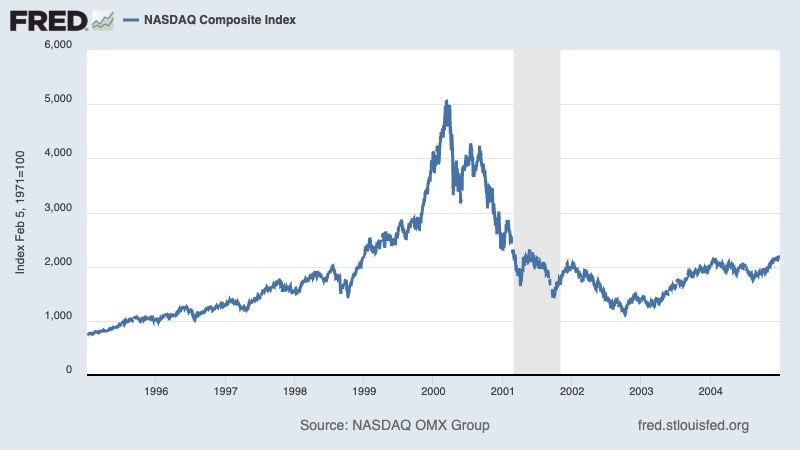
The people who have been reading us for a while know we think we are currently living in the financial mania chapter of AI, which means most private AI companies are way overvalued and that over 90% of existing AI companies will not be here in five years. Our proof in point is that of the thousands of internet companies VC-backed in the 1990s, only Amazon (founded 1994), eBay (1995), Netflix (1997), Google (1998), and Salesforce (1999) are still standing. Conversely, over 1,000 VC-backed Web2 companies (e.g., Uber, Facebook, Tesla, ByteDance) have succeeded and continue to thrive.
The bottom line is you can bet that innovation history will repeat itself during Web3—so beware! Immodestly, I know a little bit about calling tech company valuation bubbles, as documented in the book I wrote with my brother Michael in 1999, called The Internet Bubble: Inside the Overvalued World of High-Tech Stocks (HarperBusiness).
Reminder: The Internet Bubble took 2 years and 7 months for the NASDAQ to recover from the pop. 😳
Cutting through Silicon Valley's AI fantasies
cryptoniteventures.substack.com/p/its-all-abou…
Today, a more cult-like fantasy layers on top of the current financial mania: the illusion that AI models will somehow gain consciousness. Dario and Elon, as illustrated above, are part of this cult. To believe what they believe, you have to assume that the human mind is merely a complex machine or a ‘meat computer’ as Elon describes it.
Ultimately, this debate separates the materialists from those who see the origin of human consciousness differently and gives a nod to divine or non-material sources. I solidly believe in the latter and find it obvious, but this difference will not be settled here or anywhere. But let’s start the debate.
The most successful futurist of the last 60 years (and my friend and hero), George Gilder, who is well steeped in science and digital technology, repeatedly hammers home that there is a massive efficiency gap between biological brains and digital systems. We are nowhere near replicating (let alone surpassing) human-level sophistication. Consider these facts I’ve learned from George:
One human brain has roughly as many connections as the entire global internet. These connections take about the same amount of data: around a zettabyte (10²¹ bytes).
Yet the human brain runs on just ~12–14 watts of power—not enough to illuminate an incandescent light bulb.
Conversely, today’s AI data centers devour gigawatts — even billions of watts — for processing that is orders of magnitude less dense, less truly creative, and far narrower than our brain.
Silicon-based computing is wildly inefficient compared to carbon-based (biological) computing.’ True consciousness and sophisticated thought aren’t just about scale or speed; they’re about low-energy, high-density, analog-ish processing that current AI can’t touch.
‘The brain is the original neural network. AI is a prosthetic tool at best—great for augmenting humans—but it can’t think, create, or achieve consciousness. The blind spot of AI is that consciousness does not emerge from thought; it is the source of it. AI thrives on averages and existing data—regurgitating internet patterns—while human creativity involves surprise, purpose, and novelty.’ —Uncle George Gilder
In other words, the singularity (AI surpassing and obsoleting humans) is impossible in principle and mathematical absurd. George references Gödel, Turing, and Shannon to argue that consciousness and creativity require something non-computable.
Over-anthropomorphizing doesn’t compute. AI is clearly a great productivity multiplier, but the human mind’s sophistication dwarfs it in efficiency and depth, running on a fraction of the power with far greater connectivity. George predicts the future will shift toward ‘carbon computing’ (graphene, neuromorphic chips, bio-inspired hardware) and achieve brain-like efficiencies rather than brute-force silicon scaling, but still….