
JJ

412 posts

JJ banner
JJ

JJ

@HiJason

📊🔬

Katılım Temmuz 2015
491 Takip Edilen460 Takipçiler
JJ retweetledi
G | Ethena
G | Ethena@gdog97_·
The last few days have been incredible to witness. I've never seen a community rally around and engage with passion like this before. Following direct discussions with individuals in the community and validators we have taken onboard some of the concerns, namely: -Ethena is not a Hyperliquid native team -We have other product lines outside of USDH -Our ambitions extend beyond working with just one partner exchange These are valid and we accept the pushback. It appears the decision is a near certainty now and we will respectfully be withdrawing our proposal to allow validators to signal their support elsewhere if they want to. Congratulations to the Native Markets team. You deserve this. While some are complaining about their lack of credibility I think their success here perfectly embodies everything which is so special about Hyperliquid and their community. No one gives a fuck how big you are, your background, pedigree or financial resources. It is a level playing field where emergent players can win the hearts of the community and are given a fair shot at succeeding. To everyone within and outside the community who supported our proposal: thank you. It's a privilege and honour to build alongside you. Also worth calling out the other proposals which were a testament to the quality of teams now in this space and it is great to see us all elevate each other to a higher level. So what happens with Ethena on Hyperliquid going forward? Well we are simply going to do everything we said we would. If it wasn't obvious from our post, clipping 5% on tbill yields into a declining interest rate environment isn't exciting to us at all. In fact it was the least interesting part of our plans. Developing new products with native teams including: -hUSDe native synthetic dollars, -USDe enabled savings and card spending products, -enabling hedging flows on Hyperliquid, -and the wide design space of HIP-3 markets uniquely enabled by Ethena: a) reward-bearing trading collateral, b) modular prime broking, c) perpetual swaps on equities ...is what actually excited us. And we will be putting our full force behind making that a success despite the outcome here. In short, we will do what we have always done since day one: outcompete everyone else on product regardless.
English

413
260
2.4K
340.5K
JJ retweetledi
turdstomper99
turdstomper99@footllocker·
this is the most solana aligned coin i've ever seen dead in 2 days Decentralized Nasdaq
turdstomper99 tweet media
English
0
1
12
427
JJ retweetledi
Telemetry
Telemetry@bonkbot_io·
The Whale Files produced by BONKbot and @Jake_Hanrahan . for the first time, go behind the scenes of the shitcoin trenches with the elite traders who live and breathe them. raw, uncensored, unprecedented, worldwide. ep. 1 coming soon. subscribe here: youtu.be/KMh_x4idEQc?si…
YouTube video
YouTube
English
40
39
275
66.9K
Puzzle & Dragons NA
Puzzle & Dragons NA@PuzzDragNA·
We've got some exciting news! The Monster Hunter collab is returning to Puzzle & Dragons soon!
English
5
26
166
12.7K
BacGames
BacGames@BAC_Web3·
BAC Racing Club is gradually revealing the mysterious identities of some investors! Together, we make the Cyberpunk Universe an even more exciting place! We will announce information about institutional investors at the appropriate time! Keep follow and BLAST off with BAC! 💥
BacGames tweet media
English
485
4.5K
4.9K
598.5K
JJ retweetledi
Slerf
Slerf@Slerfsol·
oh fuck
English
1.5K
1.5K
6.5K
1.8M
KIP Protocol
KIP Protocol@KIPprotocol·
Genesis Blindbox NFT Transmission Loading... 📡
KIP Protocol tweet media
Dansk
4.6K
7K
7.6K
96.8K
JJ retweetledi
Bold
Bold@boldleonidas·
Bold tweet media
ZXX
98
249
2.2K
145.9K
Julian @ 𝗞𝗜𝗣 ㊋⫸
Julian @ 𝗞𝗜𝗣 ㊋⫸@julian_kip·
We're cooking something big. Technically, ground breaking. Experience-wise, will blow your socks off. You've never seen decentralised AI like this.
English
1.7K
2.9K
3.1K
62K
KIP Protocol
KIP Protocol@KIPprotocol·
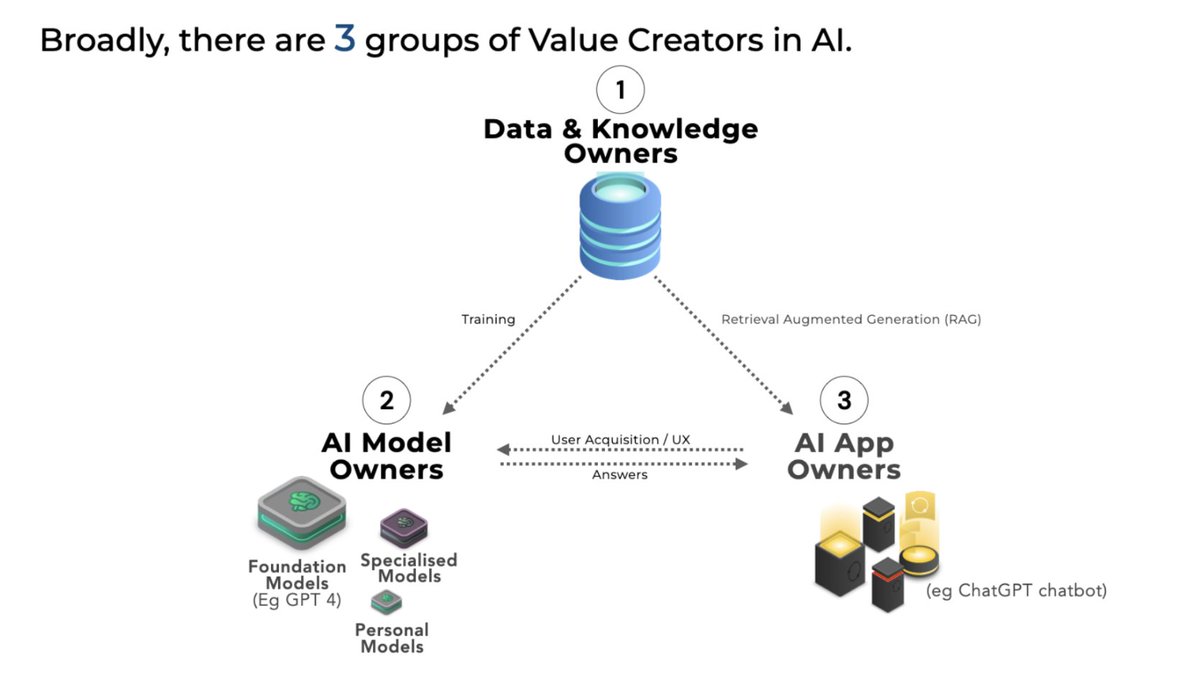
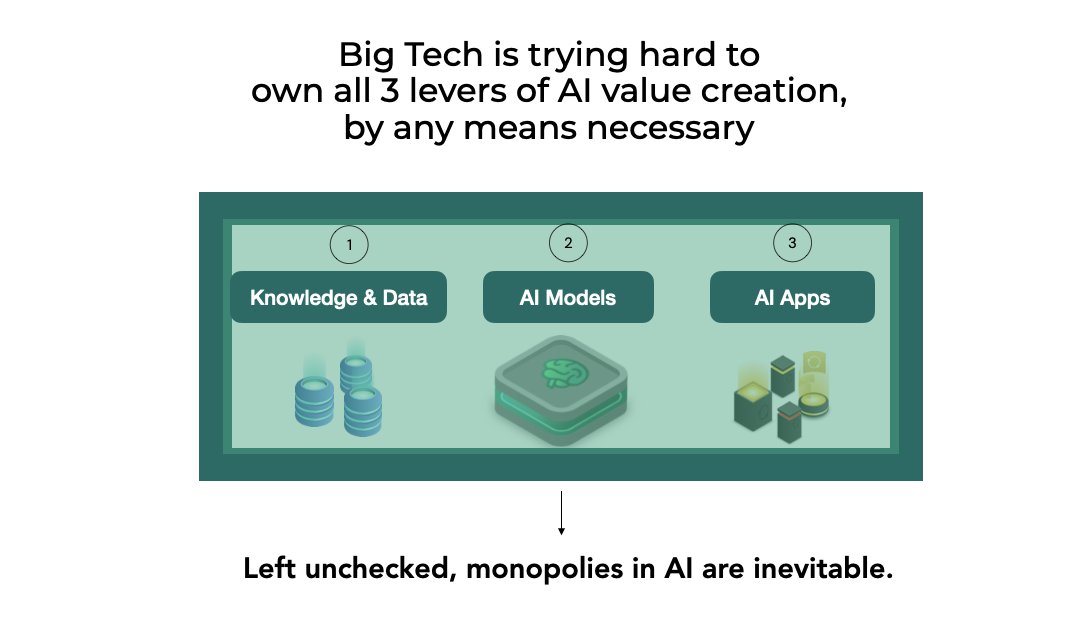
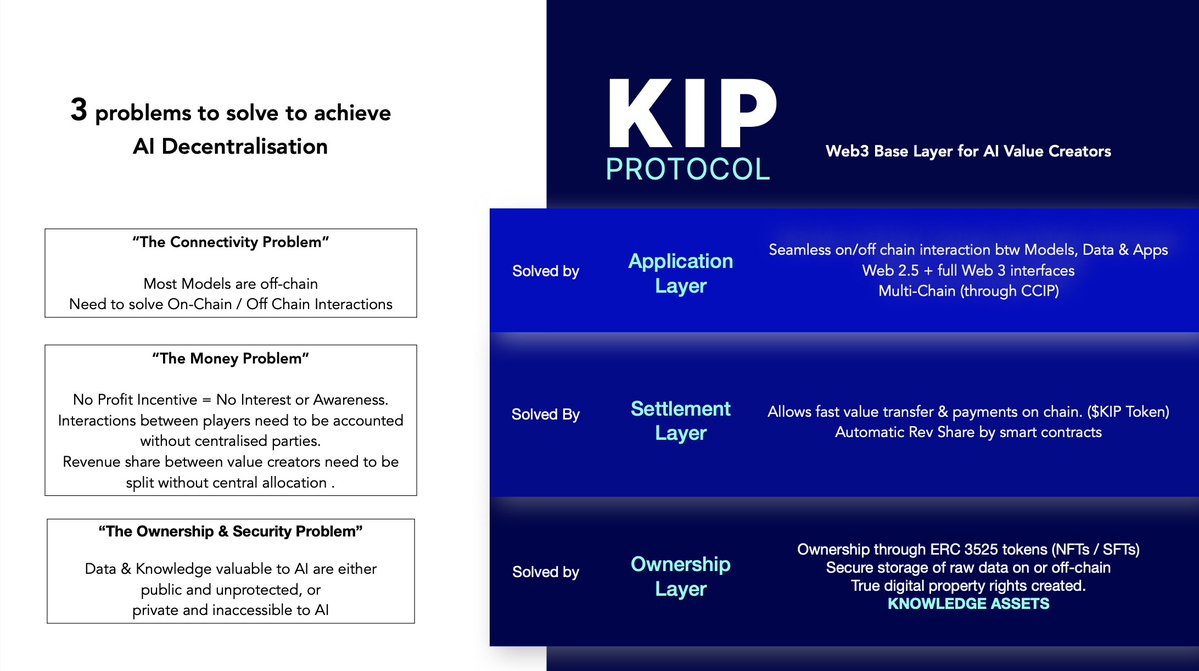
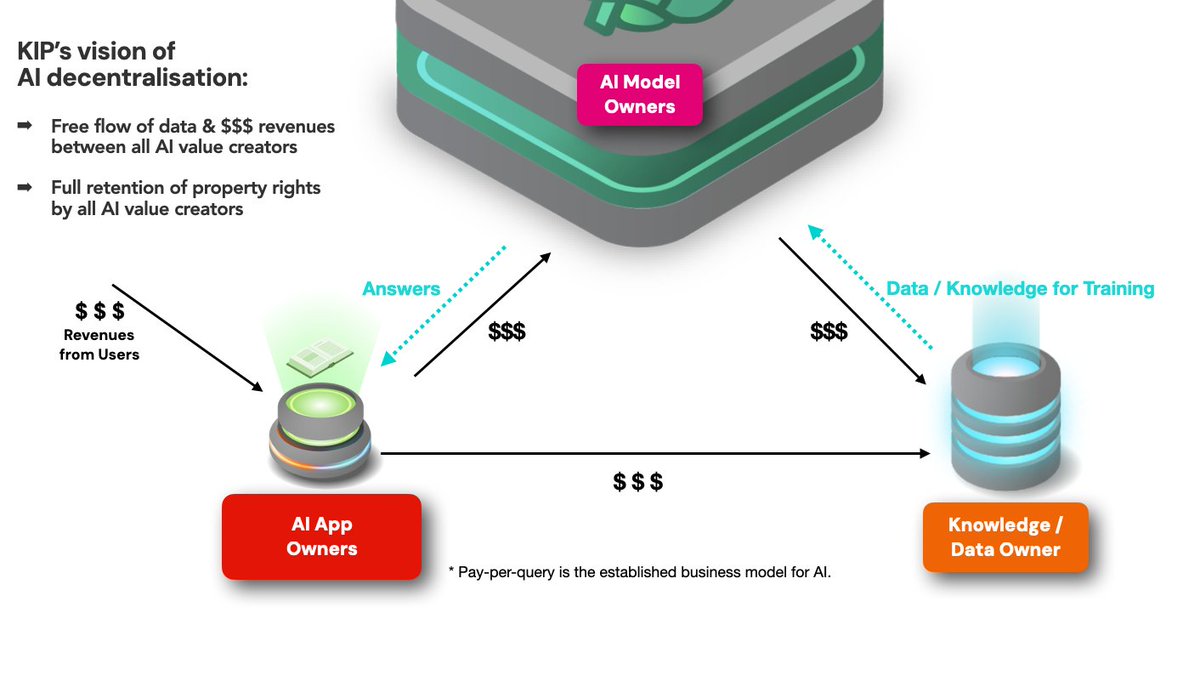
KIP Explainer Series: #2 What is RAG, and Why is KIP decentralizing it? TLDR: RAG is an innovative technique used in Generative AI, involving 3 key Value Creators in AI (app owners,📱, model owners 🤖, data owners 📚 ). KIP's successful decentralisation of RAG essentially gives a framework for the decentralisation of all of AI, and is a necessary first step to fight encroaching AI Monopolies. 1⃣ RAG IN A NUTSHELL ​​AI models are trained by feeding in data. They learn from the data, adjusting their internal weights to recognize patterns, enabling them to make predictions or decisions based on new data. The model can then answer user queries from its newly-gained "native" knowledge. But this training process requires the entire dataset to be exposed to the model, and essentially results in the data being 'absorbed' into the model. If the data includes confidential or copyrighted information, there's a risk that the model will spit that information out verbatim at some point in the future. So what if you don't wish to put your data at risk? That's where Retrieval-Augmented Generation, or RAG comes in. RAG is a sophisticated technique that enables AI models to generate answers it doesn't natively know, by retrieving data & information from external knowledge bases & databases it is given access to. It's like an intelligent assistant who does not know the answer to your question, but is able to expertly research to find the answer from external data sources. 1. User Query Input: The process begins with a user posing a question or query to a chatbot running a RAG system. For example, "What are the symptoms of COVID-19?" 2. Retrieval from External Databases: The model initiates the retrieval phase by searching through linked external knowledge bases & databases, such as medical journals, health websites, and clinical databases, to retrieve only relevant chunks of data and info related to the user query. 3. Data Processing, Filtering and Generation: Retrieved data undergoes processing and filtering to extract key information and eliminate irrelevant data points. The AI model synthesizes the retrieved data with contextual cues from the user query to generate a response. In the case of the COVID-19 symptoms query, RAG might generate a response listing common symptoms such as fever, cough, and shortness of breath, but also potentially including information the latest medical research papers that was not available when the model was trained - a higher quality response. 4.Response Delivery: The generated response is presented to the user via the chatbot interface. Thus, RAG allows external data to be used to answer AI queries without needing that data to be "absorbed" first by a model through the training process. RAG techniques are getting more sophisticated all the time, and in our research paper here, we show that quality of answers under RAG can outperform trained models. arxiv.org/pdf/2311.05903… ​​2⃣ IMPORTANCE OF RAG RAG is going to become increasingly important because: ​​​ 1. Model training is a highly technical and specialised activity, and often very expensive to do - not everyone will have the necessary skillsets or resources to able to train models. 2. There is a lot of data (confidential, proprietary etc.) whose owners may never feel comfortable to expose fully to models they don't fully own or control. One important point you may also have noticed is: Under a RAG framework, app owners,📱, model owners 🤖 and data owners 📚 work together and each contribute to the answering of user queries. Thus, in a equitable state of affairs, each party should be fairly compensated for their contributions. But there is currently no easy way to do this without compromising each party's independence or ownership rights. (Incidentally, this problem is exactly what prompted us to start building KIP, more than a year ago.) This is the "money problem". ​​​3⃣ "THE MONEY PROBLEM" WITH RAG & CENTRALISED AI Let's imagine a situation where one entity owns all three levers of AI value creation: there's no need to split payments collected from the users between the parties, as it's just internal accounting. But the flipside of that is: if we are not ok with ONE ENTITY OWNING ALL 3 LEVERS OF AI VALUE CREATION ( 📱, 🤖 , 📚 ), we must solve the issue of how to split money between the different industries of AI Value Creators. Without solving "The Money Problem", ( 📱, 🤖 , 📚 ) cannot each maintain their independence and freedom to trade. And a monopoly is already forming right now. Here's our opinion on how the monopolistic battleplan of OpenAI will work: - OpenAI obviously has some of the most powerful models - closed-source models like GPT-4, which were trained using our collective knowledge as published and scraped from the open internet over many years. That powers their apps like ChatGPT, and the user-made GPTs. - Via their Copyright Shield - that is, their commitment to pay the legal fees of anyone found to be uploading copyrighted data to their platform - they embolden and encourage their users to upload data to their closed platform without fearing legal consequences. - Given that OpenAI is a centralised, closed-source web2 platform, we should ask ourselves: does the data uploaded by users - whether to ChatGPT or the GPTs apps - still belong to the uploaders? - So with their existing models, unapologetic scraping of any and all data, Copyright Shield, and their huge war-chest, you have probably the most voracious data vacuum cleaner ever created, sucking in data and resources to feed their models. Put all the above together (and their 7 tttttrillion dollar raise for hardware) and it's not difficult to see that total monopolisation of AI development by one or a few companies will be inevitable, unless something is done. For reasons we've already shared, we passionately believe that AI monopolisation is bad for humanity, and are actively fighting against it. 4⃣THE SIGNIFICANCE OF DECENTRALISING RAG RAG involves all 3 core levers of AI value creation ( 📱, 🤖 , 📚 ). Thus, by building a framework for decentralising RAG, KIP essentially builds a framework for decentralising control over value creation in AI, thus giving a level playing field for all value creators to fight AI monopolies. We allow AI to function efficiently as a collaborative effort involving millions of small- and large-scale creators, without the need for one huge company to coordinate each of the core functions. We will do that by first solving 3 base level problems that have been a barrier to the decentralisation of RAG: 1. Ownership: Ensuring that ( 📱, 🤖 , 📚 ) can publish easily and securely to web3 easily, creating their web3 "trading entity" in the form of ERC 3525 Semi-Fungible Tokens, thus enabling them to prove their digital property rights on chain. 2. Connectivity: Ensuring smooth off-chain and on-chain interactions, providing an open environment for 📱, 🤖 , 📚 to connect to each other easily and freely 3. Monetisation: Providing a common framework for recording & accounting for the contributions of each AI Value Creator, as well as an automated revenue share and withdrawals. By bringing about decentralised RAG (d/RAG), KIP is crafting the first crucial blueprint for fighting AI Monopolies. Unlocking digital property rights for each AI value creator, and empowering each to transact while remaining independent, is the exact opposite of what Big Tech is trying to achieve. KIP Protocol arms AI Value Creators with the weapons ⚔️ necessary to fight the monopolists in AI.
KIP Protocol tweet mediaKIP Protocol tweet mediaKIP Protocol tweet media
English
4.5K
6.4K
7.2K
261K
KIP Protocol
KIP Protocol@KIPprotocol·
KIP Explainer Series: #1 Why is KIP the Web3 Base Layer for AI? First off: KIP is not a single AI app, nor a large language model, nor a database / knowledge base. KIP is a decentralized protocol that AI app owners 📱, model owners🤖 and knowledge base / data owners📚 will find essential to decentralise their work & monetise in Web3. (For brevity, we call these 3 categories 📱, 🤖, 📚 : AI Value Creators) Decentralisation of AI is an extremely large & important topic, and there are multiple groundbreaking projects taking different approaches at the problem. For us at KIP, we are focused on solving the base level problems that AI Value Creators will face when trying to deploy and monetise their work in Web3. AI MODELS 🤖 NEED APPS 📱& DATA 📚 TO CREATE ECONOMIC VALUE While there are easily 20 over categories of companies creating solutions in AI, most of the attention in Generative AI over the past year has been on the AI Models (and there is a huge variety of different categories and approaches here from transformers to GANs to diffusion models to name a few). Indeed, these models represent the true breakthrough of this new era of computing—the true Brains behind it all. But to build a business ecosystem within AI, models need to rely on at least 2 other essential Value Creators. 1) AI Apps📱: 'The Face of AI' It's easy to overlook the importance of apps amidst all the excitement over models. AI Apps are essential for getting users into AI. Apps can take many forms, like chatbots, image generators, search bots, analysis bots or in its most elegant form, simply prompts. They craft the user experience, acquire the users, and perhaps most importantly, collect the fees from the users. Many forget that ChatGPT is OpenAI’s app, powered by OpenAI’s various models (GPT 3.5, GPT 4). The then ground-breaking human-like responses of the OpenAI chatbot were largely coded on the app-end, not the model end. (Connecting to the models directly via API, and comparing the answers, will tell you this.) TLDR: without Apps, models would just be sets of code and weights sitting in a metal box somewhere with no way to utilise them. ​​​2) Data📚: 'The Lifeblood of AI' Data is needed for: a) Training & Fine Tuning Models, & b) Retrieval-Augmented Generation (RAG) All models are trained and fine-tuned on data. Without fine-tuning, models don't get stronger or smarter. But by using data to finetune or train models, it causes the data essentially to be 'assimilated' or 'absorbed' into the models, manifested in the adjustment of the model weights. So in situations where it is impossible, impractical, or illegal to just use data to directly train the models, the innovative technique called Retrieval-Augmented Generation (RAG) steps up to deliver. RAG combines the power of retrieving information from external databases with the capability of generating responses via an AI Model. It's like having a super-smart assistant who understands your questions but also knows where to find the answers even if it doesn't know the answer itself. While RAG is still relatively new, it’s our firm belief that given increased sensitivity and protectionism over data, RAG techniques could emerge as a leading approach, driving significant business value through real-world applications, and making it a dominant framework under which most people access AI in the future. TLDR: Regardless of which approach, continued AI innovation is simply not possible without data. A VIBRANT AI ECOSYSTEM REQUIRES MULTIPLE INDEPENDENT INDUSTRIES OF VALUE CREATORS Individuals and companies skilled at training and finetuning models, may not be the same people who are great at designing and marketing customer-facing apps. Similarly the researchers and domain experts with valuable data sets and knowledge bases, may not have the right skill sets to train AI models or design applications. But in a vibrant and diverse ecosystem, they don’t have to . Seperate industries of companies and individuals can work together to create use cases and economic value for users. An app designer can choose the AI model most suitable for his product plans, and pre-select the external knowledge bases most helpful for his users. But what if all 3 potentially vibrant and independent industries are being slowly absorbed into one closed ecosystem? Because that’s exactly what’s happening right now. We will cover this in detail in future articles, but for now: do a web-search for "openai copyright shield" and consider the implications for data ownership in the AI future. WHY KIP WANTS TO CATALYSE AI DECENTRALISATION ​​Monopolies in AI are uniquely dangerous, and decentralisation of AI is an urgent and necessary response to the subjugation of our collective interests to that of a narrow set of corporate interests. We are 100% for AI accelerationism (e/acc), and we do not deny the significant contributions of Big Tech in advancing AI innovation. But large companies will act only in the best interests of their shareholders, and they will do whatever they can get away with. It’s the nature of capitalism; to expect them to change their nature and ignore their driving motivations is to deny reality. We need a state of adversarial equilibrium in AI, with a multitude of different actors participating and competing in the market, fostering an environment where innovation can thrive. The future of AI must not become subjugated to any megacorp’s corporate interests. And decentralization of AI is, in our opinion, THE ONLY WAY to bring about that desired state. HOW KIP CATALYSES DECENTRALISATION OF AI KIP solves three base level problems that AI apps, models, and data owners will face when trying to decentralize. 1) On-chain / Off-Chain Connectivity 2) Monetisation & Accounting 3) Ownership & Security The “Connectivity” Problem There are > 400,000 models on Hugging Face, which is indicative of how vibrant, but also how nascent the entire AI industry really is. Current blockchain technology cannot deliver the core inference function of models (ie totally decentralised models) at a cost or speed that most ordinary users would find acceptable (although advances in edge computing may get us there soon) Thus most, if not all, of these models are off-chain, and we can expect more innovation and tinkering to be done in off-chain models. In order to unleash all those ideas and innovation in web3, KIP makes it easy to account for off-chain inference, on-chain. KIP facilitates this through a framework that allows the heavy computational tasks associated with machine learning inference to be processed outside the blockchain, while still maintaining the integrity and principles of a decentralized system. The “Money” Problem The best technology in the world would not see adoption if adopters do not enjoy increased economic benefits. The basic revenue model framework for AI can be described as “pay-per-query”, as every single query from a user expends GPU compute, and thus have to be paid for by someone. And to answer a single user query, multiple AI value creators contribute to the answering of that question. We are not advocating decentralization merely for decentralization’s sake, but rather decentralization as an alternative to monopolization. Thus, for AI decentralisation to succeed, we need to ensure that the parties who are decentralizing their AI work are able to earn revenues. This sounds obvious enough, but in the case of AI, this is not as straightforward as it sounds. Let’s give an example of a query run via RAG 1. A user makes a query to an AI Chatbot. 2. The AI Chatbot passes the query over to its brain the AI model. 3. The model retrieves only relevant chunks of data from the Knowledge Base it requires to answer the question, formulates the answer and sends it back to the App. 4. The App packages the answer and delivers it back to the user. In this simplified example, you will see how all 3 actors each contribute towards the answering of the user query. If one platform owns and controls all three (🤖,📱,📚) under a centralized ecosystem (like what OpenAI is trying to do in the 2nd diagram above), then you just have to pay that one centralised platform, as the rest is internal accounting. But if we want decentralization rather than monopolization, then each party needs to be paid, thus requiring solutions for: 1. Recording (on-chain) the contributions of each, 2. Splitting / allocating the revenues from the users 3. Enabling each to withdraw their revenues This is the “money problem” in decentralizing AI that KIP solves. We do this through a low gas, high efficiency Web3 infrastructure that provides for connectivity between AI value creators, a way to collect payments from the user, and a way to withdraw earnings. (We will cover this in an upcoming KIP Explainer) Without solving the money problem first, decentralization of AI will be much more difficult, and will be far more unlikely to gain wide-spread adoption beyond a few true believers. The “Ownership” Problem Monetisation is merely a weak privilege, if it is not tied to true ownership. We have all seen how accounts on centralized platforms can be shutdown, banned, shadowbanned at a moment’s notice. KIP solves this through using blockchain tokens, specifically the ERC-3525 token (SFTs), to “wrap” the work of the AI Value Creator. 1.For data owners: the SFTs wrap vectorised knowledge bases, or a link to an encrypted raw data file to be used for model training. 2.For model makers: the SFTs could wrap an API to an off-chain model, or a set of model weights ready for sale 3.For app devs: the SFTs could wrap the front end APIs, or the prompt itself. These SFTs serve as 'accounting entities' that can interact with each other on-chain, and record the amounts each SFT earned from a particular transaction. By solving these problems, KIP makes it possible and easy for AI Value Creators to decentralize their work, creating the starting conditions for a vibrant and much larger decentralised AI ecosystem. KIP is the necessary Web3 Base Layer for AI.
KIP Protocol tweet mediaKIP Protocol tweet mediaKIP Protocol tweet mediaKIP Protocol tweet media
English
4.9K
6K
6.6K
319.6K
JJ retweetledi
cade
cade@cade987·
what
English
121
164
1.1K
420.4K
KIP Protocol
KIP Protocol@KIPprotocol·
Announcement 🚨 We are thrilled to announce that we have successfully closed our strategic funding round led by @AnimocaVentures, the venture capital arm of Web3 behemoth Animoca Brands. 👇 1/5
KIP Protocol tweet media
English
2.5K
2.9K
3.5K
172.6K
KIP Protocol
KIP Protocol@KIPprotocol·
Retrieval Augmented Generation (RAG) allows data to be used by AI, without needing to finetune the AI. One of KIP's core inventions: Decentralised RAG. This will open up massive new industries of 📱app devs, 🤖model makers and 📚data owners being able to deploy, create and monetise in Web3. This will in turn bring whole troves of users to interact with these decentralised AI apps, operating in on a trustless framework. KIP ⏩ Decentralized AI for Everyone
English
2.2K
2.2K
2.4K
55.8K
JJ
JJ@HiJason·
@KIPprotocol $KIP 🧠 Decentralized AI for everyone!
English
1
1
2
28
JJ
JJ@HiJason·
@KIPprotocol KIP catalyses Decentralised AI🧠
Français
0
0
0
32
KIP Protocol
KIP Protocol@KIPprotocol·
AI will herald the future of our species, in more ways than we can imagine. But if AI is monopolised by only 2-3 large corps, then the economic benefits of that future will accrue mostly to them. Decentralised AI is the only way forward for us. KIP will catalyse it.
English
2.1K
1.9K
2.1K
36.8K
JJ
JJ@HiJason·
@KIPprotocol KIP is that protocol!🧠
English
0
0
0
12
KIP Protocol
KIP Protocol@KIPprotocol·
Models aren't the only players in AI. The best way to create a vibrant and robust AI ecosystem, is a Web3 protocol protecting the ownership and economic interests of 3 key groups: 👾 Model owners 🖥 App owners 📚 Data owners KIP is that protocol 🦾.
English
1.7K
1.6K
1.8K
33.2K
JJ
JJ@HiJason·
@evaalabs 0xeEf158433B20C6F8913eCBa54e937ed25122e42f
Filipino
0
0
0
16
EVAA 🍎
EVAA 🍎@evaalabs·
A bountiful harvest always starts with the sowing of the seeds. Drop your eth address below You have 48 hours ⏳
EVAA 🍎 tweet media
English
171
14
53
2.5K