Greg Stanton

1.6K posts

Greg Stanton banner
Greg Stanton

Greg Stanton

@HigherMathNotes

Motivated, accessible math. YouTuber | Open-source developer | Aspiring independent researcher. Prev: @Wikimedia #Eventmath grantee. Views are my own.

Denver, CO Katılım Haziran 2016
628 Takip Edilen882 Takipçiler
Greg Stanton
Greg Stanton@HigherMathNotes·
Yes! I've been wondering if discovery fiction (in the sense of @michael_nielsen) and open-exposition problems (as introduced by Timothy Chow) might start to receive greater attention. It's also interesting to consider how AI might assist in these more subjective areas.
Rado Kirov@radokirov

Why am I excited about math formalization with AI assistance? Paradoxically, it might free up human time and exposition space for some more human, softer and often neglected aspects of mathematics - intuition, storytelling, experimentation, etc. (From arxiv.org/pdf/2603.26524)

English
1
0
3
330
Greg Stanton
Greg Stanton@HigherMathNotes·
📢Stunning math & AI update "I still did not see how to prove this inequality, but I decided to try my luck giving it to ChatGPT Pro, which... gave me a duality-based proof..."—Terence Tao (3/23/26) How Fields medalist Tao used AI in his latest work: terrytao.wordpress.com/2026/03/23/loc…
English
0
0
2
288
Greg Stanton
Greg Stanton@HigherMathNotes·
@CoryMSimon There's a precise connection between the discrete generating functions from de Moivre (they solve recurrence relations, i.e. difference equations) and the continuous Laplace transform (it solves differential equations). Very cool story, but that's for another day!
English
0
0
0
34
Greg Stanton
Greg Stanton@HigherMathNotes·
@CoryMSimon So there you have it. You now have the short version (in a single tweet), and a longer version haha. I hope you don't mind the extra detail. That's not the full story, of course. What about other uses of the Laplace transform, like solving differential equations?
English
1
0
0
30
Cory Simon
Cory Simon@CoryMSimon·
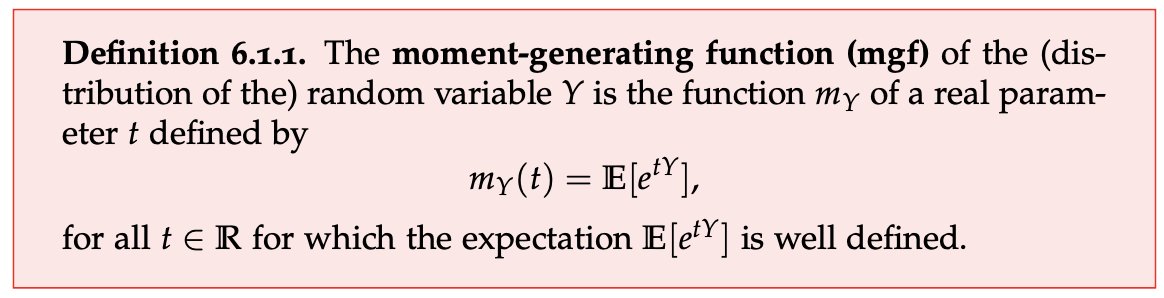
finally got around to learning about moment-generating functions (MGFs) for dealing with probability distributions. the MGF for a random variable is just a flipped, two-sided Laplace transform of its probability density. take a derivative of the MGF and evaluate at zero, voilà, we get a moment of the distribution, explaining the name. web.ma.utexas.edu/users/gordanz/…
Cory Simon tweet media
English
3
0
4
467