Hinz retweetledi

Everyone has a take on the juicy Claude Code leak.
I have a quiz instead.
Do you think like an Anthropic Product Manager/ Strategist? 10 real scenarios, 10 minutes.
claudeleakpmquiz.lovable.app”
English
Hinz
707 posts






Distributed Consistency the part no one talks about, but everything depends on Everyone talks about TPS. Everyone talks about speed. But in distributed systems, the hardest problem isn’t being fast. It’s being correct. When a system runs across multiple nodes, data doesn’t update everywhere at the same time. Node A might see the latest state. Node B might still return an older one. That’s reality. The real problem is: If consistency isn’t handled properly → the system becomes unreliable. Not because the logic is wrong. But because state diverges over time. @RialoHQ doesn’t try to ignore this. It embraces a simple truth: Not everything needs to be instantly synchronized. What matters is: → the final state is correct → state transitions are controlled → data can be verified When combined with: • structured workflows • verified external data • deterministic execution Consistency stops being a weakness. It becomes part of the system design. This matters if you want to build: • onchain finance • multi step applications • real world data systems Blockchains aren’t just transaction processors. They are distributed systems evolving over time. And if you don’t understand consistency, you won’t understand why so many things in crypto still don’t scale. Rialo is building from that reality #RialoHQ #Ai #robotic #L1 #blockchainblues #web3
MPC. FHE. TEEs. All powerful on their own, but none solve the coordination problem. The hard part isn’t just encrypting computation; it’s the orchestration required to make it functional and secure. That’s what Rialo Extended Execution (REX) does. REX is a protocol-level orchestration system for confidential computation that manages the entire lifecycle of a secure request: Program Governance – Programs to be executed are verified and approved for specific execution runs before they ever touch the core. Encrypted Routing – Encrypted inputs are routed cryptographically to a computation core only after the appropriate program logic is loaded. Explicit Consent – Computation is performed only after explicit authorization from both the application and the user, enforced by strict policy. Confidential Compute Core – Secure execution using MPC, FHE, or TEEs, including protected Web2 API calls within an isolated environment. Verifiable Outputs – The system generates and verifies cryptographic attestations that prove a specific computation was correctly executed before routing the result to its destination. REX transforms Rialo into infrastructure for real-world secure computation: Private AI agents that process personal data without seeing it. Sensitive enterprise workflows that maintain competitive secrecy. Authenticated API automation for secure, off-chain interactions. Verifiable off-chain compute with immutable on-chain guarantees. This is native privacy at the protocol layer. Get Real. Get Rialo.

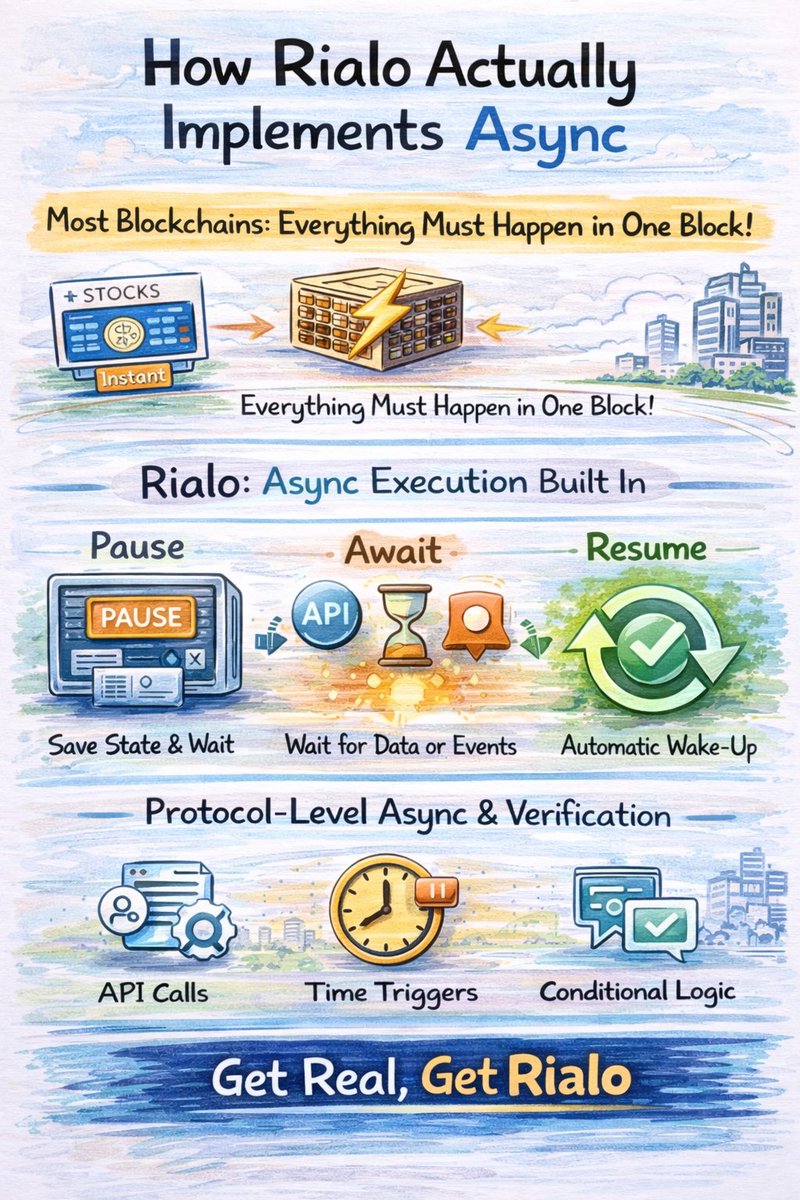
Day 29 – From Staking Rewards to Real Utility Most people see staking as a way to earn passive yield. You lock tokens, wait, and receive rewards over time. While this works, it doesn’t always help users interact with the network in a practical way. Rialo introduces a different idea called Stake-for-Service (SfS). Instead of treating staking rewards as something you simply withdraw or sell, the yield can be turned into service credits. These credits can then be used to pay for things on the network, such as transaction fees or other services. In simple terms, the rewards you earn from staking can help power the applications you use. This approach makes the system easier to use. Users do not need to constantly add gas tokens or worry about maintaining a balance just to perform basic actions. The network can automatically use staking yield to cover those costs in the background. SfS also improves capital efficiency. Rather than letting rewards sit idle, the value generated by staking can flow back into the network’s activity. This creates a loop where capital supports both security and real usage at the same time. Combined with Rialo’s fast block time, RISC-V architecture, and focus on real-world applications, this model helps reduce friction between users and blockchain infrastructure. Stake-for-Service turns staking from passive income into a system that actively powers how the network runs. @RialoHQ
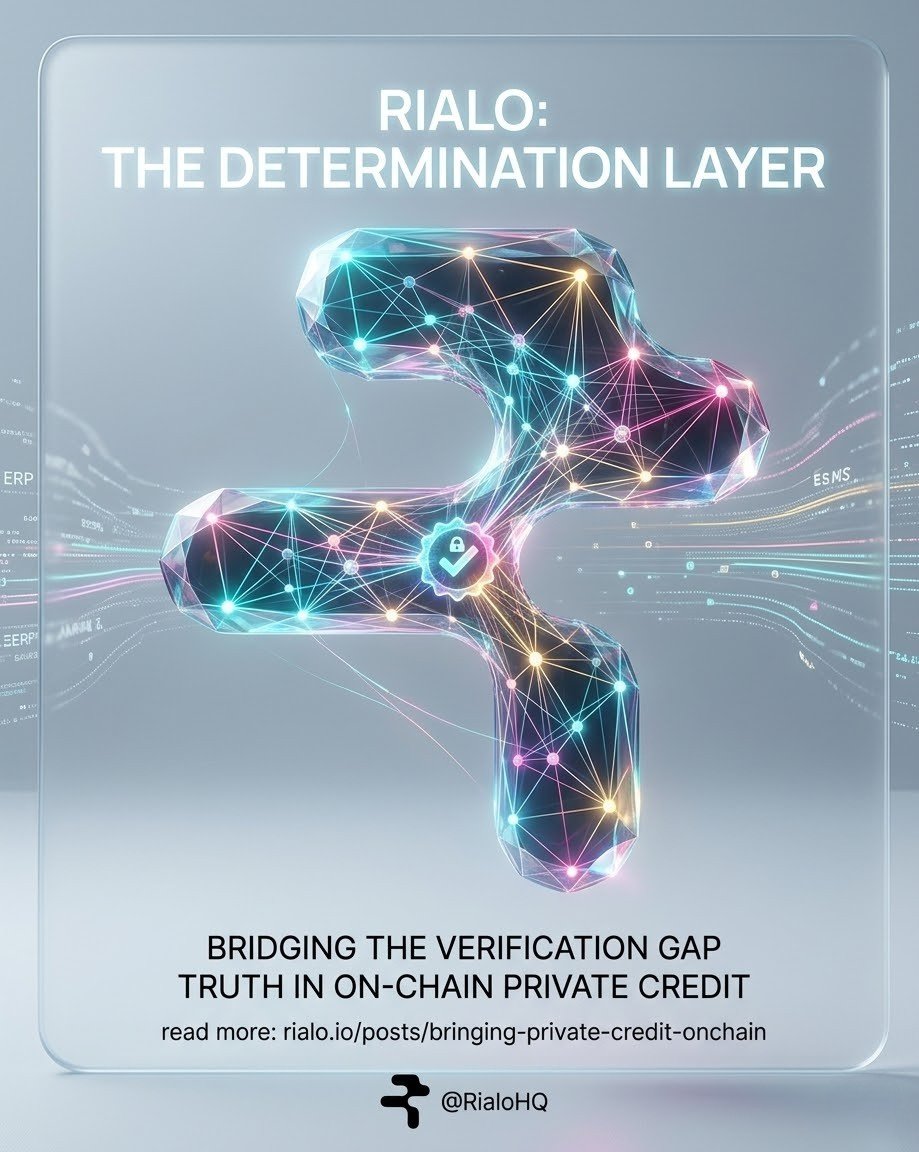
How do we bring private credit onchain? Smart contracts can perfectly enforce the rules of a credit agreement without a human in the loop, but they still rely on external inputs to determine the truth about the credit instrument before deciding how and when the rules should be enforced. Our blog post explores the verification gap and why the industry needs a Determination Layer to solve the "truth problem." Blog link below: