Sabitlenmiş Tweet
The History Feed
341 posts

The History Feed
@HistoryFeed_7
Daily history threads, forgotten stories, and moments that shaped the world.
Katılım Nisan 2026
231 Takip Edilen422 Takipçiler

1997, Stade de France.
Roberto Carlos steps up for this free kick from miles out. He takes his usual long run up and just smacks it.
Freekick from 30 yards with 20 yards runup. The ball flies way outside the post like it's heading straight into the stands, then somehow bends back in.
Visuals: Sky Sports
English

Archival footage of the Black Khan of Mongolia celebrating hitting the front page on Kick (1418)
KICK@kick
find your next fav streamer with the new front page algo
English

This clip is the last known recording of the Kaua‘i ʻŌʻō bird, captured in Hawaii in 1987.
It shows a lone male calling for a mate that would never answer. The species disappeared due to habitat loss and introduced diseases. After this moment, it was never seen again. Its final song remains a haunting reminder of a species now lost forever.
English

@historigins World War II lasted 6 years. The effects of it are still shaping the world 80 years later.
English

WORLD WAR II | TODAY IN HISTORY.
World War II (1939–1945) was the most destructive conflict in human history. It claimed between 70 and 85 million lives—equivalent to 3% of the world’s population at the time—and completely transformed the political, economic, and moral landscape of the 20th century.
Its root causes lie in the aftermath of World War I. The 1919 Treaty of Versailles humiliated Germany with enormous economic reparations, territorial losses, and military restrictions.
This created fertile ground for nationalist resentment. In Italy, Benito Mussolini’s fascism emerged in 1922. In Germany, Adolf Hitler and the Nazi Party came to power in 1933 promising to restore German greatness, seek revenge, and promote strong anti-Semitism.
Japan, for its part, sought to expand in Asia to secure resources, invading Manchuria in 1931 and China in 1937.
The spark that ignited the war was the German invasion of Poland on September 1, 1939. Hitler employed “blitzkrieg” tactics: rapid attacks combining tanks, aircraft, and infantry. Great Britain and France declared war on Germany but were unable to help Poland, which fell within weeks.
In 1940, Germany conquered Denmark, Norway, the Netherlands, Belgium, and France in a lightning campaign. Only Great Britain held out during the Battle of Britain, where the RAF prevented the German invasion.
In June 1941, Hitler made his biggest mistake by invading the Soviet Union (Operation Barbarossa). Initially, he advanced to the gates of Moscow and Leningrad, but the Russian winter, Soviet resistance, and Stalin’s massive war effort halted the advance. The Battle of Stalingrad (1942–1943) marked the turning point on the Eastern Front.
In the Pacific, Japan attacked Pearl Harbor on December 7, 1941, prompting the United States to enter the war. Japan quickly conquered much of Southeast Asia and the Pacific, but its expansion was halted at the Battle of Midway in June 1942.
The years 1942–1943 were decisive. The Allies (the U.S., the USSR, the United Kingdom, and others) coordinated their efforts more effectively. In North Africa, the British and Americans defeated Rommel’s Afrika Korps. In Italy, they landed in 1943 and overthrew Mussolini.
On June 6, 1944, D-Day, the Allies landed in Normandy, opening a second front in Western Europe. Meanwhile, the Soviet Red Army was pushing the Germans toward Berlin from the east.
At the same time, the Nazi regime carried out the Holocaust, the systematic genocide of six million Jews and millions of other victims (Roma, people with disabilities, homosexuals, political opponents) in concentration and extermination camps such as Auschwitz.
Germany surrendered unconditionally on May 8, 1945 (Victory in Europe Day). In Asia, the United States dropped atomic bombs on Hiroshima (August 6) and Nagasaki (August 9), 1945. Japan surrendered on September 2, 1945.
The consequences were immense. Europe was devastated, with cities in ruins and economies destroyed. Two superpowers emerged: the United States and the Soviet Union, which initiated the Cold War. The United Nations was created to try to prevent future conflicts.
Nazi war criminals were tried at Nuremberg, establishing the principle that “following orders” does not exempt one from responsibility for war crimes. Decolonization accelerated in Asia and Africa.
Technologically, the war spurred advances in aviation, radar, computers, and medicine. It marked the beginning of the nuclear age and left a tragic lesson about the consequences of totalitarianism, racism, and unchecked expansionism.

English

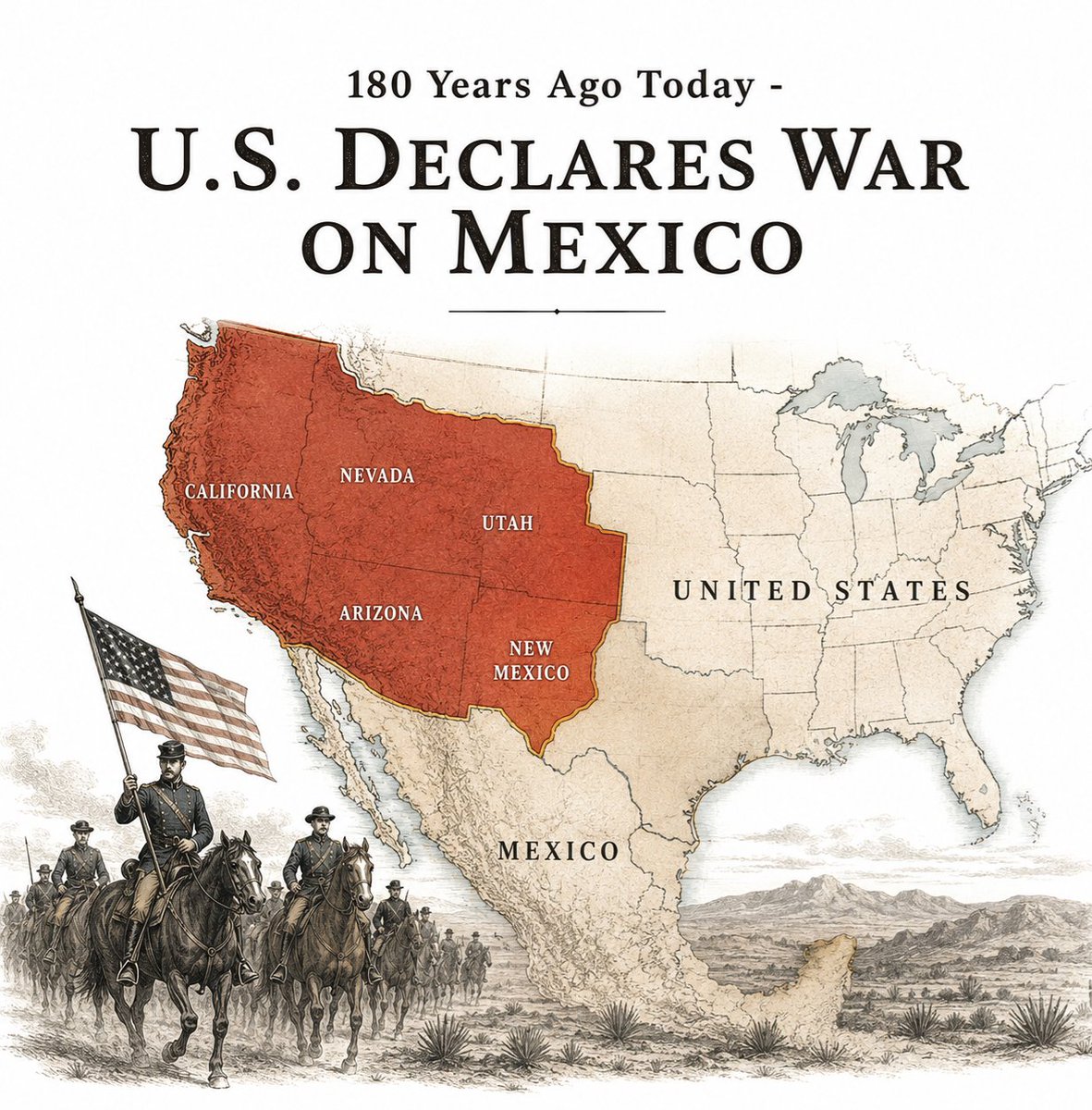
Exactly 180 years ago today the United States declared war on Mexico.
In less than two years the country grabbed California, Nevada, Utah, Arizona, New Mexico and more, more than doubling its size and redrawing the map of the West for good. It began with a border dispute and a president set on expansion.

English

@bettingkingz9 I need history loves who love to know about the things happened and provide information .
English

@john322226 Hello history lovers.
Connect with me to gain some valuable information and insights.
English

Elon don try for me! Help me pick 10 people for me to credit.
Make una use this opportunity to connect with new and serious accounts
0NLY 1 ZUMA BILLS@MightyZuma
@john322226 Elon Money too much
English

@HistoriaJack The lady is smiling looking at the camera lol....
English

Shopping on Old London Bridge

Historical Chronicles@HistoriaJack
Old London brought to life in the works of Peter Jackson (not that one)
English

Imagine Australia declaring war on a bunch of big birds.
In 1932, farmers in Western Australia were losing crops to huge flocks of emus. The government sent soldiers with machine guns to take them out. They expected an easy win against around 20,000 birds. The emus turned out to be faster and smarter than anyone thought. They scattered in small groups, dodged the bullets, and kept coming back. The soldiers fired thousands of rounds but barely made a dent. After a few weeks the operation was called off.

English

On this day, May 12, 1820, Florence Nightingale was born. She is known as the founder of modern nursing, and today is also celebrated as International Nurses Day.
Born in Florence, Italy, to a wealthy British family, she chose to become a nurse even though her parents did not support it. During the Crimean War, she worked in military hospitals in Turkey, improving cleanliness, sanitation, and patient care. Because of her work, death rates dropped sharply. Soldiers called her “The Lady with the Lamp.”
In 1860, she opened the first modern nursing school in London, helping nursing become a respected profession across the world.

English

@historyinmemes That scene basically introduced Spider-Man by saying: “Yeah, this kid operates on a completely different level.”
English

On This Day in 1949, The Soviet Union ends its eleven month blockade of West Berlin.
The Berlin Airlift one of the largest humanitarian operations in history had delivered over 2.3 million tons of supplies by plane keeping the city alive and marking a major Western victory in the early Cold War.

English