
HIVE PT | Prop Trading Firm - Funded Accounts

458 posts

HIVE PT | Prop Trading Firm - Funded Accounts banner
HIVE PT | Prop Trading Firm - Funded Accounts

HIVE PT | Prop Trading Firm - Funded Accounts

@Hiveproptrading

Advanced platform, tailored challenges, diverse markets. Prove skills. Get funded. Grow with us. https://t.co/R0x8o3mdmY https://t.co/Sc4aqzSwTG

Portugal Katılım Mayıs 2024
620 Takip Edilen2.5K Takipçiler
Sabitlenmiş Tweet
HIVE PT | Prop Trading Firm - Funded Accounts
Welcome to HIVE PT’s Trading Rules. Before you trade, read this. We offer 3 challenge types: Hive Challenge – two stages Queen Bee – one stage Worker Bee – two-stage, more rigorous Account sizes: $5K to $200K Payouts: Standard (14 days) or Express (add-on) Leverage: 1:100 by default (1:200 available as add-on) Fair play is key. The following actions are prohibited: – Bots & automation – Account transfers or sales – Market manipulation – Excessive risk – False KYC info – Any bad-faith activity Keep it consistent, stay compliant, and meet minimum trading days. Terms may change. Always refer to the full Terms of Use. We don’t offer financial advice. Trade responsibly. We want to see you on this list of payouts receivers, you should join our community on discord as well. hive-pt.com/landing-page-f…
English
11
1
12
1K
HIVE PT | Prop Trading Firm - Funded Accounts
Trader’s Highlight - Meet Ksenia! Another week, another win. We’re proud to spotlight traders who chose us—and are seeing results. No secrets, no gimmicks. Just smart decisions and the right partner. Ready to see your name here? Start your challenge today.
English
6
0
2
334
HIVE PT | Prop Trading Firm - Funded Accounts
We love the enegry of Chandu! Another week, another win. We’re proud to spotlight traders who chose us—and are seeing results. No secrets, no gimmicks. Just smart decisions and the right partner. Ready to see your name here? Start your challenge today.
English
3
0
1
234
HIVE PT | Prop Trading Firm - Funded Accounts
2. Execution Plan Pre-market Routine: Review overnight moves and global sentiment. Mark major support and resistance levels. Note any high-impact news events for the day. Scalping Example: Watch for price clustering around key levels. Enter with small risk per trade and aim for a slightly higher reward than your risk. Pause if you hit three consecutive losses. Trend Following Example: Confirm the trend on a higher timeframe. Enter on a pullback using a smaller timeframe. Risk a small percentage of capital per trade, and trail your stop as the trade moves in your favor. Range Example: Identify clear range boundaries. Enter at the edges, exit near the middle or at the opposite boundary. Cut losses quickly if the range breaks. Pair Trading Example: Monitor for divergence between two correlated assets. Enter when the spread widens abnormally, exit as it returns to normal. 3. Risk Management Set a hard daily loss limit. If reached, stop trading for the day. Limit risk per trade to a small percentage of your account. Always use stop-loss orders. Avoid taking too many trades in correlated assets at once. Review and log every trade, including your reasoning and emotional state. 4. Prop Trading Challenge Tips Break your profit target into smaller daily or weekly goals. Always confirm your trade idea on a higher timeframe before entering. Avoid trading during the first few minutes after the market opens unless you have a proven strategy for that period. Review your trades after each session to identify strengths and areas for improvement.
English
0
0
1
142
HIVE PT | Prop Trading Firm - Funded Accounts
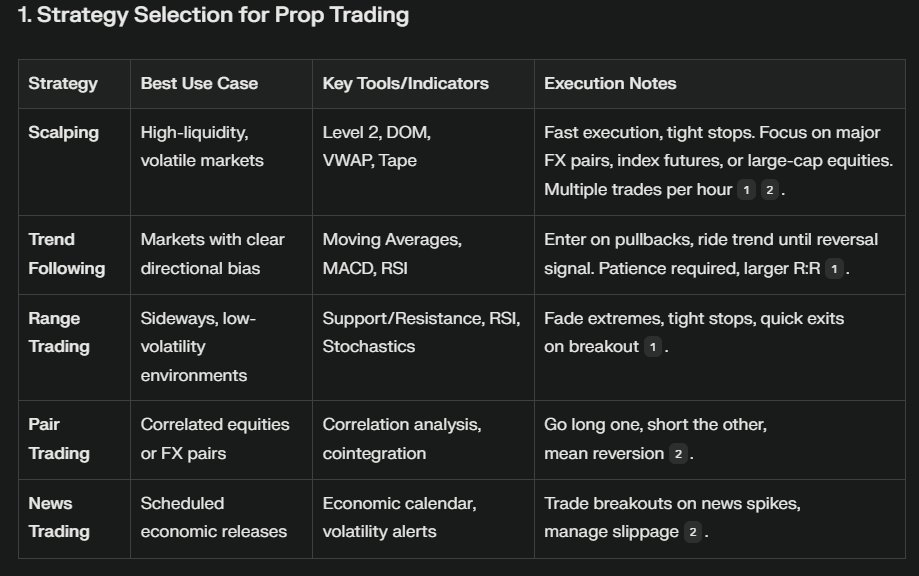
Here's our suggest strategies Scalping: Focus on highly liquid, volatile markets. Enter and exit quickly, aiming for small, consistent profits. Use tight stop-losses and monitor price action closely. Take multiple trades per session, but only when your edge is present. Trend Following: Identify strong directional moves. Enter on pullbacks in the direction of the trend. Hold trades until clear signs of reversal. Let winners run, but protect profits by moving stops as the trade becomes profitable. Range Trading: Find markets moving sideways. Buy at support, sell at resistance. Exit quickly if price breaks out of the range. Keep stops tight and profits realistic. Pair Trading: Trade two correlated assets, going long one and short the other. Look for divergence from their normal relationship and aim for mean reversion. News Trading: Focus on scheduled economic releases. Enter trades when volatility spikes, but manage risk tightly due to unpredictable moves.
HIVE PT | Prop Trading Firm - Funded Accounts tweet media
English
1
0
1
195
HIVE PT | Prop Trading Firm - Funded Accounts
Trader’s Highlight Another week, another win. We’re proud to spotlight traders who chose us—and are seeing results. No secrets, no gimmicks. Just smart decisions and the right partner. Ready to see your name here? Start your challenge today.
English
0
0
1
124
HIVE PT | Prop Trading Firm - Funded Accounts
Welcome to HIVE PT’s Trading Rules. Before you trade, read this. We offer 3 challenge types: Hive Challenge – two stages Queen Bee – one stage Worker Bee – two-stage, more rigorous Account sizes: $5K to $200K Payouts: Standard (14 days) or Express (add-on) Leverage: 1:100 by default (1:200 available as add-on) Fair play is key. The following actions are prohibited: – Bots & automation – Account transfers or sales – Market manipulation – Excessive risk – False KYC info – Any bad-faith activity Keep it consistent, stay compliant, and meet minimum trading days. Terms may change. Always refer to the full Terms of Use. We don’t offer financial advice. Trade responsibly. We want to see you on this list of payouts receivers, you should join our community on discord as well. hive-pt.com/landing-page-f…
English
11
1
12
1K
HIVE PT | Prop Trading Firm - Funded Accounts
Strategic Analysis: Iran-Israel War and Ceasefire Market Impact War Impact Analysis: The Iran-Israel conflict triggered a classic risk-off reaction in global markets, but the magnitude was notably muted compared to similar historical events. Oil prices initially surged over 10% on fears of supply disruption, but this spike quickly reversed as it became clear that neither side intended to escalate into a full-scale regional war. The lack of actual disruption to oil flows, especially through the Strait of Hormuz, reassured traders and led to a rapid normalization in energy prices. Equity markets experienced a brief pullback, reflecting heightened uncertainty and a flight to safety. However, the resilience of Israeli equities—rallying even as the conflict unfolded—signaled investor confidence in the country's military deterrence and the limited scope of the confrontation. U.S. markets, while momentarily shaken, remained near record highs, underscoring the market's belief in the conflict's containment. Safe-haven assets like the U.S. dollar and Treasuries saw inflows, but these too reversed as the situation stabilized. The overall market reaction demonstrated that, while geopolitical shocks still matter, their impact is now more fleeting and less disruptive, thanks to diversified energy sources and more sophisticated risk management. Ceasefire Impact Analysis: The announcement of a ceasefire was a strong positive catalyst. Oil prices dropped sharply, erasing the war premium and reflecting renewed confidence in uninterrupted Middle Eastern supply. Global equities rebounded, with risk appetite returning as investors discounted the likelihood of further escalation. The U.S. dollar stabilized or weakened slightly as safe-haven demand eased. For China, the ceasefire is particularly significant. As the primary buyer of Iranian oil, China’s economic interests are best served by regional stability and predictable energy flows. The end of hostilities ensures continued access to discounted Iranian crude, supporting Chinese manufacturing and export competitiveness. The U.S. benefits from reduced inflationary pressures and the avoidance of a broader regional conflict that could threaten its interests and those of its allies. The swift return to risk-on sentiment in U.S. markets reflects both relief and renewed focus on domestic economic fundamentals. Key Takeaways for Prop Traders: Volatility Opportunities: The initial spike and subsequent drop in oil and equity markets provided short-term trading opportunities for those able to anticipate the market’s overreaction and subsequent normalization. Risk Management: The episode highlights the importance of disciplined risk management and the ability to quickly adapt positions as new information emerges. Macro Awareness: Understanding the broader geopolitical context, especially the interests of major players like the U.S. and China remains essential for anticipating market moves and positioning ahead of key events.
HIVE PT | Prop Trading Firm - Funded Accounts tweet media
English
1
0
1
180
HIVE PT | Prop Trading Firm - Funded Accounts
The Middle East is not only an energy hub but also a key artery for global trade. Disruption to shipping lanes, either through direct attacks or insurance-driven rerouting, will increase costs and delay deliveries worldwide. Industries with just-in-time supply chains automotive, electronics, and consumer goods face heightened risks of shortages and production halts. You can read the full article in this link. linkedin.com/newsletters/th…
English
1
0
2
173
HIVE PT | Prop Trading Firm - Funded Accounts
The recent US airstrikes on Iran’s key nuclear facilitiesincluding Fordow, Natanz, and Isfahan - have triggered a major escalation in Middle East tensions. These strikes, described as highly successful by US officials, targeted some of Iran’s most fortified #nuclear infrastructure, marking a significant shift from indirect conflict to direct military engagement. Iran has condemned the attacks and is threatening retaliation, specifically mentioning potential strikes on US bases and the possibility of disrupting the vital Strait of Hormuz, through which nearly a fifth of the world’s oil supply passes. The region is now on high alert, with both sides preparing for further escalation. Market Impact: Oil at the Center Oil prices surged immediately after the news broke, with Brent and WTI crude both jumping as traders priced in the risk of a major supply disruption. The threat to the Strait of Hormuz is particularly critical—any closure or sustained disruption could send oil prices soaring well above $100 per barrel, leading to a sharp increase in global energy costs. Energy stocks and oil majors are rallying, while sectors dependent on cheap fuel, such as airlines and logistics, are under pressure. At the same time, gold and the US dollar are seeing increased demand as investors seek safe havens, and government bonds are rallying. Broader Economic Effects A sustained oil price spike would quickly feed into higher inflation, raising costs for transportation, food, and manufacturing worldwide. This could force central banks to delay or even reverse interest rate cuts, increasing the risk of stagflation and slowing global growth. Stock markets are showing heightened volatility, with defensive sectors like energy and defense outperforming, while cyclical and growth sectors lag. Any escalation that disrupts shipping in the Persian Gulf or Red Sea would further impact global trade, raising costs and causing delays across supply chains. Emerging markets and economies heavily dependent on oil imports are especially vulnerable to these shocks. Outlook and Scenarios If the conflict remains contained, oil prices may stabilize at elevated levels and markets could gradually recover. However, if Iran retaliates by targeting US assets or attempting to close the Strait of Hormuz, oil could spike dramatically, global equities could correct sharply, and inflationary pressures would intensify. Strategic Takeaways Investors should consider overweighting energy and defense sectors, maintaining exposure to safe havens like gold and US Treasuries, and closely monitoring developments for further escalation or potential diplomatic breakthroughs. The situation remains highly fluid, and market volatility is likely to persist as events unfold.
HIVE PT | Prop Trading Firm - Funded Accounts tweet media
English
2
2
2
263
HIVE PT | Prop Trading Firm - Funded Accounts
Volume confirms intent—without it, breakouts fail. Breakouts on low volume are fakeouts in disguise. Real institutional moves come with surging volume and order book pressure. If price breaks a key level and the volume doesn’t confirm it, wait. The trap hasn’t snapped yet.
English
0
0
1
85
HIVE PT | Prop Trading Firm - Funded Accounts
Risk per trade is more important than entry. You can have a mediocre entry, but with proper sizing and a smart stop, you’ll survive. A great entry with reckless size? That’s how accounts blow. Focus on how much you risk, not just when you get in.
English
0
0
1
73
HIVE PT | Prop Trading Firm - Funded Accounts
The news doesn’t move price—the surprise does. Markets don’t respond to good or bad data—they respond to how it compares to expectations. A “bad” NFP that’s better than forecast? Bullish. Understanding the delta between forecast vs actual is where traders find alpha.
English
0
0
0
91
HIVE PT | Prop Trading Firm - Funded Accounts
The chart doesn’t owe you anything. No matter how perfect the setup, no matter how much time you spent analyzing, the market can—and will—do whatever it wants. Your job is to respond, not expect. Entitlement is the death of traders.
English
1
1
3
77
HIVE PT | Prop Trading Firm - Funded Accounts
The Israel-Iran conflict is sending shockwaves through global markets, with oil at the epicenter. In my latest article, I break down how this war could trigger an oil price surge, disrupt supply chains, and reshape investment strategies worldwide. What’s your take—how should investors position themselves in the face of this geopolitical risk? Read the full analysis for actionable insights and sector-by-sector impact. #Geopolitics #Oil #MarketUpdate #Investing #HivePT linkedin.com/pulse/oil-shoc…
English
0
0
2
190
HIVE PT | Prop Trading Firm - Funded Accounts
In-Depth Analysis - How a War Between Israel and Iran Would Impact Global Markets,With a Focus on Oil Overview The outbreak of direct war between Israel and Iran marks a seismic shift in Middle East geopolitics, with immediate and far-reaching consequences for global markets. The conflict’s intensity, targets, and potential for escalation—especially involving energy infrastructure and the Strait of Hormuz—make oil the most critical transmission channel for economic shockwaves worldwide. 1. Immediate Market Reaction Oil Prices Surge Brent Crude and WTI: On news of Israeli strikes and Iranian retaliation, oil prices spiked sharply—Brent crude surged over 10% in a single session, reaching levels above $75 per barrel, while WTI saw similar gains. Volatility: Futures markets experienced up to 13% swings, the largest since 2020, as traders priced in the risk of supply disruption. Inflation Fears: Rising oil prices quickly feed through to higher transportation, food, and manufacturing costs, stoking inflation globally. Safe-Haven Assets Gold and Bonds: Investors flocked to gold and government bonds, driving up prices as equity markets fell and risk aversion soared. Stock Indices: Major indices in Asia, Europe, and the US opened lower, with sectors like airlines and manufacturing hit hardest by higher input costs and supply chain risks. 2. The Oil Supply Threat The Strait of Hormuz: The Ultimate Chokepoint Global Importance: Roughly 21% of the world’s petroleum liquids,about 21 million barrels per day—transit the Strait of Hormuz, the narrow waterway Iran could threaten to close or disrupt. Iran’s Capabilities: Iran possesses anti-ship missiles, naval mines, drones, and fast-attack craft, making the threat of blockade or harassment credible, even if temporary. Strategic Calculus: While closing the strait would also hurt Iran’s allies (notably China), Iranian officials have publicly stated that this option is “under serious consideration” as leverage against Israel and its Western backers. Direct Attacks on Energy Infrastructure Israeli Strikes: Israel has already expanded its campaign to target Iranian oil and gas infrastructure, including the massive South Pars gas field and key refineries. Production Disruption: Fires and explosions at these sites have forced shutdowns, compounding Iran’s ongoing energy crisis and reducing its export capacity. Global Supply Shock: Iran is the world’s fourth-largest crude oil reserve holder and the second-largest in natural gas. Any sustained damage to its facilities would tighten global supply further. 3. Broader Economic and Market Impact Energy and Commodity Markets Oil Majors and Energy Stocks: Shares of oil producers and energy ETFs typically rally on supply fears, while sectors sensitive to fuel costs (airlines, shipping, logistics) decline. Natural Gas: Attacks on gas infrastructure (like South Pars) could also send LNG and pipeline gas prices higher, especially in Europe and Asia. Industrial Metals: Disrupted trade routes and regional instability can push up prices for metals and other commodities. Inflation and Consumer Costs Fuel and Food: Higher oil and gas prices filter quickly into consumer costs for fuel and, over time, food and manufactured goods. Global Inflation: A sustained oil price spike risks reviving inflationary pressures just as many economies are recovering from previous shocks. Financial Markets Equities: Defensive sectors (utilities, consumer staples, defense) outperform, while cyclical and growth sectors lag. Safe Havens: Gold, US Treasuries, and the US dollar typically strengthen as investors seek safety. Emerging Markets: Countries reliant on oil imports or with economic ties to the Middle East face heightened risk and capital outflows. 4. Escalation Scenarios Contained Conflict Short-term Oil Spike: If the conflict remains limited to Israel and Iran, oil could stabilize after an initial spike, but volatility would remain high. Market Choppiness: Equity markets may recover after initial losses, but risk premiums stay elevated. Regional Spillover or Prolonged War Strait of Hormuz Blockade: Even a temporary closure could push oil well above $100 per barrel, triggering a global energy crisis. Sustained Infrastructure Attacks: Ongoing strikes on oil and gas facilities would keep prices elevated and markets on edge. Global Recession Risk: Prolonged high energy costs could tip fragile economies into recession, with central banks facing tough choices on inflation versus growth. 5. Strategic Takeaways for Investors Overweight Energy: Oil and gas producers, energy ETFs, and related infrastructure may outperform. Defensive Positioning: Increase exposure to gold, Treasuries, and defensive equity sectors. Monitor Supply Chains: Watch for disruptions in shipping, especially through the Persian Gulf. Prepare for Volatility: Stay nimble; headline risk will drive sharp market moves. Conclusion A direct Israel-Iran war is a textbook catalyst for oil price surges and broad market volatility. The greatest risk lies in the potential disruption of the Strait of Hormuz and direct attacks on energy infrastructure,both of which could trigger a global energy shock, drive inflation, and shake financial markets worldwide. While the situation remains fluid, energy and safe-haven assets are likely to remain in focus for as long as the conflict endures.
HIVE PT | Prop Trading Firm - Funded Accounts tweet media
English
0
0
1
473
HIVE PT | Prop Trading Firm - Funded Accounts
You’re not trading the news—you’re trading the reaction. Traders who guess the news outcome often lose. Why? Because price doesn’t care about “good” or “bad”—only about whether it surprised expectations. Price is driven by perception, not facts.
English
0
0
3
64