Chief Info

61.9K posts

Chief Info banner
Chief Info

Chief Info

@HodlerChief

Just reading and reposting what I'm interested in atm.

Katılım Ocak 2010
5.4K Takip Edilen1.1K Takipçiler
Chief Info retweetledi
Ryan Carson
Ryan Carson@ryancarson·
How to use /goal in Codex to ship huge features
English
25
9
267
14.9K
Chief Info retweetledi
Ernesto Lopez
Ernesto Lopez@ErnestoSOFTWARE·
This is literally a $1M app idea 😭 build a nano banana + ai video wrapper -add an AI guy at the bottom saying what to build + add a satisfying AI video playing at the top of the prompt playing out This format alone got this app 12M+ views with 1 single video There are also other apps in this space making $2M/mo already It just works
Ernesto Lopez@ErnestoSOFTWARE

x.com/i/article/2012…

English
13
37
284
35.9K
Chief Info retweetledi
Vaibhav Upreti
Vaibhav Upreti@vaibhav__upreti·
We're building the reliability layer for AI agents. Open source. Apache 2.0. Serious contributors welcome.
English
37
38
625
1.2M
Chief Info retweetledi
David Roberts
David Roberts@recap_david·
I know a guy running a $2K/month local newsletter business with 4 AI Agents. It's called 'Spokane Pulse" and has 7,400 subscribers, 47.5% open rate, ~11% CTR. Here's how the agents work: → A Growth Engineer agent scrapes every local news site, subreddit, and event calendar at 6am daily. It also manages all the Facebook ads for the subscriber growth → A Content Director reads the database and writes the weekly newsletter in his voice → A Sales Director handles every inbound advertiser — email back-and-forth, package pitching, AI-generated ad creative → A CEO agent orchestrates all three and reports back to him The result: a real local media business that runs like a company instead of a stack of cron jobs. This business is live and real (you can check it out yourself (link in comments) If you want the full course giving away the exact blueprint, do this: Like this post + Comment "NEWSLETTER" (must be following so I can dm) I'll send you the complete course and the city-by-city playbook — see video below.
English
222
28
326
26.3K
Chief Info retweetledi
David Ondrej
David Ondrej@DavidOndrej1·
Your AI agent dies the second you close the terminal. tmux fixes this... Detach, walk away, come back hours later and it's still running like nothing happened Watch this 25 video:
English
22
69
760
49.8K
Chief Info retweetledi
Gokul Rajaram
Gokul Rajaram@gokulr·
The Next Two Years Are the Whole Decade [I loved this interview that @shaneparrish did with @winstonweinberg . Tons of great nuggets for founders and operators. I'm enclosing an executive summary below] Winston Weinberg, CEO of Harvey, interviewed by Shane Parrish (The Knowledge Project) Summary: The companies that own the next decade get built in the next 24 months, so every operating decision has to be tuned for compounding speed. Winston Weinberg's playbook: rerank everything daily, ignore the parts of the company that are working, treat 99% of decisions as two-way doors, stress-max early while mistakes are cheap, and hire only people who can lose without breaking. His bonus thesis on AI and law: small skill edges now compound across every deal, and the lockstep careers and deliverable-based business models built around uniform talent are about to crack open. 1. The 2-Year Window. The next 1 to 2 years decide which companies own the next decade. If model capability is doubling every few months and competitors are reshaping their orgs around it now, anyone who waits a year is structurally behind. Weinberg uses the timing belief as his first filter when hiring executives, because anyone who doesn't accept it will, by default, optimize for the wrong horizon. The rest of his operating system only makes sense once you grant the premise. 2. Daily Reranking. Rerank your full task list every day, and treat the act of reranking as the actual work. Weinberg keeps a single Google doc with motivational reminders, the 3 dashboards he's watching, the 3 quarterly goals (usually 1 product launch and 1 broken area to fix), and a daily ranked list. His output correlates with one variable: how many times he reopens the doc during the day and reshuffles it. The reopening forces the meta-thought ("what's the real bottleneck?") that nothing else surfaces. 3. The Paragraph Test. Make yourself write a paragraph defending any meeting before you accept it. Weinberg's chief of staff enforces this when his calendar starts to drift. For 99% of meetings he quits halfway through the first sentence; for the ones that genuinely matter, he could write 20 pages. The forcing function works because saying no in the abstract feels social, but writing a fake-sounding paragraph feels stupid, and stupid wins. 4. Bottleneck Focus. Ignore every part of the company that's running well. Weinberg doesn't look at the working pieces, period. He spends the day on the single part that's burning the hottest, on the theory that improving an already-good area is a low-return use of CEO attention. The founders he admires have built a "machine" that runs without them and then turn 100% of their attention on the single bottleneck inside that machine. 5. The 6-Month Lag. Saying yes to investors pays out in days; saying no pays out in 6 months. The trap: a VC tells you the revenue miss is because you haven't hired a CRO, so you take 15 exec interviews and get a weekly pat on the back for "making progress." The actual cause is product weakness, which takes 2 quarters to fix and looks like nothing for the first 4 months. Most founders cannot stomach 6 months of looking wrong in public while they fix the actual cause, which is why most don't make it. 6. Two-Way Doors. Treat 99% of decisions as two-way doors and decide fast. The people who break in Weinberg's company freeze: they treat every choice as one-way, plan all 10 stairs before stepping on the first, and burn a week on a question they could've answered in 10 seconds by just deciding. Weinberg's own regrets are all about slow decisions, never wrong ones. Decision speed becomes a culture problem at scale: the founder's principles for how to decide have to become legible enough that everyone makes faster calls with the same logic, or the company calcifies waiting on him. 7. Cheap Mistakes. Stress-max early, while the blast radius is small, and never fire anyone for mistakes. Firing someone at a 10-person company is uncomfortable but survivable; avoiding the same conversation at 800 people can implode the org, so do the scary thing while it's cheap. Weinberg has never let anyone go for mistake count; the people who leave always break first, through decision paralysis, refusal to hire above themselves, or inability to scale through chaos. Building a company is roughly 1,000 failures and a few wins, so the hiring filter is "what's your rate of learning when things go wrong?" 8. The Stress Radius. A CEO's stress has a radius, and the radius grows with the company. At 50 people the team absorbs the founder's nerves; at 800 the whole org reorients around them, and if the CEO stresses about everything, no one can tell which fire actually matters. Weinberg over-rotated on multiple threats last year and watched it create org-wide thrash before he caught it; the fix is being more selective about which anxiety the team gets to see. Urgency scales the same way: hire leaders who already feel it, and they push it down two more layers before the founder has to. 9. The Forced No. The almost-acquisition that collapsed in early 2024 was the best thing that happened to Harvey. Weinberg signed a term sheet to buy a company 10 times their size, came up short on the $700M financing (raised about $500M in clean equity), refused the PIK debt that would have put control at risk, and walked away thinking the company was over. 24 hours later he was rebuilding; the forced no killed the shortcut and made them actually build the company. He now has a team that has failed together a dozen times and a personal pattern of "it's over → 24 hours → it's not over" that runs roughly once a week. 10. The Power Law. AI turned the 10x engineers in Harvey's company into 100x. Two reasons: the communication tax collapsed (the silent geniuses who could never manage up can now ship on a Sunday and let the work argue for them), and translation costs dropped (a coding model can render a complex legal concept as an engineering analogy in seconds, so good ideas spread without the right vocabulary). The second-order effect is that small skill edges now decide who gets the work; the rainmaker partner wins most of the deals by being slightly better at a handful of tasks that compound across every transaction. Industries built on lockstep promotion are about to crack, because the better junior will visibly out-earn the senior, and the firms that promote on merit instead of tenure will pull away. 11. The Lawyer's Moat. The lawyer's moat is reading the jury, the deal room, and the other side of the table. Drafting briefs and running diligence were always going to commoditize; AI puts a premium on year 1 of law school (critical thinking, argument construction) and erases most of years 2 and 3 (doctrine that AI knows better). Professional services splits in two: deliverables get commoditized, judgment gets more expensive, and the M&A lawyer who personally knows the players on the other side becomes more valuable because that relational data is the hardest to put in a model. Volume is also coming: data rooms in 10 years will be 50 times bigger because AI writes 50 times more contracts, agent-plus-human review becomes the only way the work happens, and the deal that took 3 weeks closes in 48 hours or loses to the firm that can. 12. Product Over Sales. Once you have distribution, spend almost all your time on product, and reearn your position every 6 months. Weinberg's most-repeated mistake is stepping away from product to do sales: it feels great for 2 quarters and helps nothing for 10, because product is the only thing that actually compounds. The closing discipline is to walk into month 7 knowing you spent everything you had in months 1 through 6, and then do it again against a bar that has doubled or tripled. He's more confident in Harvey today than ever despite 10 times more external threats, because the team has now failed enough times together that nothing genuinely surprises them anymore.
Shane Parrish@shaneparrish

My conversation with @winstonweinberg, co-founder of @Harvey. 0:00 The List that Powers His life and Work 2:20 How to Say “No” 7:26 3 Principles for Decision-Making 8:18 How Harvey is Changing the Legal World 11:36 The Cold Email to Sam Altman 12:56 The Demo Strategy that Shocked 17:55 Advice Winston Didn't Take 19:34 The Deal that Almost Killed Harvey 21:56 How to Build Resilience to Failure 24:00 How Winston Hacks His Stress 29:36 Creating a Sense of Urgency on Your Team 31:29 Who Not to Hire 35:09 How to Screen for Resiliency in Interviews 45:28 Does AI Make a Better Lawyer? 48:54 The Future Law Firms 54:52 Why Legal Costs Aren't Going Down 00:56:48 3 Principles The Work 01:00:54 How Winston Defines Success Listen now 👇 (Includes paid partnerships.)


English
5
15
120
26.8K
Chief Info retweetledi
dunik
dunik@dunik_7·
why does Boris Cherny ship 30 PRs a day and you can't on the exact same Claude? an agent with no memory is just as dumb on run 100 as it was on run 1. that's your ceiling. give it a memory three layers, one evening: / a file it reads at the start and rewrites at the end / one filter for what survives "would this change how it acts next time?" / a weekly job that consolidates its memory while you sleep they're not out-prompting you. their agents just don't forget.
dunik@dunik_7

x.com/i/article/2058…

English
17
12
124
19.4K
Chief Info retweetledi
Collin Rugg
Collin Rugg@CollinRugg·
NEW: Spencer Pratt fires back at reporter after he was asked about his plan for the homeless, says they will all end up in Seattle. Reporter: "What are your plans for the over 40,000 homeless in Los Angeles?" Pratt: "Well, they're not homeless, they're drug addicts... These people have been bused in by scam rehabs, scam NGOs, scam homeless nonprofits." "These people, when I unplug them ... they're all going to Seattle, where the mayor will welcome them."
English
2.6K
9.3K
80.6K
29.2M
Chief Info retweetledi
CyrilXBT
CyrilXBT@cyrilXBT·
DROPSHIPPING 2016: Unlimited opportunity. Almost nobody doing it. First movers built empires. DROPSHIPPING 2019: Saturated. Margins gone. Too late. CLIPPING 2026: Unlimited opportunity. Almost nobody doing it systematically. First movers building empires right now. We are absurdly early to this.
Vadim@VadimStrizheus

x.com/i/article/2058…

English
43
88
926
188.9K
Chief Info retweetledi
Hermes Agent Tips
Hermes Agent Tips@HermesAgentTips·
JUST IN 🔥 Hermes just added an optional OpenHands skill this changes quite a bit how agents work You can now route a coding task from Hermes into a headless OpenHands run, pick the model/provider yourself, and keep the workflow as a reusable skill instead of manually remembering all the CLI weirdness this basically means you can now have Hermes send a coding task to OpenHands, choose which AI model runs it, and save the setup as a skill so you do not have to remember all the command line details remember to do hermes update in your CLI to get this
Teknium 🪽@Teknium

Hermes Agent now can orchestrate the @OpenHandsDev agents with a new optional skill! `hermes update` then do `hermes skills install official/autonomous-ai-agents/openhands` Reminder: You can already do this for claude code, codex, opencode, and hermes itself, you can force load the skill with `/ ` or just ask hermes to use them, and it should find them. These ones are all built-in skills :)

English
8
8
104
10.9K
Chief Info retweetledi
Camus
Camus@newstart_2024·
Carlos Whittaker did a 7.5-week no-screen experiment and the results are wild. No phone. No TV. No laptop. No watch. Nothing. He even got his brain scanned before and after by a neuroscientist. The outcome? His cerebellum healed years worth of damage in just seven weeks. His cognitive memory score jumped from the 50th percentile to the 99th percentile of adult men in America. He said he felt like a completely different human, sharper, clearer, more alive. This one stopped me in my tracks. I’ve been feeling the scroll fatigue hard lately, and hearing someone actually measure the difference with real brain scans is next-level motivating. Our constant screen exposure might be doing more quiet damage to our brains than we realize. Sometimes the simplest reset (doing less) creates the biggest upgrade. Have you ever done a serious digital detox? Would you try one this extreme?
English
151
1.9K
9.2K
522.1K
Chief Info retweetledi
MTS
MTS@MTSlive·
We broke down everything you need to know about world models. What they are. How they work. The math behind them. And what recent developments like DreamZero and Agora-1 are actually building. Read the full drop: drops.mts.now/world-model
MTS tweet media
English
11
23
122
79.7K
Chief Info retweetledi
Ihtesham Ali
Ihtesham Ali@ihtesham2005·
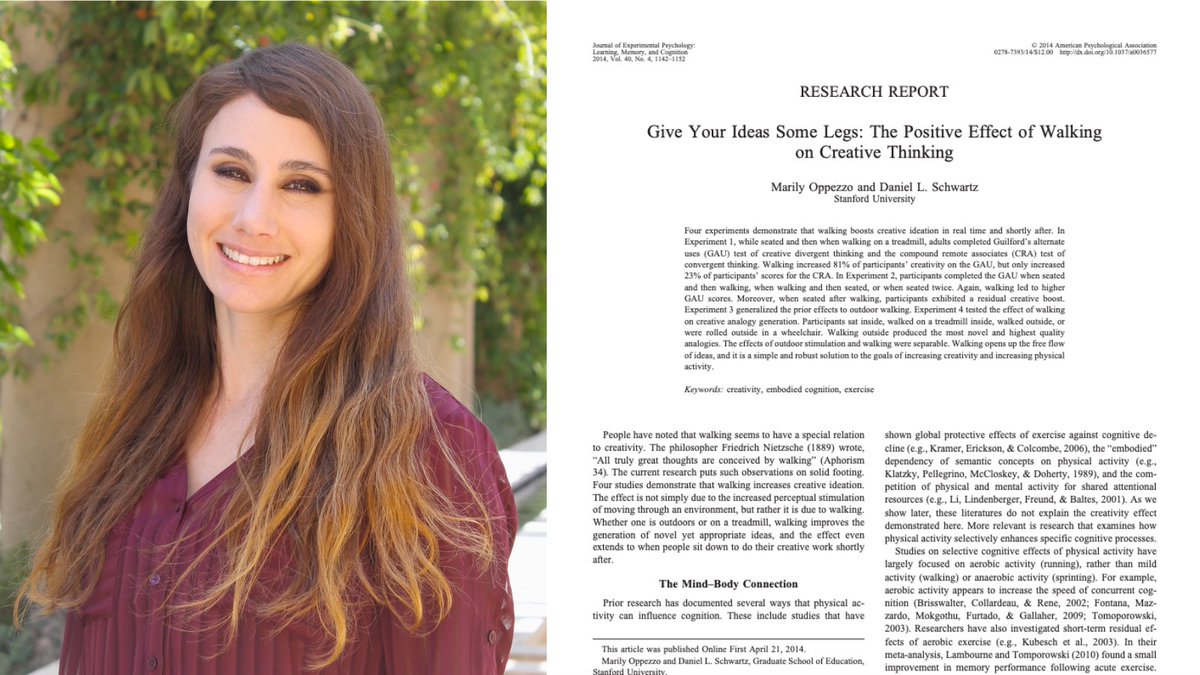
A Stanford psychologist spent 4 years proving that the simple act of walking generates 60% more creative ideas than sitting, and the experiment she designed to kill every alternative explanation is one of the most decisive findings in modern psychology. Her name is Marily Oppezzo. She got the idea for the study while walking with her advisor at Stanford to discuss her thesis topic, and the paper she eventually published in the Journal of Experimental Psychology in 2014 is sharp enough that it should have ended the seated meeting on the day it came out. She ran 4 experiments on 176 people. Same person tested twice. Once sitting, once walking. The creativity tasks were the standard ones psychologists have used for decades to measure how good a brain is at generating novel useful ideas. The result was almost too clean to publish. 81% of participants in the first experiment produced more creative ideas while walking than while sitting. In the second experiment, 88%. In the third, 100%. Every single person walked into a more creative version of themselves. On average, people generated 60% more novel useful ideas the moment their legs started moving. The skeptical question is the obvious one. Maybe it was the fresh air. Maybe it was the scenery passing by. Maybe it was the change of environment doing the work, not the walking itself. Oppezzo killed every one of those explanations with one experimental decision. She put people on a treadmill facing a blank wall. No scenery. No fresh air. No environmental change. Just legs moving in place while staring at white drywall. The 60% boost held. Then she ran the experiment that closed the case completely. She took participants outside in two conditions. Half of them walked through a Stanford courtyard. The other half were pushed through the exact same courtyard in a wheelchair. Same outdoor stimulation. Same scenery passing at the same speed. The only difference was whether the legs were moving. The walkers produced dramatically more novel high-quality ideas than the wheelchair group. The outdoors did almost nothing on its own. The walking did everything. This is the part of the study that hit hardest when I read it the first time. She also tested the opposite kind of thinking. Convergent thinking. The kind where there is one right answer and you have to narrow down to it. Word puzzles where 3 words share a hidden fourth word that connects them. The seated participants did slightly better on these. Walkers got slightly worse. Walking is not a general intelligence enhancer. It does one specific thing. It opens up the divergent search inside your brain. The part that generates options. The part that produces unexpected connections. The part that takes a problem and finds five ways into it instead of one. When you need to converge on the single right answer, sit down. When you need to find the answer in the first place, get up. The mechanism is now well understood. Walking selectively activates what neuroscientists call the default mode network, the system inside your brain that runs when you are not consciously focused on anything. The DMN is where mind-wandering happens. Where memories cross-reference each other. Where ideas that have been sitting in separate folders inside your head finally bump into each other. When you sit at a desk and force yourself to concentrate, you suppress the DMN. When you walk at a natural pace, the executive part of your brain gets just busy enough handling the walking that the DMN comes online and starts doing the work that focus was blocking. The most useful finding in the entire paper is the one almost nobody quotes. The boost did not turn off the moment people stopped walking. Participants who walked first and then sat back down stayed elevated. Their next round of seated creativity work was still significantly better than people who had been sitting the whole time. The rest lingered for at least several minutes after the legs stopped moving. You do not need to do creative work while walking. You need to walk before the creative work. The brain holds the state. The history of this is the part that should haunt anyone who still does meetings in chairs. Charles Darwin built a gravel loop behind his house in Kent called the Sandwalk and walked it 3 times a day for the rest of his life. The theory of evolution was developed one lap at a time on that path. Nietzsche walked up to 10 hours a day during the years he wrote his most important books and openly said the work was conceived on his feet. Beethoven composed for the morning and walked for 5 hours every afternoon with a pencil in his pocket for when something landed. Kahneman said the best thinking of his Nobel Prize-winning career happened on leisurely walks with Amos Tversky. Steve Jobs refused to take important conversations sitting down. He held them on foot. Every one of them was using the system Oppezzo would not measure until 2014. They just did not know what to call it. The question worth sitting with is the one almost nobody asks. Every meeting you have ever attended sitting around a table was a meeting held at a fraction of the brain power that was actually available to the people in the room. Every brainstorm that got stuck inside a conference room. Every problem you tried to solve at a desk and gave up on. Every idea you could not quite get to. The intervention is the easiest one in modern science. No supplement. No app. No subscription. No training program. Just a pair of legs and 15 minutes. The Stanford lab proved it. The philosophers knew it. The neuroscience explains it. And almost everyone reading this is still trying to think their way out of problems sitting completely still.
Ihtesham Ali tweet media
English
188
2K
7.7K
720K
Chief Info retweetledi
Arjun Iyer
Arjun Iyer@arjuniyer_·
Ran the same prompt through two @AnthropicAI Claude Code sessions on a microservices app. Session A (pure Claude Code): green unit tests, declared success, would have shipped a broken frontend. Session B (signadot-validate skill): caught the cross-service break with Playwright, fixed the frontend, re-validated, golden path passed. Same model. Same code. Same prompt. Different validation surface. youtube.com/watch?v=St2ckb…
YouTube video
YouTube
English
8
20
118
3M
Chief Info retweetledi
Jack Moses ∞
Jack Moses ∞@jackmoses777·
The River of Money is by far the most impactful article I've ever written. Many people who read the article say it's changed their perception of money and value exchange. The concepts have become mental hooks for myself and others to orient our actions in business in ways more aligned with the energetic properties of money. One time, a friend in Thailand told me she read an article about a "River of Money" that had her completely rethinking her approach to business. She talked to me about the article for 5 or 10 minutes, having no idea I wrote it. This was a good indicator that the idea was actually sticky. The funny thing about this article is, I wrote it in one shot for 2 hours while waiting to board my plane in Boston. I had no preparation, no research, no outlining, no purpose, and no AI. It just seemed like an interesting idea, and I wanted to explore it. I wrote the article to discover what I thought, rather than to prove a point or teach something I already knew. This experiment and the results opened my mind to a new way of writing. Standard online writing advice is to start with an outline, have a clear purpose for your piece, and finish with actionable advice for the reader. But approaching it backward, having no outline and no idea where the article was going, led to both an expansion of my own thinking and an unconventionally impactful experience for the reader. So here's the point: Write more articles for the sake of discovering what you think — not for proving what you know. You just might write your way into an idea that changes your worldview forever.
Jack Moses ∞@jackmoses777

x.com/i/article/2014…

English
12
72
793
151.5K
Chief Info retweetledi
Ole Lehmann
Ole Lehmann@itsolelehmann·
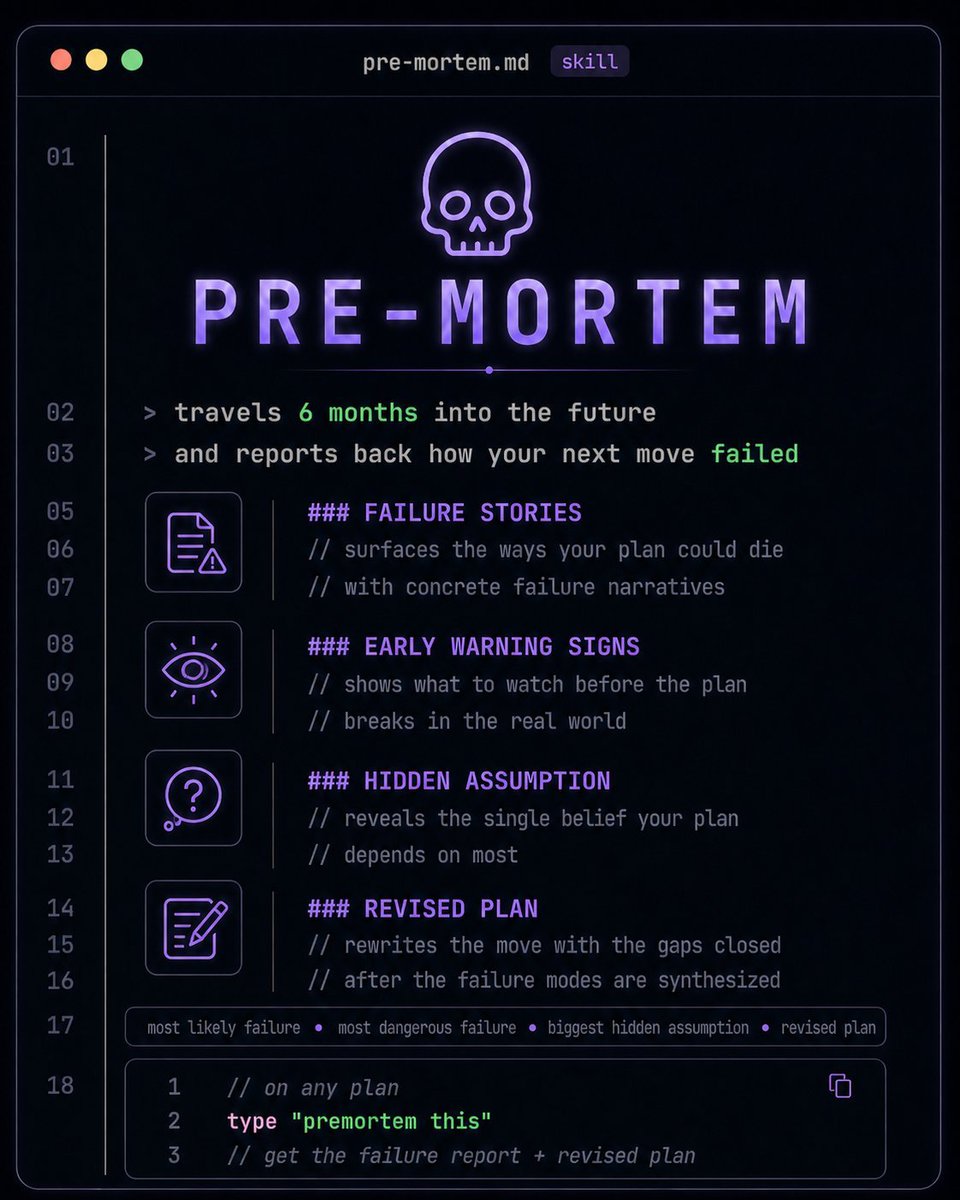
POV: claude traveled 6 months into the future and told you exactly how your next move failed. it's called a premortem. daniel kahneman (nobel prize-winning psychologist behind "thinking fast and slow") called it his single most valuable decision-making technique. when you ask claude "is this a good plan?" it finds all the reasons to say yes. that's what it was trained to do (to be helpful and agreeable). so you walk away feeling confident. you execute, and spend weeks / months building on top of that plan. then it blows up. and you realize the problem was obvious in hindsight, you just never stress-tested it because claude told you it was solid. a premortem fixes this by flipping the frame. instead of asking "what could go wrong?" you tell claude "it's 6 months from now and this is already dead. tell me how it died." that shift turns off claude's optimism because there's nothing to be optimistic about. the premise already says it failed. so claude stops looking for reasons your plan will work and starts explaining how it fell apart. claude comes back with every way your plan could die, each one with a full failure story and the early warning signs to watch for. then a synthesis pulls it all together: > which failure is most likely > which failure is most dangerous > the single biggest hidden assumption you're making (often the most valuable part) > a revised version of your plan with the gaps closed you say "premortem this" and give it your plan. the skill handles the rest.
Ole Lehmann tweet media
Ole Lehmann@itsolelehmann

x.com/i/article/2051…

English
29
84
562
75.8K