Eric
3.5K posts

Eric
@HomeAndHandy
I'm a theologian, tinkerer, and I get followed by scammers, bots, and fake people pretending to be the real person.
Katılım Nisan 2017
301 Takip Edilen664 Takipçiler

Stephen De Young says Classic Arminians taught limited atonement. So weird! youtube.com/clip/UgkxfQI1N…
English

U.S. THREW DOWN THE GAUNTLET -- NOW NATO IS SCRAMBLING
After Trump blasted allies and said the U.S. doesn’t need them, NATO SecGen Mark Rutte is now saying the quiet part out loud -- they’re actively working to reopen the Strait of Hormuz.
He confirmed he’s been in contact with multiple allies and that securing the Strait is now a priority.
Translation: pressure is on.
Trump called out NATO, the EU, and others to step up… and now they’re being forced to respond, because Hormuz isn’t optional -- it’s a global oil lifeline.
If allies move and secure the route, oil pressure eases and markets stabilize. If they don’t, energy stays elevated and volatility sticks around.
U.S. set the tone, now the world has to act.
CryptosRus@CryptosR_Us
TRUMP: WE DO NOT NEED THE HELP OF ANYONE Trump says NATO allies don’t want to get involved in a U.S. operation against Iran, and even called out countries like Japan, Australia, and South Korea for staying on the sidelines. Read between the lines... This isn’t just about Iran. It’s about fracturing alliances. At the same time we’re dealing with oil swings, shipping risk, and global tension rising, the world looks less coordinated than it did even a year ago. And when things start to feel unstable like this, money doesn’t just sit still -- it looks for something neutral. Something outside the system. That’s usually when Bitcoin starts getting a bid again. 👀
English
Orthodoxy summarizes a tension: on one hand, through our sin nature, none of us can work our way to the Father; rather, the Father works His way to us. On the other hand, the Bible clearly shows we have the ability to choose this day whom we will serve (Joshua 24:15 and similar passages).
The tension is resolved through our Lord’s generous ministry of grace, which enables us to come forward into His mighty presence. As such, any conversation that discusses our sin nature or our ability to choose the good over the evil that omits talking about our Lord’s redemptive ministry of grace is missing the mark.
English

The saying that “no one would ever choose Christ” makes it seem like God is unlovable and that no one could genuinely be drawn to Him unless they were forced.
Jeff Day 💹🧲@dayjeff
And why would someone not choose Christ when the realize they are lost and they see in the gospel of John Christ is the Savour? Election is pride in that you believe you were chosen while others are not.
English
@Radicalized1923 @alphafox I like Invicta because I’m not afraid to wear them and scratch them up.
English

@HomeAndHandy @alphafox Friends don't let friends wear Invicta.
English


@HomeAndHandy @alphafox That Invicta will be rusted in pieces in like 30 years lol
English



@CherylSchatz @Soteriology101 Leighton Flowers entire ministry is being anti-Calvinist. It’s pretty sad.
English
Why some minds gravitate toward Calvinism.
Leighton Flowers gives a fair take on why he and others were drawn to Calvinism. @Soteriology101
English
To paraphrase from his sermon, Free Grace, Wesley said that no matter how one interprets a difficult passage, it cannot mean that God is unjust, unloving, a liar, lacking in mercy, or anything contrary to His revealed character as loving, just, and merciful toward all. If a Calvinist reading leads to portraying God as decreeing damnation for most people apart from any foreseen response (making Him appear arbitrary or cruel), then that reading must be wrong — "it cannot mean that."
Even if a verse appears to support Idea X on the surface, Idea X is so incompatible with other clear biblical truths (especially about God's character) that X cannot be the correct meaning. We must reject X and look for a different valid interpretation.
English
I disagree. Partisan theological leanings are all derived from “what the Bible teaches.” As such, pastoral candidates should be forthcoming and honest about their theological understandings and if they cannot, then they are not yet called to fill an elder position in the local church.
English

Every preacher should eschew labels. Just teach what the Bible teaches.
It’s funny how few complain about JD Farag and Jack Hibbs and a score of dispensationalist preachers teaching about the “pretrib rapture” and Israel’s supposed standing as the “people of God” and those positions are far less solid Biblically than election.
English
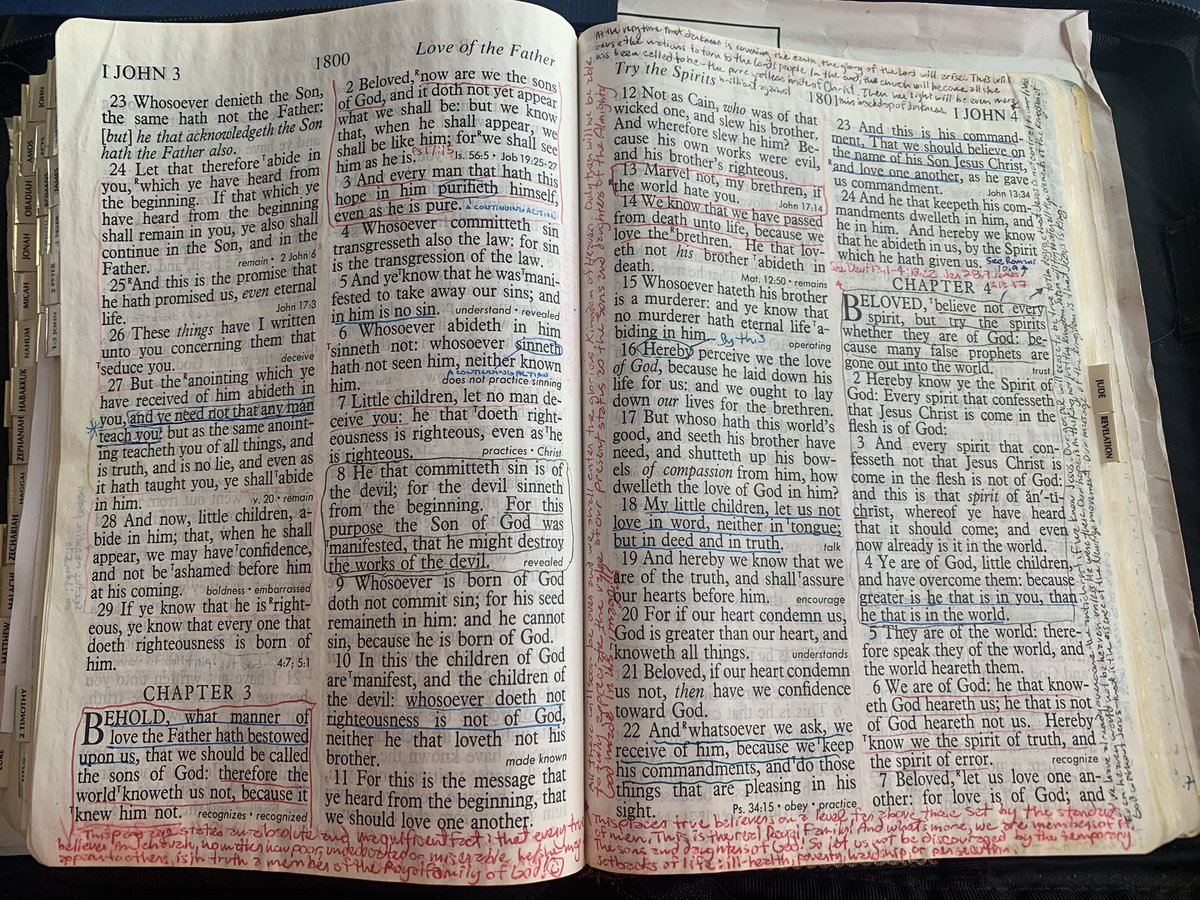
Thank you for being forgiving of my grammar and punctuation. Smile. Likely, while you responded to this, I was awkwardly responding to you on my phone to your prior response. For streamlining purposes, if you are so willing, let's collapse everything into this discussion.
Streamlining wise, Heiser's thesis, is that Second Temple Judaism (STJ) was the perspective held at the time of Jesus' ministry as well as the time the NT the was originally authored in. For his part, Heiser makes a reasonably good case for a three-fold view of our sin nature in his books The Unseen Realm and Reversing Hermon: Enoch, the Watchers, and the Forgotten Mission of Jesus Christ. If Heiser is right, then to mine the most out of both the OT and the NT, we need to both understand the STJ view and then apply it as something of a hermeneutical filter to both the OT and the NT.
Sadly, Heiser didn't get his PhD until 2005 (after I was done with my formal education) and didn't publish The Unseen Realm until 2015, and Reversing Hermon until 2017. For my part, I stumbled upon Heiser when I was studying 1 Enoch from Jude's direct quotation of 1 Enoch only to learn that Michael Heiser had passed away. Sigh.
Anyway, we are in agreement: Sin enters through Adam's rebellion of our Lord's defining what is good and what is wrong, by prioritizing his own definition of what is right and what is wrong. As you stated, the fallen angels shared esoteric, forbidden knowledge with humanity that worked to accelerate and magnify sinful humanity's sin nature in a pre-flood period when people lived for a long, long time, thereby allowing humanity's population to grow at a much faster pace than nowadays (cf. Gen. 6:1:3 "My Spirit shall not strive with man forever, for he is flesh: his days shall be 120 years..."). Yet post flood, Heiser explores how this knowledge was preserved through the giants that survived the flood ("...and afterward" Gen 6:3, cf Numbers 13:33) and then set the stage for humanity to build a ziggurat in the Tower of Babel story (cf Gen 11:1-9) where against the mandate from the Garden ("Be fruitful and multiply, and fill the earth and subdue it," Gen 1:28 cf., go and expand the kingdom where God and humanity come together and meet) humanity gathers together and repeats the sin of Adam by rejecting our Lord's plan and his moral authority by effectively saying, "God, come meet us here in this place."
Again, this doesn't modify our view on TD, which nominally defined, is that no part of the person is left unaffected by the fall, as well as the practical application that "we don't work our way to God, rather, God works His way to us". However, if Heiser is right, this three-fold view on our sin-nature does add depth and insight to our contemporary view sin nature.
English

Thank you for explaining that clearly. I understand the framework you are describing. The Second Temple literature did develop a much more elaborate explanation for evil in the world by combining Adam’s fall with angelic rebellion and the spread of corrupt knowledge among humanity. Those ideas certainly appear in writings like 1 Enoch and influenced the intellectual environment of that period.
Where I would be cautious is allowing that framework to shape our doctrine of sin more than the canonical Scriptures themselves. The Bible does acknowledge angelic rebellion and spiritual conflict. Genesis 6:1–4 is difficult and has been interpreted in different ways, and passages like Deuteronomy 32:8–9 and Psalm 82 show that Scripture recognizes a spiritual realm in which God rules over all powers. The New Testament also affirms that there are real spiritual forces opposed to God. “Our struggle is not against flesh and blood, but against the rulers, against the powers, against the world forces of this darkness” Ephesians 6:12.
However, when the apostles explain the origin and universality of human sin, they consistently trace it back to Adam rather than to fallen angels or corrupted knowledge. Paul’s argument in Romans is very deliberate. “Through one man sin entered into the world, and death through sin, and so death spread to all men” Romans 5:12. The entire structure of redemption in Romans 5 depends on that parallel between Adam and Christ. The problem begins with the disobedience of the first man and is answered by the obedience of the second. “For as through the one man’s disobedience the many were made sinners, even so through the obedience of the One the many will be made righteous” Romans 5:19.
The presence of demonic powers and spiritual rebellion certainly intensifies the conflict in Scripture, but it does not redefine the root of the human problem. The Bible consistently locates that root in the fallen heart of man. “The heart is more deceitful than all else and is desperately sick” Jeremiah 17:9.
So I agree that the biblical narrative includes a real supernatural conflict and that some Second Temple literature reflects how Jews were wrestling with those themes. But the doctrinal explanation of sin in the New Testament remains anchored in Adam’s fall and the corruption that now characterizes all humanity. The central battle Christ comes to win is not merely against corrupt spiritual powers but against sin and death itself, which entered through Adam and are defeated through the cross and resurrection. “For He rescued us from the domain of darkness, and transferred us to the kingdom of His beloved Son” Colossians 1:13.
English
I see many comments from dispensationalists accusing Covenant Theology of teaching replacement theology. That accusation is repeated so often that many people assume it must be true. The reality is the opposite. The idea that God deals with two separate peoples in two separate plans is the work of dispensationalism itself, not Covenant Theology.
Covenant Theology has historically taught that there is one people of God united in Christ. The promises made to Abraham find their fulfilment in Christ and therefore in all who belong to Him. Scripture is clear on this point. “If you belong to Christ, then you are Abraham’s descendants, heirs according to promise” Galatians 3:29. The church is not a replacement for Israel. It is the continuation and fulfilment of the covenant people gathered through the Messiah. Paul explains this using the image of an olive tree where Gentile believers are grafted in among the natural branches. “If some of the branches were broken off, and you, being a wild olive, were grafted in among them and became partaker with them of the rich root of the olive tree” Romans 11:17. There is one tree, not two separate peoples of God.
The charge of replacement theology is actually a product of a much later system. In the sixteenth century during the Reformation, Jesuit scholars such as Francisco Ribera in 1585 developed a futurist interpretation of prophecy in response to Protestant reformers who identified the papal system as the Antichrist. Ribera pushed most prophetic fulfilment into a distant future and separated Israel and the church in the prophetic timeline. Later another Jesuit writer, Manuel Lacunza in the late eighteenth century, expanded these ideas.
In the nineteenth century John Nelson Darby of the Plymouth Brethren adopted and systematized these concepts into what became dispensationalism. Darby taught that God has two distinct peoples with two different destinies. That framework was later popularized through the Scofield Reference Bible published in 1909. From there it spread widely through Bible conferences and evangelical institutions.
Ironically the system that divides Israel and the church into separate programs is the one that creates the very tension it then accuses others of holding. The New Testament consistently points to fulfilment in Christ rather than separation. Paul writes that Christ “has made both groups into one and broke down the barrier of the dividing wall” Ephesians 2:14. Gentiles who were once strangers are now “fellow citizens with the saints and are of God’s household” Ephesians 2:19.
The gospel does not create two peoples of God. It gathers one people from every nation through the Messiah. That is the consistent witness of the New Testament and the historic teaching of the church long before modern dispensational systems appeared.
English
@RicoSauve111 Because for women of the 1st century, their hair was considered part of their fertility. Thus the hair covering for women and men having long hair being a dishonor to them.
English

Quick survey: as common ground, we both hold to TD—with your background in Calvinism and my own in Wesleyan-Arminianism. While we both hold salvation is monergistic, my WA view holds the who that saves as God alone and the how our Lord saves as a work in our person were our Lord works in us, and through us, and when we are prepared with us.
That said, Heiser was an OT scholar who came to understand second temple Judaism viewed our sin nature came from
1) Adam’s Fall where sin and death entered the world.
2) From the fallen angels of Genesis 6:1-4, the story of which is expanded in the non-canonical book of 1 Enoch and put forward that Genesis 6:1-4 was an apologetic to the Mesopotamian stories about giant “gods” pre-flood and the knowledge managed to survive the flood through the “hybrid” giants post-flood. This is built on Duet 32:8-9 and Psalm 82.
3) The Tower of Babel humanities rejection of our Lord’s authority where Our Lord, kicked humanity to the divine council effectively divorcing humanity. Then God went on to supernaturally create the family through which he would save humanity through Abram and Sara.
The result is a far more nuanced, supernatural view of our sin natures but topically doesn’t affect our views on TD but does help explain many weird OT and NT pericopes as well as add a different perspective on the battle Jesus is fighting as well as the battle Abraham and those born in and grafted in are fighting. The long and short of it being a far more supernatural battle than what our professors knew to share with us.
English
@HomeAndHandy I am not very familiar with all of Michael Heiser’s work on that specific question. Could you briefly explain how he understands the Second Temple Jewish view of sin? I would be interested to hear how he frames it so I can understand what part of his argument you have in mind.
English
@iamrjknight FWIW, here is my original question.
Eric@HomeAndHandy
As we know, in Romans Paul is writing to primarily a Jewish Christian audience and is taking them on a literary journey so to speak, starting with homosexuality, a thing that the Jewish audience acknowledged as sin, going on to explore how all of have fallen short of following the law (cf. Rom 3:10 et al), and then going on to integrate the gentiles as part our Lord's overarching plan of salvation juxtaposing circumcision with uncircumsicion. Anyway, where do you come down on the second temple view of sin (cf. apocalyptic literature 1 Enoch, Jubilees, 4 Ezra) that held sin entered the world through Adam's fall, was magnified through forbidden angelic knowledge (cf. Gen 6:1-4), and reaffirmed at the Tower of Babel where mankind sought to create a centralized kingdom independent from God's authority?
English
In much of Second Temple Judaism the understanding of sin had slowly shifted toward outward law keeping and covenant identity rather than the condition of the heart before God. That is why Jesus repeatedly confronted the religious leaders. He exposed that external righteousness cannot deal with the real problem. “You clean the outside of the cup and of the dish, but inside they are full of robbery and self indulgence” Matthew 23:25.
Scripture presents sin as something far deeper than behaviour. It is a corruption of the heart itself. “The heart is more deceitful than all else and is desperately sick” Jeremiah 17:9. That is why the law could reveal sin but could never remove it. Only Christ could deal with it. As Paul writes, “For by the works of the Law no flesh will be justified in His sight; for through the Law comes the knowledge of sin” Romans 3:20.
So the gospel confronts both the outward sinner and the religious man who believes external obedience is enough. Both stand equally in need of the righteousness that comes through Christ alone.
English