WMartinBuilds

399 posts

WMartinBuilds banner
WMartinBuilds

WMartinBuilds

@HomeBuilderWM

🏡 Transforming homes into havens. Ex-emu farmer. BBQ aficionado. Co-host.

Murfreesboro Katılım Haziran 2023
327 Takip Edilen41 Takipçiler
WMartinBuilds retweetledi

Big Brain Business
Big Brain Business@BigBrainBizness·
Doug Leone, Sequoia Capital partner, offers a counterintuitive take: the best pitches aren't the polished ones. They're the ones where founders openly admit their mistakes. In 2007, Sequoia led Dropbox's $1.2M seed round at a $5M valuation. Eleven years later, the company went public at $9 billion. But back in 2007, Dropbox was far from a sure thing. Online storage was a crowded, commoditized market. So what made Sequoia bet on Drew Houston? Doug explains: "Drew Houston, who was going to launch a company in a crowded market and yet could clearly articulate why none of the existing products were going to make it. Crystal clear thinking is one of the things we look for. Not a fancy slide pitch, but crystal clear thinking." What won Sequoia over was clarity, not polish. Doug shares another example of a great pitch, Fred Luddy, whose company was growing like a weed: "All he told us was all the mistakes he made. Those were the great pitches. Those were people that were self-aware. They were crystal clear thinkers. They were willing to learn, willing to listen, and in some cases willing not to listen." Doug also emphasises that the smallest details reveal a founder's mindset: "We pay careful attention to little words, to the pronoun being used. When someone says, 'I can ship you this thing,' it's a little warning. Fred, what do you mean you can ship us? You're not shipping us anything. It's your company that's shipping us." And he acknowledges the paradox in great founders: "Founders tend to not be the greatest listeners. And in many cases, they're right because they're doing new things, trying new things."
English

5
14
91
11.7K
WMartinBuilds retweetledi
Feras Khouri
Feras Khouri@Ferastotle·
I was on a trip recently with a group of people who have built things worth paying attention to. What struck me wasn't the tactics they talked about. It was how consistent the themes were across all of them regardless of industry, model, or stage. Every single one of them came back to three things. Consistency, meaning they stayed in the game long enough for compounding to work in their favor. Commitment, meaning they went deep on one thing instead of spreading across many. And control, meaning they took full ownership of outcomes, good and bad, without looking for someone else to credit or blame. None of them talked about a moment of brilliance or a perfect decision or being in the right place at the right time. They talked about not wavering. About being so committed to one thing that the grifters and the distracted people eventually fell away and they were still standing. The luck part is real. But luck finds people who are still in the game.
English
0
2
13
341
WMartinBuilds retweetledi
Trace Cohen
Trace Cohen@Trace_Cohen·
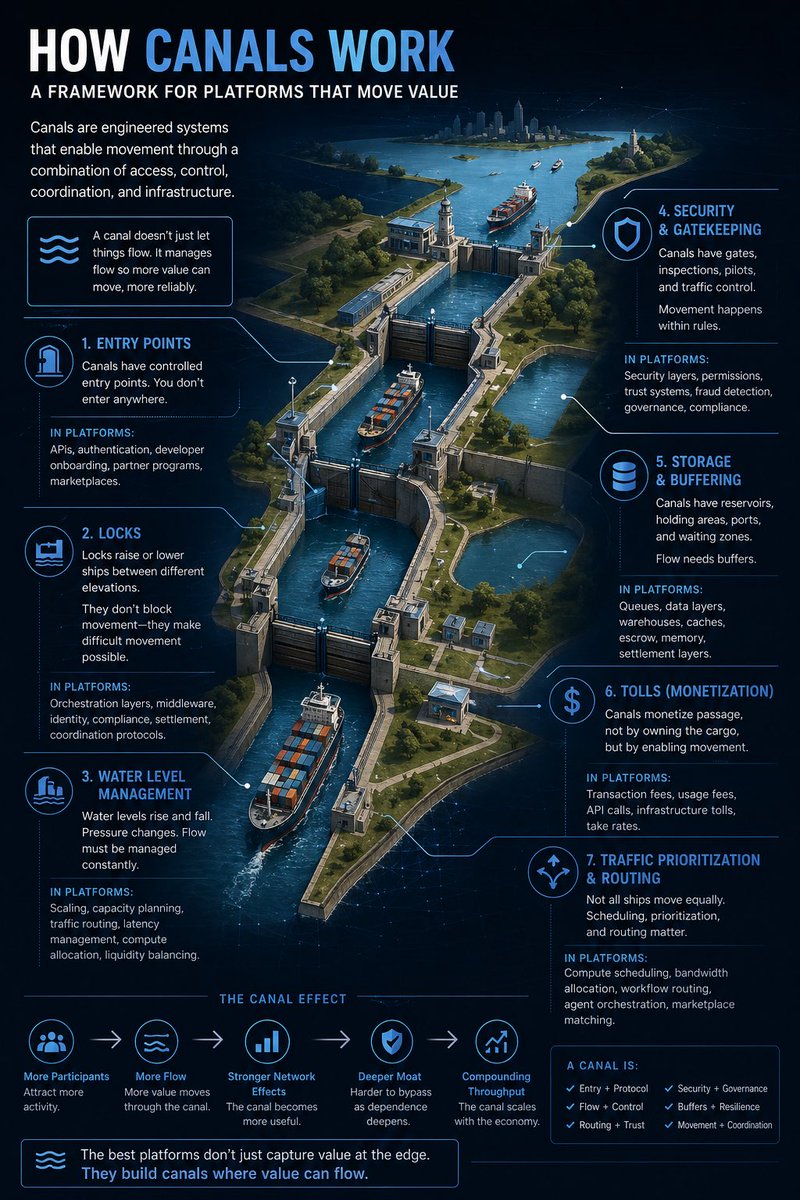
Canals may be a better metaphor for modern platforms than networks or moats. What makes a canal powerful is not openness alone, but engineered coordination. A canal is a managed system of entry points, locks, routing, buffering, security and tolling that allows value to move across fragmented terrain. It combines flow with control, interoperability with governance, openness with structure. That looks remarkably similar to what many important technology platforms are becoming. APIs resemble entry points. Orchestration layers function like locks, translating movement across incompatible systems. Data infrastructure and queues act as reservoirs and buffers. Security and trust layers serve as gates. Usage based pricing often looks less like software licensing and more like canal economics, where value accrues through facilitating passage. This is why the metaphor has real analytical weight. A canal does not simply connect endpoints. It increases the volume, velocity and reliability of what moves between them. It makes ecosystems possible by making coordination scalable. That may be what the best platforms increasingly do. They do not just offer products. They engineer movement. And perhaps that is an underrated way to think about platform power in the age of APIs, agents and infrastructure: not as owning an endpoint, but as becoming the route through which increasingly important flows pass.
Trace Cohen tweet media
English
0
3
3
401
WMartinBuilds retweetledi
Big Brain Business
Big Brain Business@BigBrainBizness·
Jensen Huang on how he keeps 55 executives motivated when they're already incredibly wealthy: His answer reveals an unconventional management philosophy that starts with the structure of his leadership team: "I'm surrounded by 55 people. My management team, my direct reports is 55 people. I write no reviews for any of them. I give them constant reviews and they provide the same to me." Even more surprising is how he handles compensation: "My compensation for them is the bottom right corner of Excel. I just drag it down. Literally, many of our executives are paid the same exactly to the dollar. I know it's weird. It works." Jensen also avoids the typical executive rituals that most CEOs rely on: "I don't do one-on-ones with any of them unless they need me. I never have meetings with them just alone. There's not one piece of information that I somehow secretly tell E-staff that I don't tell the rest of the company." He explains the thinking behind this radical transparency: "In that way our company was designed for agility, for information to flow as quickly as possible. For people to be empowered by what they are able to do, not what they know. That's the architecture of our company." But the real answer to keeping wealthy employees motivated comes down to one thing — his own behavior: "How do I celebrate success? How do I celebrate failure? How do I talk about setbacks? Every single thing, I'm looking for opportunities to instill every single day. What is important, what's not important, what's the definition of good? How do you think about a journey? How do you think about results? All of that all day long." The lesson is clear: when money no longer motivates, culture does. When your top people no longer need the paycheck, what they need is a leader worth following.
English
28
97
1.2K
199K
WMartinBuilds retweetledi
John Wilson
John Wilson@WilsonCompanies·
Scale changes the game in ways most operators don’t expect. 1/ Pricing shifts first: I’ve seen operators paying up to 50% less for the same equipment while selling at the same market price, and that gap flows straight to margin. 2/ Margins expand fast: branches moved from 10–15% to 30–40% profitability after centralizing core functions, even after allocating shared costs. 3/ Capacity becomes a lever: one branch left $20K–$60K+ on the table from labor constraints, while a connected system redistributes that work instead of losing it. 4/ Acquisition speed increases: three deals in 90 days added $6M–$7M in revenue, and with systems in place each new deal gets easier to absorb. 5/ The platform is the multiplier: at $30M–$40M, leadership, marketing, and ops infrastructure are in place, making multi-location scale possible and setting up the path to $100M+.
English
5
1
25
4.2K
WMartinBuilds retweetledi
John Wilson
John Wilson@WilsonCompanies·
Prepping for fourth acquisition this year, closing in a few weeks. We fully skipped the $30M’s, now mid 40s - solidly 8fig EBITDA. Under 1x debt. Still bootstrapped. You can just do things.
English
16
4
212
19.7K
WMartinBuilds retweetledi
Alan Peterson SBA
Alan Peterson SBA@AlanPetersonSBA·
How buyers are winning deals right now: Real operating experience in the target industry still carries the most weight at the desk. But a searcher with budget ownership, people management, or ops experience — and the drive to back it up — is very much still in the fight. Pedigree helps. Proven reps help more. ETA buyers — what’s actually moving the needle for you when you’re reviewing a deal?
English
0
1
1
90
WMartinBuilds retweetledi
Big Brain Business
Big Brain Business@BigBrainBizness·
Airbnb CEO Brian Chesky on the three things a founder has that a professional manager never will: The first is biological parenthood. "When you're the biological parent of something, like it came from you, it is you. There's a deep passion and love." This isn't just a professional responsibility. It's personal in a way hired leadership can never match. The second is permission. "I could rebrand the company and a professional manager would probably come and say I can't do that, but I know how we named it. I know how we branded it. So you know what you can change." Founders have the authority to make bold moves because they understand the origins of every decision. A professional manager inherits the rules. A founder wrote them, so they know which ones can be broken. The third is knowing how to rebuild what they built. "You know the freezing temperature of a company. You know at what temperature it melts, what this looked like before it was tooled, where it came from, the alloys where they were sourced from." @bchesky sums it up: "You're not just managing it, you're building it." When companies lose their founders too early, they often lose the one person who truly understands what the company is made of.
English
9
24
133
27.8K
WMartinBuilds retweetledi
Gasper C. | Rebelpreneurs
Gasper C. | Rebelpreneurs@GasperCrepinsek·
If you want to build a business and quit your 9-5, THIS should be your #1 priority: Get in rooms full of serious entrepreneurs who are building, shipping, & selling, not dreaming about it over Friday beers. Your environment shapes your reality. Physical OR digital Same effect
English
2
1
5
176
WMartinBuilds retweetledi
Ben Kelly
Ben Kelly@benkellyone·
Due diligence checklist for any business: • 3 years of clean financials • Diversified customer base • Reasonable lease terms • Transferable systems • Stable workforce If any of these are missing, the price should reflect it.
English
11
7
61
3.3K
WMartinBuilds retweetledi
Alan Peterson SBA
Alan Peterson SBA@AlanPetersonSBA·
Looking forward to @SMB_ash next week! If you will be there, shoot me a note and let’s connect!
SMBash@SMB_ash

There are only so many ways to say it: you’ll regret sitting on the sidelines. To quote one of our hosts, @KHendersonCo: “Buying and operating a small business is the single best wealth building tool for the American middle class.” But SMBash isn’t about convincing you. It’s about teaching you. Our speakers, sponsors, and attendees aren’t guessing. They’ve done the work. They know what matters. And they’re here to share real, practical ways to approach both the search and the operation. Small and medium businesses are the backbone of the American economy. If you want to be part of that world—really part of it—you need more than interest. You need a plan. Come learn how to navigate Entrepreneurship Through Acquisition and small business ownership. Thanks to this years sponsors! @AxialCo @SBA_Matthias @bylinebank @firstib @smblawgroup @ampleo_ @systemsixbooks @patrickdichter @Hollywellteam PPS Solutions @NewCoRisk @PreferredData and Elite Video

English
0
1
0
164
WMartinBuilds retweetledi
Trace Cohen
Trace Cohen@Trace_Cohen·
Most people frame work life balance as a tradeoff. Hours worked versus hours lived. That framing assumes work is something you endure so you can get back to your life. I think that’s backwards. The real variable is not time, it is alignment. If your work feels like a tax, no amount of balance will fix it. You will always be trying to escape it. Nights, weekends, vacations become recovery instead of enjoyment. But when your work actually fits how you think, build, and operate, the equation changes. It stops being something that drains you and starts becoming something that compounds you. That doesn’t mean you work all the time. It means the time you do spend working doesn’t hollow you out. So when you step away, you are not recovering. You are just…living. The goal is not balance as separation. It is balance as integration. Build a life where your work gives you energy, not one where you constantly need relief from it.
English
0
2
3
213
WMartinBuilds retweetledi
David Heacock
David Heacock@davidfilterbuy·
I was the bottleneck in my own company because I wanted to touch everything. Then I discovered the 10-80-10 rule. First 10%: set the vision. Middle 80%: your team executes. Last 10%: you review and add your touch. Delegate without losing control.
English
0
2
3
198
WMartinBuilds retweetledi
Mike Scully
Mike Scully@Mike_Scully_·
Getting rich in the next 12 months will look boring: Build an audience. Build a simple AI-powered product. Talk about it relentlessly. That’s it. No degree required. No massive team needed. Just leverage, speed, and consistency.
English
2
2
9
419
WMartinBuilds retweetledi
God of Prompt
God of Prompt@godofprompt·
Ignore this noise. The guy should be in jail for this. Do NOT give in to anxiety, fear, sensationalism It’s just a tool. That’s it. The guy vibe coded a wrapper and acts like he’s curing cancer.
Alex Finn@AlexFinn

This is one of the most important weeks of your life It is more than likely both Opus 4.7 and ChatGPT 5.5 will release in the next few days Both will be humanity shifting technologies When massive shifts drop like this you need to do EVERYTHING in your power to be using them the moment they come out You need to be calling in sick from work You need to be asking your significant others to watch the kids You need to be faking your death so your friends don't call you You do what it takes to get your hands on these pieces of technology When we have nuclear shifts in the landscape, massive opportunities arise. This will be one of those times There's going to be a short time period after the release of these models where it will be easier and faster than ever to build revolutionary products, and not many people will be doing it If you jump on these opportunities, you can build life changing wealth. These are the times where people put on the AI sorting hat and that hat says either "permanent underclass" or "permanent overclass" Take these actions now: • Download Claude Code Desktop • Download Codex app • Get your OpenClaw ready for the update • Learn these tools inside and out • Moment the new models drop plug them in and use them Your entire lineage is depending on this

English
5
2
17
5.4K
WMartinBuilds retweetledi
🌸Eri ~ Carpe Diem
🌸Eri ~ Carpe Diem@sentosumosaba·
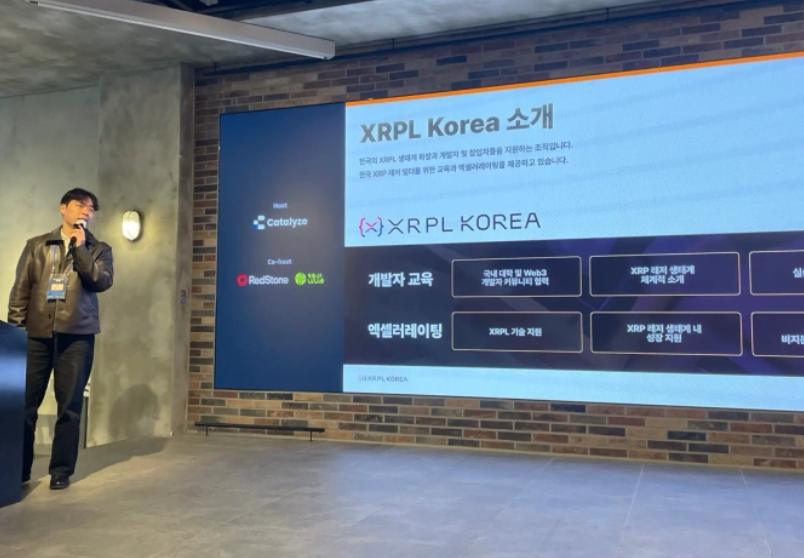
Greater🔥ASIA $XRP SCOOP 🇰🇷🇯🇵🇸🇬🇻🇳🇲🇾🇨🇳🇰🇭 🇭🇰🇹🇼🇮🇩🇮🇳🇦🇺🇳🇿🇹🇭 "XRPL Built for Korea’s Regulatory Environment, Could Serve as Institutional Infrastructure" - Jake Ku (@noDoubt_itgrowth) Head of Growth @Catalyze_RS & @xrplkorea, Keynote Speech at the AI/InfraCon. Photo: Kang Min-seung Article: en.bloomingbit.io/feed/news/1100… Go Jake! 💪
🌸Eri ~ Carpe Diem tweet media
English
6
41
215
5.7K
WMartinBuilds retweetledi
Alessandro Palombo
Alessandro Palombo@thealepalombo·
I've lived in Switzerland. I've incorporated there. I've walked the lakeside in Zug at 8pm wondering where everyone went. 250 millionaires a month are moving to Switzerland. Most end up in Zurich or Geneva. For many it works. But not for all. I asked friends living there, compared it with the data and assembled this guide. I came to the conclusion there are two approaches to Switzerland for most of us. A practical and unfiltered Swissmaxing thread 🇨🇭 🧵
Alessandro Palombo tweet mediaAlessandro Palombo tweet mediaAlessandro Palombo tweet media
English
74
96
1.1K
352.5K
WMartinBuilds retweetledi
Bryan Daugherty, CCI, CBI, SME
Bryan Daugherty, CCI, CBI, SME@BWDaugherty·
DSC-3 Isomorphic Engine just went nuclear on commodity hardware. 🚀 We ran a LIVE benchmark on a single @NVIDIA RTX 6000 Ada. The results shouldn’t be possible: 🔹 1M → 500M spins (variables) 🔹 21.8s to solve 🔹 1.15 B/s throughput 🔹 14.9 GB VRAM usage The Reality Check: ❌ D-Wave: Cannot solve (Max ~5k qubits) ❌ Toshiba SQBM+: Cannot solve (Max ~100k variables) ❌ Fujitsu DA: Cannot solve (Max ~8k variables) Those systems cost $10M+. We just solved a 500M-variable problem on a single GPU you can buy today. Classical optimization has a new ceiling. See the live benchmark: dsc3.originneural.ai What massive combinatorial problem should we throw at it next? #DSC3 #GPU #Optimization #QuantumTech
Bryan Daugherty, CCI, CBI, SME tweet media
English
0
4
6
594