

Matthias Honegger
6.9K posts
Matthias Honegger
@HoneggerM
The future, governance of climate and of potential interventions. Look at trends, work on increments. Kindness & truth. @PerspectivesCC & @CFG_ThinkTank
Brussels, Belgium Katılım Ekim 2009
2.6K Takip Edilen2.1K Takipçiler
Matthias Honegger retweetledi

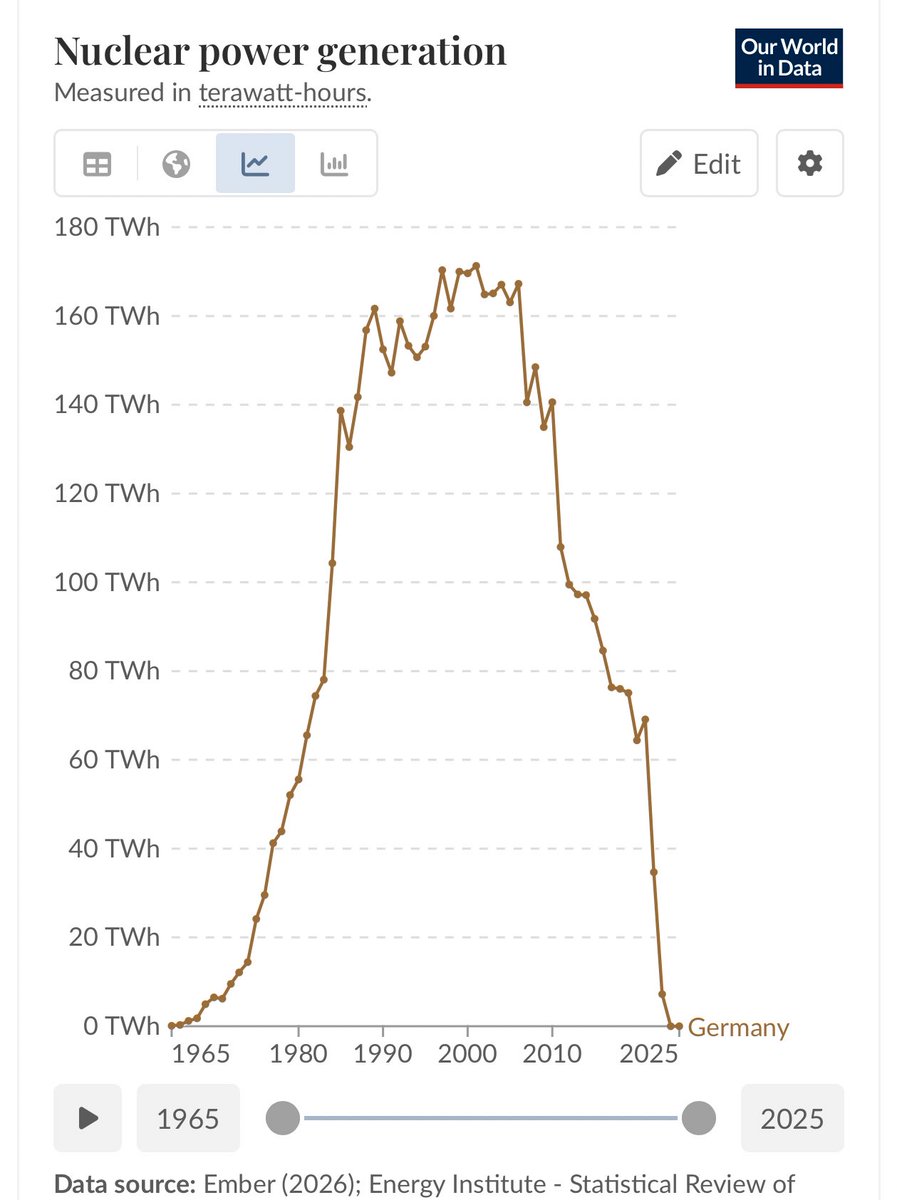
Unreal numbers 👀⚡️
"JPMorgan estimates that, had Germany not phased out nuclear power, the country would have generated 50% less electricity from fossil fuels and 84% less electricity from natural gas in 2024. Electricity prices in Germany would have been around 25% lower, and the country would have imported half as much electricity.."
English
Matthias Honegger retweetledi

Earth is now warming at a rate of around 0.35 ºC per decade, fresh analysis finds.
go.nature.com/4aV6Gu8
English
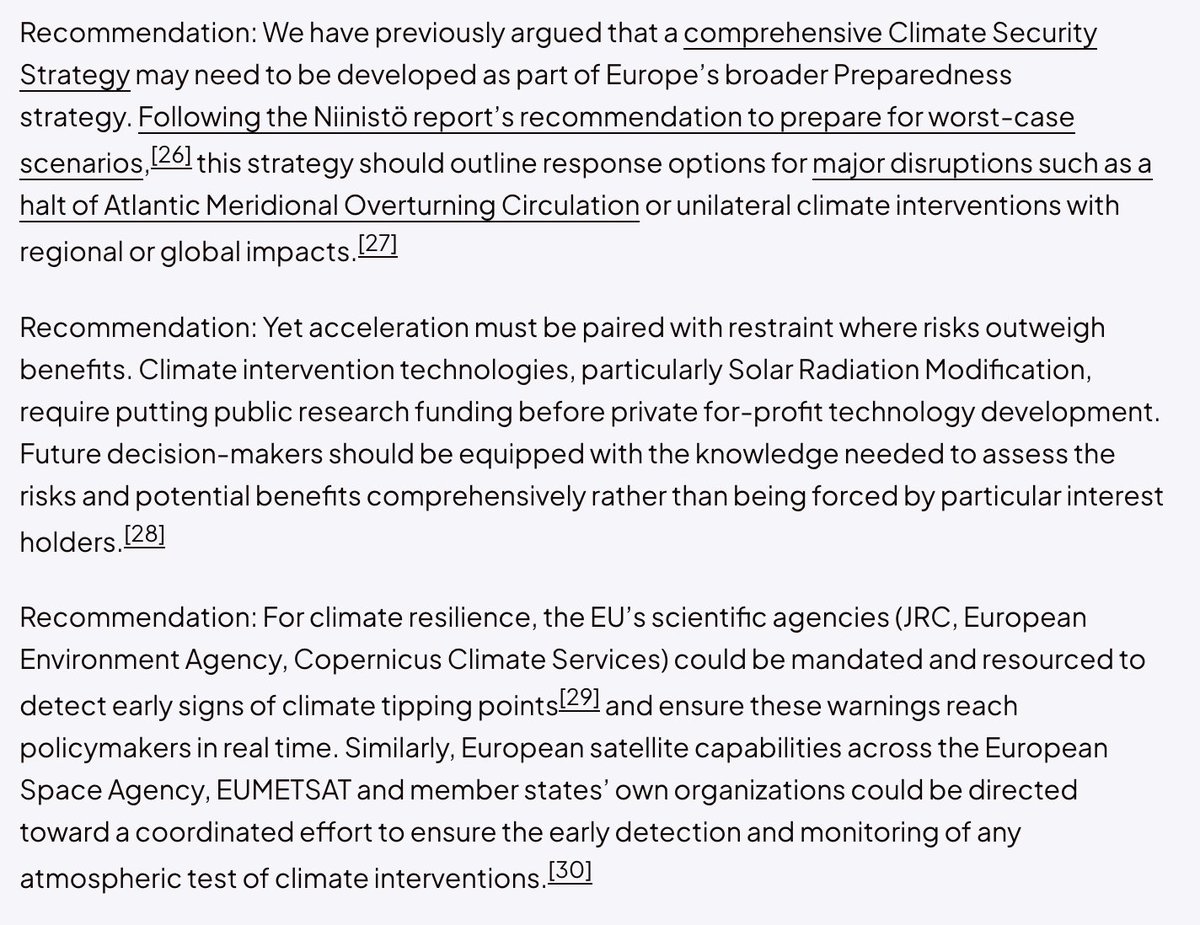
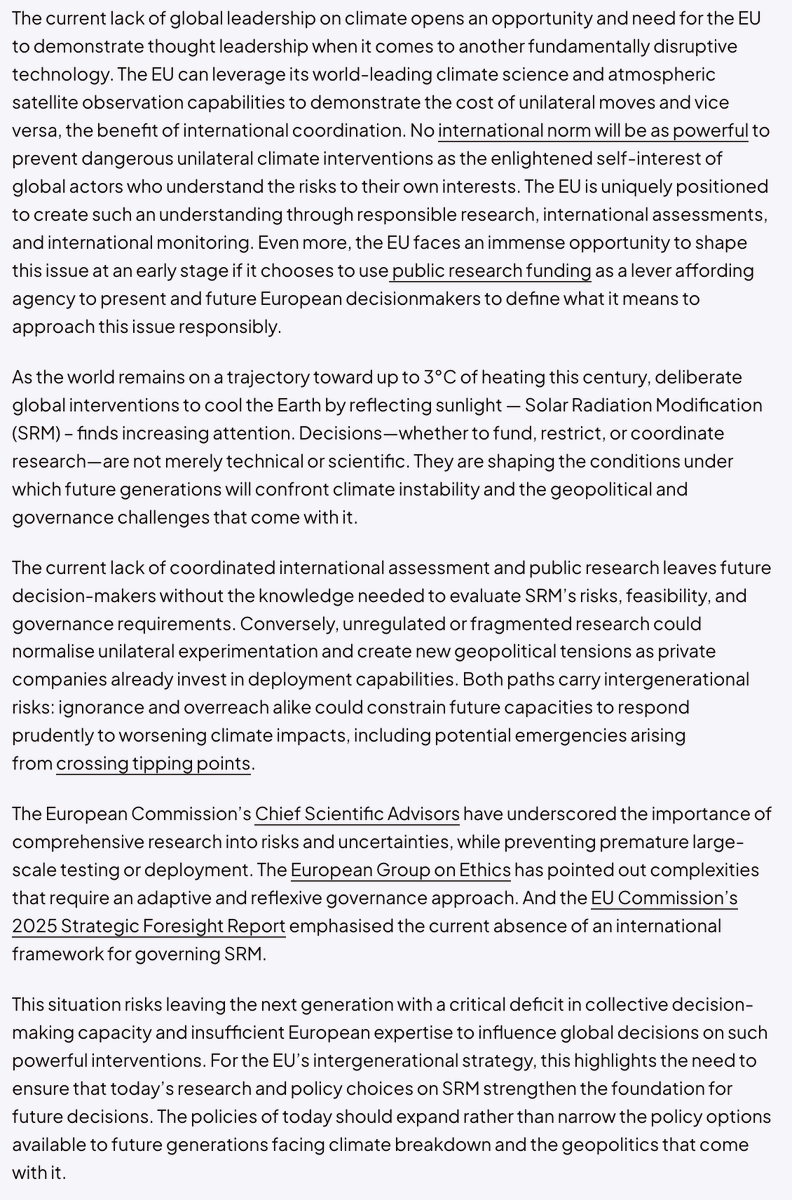
👶 Intergenerational fairness requires anticipating how todays actions or inactions alter the landscape for future generations of decisionmakers and citizens.
🙏 The EU intergenerational fairness strategy opens up clear opportunity pathways to do so across a range of high-stakes technologies and related governance.
👉 The Centre for Future Generations' submission provides context and recommendations, including specifically for climate interventions (alongside biotech, AI, and neurotech the need for foresight).
#subchapter-8" target="_blank" rel="nofollow noopener">cfg.eu/submission-to-…
English
@geoengineering1 My answer is that actions thate are broader that the physical use of SAI can use the idea or reality of SAI to provoke a reaction.
English

🤔 Recent discussion on the security dimensions of solar radiation modification (SRM) has surfaced long-held concerns that the scientific community would overlook messy geopolitics by constructing the idea of a planetary sunshade in the sanitised model world of rational decision-making for the global good.
✔️ These articles are doing a great job at explaining that the world of political power and global decisions generally does not optimise for global welfare, much in contrast to the world modelled in climate mitigation scenarios. Some are thus rightly pointing to a feature of the SRM governance problem, which is the “free-driver” risk: This seemingly low-cost, high-power lever could be pulled against scientific evidence, prematurely, excessively, or in the absence of strong global agreement and broad-based support. The resulting political and physical risks are devastating and potentially destabilising to global and regional security. This is where the governance of SRM resembles efforts at ensuring the non-proliferation and non-use of nuclear or chemical weapons.
🔥 At the same time, I am hearing well-founded concerns in the scientific community that this observation leads to jumping to faulty conclusions. Indeed, the world is dynamic, not secure, nor stable, and the unfolding and growing impacts of climate change on populations, economies, and militaries are known to act as a serious threat multiplier. The scenarios (without SRM in the mix) in which climate-induced desperation triggers regional destabilisation, which slips toward armed conflict, plausibly lie ahead on our current path.
✖️ Climate acting as a severe threat-multiplier, especially in a +3°C world, and SRM’s theoretical potential to counter climate change raises crucial questions: Research to date consistently points to a theoretical potential of SRM – in a non-conflictual deployment case – to dramatically reduce physical climate threats.
➗ This represents a potential for SRM to act as a “threat-divider”, which is intertwined with the geopolitics under SRM-cooled or climate-heated conditions. Additionally, the power of SRM and the devastating consequences of competitive or conflictual use and potential termination might act as an incentive for tacit if not explicit coordination. Though global decision-making is not rational, the question of incentives remains valid and important.
🔗 To date, research and assessments have not managed to integrate the requisite scientific-geopolitical analysis to produce robust evidence in favour of or against that theoretical potential. And such analyses’ findings will themselves influence the likelihood of alignment or conflict. This is why SRM is both: A non-deployment issue requiring prevention AND a potential climate action issue that requires clarification of its potential and risks.
This is why it is essential to unpack two distinct governance questions:
1. The SRM-deployment question: How to build governance that effectively addresses the deployment-proliferation risk?
2. The SRM-research question: Which form of (geopolitically aware) research can produce the knowledge that may guide power and political choices for the (non-conflictual) use or deterrence of SRM in a 3°C climate threat-multiplied world?
🛑 Some have simply answered question 1 by demanding a ban on public research in the apparent hope that this would halt any possibility of proliferation. However, I believe reality has already demonstrated this to be ineffective: Private actors have started to develop technology, speculating on future government contracts for deployment, and they won't be the last ones to do so.
❗️A lack of internationally trusted joint assessments and the current knowledge asymmetry weaken the odds for alignment. Inaction exacerbates, not alleviates, risks to all.
🌐 This is why I choose to focus on advancing the governance infrastructures – from research and assessments to the transparent information provision and atmospheric monitoring – that may enhance global power balance in high-stakes choices that affect us all around the world today and our next generations.
English
@geoengineering1 Your question was: can SAI be used to provoke a reaction. The above is my answer…
English
@geoengineering1 Yes, communicating about SRM / planting information etc can. (See Trish’s article).
English
@HoneggerM Do you think SAI can be used as a hybrid warfare weapon - deliberately provoking geopolitical unrest, mistrust, and escalation? (As opposed to a targeted weapon)
English
🌍 10 New Insights in Climate Science 2025 from @ESA_EO
1. Record-breaking warmth in 2023–2024 raises new questions: Shift to El Niño amplified extremes, but natural variability can’t explain it all. Earth’s energy imbalance suggests accelerating global warming.
2. Rapid ocean warming and intensifying marine heatwaves: Sea-surface temps rising unprecedentedly, causing ecosystem damage, livelihood threats, extreme weather risks, and reduced ocean carbon absorption.
3. The global land carbon sink is weakening: 2023 saw a decline in land carbon uptake, potentially shrinking the carbon budget. Northern ecosystems hit by wildfires and permafrost thaw.
4. Climate change and biodiversity loss amplify one another: They create a destabilizing feedback loop, threatening ecosystems and carbon storage. Better coordination across conventions needed.
5. Climate change is intensifying groundwater depletion: Faster depletion due to disrupted recharge and rising demands, risking agriculture, subsidence, and seawater intrusion.
6. Climate change is driving the global surge in dengue: Record outbreaks as warmer temps expand mosquito habitats. Urbanization and travel worsen it, straining health systems.
7. Heat stress is reducing labour productivity and incomes: Eroding productivity, especially in developing countries, with global supply chain impacts. Low-emissions paths cut GDP losses.
8. Carbon dioxide removal must scale up safely and responsibly: Essential for residual emissions, but must complement reductions. Needs governance, research, and safeguards.
9. Strengthening integrity in carbon credit markets: Expansion exposes issues like overestimation. Shift to contributions over offsets for credibility.
10. Policy packages outperform single measures: Integrated mixes achieve more reductions. Carbon pricing with subsidy reform effective; tailor to national contexts.
Read the full report: t.co/TffwQvuH5o
ESA Earth Observation@ESA_EO
What does the latest research tell us about Earth's changing climate? The '10 New Insights in Climate Science 2025' report highlights ten key findings, including accelerating ocean warming, record‑breaking global heat and reduced carbon uptake on land. Read more: esa.int/Applications/O… 📹contains modified Copernicus Marine Service data (CNR, Buongiorno et. al.), processed by ESA
English
In a short but extremely relevant and fair podcast segment, @KarlMathiesen of @POLITICOEurope is being interviewed on his research into and journalistic coverage of the issue of climate interventions/solar radiation modification / geoengineering and the startup company Stardust.
If you consume one piece on this topic, these few minutes should be it.
open.spotify.com/episode/1nKtHt…
Outrage Optimism: The Climate Podcast
English
EVs and solar panels powered China's emission stabilization in most of 2025
carbonbrief.org/analysis-china…
English
A relevant datapoint: The annual climate outlook from the Rhodium Group finds that the range of possible climate futures has essentially not changed in the past two years. climateoutlook.rhg.com/?utm_campaign=…
English
Climate policy is psychologically hard for many reasons. One of them is the fact that two statements are true at once:
We are making amazing progress in building out clean power!
We are loading the atmosphere with unprecedented amounts of heat and destabilising the planet!
Dr. Robert Rohde@RARohde
@Noahpinion Cutting the top off of the future emissions curve is great progress, but our trajectory is still far removed from the kind of deep cuts that would be needed to meet Paris Agreement targets.
English
A personal reflection on recent events (private sector SRM funding and discussions in Helsinki, Brussels, New York, Paris, Brasilia, and more):
In policy debates, we tend to get stuck in false dichotomies: control versus freedom, risk versus responsibility, innovation versus precaution. The world we inhabit is far more complex. Being prepared for things to come demands systemic and strategic thinking and doing.
Europe cannot control the world through regulation alone. Alternatives need to be explored, and genuine European leadership is urgently needed as other global actors have become unreliable — leadership that engages and shapes before others have predetermined the outcomes.
Take advanced AI. It is taking on a life of its own, with transformational risk and potential. A purely reactive posture does not suffice. If Europe wants its values to be reflected in the technologies that shape our futures, it must pull more levers: Yes to regulating AND to actively shaping through participation. Sitting back would hand control of this immensely powerful technology to others who do not share our principles.
A similar dilemma plays out in Solar Radiation Modification (SRM). Europe has long failed to research SRM’s risks and uncertainties, worried that doing so could signal openness to a dangerous shortcut in climate responsibility. Yet holding back cedes the expertise – and shaping power – to others who might not share those concerns – including the private sector. Consider Stardust Labs, which just raised $60 million in its second funding round, in a field where the cumulative total global research funds have barely reached $100 million. Europe risks losing the capacity to shape what happens next.
Meetings like Think and Do 2025, and broader exercises in strategic foresight, are exactly the spaces where we can step out of reactive thinking. Here, diverse stakeholders can connect, reflect on unintended consequences — both positive and negative — and chart pathways that acknowledge complexity instead of retreating from it.
Sometimes, what looks like caution — for example, withholding public funding for sensitive research — can actually deepen the risks, leaving power and expertise in the hands of others. Those who might develop technological capability at a time when deployment CANNOT BE AN OPTION. Real leadership means engaging responsibly before others take over, not abstaining.
There are real opportunities to shape our unfolding future: The provision of research funds gives the funder an immense toolset, including setting priorities (e.g. studying risks of unilateral SRM use), defining conditions (e.g. radical transparency, engagement, and communication), and thereby shaping the norms by which the field will abide.
Surely there are trade-offs to consider – including limited overall research funds. But a closer look at the interdependencies may also uncover synergies and "risk-superior moves" that allow tackling multiple concerns at once.
English
What's your sense: is there a general causation between online media consumption and increasing distress and doom aka doomscrolling (perhaps due to reduced social connections etc) in general – some of it expressing as climate distress/doom? How much of that might be general doom and how much induced by online climate communications?
English

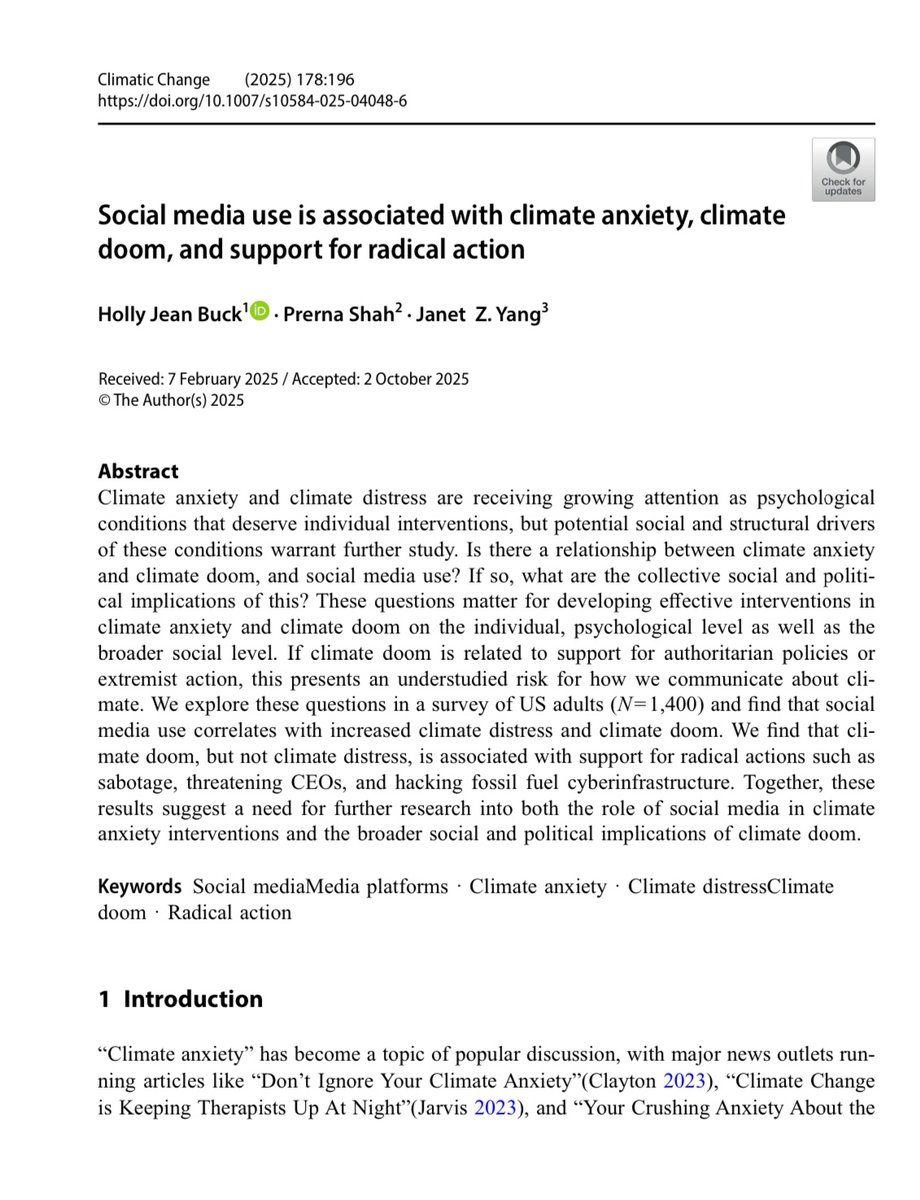
Does being extremely online correlate with climate distress and climate doom?
New paper suggests so. We also looked at how these relate to support for radical action. details in the paper
English
Imagine there’s a 1 in 10 chance of catastrophic failure on a ship, plane, or train ride: would you get on board?
Johan Rockström@jrockstrom
If the likelihood of a catastrophic event is > 10% then the Risks are unacceptable high. This is the point we have reached on scientific evidence for AMOC shutdown. This is the "Don't look up moment" for risks of liveability on Earth theguardian.com/environment/20…
English