
Sabitlenmiş Tweet
HOOKED!
687 posts


HOOKED!
@HookedExchange
Pioneering REHYPED stablecoin liquidity on Uniswap v4. UFSF grantees. Swap fees + external yield. Most earn once. The best earn twice.
Katılım Haziran 2025
7 Takip Edilen367 Takipçiler

Everyone loves to talk about TVL, but almost nobody talks about retention.
That is the real battle.
Most protocols run the same loop.
Pay incentives to rent liquidity.
Hit a TVL screenshot.
Watch the yield collapse when emissions cool.
Watch liquidity fragment across venues again.
Here is the uncomfortable part.
Stablecoin pools are designed for stability, which compresses fee yield. That is why less than 1 percent of stablecoin supply sits in DEX liquidity in the first place. The math makes LPs choose between swap fees or lending yield, and that choice is capital inefficiency disguised as “strategy.”
REHYPED liquidity stacks both legs in one position.
Swap fees when flow is there.
External yield when flow is not.
Question for you.
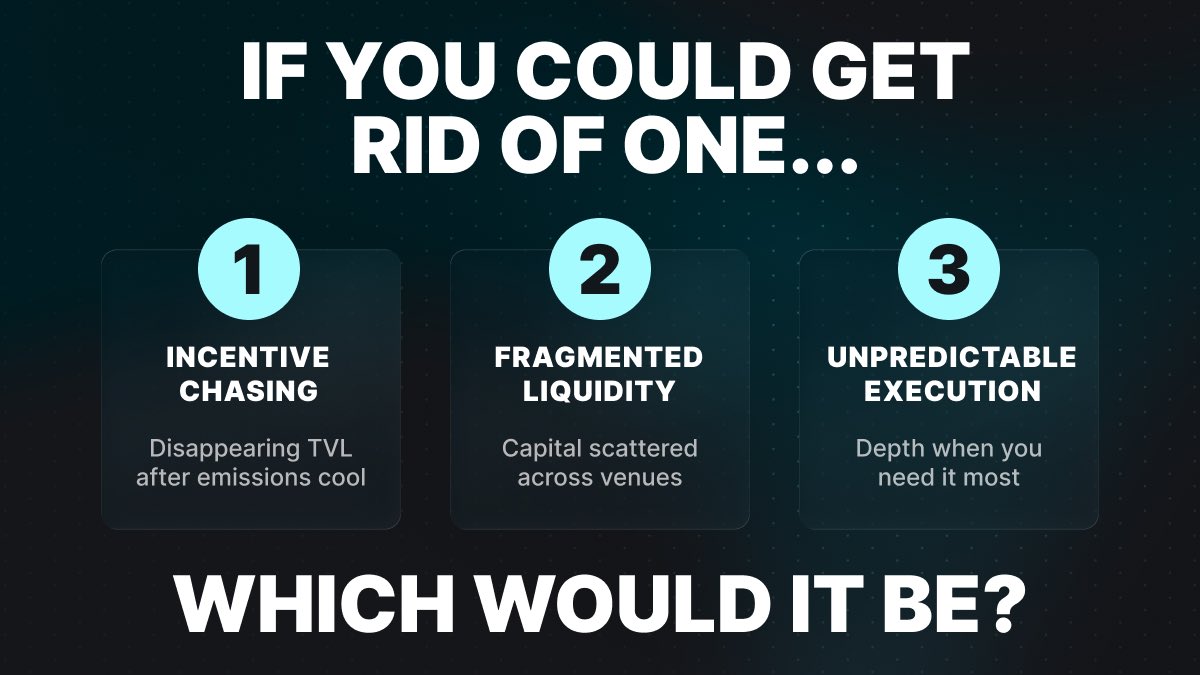
If you could remove one thing from DeFi liquidity forever, what would it be.
Incentive chasing, fragmented liquidity, or unpredictable execution.
Reply with one, and tell us why.
English
This is exactly why we are building HOOKED!
Stablecoin liquidity is becoming the core settlement and routing layer onchain. Most swaps begin and end in stables, and that is where depth matters most for the whole ecosystem.
We are building on Uniswap v4 hooks to make stable liquidity more capital efficient and more resilient, with better execution surfaces for routers and aggregators.
On the LP side, we are shipping REHYPED liquidity. Stablecoin positions that can earn swap fees plus an external yield leg in one place. That yield floor helps liquidity stay sticky when volume cools, which is how execution stays durable through cycles.
Better routing needs better rails. Better rails require liquidity that stays.
Question for you. What should the default max slippage be on large swaps, and should interfaces force manual confirmation above a certain price impact? Reply with your take. 🪝
English
Routing is not execution quality.
You can route through five pools and still get a catastrophic outcome if the final venue is thin.
Any serious DeFi UX should treat extreme trades as a different class of risk.
Hard slippage caps.
Clear price impact warnings.
Manual confirmation above a threshold.
Simulation that actually reflects depth.
Humans misclick. Bots misfire. Wallets auto route. And when size meets shallow liquidity, the AMM does exactly what it is designed to do. It reprices.
That is not a bug. It is the system.
So the fix is not “be careful” as a product philosophy. The fix is deeper liquidity where most flow lives, plus guardrails that make self nukes impossible by default. If DeFi wants mainstream trust, catastrophic edge cases must become rare, and ideally impossible.
English
A trader just lost over $50M on a single onchain swap.
No hack. No exploit. Just liquidity and AMM math.
They held ~50M in aUSDT on Aave and wanted to rotate into AAVE. The route executed as:
USDT → WETH → AAVE, across multiple pools.
The fatal detail was the last step. The AAVE pool did not have enough depth for that size. In AMMs, price is a curve. When you trade too much relative to liquidity, you push the price against yourself with every fill. That is price impact.
In this case, the swap walked the curve so aggressively that the trader ended up with roughly 327 AAVE worth about $36k.
The value did not disappear. It transferred via the AMM mechanism to liquidity providers along the path. This is the dark side of permissionless markets when safeguards are weak.
English
HOOKED is built on Uniswap v4 hooks for a reason.
Programmable liquidity lets pools adapt.
Dynamic fees can price risk.
Custom logic can protect LP outcomes.
And REHYPED liquidity can keep stables productive.
What feature do you want to see first in a new DEX.
Better execution, better LP yield, or better safety.
English
Did you know concentrated liquidity is not passive.
It is active market making.
When you provide liquidity inside a narrow range, you earn more fees per dollar, but you take on a new risk. If price leaves your range, your position goes inactive and your fee stream turns off. That is why so many LPs feel like their yield is random. It is not random. It is regime driven.
Now add the stablecoin reality.
Stable pairs have low impermanent loss, but also structurally lower fee yield because they hug parity. That is why incentive programs became the default crutch.
Our view is simple.
A stable LP position needs a baseline.
A yield floor that persists when fees are quiet.
So here is the question.
What do you optimize for today.
Maximum fee APR in the best weeks, or a smoother return curve you can hold through the cycle.
Reply with peak or consistent, and your honest reason.
English
