James Hopf

16.9K posts

James Hopf

James Hopf

@HopfJames

Retired nuclear engineer. Climate action and nuclear power advocate. Supporter of tech-neutral climate policies.

Tracy, CA Katılım Ekim 2020
208 Takip Edilen8.2K Takipçiler
James Hopf
James Hopf@HopfJames·
No reason to think it would be any worse than a missile attack on an oil tanker, or other sips containing hazardous chemical/material. Such rare attacks would not come close to offsetting the environmental benefits under normal operation. Cargo currently use Bunker C, a particularly dirty/pollution trype of oil. Massive CO2 and air pollution. Nuclear powered cargo ships would emit neither.
English
2
0
18
387
James Hopf
James Hopf@HopfJames·
The Korea Atomic Energy Research Institute, the Korea Research Institute of Ships & Ocean Engineering, and Samsung Heavy Industries are working together to develop a molten salt reactor powered containership. Article link in reply. The American Bureau of Shipping (ABS) granted "basic design approval." "The ABS reviewed and verified the technical feasibility and safety of the technology and design. The receipt of the Approval in Principle (AiP), the group said, is a confirmation of the potential of marine nuclear technology.”
James Hopf tweet media
English
30
205
935
104K
James Hopf
James Hopf@HopfJames·
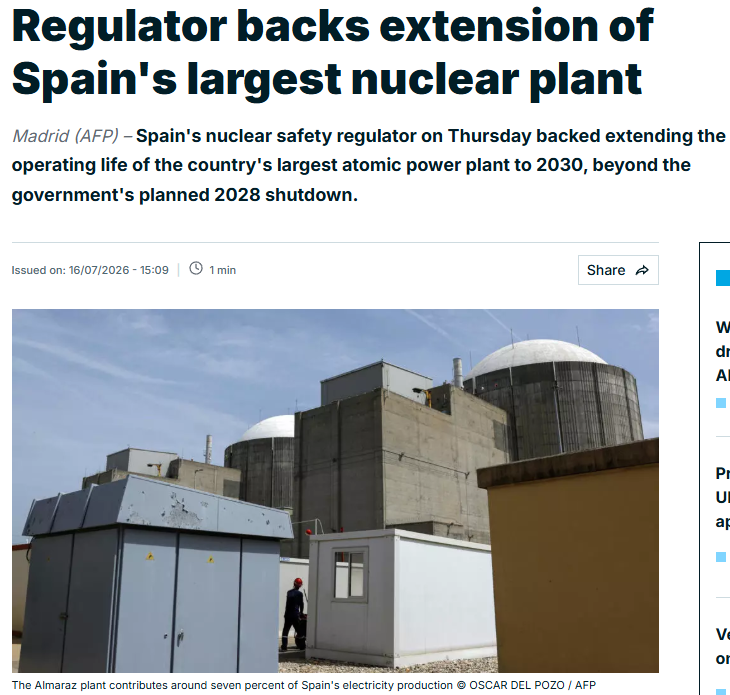
Spain's anti-nuclear PM told the utilities that the Almaraz nuclear plant will be allowed to operate until 2030 (vs. 2028) only if it met all safety requirements. Spain's regulator confirmed that it would. Will the PM keep his promise? Article link in reply. Or will he stick to his dogma and force it to close anyway. The current government still want to phase out all of Spain's nuclear plants, i.e., Spain's source of reliable, clean power. This, despite high energy costs, reliability problems, and lack of energy security (Iran war). Perhaps we should poll the Spanish people on this topic. This needs to be about more than letting a single plant operate for two more years. Spain needs to keep all of its remaining nuclear plants, and operate them through 2050 (the year when climate goals come due).
James Hopf tweet media
English
9
12
74
5K
James Hopf
James Hopf@HopfJames·
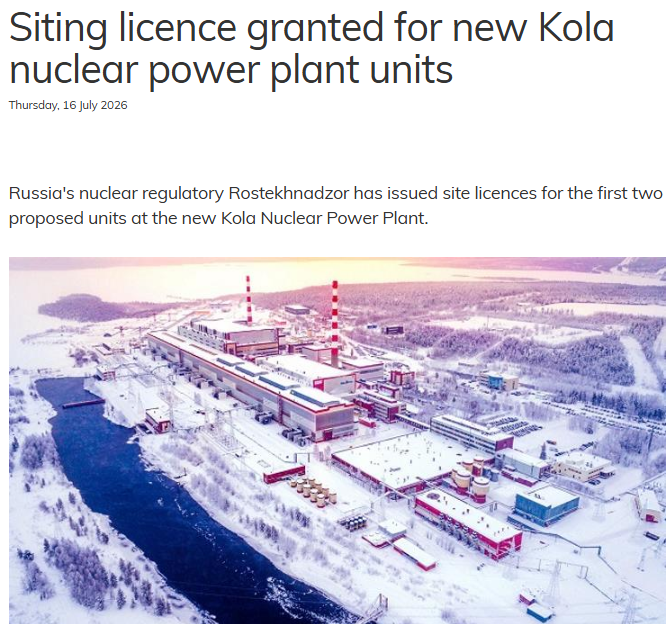
Russia has chosen a site 10 km South of the Kola nuclear plant to built a new plant. The plant will eventually have four 600 MW VVER-S reactors. The first two reactors will be built from 2027 to 2037. Article link in reply. The reactors may be able to use MOX fuel (which Russia apparently has at its disposal). The new reactors will replace the four VVER-440 reactors at the existing Kola plant, when they reach the end of their "operating lives". Those reactors started operation in 1973 and 1984. The article does not say when they would close. They should do what the US is doing, i.e., run their plant for 80 (perhaps 100) years. I'm a bit surprised that the new reactors will take ~10 years to build. I thought Russia was as good as China in terms of building reactors. Apparently, ony China can build them in ~5 years.
James Hopf tweet media
English
8
4
36
2K
James Hopf
James Hopf@HopfJames·
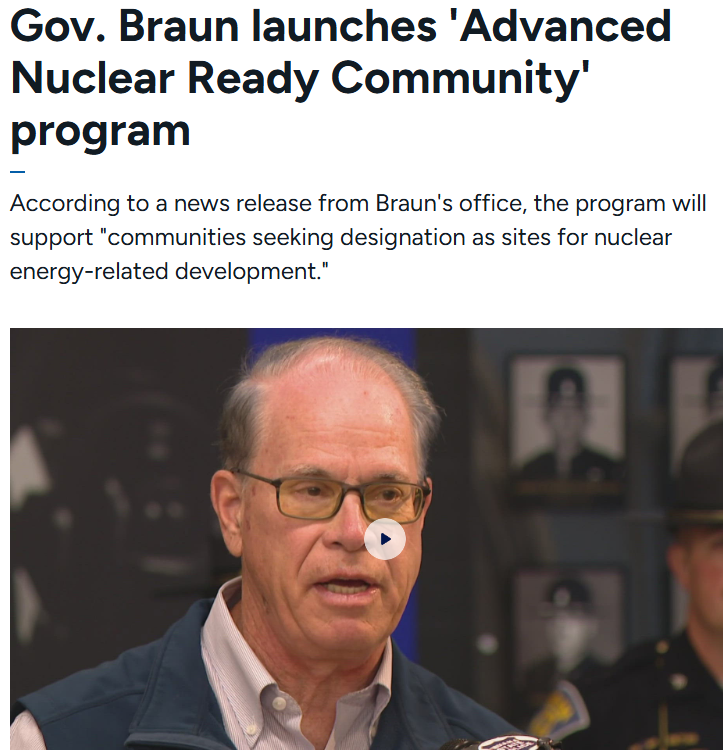
Indiana's governor has launched an "Advanced Nuclear Ready Community" program. It will provide community education about nuclear, help with local nuclear work force development, and will facilitate nuclear siting and permitting. Article link in reply.
James Hopf tweet media
English
3
7
30
1K
James Hopf
James Hopf@HopfJames·
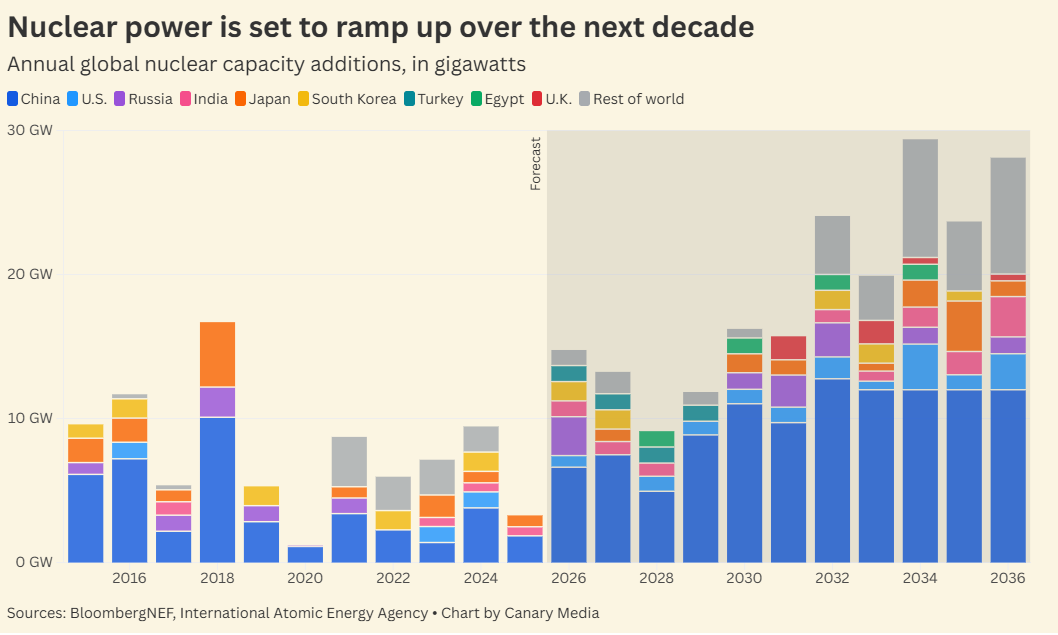
I tweeted awhile ago about BloombergNEF's prediction that world nuclear capacity would increase by 44% by 2036 (from 372 GW to 535 GW). This article presents additional information about where the growth will happen. Article link in reply.
James Hopf tweet media
English
5
14
50
2.8K
James Hopf
James Hopf@HopfJames·
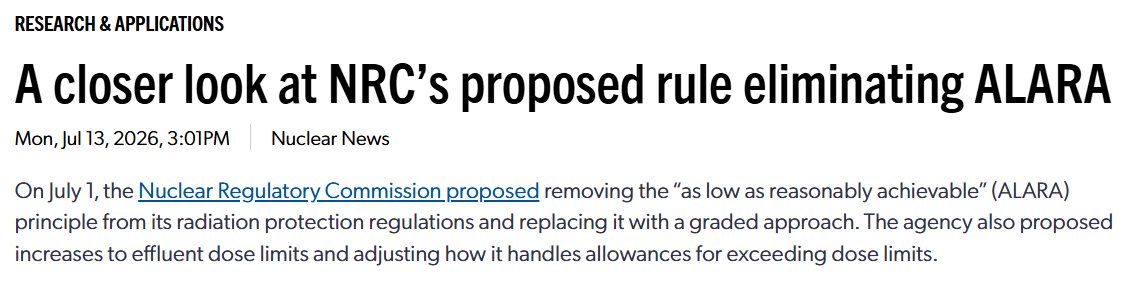
I found this article, about NRC's proposal to eliminate ALARA, to be frustrating in many ways. Article link in reply. For starters, they didn't interview any ALARA (and LNT) opponents. They deserved a seat at the table, given how many people believe that ALARA and LNT are flawed. I don't understand this NRC statement: "The rule change also discusses the limits of the LNT model but finds that no consensus-supported, regulation-ready alternative model exists at this time.” Everyone understands the convenience of using LNT. It's simple to administer and is very clearly conservative (i.e., it yields upper bound estimnates of health effects). Are they saying that the won't change LNT unless there is complete consensus? What does "regulation-ready" mean? They like the convenience of LNT? How would a determination that no regulations, or required actions, are needed below a speficied threshold be hard to regulate? Nothing is easier than no regulation (doing nothing). No regulations need to be "ready." The idea for eliminating ALARA is that the dose limits remain the same, but it would reduce or remove unneeded administrative costs. The interviewees didn't think that it would be worth the polical capital, since the cost savings were predicted to be low. I'm not sure the operational costs of ALARA are that low (on a per MW-hr generated basis), particularly for small reactors. I also belive NRC's argument that they're not changing the dose limits will work with the public (to the extent that the general public is even paying attention). They do, however, need to make an effort to explain the benefits of the proposed changes. BTW, is any other industry subject to an "ALARA" requirement? Applying such a program to coal plants would make far more sense, given that their impacts are thousands of times larger. I'll finish with one point/plea. Removing LNT so plants can save small amounts of money would be one thing. But strict adherence to LNT sometimes has enormous costs. The interviewees argue that any increase in dose limits will result in reduced popular support, but some LNT-based actions have resulted in huge loss of public support. My understanding is that post-accident evacuation policies are LNT-based. Evidence of health impacts from doses below 10 Rem is weak to non-existant. We can't prove that there is an effect, but we can't prove that there is not. In other words, it's noise level. The Japanese government evacuated a large number of people, for a long time, to avoid exposures less than 10 Rem. They even referred to such areas as being UNINHABITABLE! Pretty strong words for an area that may have a small potential health effect. Analyses show that those "uninhabitable" areas are actually less unhealthy than living in Tokyo (let alone heavily polluted cities like Beijing!). This unjustified action had a huge impact on the lives of a large number of people. It taught the Japanese public that nuclear is uniquely dangerous. As a result, many (most?) Japanese people, to this day, prefer coal over nuclear! The resulting use of coal and gas generation, in place of clean nuclear, caused tens of thousands of deaths, FAR more deaths than what would occur if they didn't do any long-term evacuations. Shelter in place, as is done in other industrial accidents/fires is the right policy. Even if we decide that doses under 10 Rem have some health effect, we must not respond with an "any significant nuclear-related health effect must be avoided" policy. The benefits and harms of an evacuation must be objectively considered. The question is not "will not evacuating have any health effect". The question is whether evacuation may result in a larger negative result.
James Hopf tweet media
English
1
7
23
1.3K
James Hopf
James Hopf@HopfJames·
TRISO-X's HALEU TRISO fuel fabrication facility in Oak Ridge will provide ~1100 jobs to the local area. Article link in reply.
James Hopf tweet media
English
1
5
21
1.3K
Lenny
Lenny@LennyCoele·
@MarcInRenew @HopfJames They did not in fact the turbine was sold and the supporting systems scrapped. Turbine halls are empty. Parts of the primary systems are gone too.
English
2
0
0
23
James Hopf
James Hopf@HopfJames·
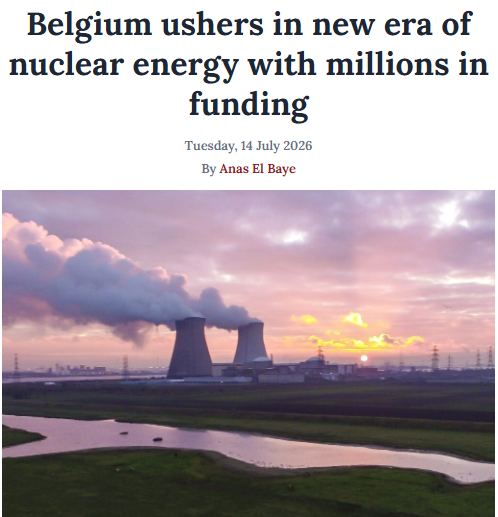
Belgium has gone from a nuclear phaseout policy to keeping (some) reactors on and providing grants for nuclear R&D. Article link in reply. They no longer view nuclear as dirty and dangerous, and they now know that they can't get all of their power from renewable sources. Quote: "...we thought renewables would cover all the energy we needed ... the reactors' closure was ideological, but the decision to reopen them is pragmatic." IMO, what they need to do now is restart the five reactors that are still closed.
James Hopf tweet media
English
6
31
116
3.2K
James Hopf
James Hopf@HopfJames·
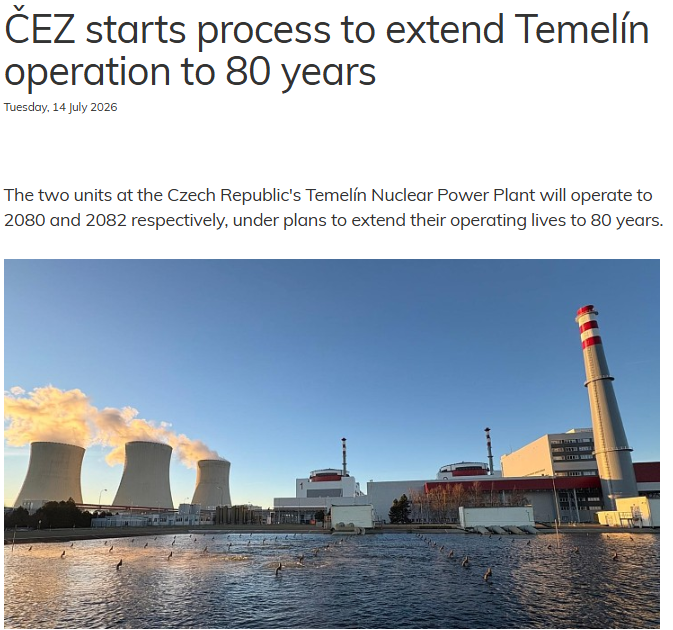
The Czech Repubic is following the US's lead, and is extending operation of its Temelin plant to 80 years. The plant will operate until 2082. Article link in reply. This may be the world's first 80 year operation license for nuclear plants that young (under 25 years).
James Hopf tweet media
English
4
15
62
3.1K