
Horizon Armenian News

4.6K posts

Horizon Armenian News banner
Horizon Armenian News

Horizon Armenian News

@HorizonWeekly

Armenian News - Media

Canada Katılım Mart 2014
198 Takip Edilen1.8K Takipçiler
Horizon Armenian News
Horizon Armenian News@HorizonWeekly·
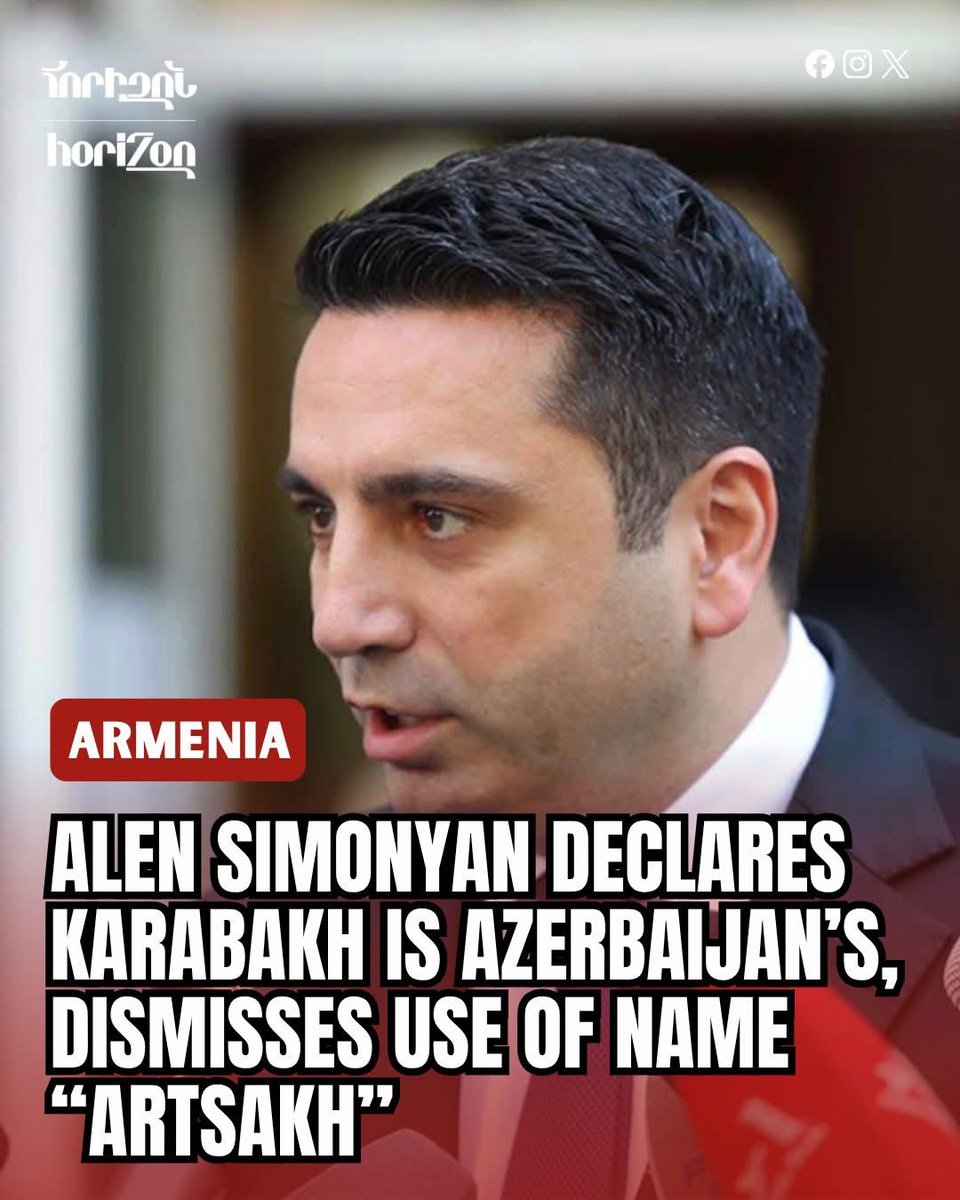
Alen Simonyan declares Karabakh is Azerbaijan’s, dismisses use of name “Artsakh” --- (Horizon Weekly / YEREVAN) — Armenia’s National Assembly Speaker Alen Simonyan stated that Karabakh is part of Azerbaijan and openly questioned the use of the name “Artsakh,” adopting rhetoric that directly mirrors Azerbaijani positions while dismissing longstanding Armenian historical and political claims. Speaking to journalists, Simonyan defended Armenia’s role in the Prague process as a necessary step to preserve statehood, arguing that it secured the country’s territorial integrity and prevented scenarios such as loss of sovereignty or external domination. At the same time, he rejected criticism of Azerbaijani naming practices, going so far as to suggest that Armenians should not object if cities such as Yerevan are referred to by altered names abroad. He insisted there should be no reaction to such cases, reiterating his position that Karabakh belongs to Azerbaijan and questioning the continued use of any alternative designation. The remarks effectively equate Armenian claims, rooted in history, identity, and recent conflict, with what Simonyan portrayed as unwarranted sensitivities, while normalizing the language and framing advanced by Baku. His statements mark one of the clearest acknowledgments by a senior Armenian official that the issue is no longer being treated as a matter of dispute, but as settled in Azerbaijan’s favour. Simonyan further claimed that those who criticize the Prague process do not want Armenia to exist as an independent state, drawing a stark line between the government’s position and any dissenting view. This framing dismisses substantive concerns over the long-term implications of the process, including its impact on national rights, security, and political leverage. Addressing substantive accusations that the government is yielding to Azerbaijani demands, Simonyan denied any such concessions, pointing instead to a pre-existing constitutional reform agenda. He defended ongoing discussions about removing references to the Declaration of Independence from the Constitution, arguing that “new realities” require adjustments. In doing so, he signalled a willingness to revise foundational state documents in line with the government’s current approach, a move that has raised serious questions about the erosion of Armenia’s political and legal framework. Simonyan repeatedly justified the government’s direction by invoking the need to avoid renewed war, suggesting that preventing casualties outweighs other national considerations. He characterized the ruling Civil Contract party as the sole guarantor of peace, while labelling opposition forces as proponents of war, reducing a complex national debate to a binary political narrative ahead of the 2026 parliamentary elections. He also pointed to what he described as harassment targeting his family and that of Prime Minister Nikol Pashinyan, though his remarks came amid broader public backlash against the government’s rhetoric and policies. The statements follow a widely circulated March 22 incident in Yerevan’s metro involving Pashinyan and a woman displaced from Karabakh. The prime minister attempted to hand her a pin depicting Armenia’s map, but she refused it, stating that she identifies with a different version. The exchange escalated, with Pashinyan rejecting accusations that he had relinquished Karabakh. The woman, Armine Mosiyan—daughter of Meruzhan Mosiyan, a field commander killed during the First Nagorno-Karabakh War in 1993—was later invited by Pashinyan to the government building for a public apology. Taken together, Simonyan’s remarks and the surrounding developments reflect a government line that not only abandons longstanding national positions but also increasingly delegitimizes those who continue to assert them, framing dissent as a threat rather than a political reality.
Horizon Armenian News tweet media
English
0
0
1
207
Horizon Armenian News
Horizon Armenian News@HorizonWeekly·
Emmanuel Grégoire Wins Paris Mayoral Race Over Pro-Azerbaijani Rachida Dati --- Emmanuel Grégoire has been elected mayor of Paris, securing a clear victory over right-wing challenger Rachida Dati and extending more than two decades of left-wing leadership in the French capital. Grégoire, a Socialist and former deputy mayor under Anne Hidalgo, won just over half of the vote, with results placing him between roughly 50 and 52 percent. Dati trailed with just over 41 percent, while far-left candidate Sofia Chikirou finished a distant third. The 48-year-old’s victory was widely anticipated and confirms Paris’s continued alignment with the political left. Having served as Hidalgo’s deputy from 2018 to 2024, Grégoire enters office with extensive experience at City Hall and has pledged to maintain many of the outgoing administration’s policies, particularly in areas such as environmental planning and social support. In his first remarks following the win, Grégoire emphasized that his priorities would focus on the city’s most vulnerable residents, stressing the urgency of addressing homelessness and social inequality. He also signalled continuity in Paris’ urban policies, including its strong push toward cycling infrastructure and reduced car use. The defeat of Rachida Dati marks a significant political setback for the right, which had hoped to reclaim Paris after years in opposition. Dati, a former culture minister, ran a high-profile campaign but remained a polarizing figure. Her candidacy drew particular scrutiny among Armenians and their allies due to longstanding and well-documented ties to Azerbaijani authorities and the Aliyev family. Azerbaijani state-linked sources have previously highlighted her meetings with President Ilham Aliyev and First Lady Mehriban Aliyeva, including visits to Baku, while French media have reported on controversies surrounding those relationships. In 2025, Dati also lost a defamation case tied to claims about her links to Azerbaijan, with a French court ruling that such characterizations fell within the bounds of legitimate political debate. Her campaign was further complicated by legal challenges and a divisive political profile, factors that appear to have weighed on voters in a city that has consistently leaned left in recent decades. Grégoire succeeds Anne Hidalgo, who served as mayor since 2014 and was widely regarded as a close friend of the Armenian community. Under her leadership, Paris maintained strong symbolic and political support for Armenian causes, including recognition initiatives, commemorations, and public advocacy on issues related to Armenia and Artsakh. Municipal election results across France showed a broader pattern of resilience for mainstream parties, with Socialists and their allies holding major cities such as Paris, Marseille, Lyon, and Lille. While both far-right and far-left forces made gains in certain municipalities, the overall outcome reinforced the continued dominance of established political blocs in key urban centres. Grégoire now takes office at a politically sensitive moment, as France looks ahead to future national elections, with Paris expected to remain both a symbolic and practical stronghold for the country’s left.
Horizon Armenian News tweet media
English
0
0
3
72
Horizon Armenian News
Horizon Armenian News@HorizonWeekly·
ANCC convenes Annual General Meeting in Kingston — (Horizon Weekly / OTTAWA) – On Saturday, March 21, 2026, the Armenian National Committee of Canada (ANCC) convened its annual general meeting in Kingston, Ontario. During the one-day session, members conducted a comprehensive review of the committee’s recent activities, assessing key achievements and identifying ongoing challenges. Particular emphasis was placed on continuing and enhancing the effectiveness of ANCC’s work across its operational, tactical, and long-term planning levels. Discussions also focused on further strengthening communications, public engagement, and political advocacy efforts. The committee established its policy priorities for the year ahead, underscoring the critical importance of youth engagement. It was highlighted that fostering the next generation’s involvement remains essential, with a focus on expanding educational initiatives, volunteer opportunities, and civic and political awareness programs. Throughout the meeting, the committee reaffirmed its steadfast commitment to advancing the rights and just cause of the people of Artsakh. In this context, members stressed the importance of sustained international advocacy to secure the release of Armenian prisoners and hostages held in Azerbaijan, as well as to uphold and implement the right of return for displaced Armenians of Artsakh. The urgent need to protect Armenian cultural and religious heritage, in light of ongoing threats and acts of destruction, was also strongly emphasized. In addition, the committee reiterated its principled commitment to promoting democratic governance and safeguarding religious freedoms in Armenia, recognizing these as fundamental pillars for both the country’s long-term stability and the protection of broader Armenian national interests. The meeting concluded with a reaffirmation of the committee’s firm resolve to advance these priorities with determination, unity, and strategic focus in the period ahead.
Horizon Armenian News tweet media
English
0
0
4
58
Horizon Armenian News
Horizon Armenian News@HorizonWeekly·
Letters Submitted to Senior UN Officials on Safeguarding the Rights of the People of Artsakh ⸻ During the 61st session of the United Nations Human Rights Council in Geneva, Mario Nalbandian—member of the Committee for the Protection of the Rights of the People of Artsakh, established by the National Assembly of the Republic of Artsakh, Vice President of the Socialist International, and the Armenian Revolutionary Federation’s representative to it—held a series of meetings with senior United Nations officials. The discussions focused on pressing issues concerning the fundamental rights of the people of Artsakh, including the right to collective return, the release of Armenian prisoners unlawfully held in Azerbaijan, the protection of Armenian cultural heritage, and the ongoing social challenges faced by displaced Artsakh Armenians currently residing in Armenia. Nalbandian delivered to UN officials formal letters from the President of the National Assembly of the Republic of Artsakh, Ashot Danielyan, along with collective petitions endorsed by the leaders of Artsakh’s communities. In his letter, Danielyan underscored that the absolute priority for the people of Artsakh remains their safe, dignified, and collective return to their ancestral homeland. He stressed that lasting peace in the region cannot be achieved through the legitimization of ethnic cleansing, but rather requires the full restoration of the rights of the indigenous population, under credible international security guarantees. In parallel, a joint appeal signed by the heads of more than 60 Artsakh communities emphasized the urgent need to expand humanitarian and social assistance programs, ensure transparency and accountability in the distribution of aid, and mobilize international pressure on Azerbaijan to halt the destruction of Armenian settlements and to create the necessary conditions for a secure and dignified return. The letters further called for the designation of a dedicated UN focal point or mechanism to facilitate direct engagement and ensure sustained international attention to the evolving needs and rights of the people of Artsakh.
Horizon Armenian News tweet media
English
0
4
7
135
Horizon Armenian News
Horizon Armenian News@HorizonWeekly·
Turkey, Egypt, Pakistan and Britain: Key mediators in reducing tensions in the Middle East —- (Horizon Weekly) – Over the past 48 hours, the risk of a broader military escalation in the Middle East has temporarily eased, largely due to intensified international mediation efforts. According to reports by Axios and Reuters, several countries—most notably Turkey, Egypt, and Pakistan—have played a pivotal role in maintaining open lines of communication between Washington and Tehran. Senior officials from these states have held a series of bilateral meetings and phone conversations with U.S. Special Envoy Steve Witkoff and Iran’s Foreign Minister Abbas Araghchi, aiming to de-escalate tensions and advance diplomatic dialogue. Meanwhile, Oman has continued to serve as a trusted intermediary, facilitating indirect talks in Geneva and Muscat. These discussions have focused in particular on securing an agreement to reopen the Strait of Hormuz, a critical global shipping route. The United Kingdom has also joined the diplomatic push. As reported by The Guardian, London has not only backed the negotiations but has been actively involved in backchannel diplomacy, working to prevent potential strikes on vital energy infrastructure across the region. Amid these coordinated efforts, Iran has signalled its willingness to explore the restoration of maritime navigation. This development helped pave the way for U.S. President Donald Trump’s decision to delay planned military strikes by five days. Despite public denials from certain factions within Tehran, mediation efforts are continuing behind closed doors, with diplomats racing to secure a lasting understanding before the newly set deadline expires.
Horizon Armenian News tweet media
English
0
0
3
49
Horizon Armenian News
Horizon Armenian News@HorizonWeekly·
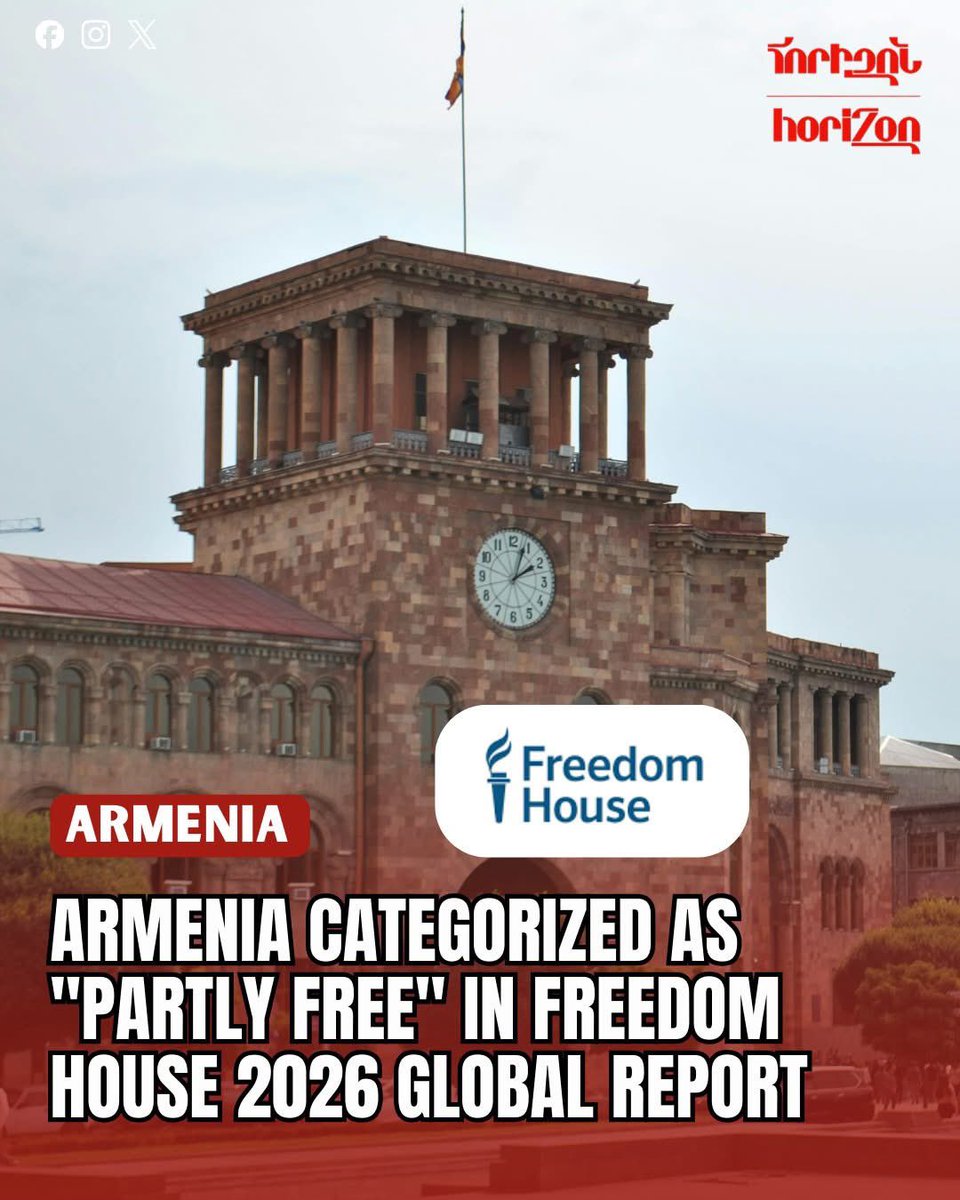
Armenia categorized as "Partly Free" in Freedom House 2026 Global Report --- The international human rights organization Freedom House has released its "Freedom in the World 2026: The Mounting Shadow of Autocracy" report, revealing a sobering milestone as global liberty declined for the 20th consecutive year in 2025. The study highlights a widening gap in democratic stability, noting that political rights and civil liberties deteriorated in 54 nations, while only 35 improved. Against this backdrop of global contraction, the South Caucasus and its neighbours present a complex landscape of stagnation, sharp decline, and entrenched authoritarianism. Armenia maintained its status as a "partly free" nation amidst the regional volatility, holding a steady score of 54 out of 100. This rating reflects a 23/40 score for political rights and a 31/60 for civil liberties, matching its performance from the previous year. While the report indicates that Armenia’s general democratic progress has plateaued, the country continues to perform well in the digital sphere, maintaining a "free" classification for internet freedom with a score of 72. In contrast, neighbouring Georgia saw its democratic standing erode further. Though still categorized as "partly free," Georgia’s score dropped to 51 from the previous year’s 55. Freedom House attributed this decline to the government’s response to large-scale anti-government protests that began in 2024 and persisted throughout 2025. The report detailed the disproportionate use of force and police mistreatment of demonstrators, noting that opponents of the ruling Georgian Dream party have faced a coordinated campaign of harassment, physical attacks, and legislative barriers designed to stifle civic and political participation. The situation in Azerbaijan remains among the most critical in the region, with the country’s score falling to just 6 out of 100. Retaining its "not free" status, Azerbaijan has seen a dramatic collapse from its score of 33 two decades ago. The report asserts that since 2005, an authoritarian system has fully consolidated around President Ilham Aliyev and his family. Since taking power in 2003, Aliyev has used constitutional amendments to expand executive authority, abolish term limits, and undermine the independence of the judiciary and the legislature. This lack of oversight has allowed corruption to flourish, treating state assets as private wealth. According to the findings, the Aliyev administration maintains its dominance through a sophisticated network of patronage, utilizing the state oil company to reward loyalists with lucrative contracts in exchange for political support. Public funds are also reportedly diverted to pro-government media outlets to burnish the administration’s image while discrediting the opposition. When these systemic tools fail to silence dissent, the report notes that the state resorts to harsher measures, utilizing security forces and the criminal justice system to suppress critics. The regional trend of restricted liberty extends to other major neighbours, with Turkey scoring 32 points and Iran 10. Both nations remain classified as "not free," further illustrating the "mounting shadow of autocracy" that Freedom House warns is increasingly defining the geopolitical landscape.
Horizon Armenian News tweet media
English
0
0
4
359
Horizon Armenian News
Horizon Armenian News@HorizonWeekly·
US Intelligence says Armenian constitutional referendum outcome not guaranteed --- (Horizon Weekly) — A recent annual report from U.S. intelligence services indicates that while significant strides have been made toward a final peace agreement between Armenia and Azerbaijan, critical obstacles remain. Chief among these is the demand from Azerbaijani President Ilham Aliyev for Armenia to amend its Constitution. Aliyev continues to insist on the removal of a reference that he claims implies Nagorno-Karabakh is part of Armenia, a move that would require a constitutional referendum. U.S. intelligence officials noted that approval of such a referendum in Armenia is “not guaranteed,” underscoring a major uncertainty for the diplomatic process. The report identifies the August 2025 Peace Summit held at the White House as a “significant turning point” in regional relations. Under Washington’s auspices, the two nations reached preliminary agreements on a peace treaty and approved the “Trump Route for International Peace and Prosperity” (TRIPP) project. This U.S.-managed transit route connects mainland Azerbaijan with its Nakhchivan exclave via southern Armenia. By opening new trade flows, the project aims to benefit both countries and enhance overall regional stability, marking a shift from the military escalations seen in 2020 and 2023. Amid these diplomatic pressures, Armenian Justice Minister Srbuhi Galyan recently addressed ongoing legal debates over the country’s foundational documents. Responding to inquiries about the proposed new Constitution, Galyan clarified that the current draft text does not include a preamble. This is a vital distinction, as the controversial reference to the 1990 Declaration of Independence, which Baku views as a territorial claim, is housed within the preamble of the existing 1995 Constitution. Galyan emphasized that while the Declaration is a historical document based on fundamental principles, the new Constitution must look toward the future to ensure a “peaceful and secure country.” Despite the remaining hurdles, the U.S. assessment observes a positive shift in momentum. Border ceasefire violations have plummeted to near-zero levels since the August summit. Additionally, signs of economic cooperation have emerged, with Azerbaijan supplying gasoline and allowing wheat transit to Armenia, while Prime Minister Nikol Pashinyan has offered reciprocal proposals to maintain the thaw in relations. The coming months will be decisive as the Armenian government navigates the domestic political challenges of constitutional reform against the backdrop of this fragile regional peace.
Horizon Armenian News tweet media
English
0
0
3
99
Horizon Armenian News
Horizon Armenian News@HorizonWeekly·
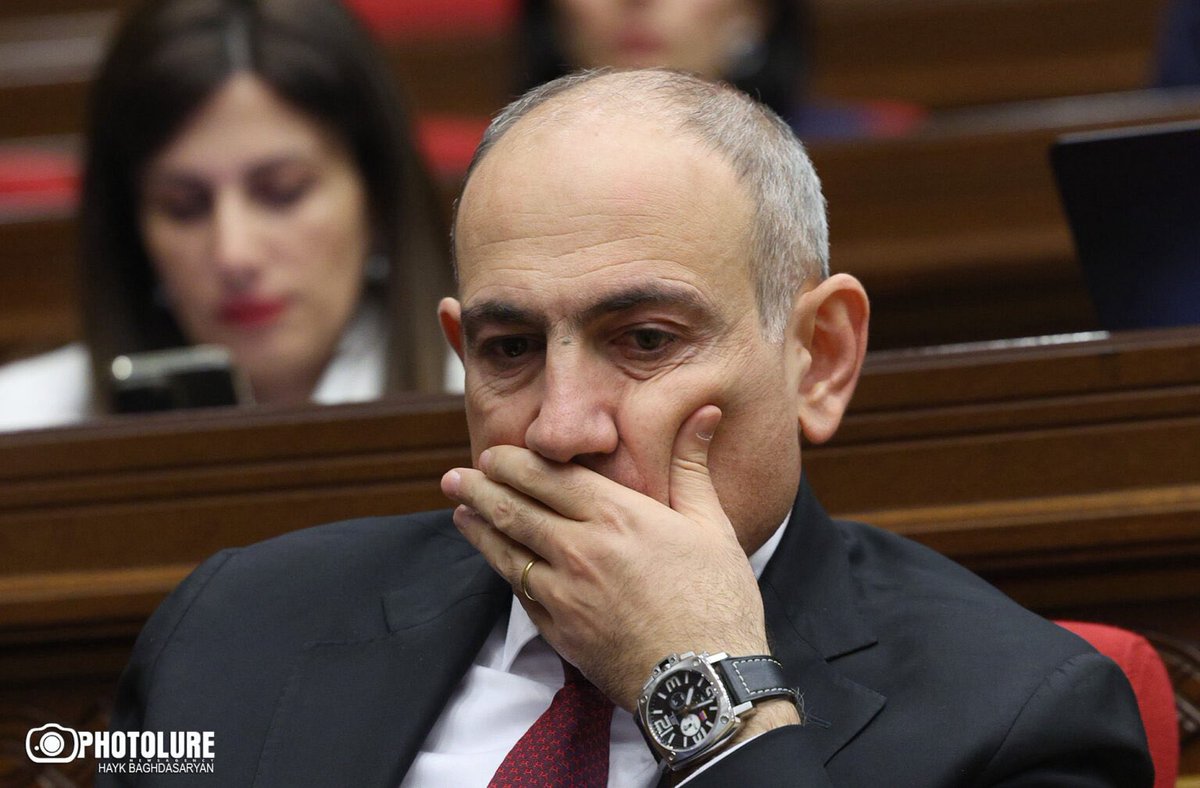
Public distrust grows as Pashinyan’s support falters —- (Horizon Weekly / YEREVAN) — A newly released public opinion survey conducted in Armenia in early February paints a picture of a deeply dissatisfied electorate ahead of the country’s June 2026 parliamentary elections, raising questions not only about the government’s standing but also about how such polls are interpreted and presented. The survey, conducted among 1,506 respondents across Armenia, found that only 47 percent believe the country is moving in the right direction, while 42 percent say Armenia is headed in the wrong direction. These numbers alone point to a country that remains sharply divided after years of political turmoil, security crises and economic pressure. Perhaps even more striking is the level of public distrust toward Armenia’s political leadership. According to the survey, nearly half of respondents say they trust no political leader at all, a figure that far exceeds the support enjoyed by any individual politician. Prime Minister Nikol Pashinyan, despite leading the government for nearly eight years, registers trust from only 18 percent of respondents, while other figures trail behind with single-digit support. Such numbers raise uncomfortable questions for a government that once claimed overwhelming public legitimacy. After years in power and a series of national crises, Pashinyan’s support appears increasingly narrow and fragile. Security concerns remain the dominant issue shaping public opinion. National security and border issues were cited as the most pressing problems facing the country, followed by unemployment and rising living costs. These concerns reflect the lingering consequences of the disastrous security situation Armenia has faced in recent years, developments that many critics hold the current government responsible for. Despite these realities, the poll’s headline figures suggest that Pashinyan’s ruling Civil Contract party would receive 24 percent of the vote if elections were held today. But a closer look reveals a far less stable political picture. Thirty percent of respondents remain undecided, a number larger than the support base of any single political force. In addition, a notable share of respondents say they would spoil their ballot or abstain from voting altogether. Taken together, these figures indicate that Armenia’s political landscape remains wide open and that a large segment of voters is still searching for an alternative. The survey also raises broader concerns about how international polling organizations frame Armenia’s political reality. Such polls often emphasize the incumbent government’s relative lead while downplaying the deeper crisis of public confidence reflected in the numbers. When nearly half of the population says it trusts no political leader and a large portion of voters remain undecided, the claim that the current authorities enjoy a stable political mandate becomes difficult to sustain. The data instead point to a political environment in which opposition forces could still mobilize substantial public support if they succeed in consolidating and channelling the widespread dissatisfaction that exists across Armenian society. In this sense, the poll may reveal less about the strength of the current government than about the depth of public frustration with Armenia’s political trajectory — and the growing demand for a credible alternative capable of restoring national security, economic stability and political accountability.
Horizon Armenian News tweet media
English
0
0
1
104
Horizon Armenian News
Horizon Armenian News@HorizonWeekly·
The Armenian National Committee of Canada (ANCC) has written to Foreign Affairs Minister the Hon. Anita Anand, outlining the Armenian-Canadian community’s key priorities regarding Armenia and Artsakh, while expressing appreciation for Canada’s principled engagement. The ANCC welcomed Canada’s support for Armenia’s sovereignty and its calls for accountability following the ethnic cleansing of Artsakh, but also raised serious concerns about democratic backsliding in Armenia, including the concentration of power, pressure on opposition voices, and the jailing of clergy - amidst the government’s ongoing unconstitutional attacks on the Armenian church. The organization stressed that freedom of religion, political pluralism, and institutional independence must remain central to Armenia’s democratic trajectory. On regional peace and security, the ANCC emphasized that any durable settlement must reflect the Helsinki Final Act, uphold the right of return of forcibly displaced Armenians from Artsakh, secure the release of Armenian prisoners, and protect Armenian cultural and religious heritage. The letter also highlighted the importance of responsible arms export controls and reaffirmed the ANCC’s readiness to work constructively with the Government of Canada to advance democracy, human rights, and a just and lasting peace in the region. More: horizonweekly.ca/en/ancc-outlin…
Horizon Armenian News tweet media
English
0
2
14
2K
Horizon Armenian News
Horizon Armenian News@HorizonWeekly·
Opposition forces hold talks ahead of 2026 elections, unity still unclear —- With Armenia’s 2026 parliamentary elections approaching, opposition parties continue negotiations over possible alliances and electoral strategies, but have yet to agree on a unified approach to challenge Prime Minister Nikol Pashinyan. The Armenian Revolutionary Federation says talks are mainly focused on preserving the “Hayastan” alliance led by former President Robert Kocharyan, while other opposition forces, including the Republican Party and Armenian National Congress, are holding separate discussions on cooperation, leadership, and candidate selection. Several movements and figures have announced their own prime ministerial candidates, and some parties plan to run independently. Meanwhile, the ruling Civil Contract party says it will contest the elections alone and is confident of victory. Despite ongoing talks, divisions over leadership and strategy continue to hinder the formation of a united opposition front. Read more: horizonweekly.ca/en/opposition-…
Horizon Armenian News tweet media
English
0
0
3
75