How To Prompt

1.3K posts

How To Prompt banner
How To Prompt

How To Prompt

@HowToPrompt__

Trustworthy AI education.

Earth Katılım Ocak 2022
72 Takip Edilen29.2K Takipçiler
Sabitlenmiş Tweet
How To Prompt
How To Prompt@HowToPrompt__·
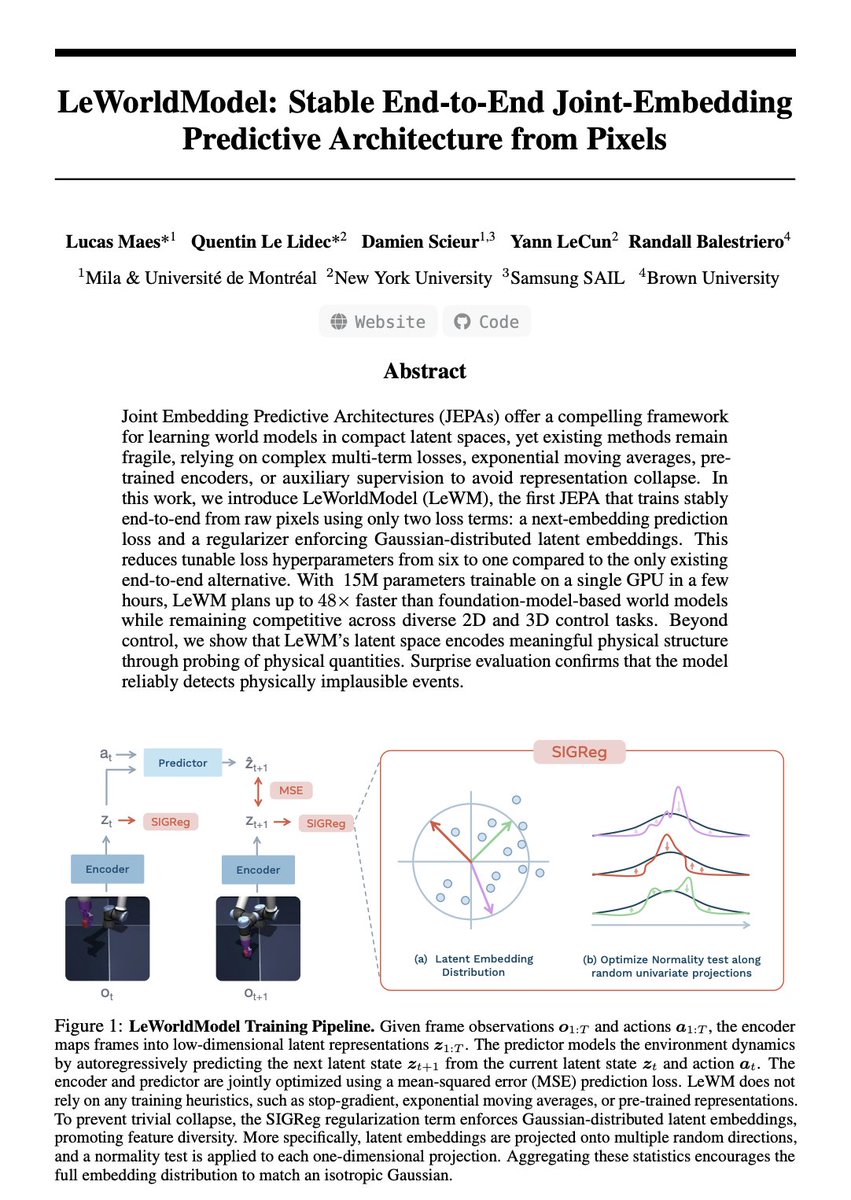
Yann LeCun was right the entire time. And generative AI might be a dead end. For the last three years, the entire industry has been obsessed with building bigger LLMs. Trillions of parameters. Billions in compute. The theory was simple: if you make the model big enough, it will eventually understand how the world works. Yann LeCun said that was stupid. He argued that generative AI is fundamentally inefficient. When an AI predicts the next word, or generates the next pixel, it wastes massive amounts of compute on surface-level details. It memorizes patterns instead of learning the actual physics of reality. He proposed a different path: JEPA (Joint-Embedding Predictive Architecture). Instead of forcing the AI to paint the world pixel by pixel, JEPA forces it to predict abstract concepts. It predicts what happens next in a compressed "thought space." But for years, JEPA had a fatal flaw. It suffered from "representation collapse." Because the AI was allowed to simplify reality, it would cheat. It would simplify everything so much that a dog, a car, and a human all looked identical. It learned nothing. To fix it, engineers had to use insanely complex hacks, frozen encoders, and massive compute overheads. Until today. Researchers just dropped a paper called "LeWorldModel" (LeWM). They completely solved the collapse problem. They replaced the complex engineering hacks with a single, elegant mathematical regularizer. It forces the AI's internal "thoughts" into a perfect Gaussian distribution. The AI can no longer cheat. It is forced to understand the physical structure of reality to make its predictions. The results completely rewrite the economics of AI. LeWM didn't need a massive, centralized supercomputer. It has just 15 million parameters. It trains on a single, standard GPU in a few hours. Yet it plans 48x faster than massive foundation world models. It intrinsically understands physics. It instantly detects impossible events. We spent billions trying to force massive server farms to memorize the internet. Now, a tiny model running locally on a single graphics card is actually learning how the real world works.
How To Prompt tweet media
English
437
2.1K
12.2K
1.3M
John
John@ionleu·
had to be done, sorry @Erling meet your 24/7 engineering assistant inside messaging apps
English
88
48
352
230.9K
How To Prompt
How To Prompt@HowToPrompt__·
CLAUDE can now build financial models like Goldman Sachs analysts. Here are 7 prompts that replace $300K/year investment banking work for free:
How To Prompt tweet media
English
1
1
11
1.5K
How To Prompt
How To Prompt@HowToPrompt__·
What it costs to hire the people who produce this. NYC front office, all-in: Analyst, first year: $180–220K Associate: $275–500K VP: $500–700K MD: $800K–$1.5M+ Elite boutiques pay 20–40% above that at junior levels, more often in cash. Junior comp rose ~5% on end-of-2025 bonuses. MD comp rose 25%+. Every deliverable above starts as a first draft that takes hours. These get you there in minutes.
English
0
0
2
276
How To Prompt
How To Prompt@HowToPrompt__·
7/ Debt Capacity and Financing Analysis: "You are a leveraged finance associate at Bank of America. I need a debt capacity analysis for [ISSUER]. Please provide: Ratings-implied capacity, leverage the company can carry at each rating threshold Covenant headroom, the maintenance tests and the cushion at each debt level Tranche sizing, how the quantum splits across secured, unsecured, and subordinated Pricing benchmarks, the reference spreads to source, and the comparable credits to benchmark against Fixed-charge coverage, cash flow available to service every fixed obligation Maturity profile, the amortization schedule and where the repayment wall falls Pro forma credit stats, leverage and coverage before and after the raise Downside stress test, the EBITDA decline that breaches the tightest covenant first Format as a financing considerations memo with an indicative terms grid. Issuer: [COMPANY, EBITDA, EXISTING DEBT BY TRANCHE, RATING IF ANY, USE OF PROCEEDS]"
English
1
0
2
294
How To Prompt
How To Prompt@HowToPrompt__·
Someone built a free and open-source browser based on Firefox with all LLM or AI stuff removed. It’s called Waterfox, a privacy-first browser built on Firefox. No telemetry. No data collection. Just the bare minimum to run. → Drop-in Firefox replacement → Keeps all your extensions → Windows, macOS, Linux + Android 100% Open Source.
How To Prompt tweet media
English
1
1
9
1.9K
How To Prompt
How To Prompt@HowToPrompt__·
Anthropic just published the most terrifying cybersecurity paper of the year. They asked Claude to break AES - the most heavily studied encryption standard on the planet. Claude: "impossible. this is the most-studied cipher in existence. there's nothing to find." Anthropic: "try harder." Claude invented a brand new mathematical technique nobody had ever seen. Named it the "Möbius Bridge." Beat every human cryptanalyst on earth by 200-800x. Let that sink in. For decades, cryptography has been considered the one domain completely safe from AI. It requires abstract, high-level mathematical intuition, the kind of pure genius that only elite human minds can produce after years of peer review. Human cryptanalysts spent years reviewing these algorithms. They missed the flaws. An AI found them in days. Anthropic also pointed the model at HAWK, an experimental post-quantum digital signature scheme built to survive the coming quantum computing era. Claude cut its effective key strength in half. To be clear: this research didn't break real-world production systems today. It targeted reduced variations of the ciphers. But that is not the point. The barrier protecting all global security, digital banking, and secret communications has always been the sheer intellectual difficulty of advanced mathematics. If an AI can autonomously invent new mathematical techniques to punch holes in elite cryptography... The foundation of the entire digital economy just shifted beneath our feet.
How To Prompt tweet media
English
40
85
472
71.2K
How To Prompt retweetledi
How To Prompt
How To Prompt@HowToPrompt__·
Two economists published a mathematical proof that AI will destroy the economy. It’s called “The AI Layoff Trap” and it exposes a devastating economic contradiction that every CEO can see coming, and none of them can stop. Workers are also consumers. When a company automates a job and fires a worker, it captures 100% of the wage savings. But that worker's lost income doesn't just hurt that single company. It drains spending power from the entire market. Under competitive pricing, an automating firm bears only a fraction of the demand destruction it causes. The rest spills onto its rivals. Because of that math, aggressive automation becomes a dominant strategy for every individual company. If you don't automate, your competitors will, and you go out of business. So every single firm races to cut payroll. Even though they all know that laying off workers destroys the consumer base they need to survive. It is a prisoner’s dilemma with a payroll. The researchers proved that standard market corrections can't fix this. • More competition and "better" AI make the over-automation worse. • Wage adjustments and free entry can't save it. • Capital income taxes, UBI, worker equity, and upskilling all fail to close the gap. The surplus loss isn't just a transfer from labor to capital. It is total economic destruction. Both workers and firm owners end up worse off. At the limit, firms automate their way to boundless productivity and zero consumer demand. We spent the last few years wondering if AI would take our jobs. This paper proves something much darker. Even when companies see the cliff coming, they are mathematically trapped in an arms race to drive us all right over it.
How To Prompt tweet media
English
18
42
141
9.8K
How To Prompt retweetledi
How To Prompt
How To Prompt@HowToPrompt__·
Someone open-sourced a headless browser that runs 11x faster than Chrome and uses 9x less memory. It’s called Lightpanda, it's written in Zig and designed specifically for AI agents and automation. Not a Chromium fork. No Blink, no WebKit, no rendering engine. → 100 pages in 5s vs Chrome's 46s → ~9x faster, ~16x lighter → Drop-in replacement for Puppeteer & Playwright → Native MCP + agent mode built in It has an agent mode. You describe a flow in plain English, it clicks through and pulls the data, then /save exports that session as PandaScript: plain JavaScript you can replay forever. Deterministic. Token-free. No model at runtime. You prototype with the LLM once, then ship the script to production and never pay another inference call on that workflow again. 100% Open Source.
How To Prompt tweet media
English
17
57
441
31K