Howard Yu

922 posts

Howard Yu banner
Howard Yu

Howard Yu

@HowardHYu

LEGO® Professor @ IMD Business School | Thinkers50 Strategy Award Winner | Director, Center for Future Readiness

Lausanne, Switzerland Katılım Haziran 2011
2K Takip Edilen3.4K Takipçiler
Howard Yu
Howard Yu@HowardHYu·
@Allbirds just sold its shoe business for $39 million and rebranded as an AI compute company. Stock is up 600%. It has no GPU procurement team and has never offered an AI product.
Howard Yu tweet media
English
1
0
0
74
Howard Yu
Howard Yu@HowardHYu·
The US raised $250 billion in AI funding last quarter. Every frontier lab is American. And yet China now has roughly double the users of the most viral AI agent framework on the planet. Something does not add up. Or maybe it adds up perfectly. If you have spent time in Chinese tech, you have seen this before. Early 2000s. Shenzhen factories cranking out handsets. Every startup building a messaging app. Chaotic, redundant, mostly doomed. Superior technology did not capture the largest market. Distribution and proximity to daily life did. That chaos produced WeChat. @openclaw, a framework for building personal AI agents, went viral in early 2026. In the US, Google disabled accounts of subscribers routing tokens through it. @AnthropicAI killed OAuth access. No major cloud provider launched a hosted service. The security concerns were real (280+ advisories, thousands in compute burned per user) but the net effect was containment. In China, every major cloud provider launched a hosted service within weeks. Tencent shipped more than ten agent products in a single month. ByteDance built the official skill marketplace mirror. Baidu hosted installation events that drew thousands. When Tencent integrates OpenClaw into WeChat, the agent shows up as a regular chat contact. You message it. It controls your computer remotely. No separate download. No API keys. For 1.4 billion people who already pay bills, book rides, and file taxes inside one app, talking to an agent feels like talking to another contact. The infrastructure was already there. Then there is pricing. Chinese AI models run 5 to 24 times cheaper than American equivalents. A chatbot query might burn 30,000 tokens. An agent doing a complex task burns 20 million. At that scale, cost per token decides what gets built and what stays a demo. The US is building the best engines. China is building the roads.
Howard Yu tweet media
English
1
0
0
76
Howard Yu
Howard Yu@HowardHYu·
The CEO of @Crocs once said: "Our goal is not to make the haters love the brand. It's to exploit that tension, because it creates PR, media, and interest, things that would cost a fortune to buy otherwise." His CMO went further: "We are very confident being ugly. We have been ugly since 2002 and we have no intent to change that silhouette." Crocs does $4.1 billion in revenue. Google searches for "ugly shoes" have grown consistently for five years. It's not an insult anymore. It's a fashion category. Allbirds was the opposite: inoffensive, minimalist, pleasant. No one hated Allbirds. But no one was passionate about them either. It just sold for $39 million. Turns out, being hated by some people is worth a fortune. Being liked by everyone is worth almost nothing.
English
1
2
2
187
Howard Yu
Howard Yu@HowardHYu·
In the fall of 2021, two shoe companies went public within six weeks of each other. Both were sustainability-conscious. Both had passionate founders. Both had cultural buzz. One was valued at $7.3 billion. The other at $4.1 billion. Five years later, one commands a ~$20 billion market cap. The other just sold for $39 million, roughly 1% of its peak. Google Trends shows the exact crossover moment: November 2022. That's when On Running overtook Allbirds in search interest. The lines didn't reverse ever since. On kept climbing. Allbirds entered what one analyst called “terminal descent.” And yet, both companies had coherent strategies on paper. VCs loved them. In fact, VCs loved Allbirds far more. But it flamed out. And it's On that's still running a marathon. Why?
English
0
0
0
65
Howard Yu
Howard Yu@HowardHYu·
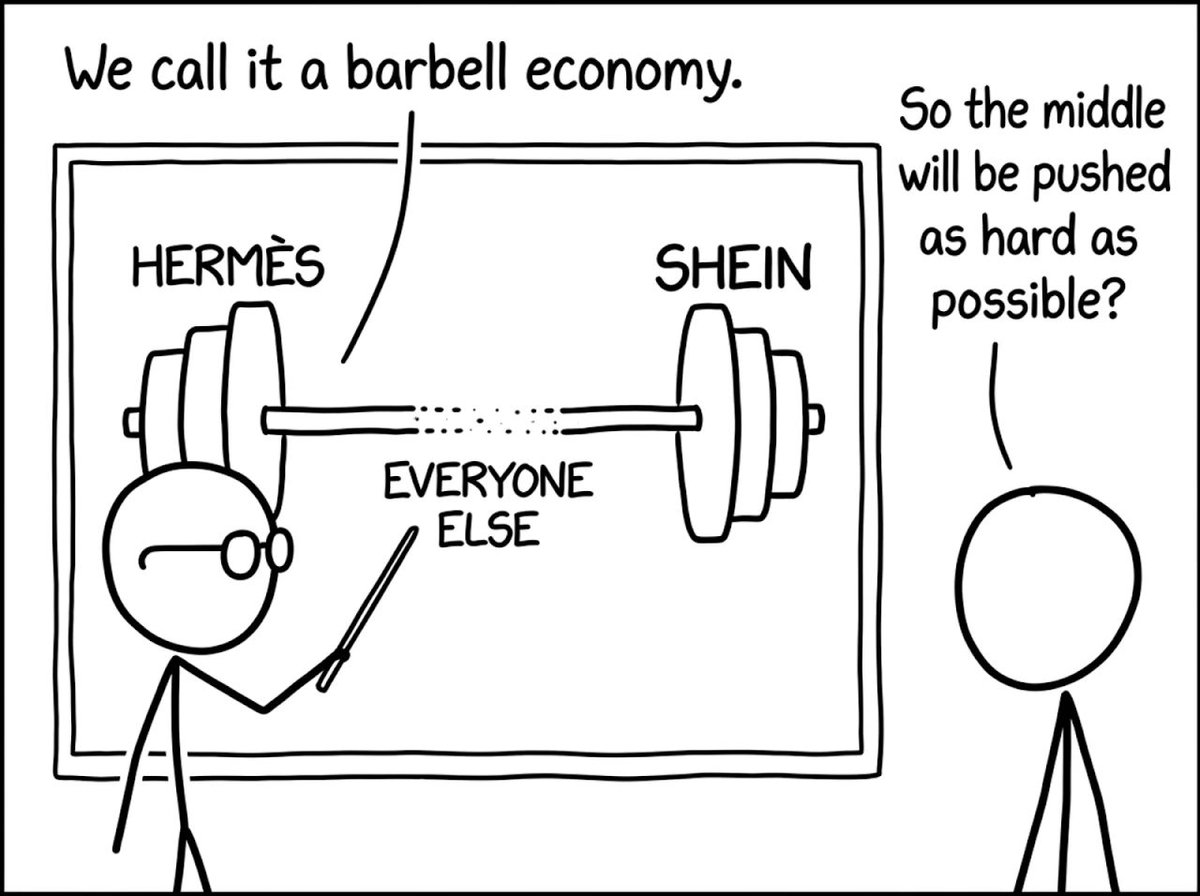
They built careers on expertise that the platform now absorbs in real time. We call it a barbell economy. The middle will be pushed as hard as possible. What does this mean for your industry or career? Drop your take below 👇 Full essay: howardyu.substack.com/p/coase-vs-cla…
English
0
0
0
58
Howard Yu
Howard Yu@HowardHYu·
The weight falls on the people it displaces. The buyer with 20 years of market intuition, now redundant because click data reads her region faster than she can. The independent designer whose viral post gets scraped and reproduced before she can file a copyright claim.
English
1
0
0
77
Howard Yu
Howard Yu@HowardHYu·
Shein is now exploring offering its manufacturing model as a service to other retailers. If that happens, this system becomes infrastructure anyone can rent.
English
1
0
0
63
Howard Yu
Howard Yu@HowardHYu·
Shein built a platform that removed design judgment as a bottleneck entirely. Scrape trending images. Fragment the design into producible components. Route to suppliers. Ship before competitors finish their first sample review. Design to shelf in 10 days.
English
1
0
0
71
Howard Yu
Howard Yu@HowardHYu·
The premium end survives on brand and craft. Hermès is fine. The ultra-cheap end survives on speed and data. Shein is fine. The middle is organized around planning cycles and seasonal catalogs that no longer match how demand moves.
English
1
0
0
58
Howard Yu
Howard Yu@HowardHYu·
H&M produces 4,400 new styles a year. Shein produces over 314,000. A 71-to-1 ratio. That ratio is not a competition. It’s a different species. 🧵
Howard Yu tweet media
English
1
2
1
184
Howard Yu
Howard Yu@HowardHYu·
@Xiaomi's first car (SU7) sold out its 2024 production in 1 day. Wild, considering in 2016 it was a “unicorpse” after phone sales collapsed. @leijun swallowed pride, built Mi Home stores, grew an ecosystem, and HyperOS made the car inevitable. Full story: howardyu.substack.com/p/how-xiaomi-c…
Howard Yu tweet media
English
0
0
0
59
Howard Yu
Howard Yu@HowardHYu·
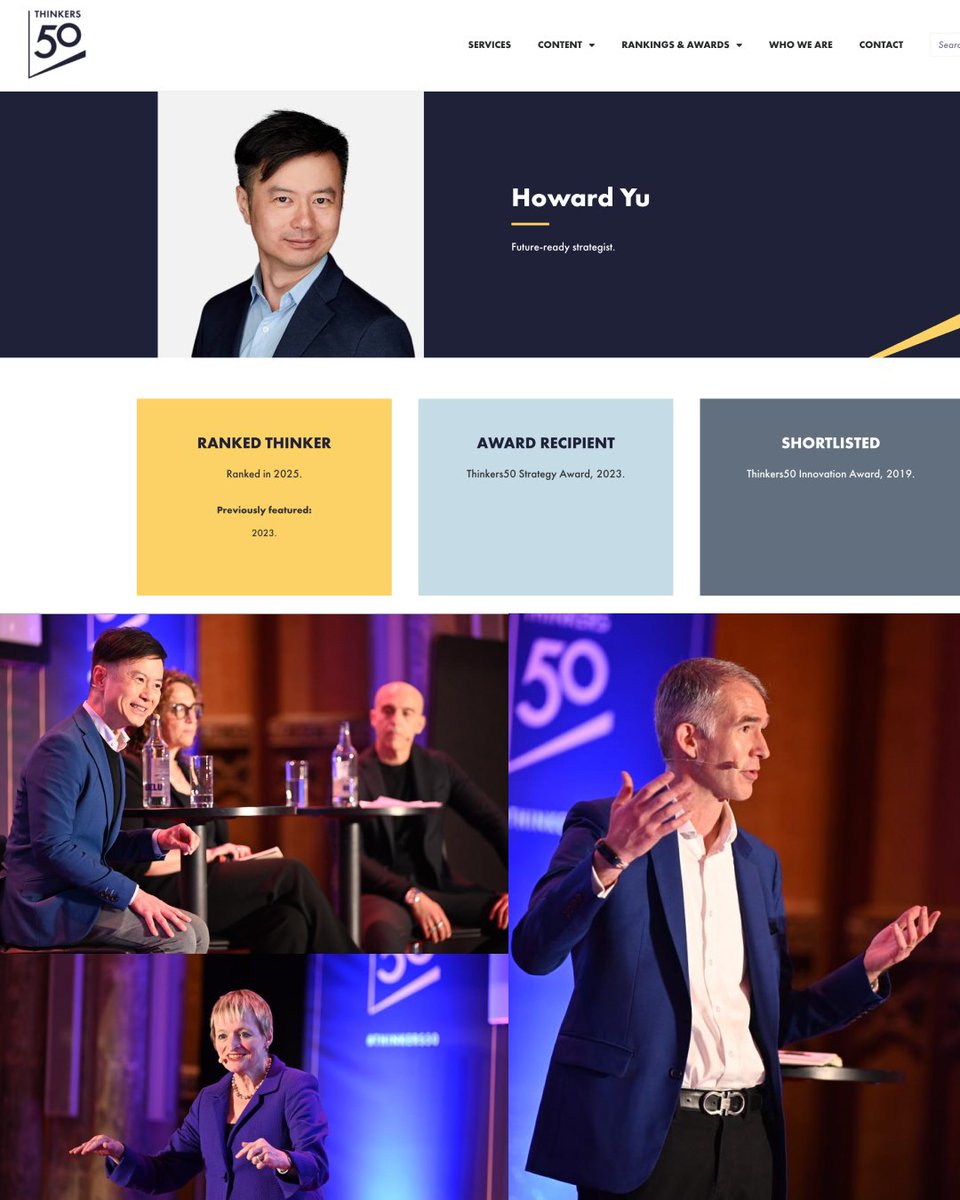
I'm honored to be named to the @thinkers50 ranking for the second time! At the London Guildhall event, I got into what actually separates companies that stay future-ready from the ones that don't. What I keep seeing: It's not about being ten steps ahead; it's about being one *inch* ahead at the right moment, with total clarity on what matters next. - Mastercard spent two CEO generations simplifying their entire organization. - DBS Bank went from "Damn Bloody Slow" to the leading digital bank in Asia. - Swiss pharma companies built capability stacks that made them immune to tariffs. …same pattern across all of them. The real issue isn't strategy - most successful companies have good strategy. The problem is the knowing-doing gap. The C-suite gets it, but three levels down, people are drowning in the same generic priorities everyone else has. The actual work is making sure the person on the front line knows the true north well enough to make the right call when it matters. It takes heated debate, with love, to get to the truth. It takes stacking new capabilities without abandoning what you're actually good at. At Thinkers50, I reconnected with friends and colleagues like Rita McGrath, who has always been a role model in thinking through innovation, and Scott Anthony, whose new book Epic Disruption is, indeed, an epic event. Very grateful to be part of this community :) P.S. If you’re interested in more of my thinking, my newsletter just passed 10k subscribers. Link below:
Howard Yu tweet media
English
1
1
5
220
Howard Yu
Howard Yu@HowardHYu·
After a year of building this with the team at MIT Sloan, we're officially launching the Future Ready Enterprise! This program is something I'm incredibly proud of. We set out to create something that didn't exist: a true partnership between @IMD_Bschool and @MITSloanExecEd that brings together our research on strategic transformation with their cutting-edge work on AI and digital systems, delivered across two incredible cities. Singapore, where we dig into how companies like DBS Bank actually rewired themselves for speed. Then Cambridge, where we spend a week in Kendall Square working through AI strategy and what leadership looks like when everything's uncertain. The whole idea came from a frustration we kept hearing from leaders: "I know we need to transform, I just don't have a roadmap or the time to build one." So we built that space: Participants bring their own challenge on day one and work on it across both weeks, testing ideas with faculty and a global cohort, and they leave with something real they can implement. First cohort kicks off February 2026 … and I genuinely can't wait to see it in action. Check out the video and details in the first comment 👇
English
2
1
3
469
Howard Yu
Howard Yu@HowardHYu·
After seeing a study covering 48 years of U.S. presidential daily diaries, I realized this: there’s no link between early mornings and lasting legacies. See full analysis here: howardyu.substack.com/p/two-charts-s…
English
0
0
3
126
Howard Yu
Howard Yu@HowardHYu·
Satya Nadella just stepped back from running @Microsoft's sales operation. Jensen Huang (@NVIDIA) still codes. Both run trillion-dollar companies in the same industry. One wins by doing less. One wins by doing everything. How? We've been sold a myth that great leaders must pick one mode: either delegate everything and focus, or stay hands-on across the business. But Nadella and Huang prove that's wrong. Last month, Nadella handed Microsoft's entire commercial operation to Judson Althoff. After a decade of sales calls and customer pitches, he's now focusing exclusively on what he calls "our highest ambition technical work" - AI research, data centers, systems architecture. Huang operates the opposite way. He runs product launches, meets heads of state, designs chips, and coaches startups. His goal is to create conditions where "amazing people come to do their life's work." For him, that means weaving engineering, business, and evangelism together himself. Same industry. Same moment. Opposite approaches. Both winning. Because the real question isn't "should I focus or integrate?" It's "what does my wiring demand, and what does this moment require?" Here's how to figure out which mode you need: If you're drained and your company needs specialized depth - focus like Nadella. Delegate everything except the one thing only you can push forward. If you're energized connecting dots across functions and your company needs integrated vision - stay broad like Huang. If you're drained AND nothing's getting attention - you're in the wrong role or need to restructure. If you're energized but your company keeps stalling - your integration might be the bottleneck. Bring in someone who can own a major function. So tomorrow, open your calendar. Look at last week. Which sessions energized you? Which drained you but could be owned by someone else? What critical work are you avoiding that only you can do? Then match that against what your company needs right now. The trap is copying someone else's operating system because it worked for them. What matters is building a rhythm that fits your wiring and your company's moment - then running it without apology. P.S. Want to see the data behind why copying routines doesn't predict success? Check the first comment 👇
Howard Yu tweet media
English
2
2
6
652
Howard Yu
Howard Yu@HowardHYu·
If a project proves very hard—even if you want to succeed but have failed so far—there are only two reasons: either your grit is being tested, or a pivot is needed.
Howard Yu tweet media
English
1
1
3
383