Hrishi@hrishioa
This is THE question we struggled with for a while
In the end we made an opinionated call on a few tradeoffs:
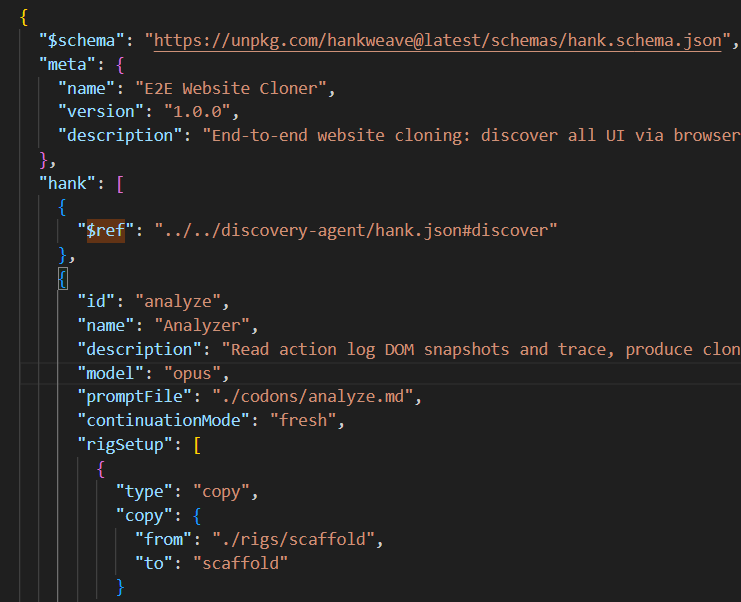
The biggest one is reusability. A JSON DSL is significantly more restrictive, but to us it preserved the code/data boundary well enough to have codons (units of agentic work) be reusable across people, companies or tasks. It also means that we can (as we do now) have LLMs edit these DSLs without crossing that boundary.
The second is surface area - integrating into typescript or python creates the exact same problem of diversity that we were fighting at the time. Because you can do almost anything, almost everything will be done - which means that
- deterministically reasoning about executions and rollbacks before starting (like hankweave's preflight does),
- keeping up test surface area across models, backbones and known behavior, and
- the debugging path (which was the most important thing for us with hankweave) becomes needlessly complex. In hankweave today, if something breaks - there is a known, well-trodden way to fix and test the fix.
Third one - that I think is a little less important now, but we were super concerned about it in June - is auto-recovery. Hankweave is not turing complete, which makes unrolling executions and automatic budgeting a lot easier.
Remains to be seen if we're wrong - as we accumulate more usage it'll become apparent. The prime philosophy in hankweave has been 'don't build anything that you don't NEED' and so far we haven't needed to move past JSON.
Longer-term I think we might build typescript integrations that compile down to the DSL so we get the fun of working with the linter and typechecker back - we've had a few experiments in progress!