HypernativeLabs

1.7K posts

HypernativeLabs banner
HypernativeLabs

HypernativeLabs

@HypernativeLabs

Proactive security for onchain finance. The AI-native platform trusted by 350+ enterprises and institutions to prevent hacks, exploits, and fraud.

Katılım Ekim 2022
133 Takip Edilen16.4K Takipçiler
Sabitlenmiş Tweet
HypernativeLabs
HypernativeLabs@HypernativeLabs·
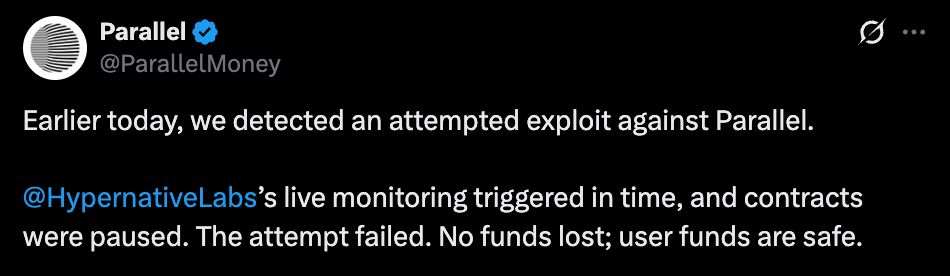
An attempted exploit on @ParallelMoney’s vaults was stopped automatically today. Hypernative detected the pattern and paused the relevant contracts within seconds. No funds lost. This comes after a brutal stretch for onchain security. April alone saw major incidents at Drift and KelpDAO, part of a wider surge in successful exploits. Attackers are coming prepared. The difference, increasingly, is whether the protocols are too. Credit to the Parallel team for having the monitoring and automated response in place before it was needed. That’s the work that doesn’t make headlines until it does.
HypernativeLabs tweet media
English
3
13
67
33.2K
HypernativeLabs
HypernativeLabs@HypernativeLabs·
Compliance tools flag addresses after someone reports them. By then, the operation has already moved. Gal Sagie on why fraud detection needs to happen before funds settle. The Future of Crypto Compliance with @HenriArslanian. Exchanges, wallets, payment providers and their users face off against the industrial fraud complex every single day. In The Ultimate Guide to Web3 Security, we break down the controls that user-facing platforms need across the full transaction lifecycle: from pre-signing transaction clarity to real-time counterparty screening and automated response. Download your free copy here: buff.ly/g35iTVN
English
0
0
1
309
HypernativeLabs
HypernativeLabs@HypernativeLabs·
Tokenization is no longer a pilot. Banks and asset managers are already issuing and servicing tokenized bonds, treasuries, money market funds, and private shares, and most of their existing risk controls were not built for what happens after a transaction is signed. In May, a compromised signer minted unbacked tokens against zero collateral on a tokenized asset issuer's own minting contract. Every signature was valid. Both of its stablecoins broke their peg. On July 23, Adi Zepkowitz (VP EMEA), Guillermo Muñoz (Director, Security Engineering), and Yaniv Fogel (Head of Professional Services) walk through what actually closes that gap, from the pre-signature check through monitoring and incident response. Worth your time if you're anywhere near RWA issuance or custody. buff.ly/r0wi3ZQ
HypernativeLabs tweet media
English
2
0
1
362
HypernativeLabs
HypernativeLabs@HypernativeLabs·
When Telegram shut down Huione's channels in May 2025, scam transaction volume didn't drop. It migrated within days to a related platform called Tudou Guarantee, with the same controlling parties. Alex Rabke, VP Americas at Hypernative, used the Huione case to make a structural point during our recent webinar on the onchain fraud prevention blueprint. The platform was a $27B criminal enterprise, larger than Silk Road, but the takedown only affected the venue. The infrastructure built to support thousands of fraud vendors, money laundering services, and scam-site-as-a-service kits kept operating. This is just one part of a deep dive into fraud prevention put out recently by our security team. Watch the full session on demand: buff.ly/7vc8mvn
English
0
0
6
1.2K
HypernativeLabs
HypernativeLabs@HypernativeLabs·
Most postmortems describe an attack as a single moment. In our recent webinar, Hypernative Product Manager Elad Feldman argued that the biggest 2026 attacks are better understood across three layers: 1️⃣ The staging signals that appear days or weeks before execution 2️⃣ The response that should trigger while the attack is underway 3️⃣ The policy check at the moment of execution. The April losses happened where all three were missing. No one watched the early signals, no one had a response configured, and nothing evaluated the transaction itself beyond whether it was authorized. Watch the session for how each layer maps to a real attack: buff.ly/lqqkvfR
English
0
1
15
1.4K
HypernativeLabs
HypernativeLabs@HypernativeLabs·
On a blockchain, there's no undo button. Shawn Lim, Hypernative's VP of APAC, sits down with @mpost_io to discuss what that means for institutions moving onchain, and why security has to happen before a transaction executes, not after.
Mpost Media Group@mpost_io

Traditional financial institutions are moving on-chain at speed—but the moment a transaction executes on a blockchain, it's final. That demands a fundamentally different approach to security than anything they've managed before. We spoke with Shawn Lim, VP of Asia at @HypernativeLabs, the platform securing over 350 institutions and protocols across 80-plus blockchains, with more than $3B in client funds protected. He unpacks what institutions consistently underestimate when entering Web3, how pre-execution threat detection works in practice, and what it will take for security to become a foundation for adoption rather than a barrier to it. Read the full interview: mpost.io/hypernative-ha…

English
0
1
2
945
HypernativeLabs retweetledi
Taler
Taler@talerfinance·
Welcome to Taler Finance | The curated vault era is here, but infrastructure still lags behind traditional asset management. Taler closes that gap. We build and scale tailored vault infrastructure for institutions and ecosystems. A thread 🧵
English
27
14
94
3.8K
HypernativeLabs
HypernativeLabs@HypernativeLabs·
Why compromise one target when you can compromise the infrastructure thousands of targets share? @GalSagie on the attacker economics driving today's biggest losses. The Future of Crypto Compliance with @HenriArslanian. Whether you are building crypto infra or depend on it to manage or move funds, the right security posture can go a long way. We break this down in The Ultimate Guide to Web3 Security. Years of frontline experience from 300+ crypto-native and institutional projects distilled into an actionable security playbook. The wins. The close calls. The patterns. Download your free copy here: buff.ly/g35iTVN
English
0
1
20
1.1K
HypernativeLabs
HypernativeLabs@HypernativeLabs·
Can you exit a position on a compromised DeFi protocol before the damage reaches you? At a @ColliderVC panel in Tel Aviv, Tomer Menuchin, who leads growth and strategy at @kpk_io, described how the firm exited a Resolv position in the same block as the exploit. kpk monitors every onchain position with automations covering each collateral allocation across Morpho, Euler, and Gearbox. When the Hypernative alert fired, the exit was automatic. "I don't think I've ever seen something like that," Tomer said. "I was stunned." Every quarter, kpk's company-wide meeting opens with a single KPI: never lose funds. That is not a slogan. It is an operational standard. Automated response is just one of the tools leading teams use to stay ahead of threats. We break down the whole security toolkit in our The Ultimate Guide to Web3 Security, along with a playbook for how to use them: from real-time monitoring, pre-transaction security, and operational controls to compliance, risk, and treasury safeguards. Download your free copy here: buff.ly/g35iTVN
English
1
5
24
1.5K
HypernativeLabs
HypernativeLabs@HypernativeLabs·
Regulatory clarity moves faster when security teams are in the room. We're joining The Digital Chamber to work directly with policymakers and industry peers shaping the rules for onchain finance.
The Digital Chamber@DigitalChamber

Please join us in welcoming @HypernativeLabs to The Digital Chamber! Hypernative is the institutional enablement layer for onchain finance. Predicting and preventing threats before they occur, Hypernative gives investors, builders, and operators total confidence to participate onchain. Today, Hypernative protects more than $100 billion in digital assets for over 350 organizations across 75+ blockchains.

English
0
0
1
915
HypernativeLabs
HypernativeLabs@HypernativeLabs·
The smart contracts are getting better. The ops around them aren't. @gbvpzffd2r, CTO of Hypernative, said it plainly on The Cap Room: the industry has matured on the code side with better audits, more experienced developers, more secure contract design. The gap now is in operations. AWS configurations, admin access controls, key management, jump servers: the Web 2 hygiene that enterprise security teams treat as table stakes. Hypernative came to Web3 from Web2, and that background shaped what the company built. A classic CSO walking into a DeFi team today would find a lot that looks foreign. That gap is where attackers are operating now. Learn more at buff.ly/Yb0hQ0u
English
0
0
7
844
HypernativeLabs
HypernativeLabs@HypernativeLabs·
Proud to see our client @Predictstreet on the pitch at the World Cup. Behind the signage is @ADIChain_, the first institutional Layer 2 for stablecoins and real-world assets in the MENA region, now running Hypernative's real-time monitoring and automated response across its ecosystem. Institutional adoption starts with security that operates at the speed of the threat. Glad to be the layer that makes it possible. buff.ly/V1SVmo7
HypernativeLabs tweet media
English
0
0
0
636
HypernativeLabs
HypernativeLabs@HypernativeLabs·
This is what security at protocol scale looks like: coverage that expands automatically as new vaults launch, and a response path that does not depend on someone being awake, online, and fast enough. Great work by the Accountable team building the wiring from detection to action!
Accountable@AccountableData

Accountable's Vault-as-a-Service lets managers operate independently. They control their own contracts, keys, and strategies, meaning security monitoring & response must scale automatically as new vaults go live. Here's how we built a live defense layer with @HypernativeLabs

English
2
2
10
2.6K
HypernativeLabs
HypernativeLabs@HypernativeLabs·
MiCA. DORA. Evolving regulator expectations across major markets. They're all converging on the same baseline: continuous monitoring, real-time risk controls, demonstrable audit trails. Institutions building this into their infrastructure now won't have to rebuild from scratch when the bar rises. Our take, in the @ZodiaCustody ecosystem series → buff.ly/6Rb0LeM
English
1
0
4
976
HypernativeLabs
HypernativeLabs@HypernativeLabs·
April 2026 was one of the worst months in Web3 security on record. In our recent webinar, Hypernative Product Manager Elad Feldman set the table: over $645M lost across more than 60 incidents, and not from fringe projects but from established names with long operating histories. Two of the largest, both over $200M, carried North Korean attributes, pointing to well-resourced operations running over months. Elad's point for asset managers and institutions in the audience: every logo on the slide was a DeFi-native project, but the price volatility those attacks set off pushed the real cost well past the headline figure, onto everyone with exposure. Watch the full session: buff.ly/lqqkvfR
English
1
3
30
1.1K
HypernativeLabs
HypernativeLabs@HypernativeLabs·
The regulatory framing on fraud is shifting under most institutions' feet. Omri David, Senior Product Manager for Fraud Prevention at Hypernative, fielded a Q&A question on this during our recent onchain fraud prevention webinar. 🔹 MiCA in Europe carries explicit duty-of-care and operational resilience provisions. 🔹 The UK's authorized push payment fraud reimbursement rules are setting a precedent likely to extend to crypto. 🔹 FinCEN's actions against Huione signal the same direction in the US. Pre-transaction fraud screening is not yet universally mandated, but regulators are increasingly treating the failure to prevent fraud flows as a compliance failure rather than a user protection issue. We discussed this and much more in our recent webinar on fraud prevention. Watch the full session on demand: buff.ly/9NDSsMY
English
0
1
6
779
HypernativeLabs
HypernativeLabs@HypernativeLabs·
As the World Cup plays out, @Predictstreet, the official FIFA World Cup 2026™ prediction market partner built on @ADIChain_, runs on Hypernative. Custom monitoring watches its contracts in real time, surfacing threats as they develop so the team can act before an issue reaches users. High-stakes, high-traffic moments are exactly when onchain systems get tested. That is the case Predictstreet is built for, and the coverage is live now. buff.ly/wqAytXB
HypernativeLabs tweet media
English
0
1
5
1.1K
HypernativeLabs
HypernativeLabs@HypernativeLabs·
.@KaiaChain, the EVM-compatible Layer 1 built for stablecoin settlement and onchain finance across Asia, has selected Hypernative to secure its chain and its incubated DeFi platform: SuperEarn. The choice cleared Kaia's Governance Council, with members including Kakao, LINE, Animoca Brands, Binance, HashKey, and Hex Trust, then passed a public vote on Kaia's governance forum. Kaia brings together the Kakao and LINE ecosystems and moves capital across Korea, Japan, and Southeast Asia on native USDT, JPYC, and a growing roster of local stablecoins. As that liquidity flows into onchain finance and RWAs a tap away inside LINE, Kaia now runs real-time onchain monitoring and automated response across the ecosystem, starting with SuperEarn and extending to the projects and stablecoin issuers building on the chain. Read how it came together: buff.ly/ormoUck
HypernativeLabs tweet media
English
2
5
26
1.9K
HypernativeLabs
HypernativeLabs@HypernativeLabs·
The three largest crypto attacks of 2026 shared one trait: every security control passed at the moment of execution. Signatures were valid. Quorums were met. Governance ran as designed. In our latest webinar, Hypernative Product Manager Elad Feldman draws the distinction that explains all three: conventional security asks whether an action was authorized, while almost nothing asks what the authorized action will actually do. Attackers have learned to operate entirely inside authorized paths, which means the question worth asking is about the outcome, not the permission. Watch the full session for the breakdown: buff.ly/lqqkvfR
English
0
0
3
956
HypernativeLabs
HypernativeLabs@HypernativeLabs·
Compliance cannot happen after the fact in an onchain environment. Every counterparty wallet, every protocol interaction, every bridge transaction is a potential exposure event. Screening needs to happen before execution, not after a review cycle completes. From our Ultimate Guide to Web3 Security: buff.ly/bXOgIEt
HypernativeLabs tweet media
English
0
1
2
857