IGrain India Rahul Chauhan

8.7K posts

IGrain India Rahul Chauhan banner
IGrain India Rahul Chauhan

IGrain India Rahul Chauhan

@IGrain_India

Agri Commodity analyst Precise and Timely delivered data We don't trade hence no manipulations

New Delhi, India Katılım Aralık 2008
428 Takip Edilen8.3K Takipçiler
Sabitlenmiş Tweet
IGrain India Rahul Chauhan
IGrain India Rahul Chauhan@IGrain_India·
We are happy to share that our website igrain.in is working efficiently. Thought this website you can get Market News, Arrivals, News and other important details. Kindly register and subscribe. Sample reports attached.
IGrain India Rahul Chauhan tweet mediaIGrain India Rahul Chauhan tweet media
English
3
6
26
12.7K
IGrain India Rahul Chauhan
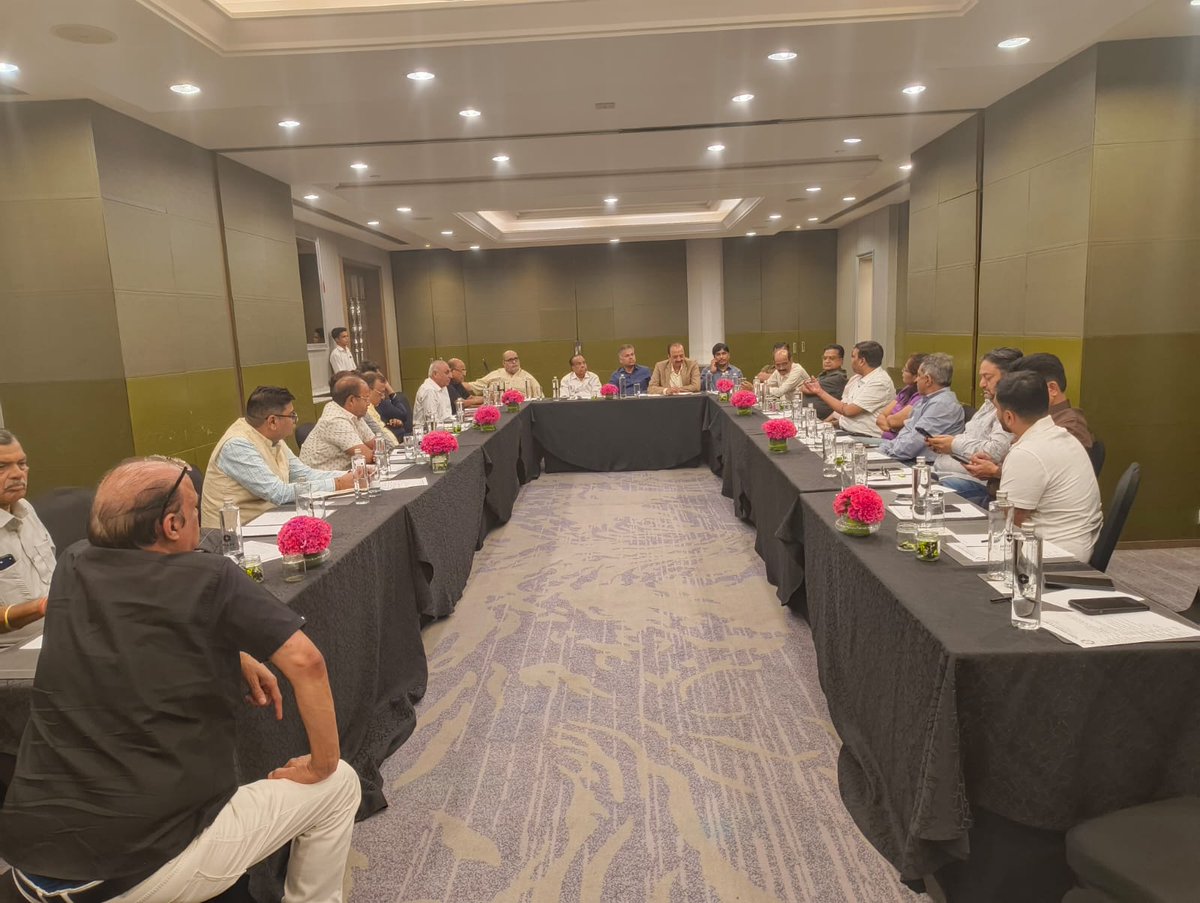
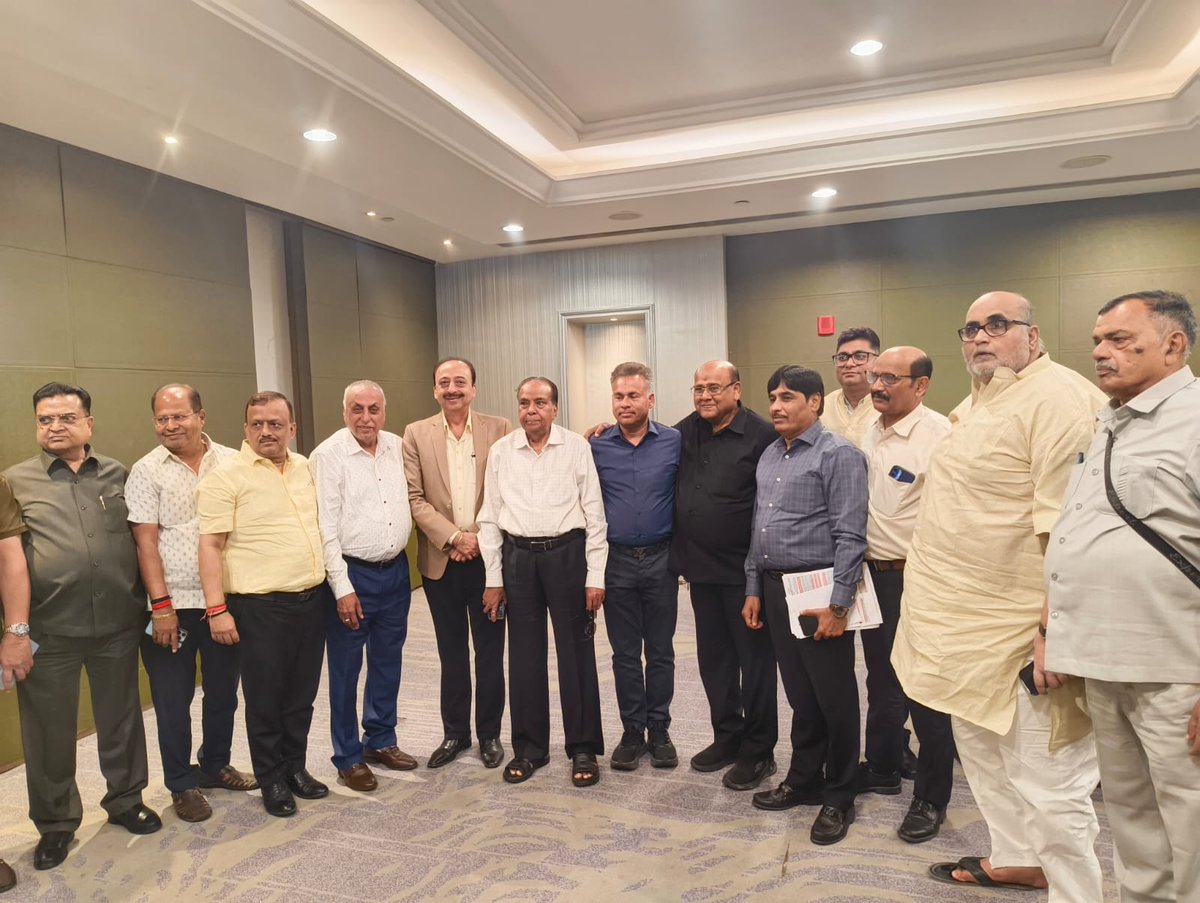
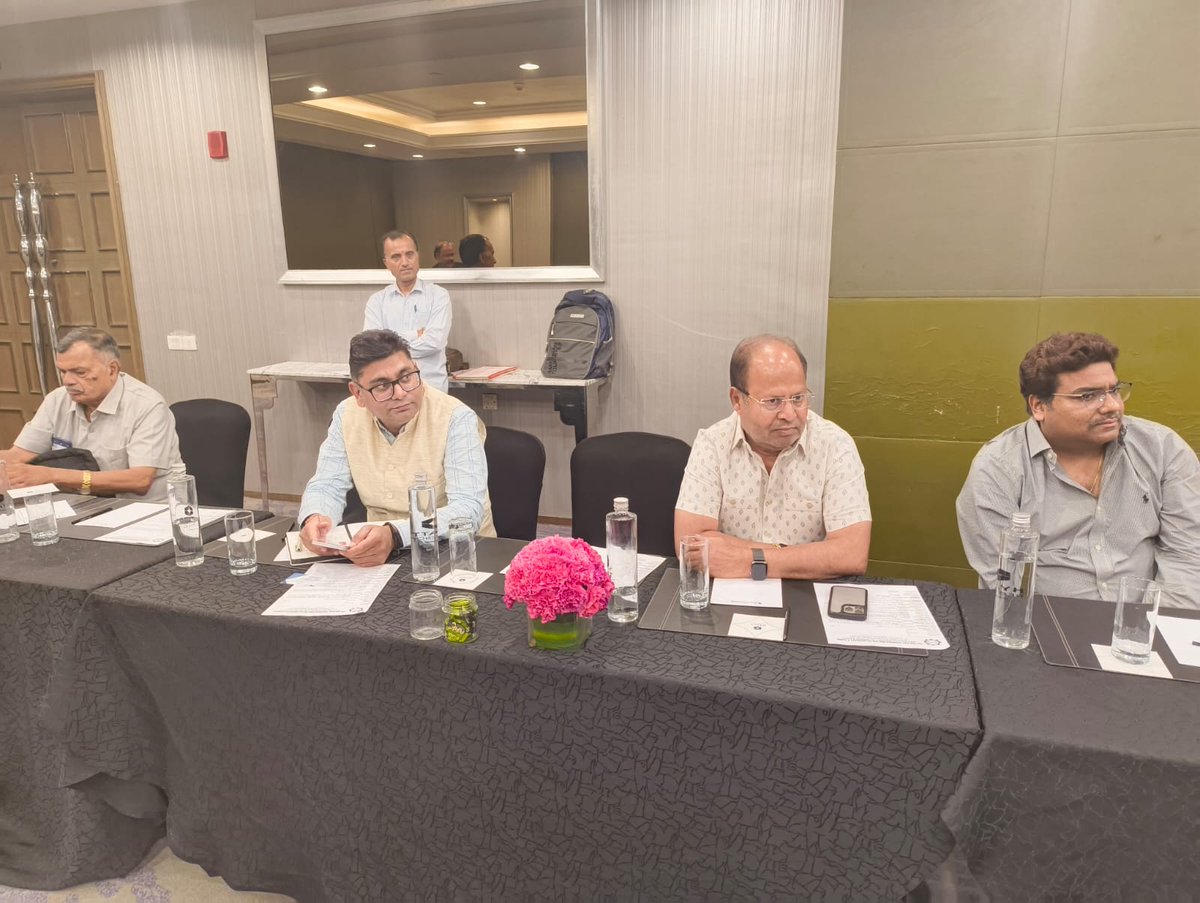
Key Highlights of COOIT Executive Committee Meeting at Hyatt Regency The Executive Committee meeting of COOIT was held under the Presidency of Mr. Babu Lal Data (President, COOIT), where several important issues were discussed and key decisions were taken. Mr. Babu Lal Data welcomed all the Present members and stated that mustard oil consumption is expected to remain strong in the coming period. He emphasized that the industry must work collectively to enhance quality and promote usage. Mr. Anil Chatar, Chairman of the Crop Committee, presented the monthly report, highlighting arrivals, crushing, production, and stock levels during the first two months of the season. According to the report, mustard crushing may increase further in the coming months, and closing stock at the end of the season is expected to remain limited. The responsibility for conducting the upcoming COOIT elections has been assigned to Mr. Hemant Gupta and Mr. Anil Kochar. In this meeting, General Secretary Mr. Gajendra Jha and Honorable Treasurer Mr. Mahesh Goyal were also present, and they shared their respective views during the discussion. During the meeting, special guest Mr. Acharya clarified the new FSSAI regulations. As per the updated norms: Mills with turnover above crore must obtain a Central License. Mills with turnover below ₹50 crore must obtain a State License. Registration is mandatory for mills with turnover of ₹1.5 crore or more. Earlier, licensing was based on production capacity. Mr. Acharya also highlighted that the major reasons for sample failures include poor quality, labeling errors, substandard products, and unsafe materials. In case a sample fails in the primary lab, the referral lab report is considered final. Recently, some mill samples were rejected due to the presence of lead. All mills were advised to maintain strict hygiene, ensure full compliance with quality standards, and pay special attention to food safety practices. It was also suggested that COOIT should issue a formal advisory to its members to prevent adulteration in mustard oil and ensure strict adherence to food safety norms. In line with FSSAI’s push for digital transparency, it was proposed that details of rejected and expired products—along with photos and batch numbers—should be periodically uploaded on the FSSAI portal. It was also announced that a conference will be held in Assam on 19–20 September, aimed at promoting mustard oil quality and encouraging consumer awareness. The responsibility for organizing this event has been given to Mr. Kailash Kabra (Assam). The conference will be conducted under the aegis of COOIT and MOPA, with hosting support from the National Edible Oil Promotion Association, Guwahati. Detailed information will be shared soon. The meeting concluded with a vote of thanks by COOIT Chairman Mr. Suresh Nagpal. IGrain India was also invited to participate in this meeting. @mpocHQ @sathia_varqa @Saveraaintl @_OILWORLD @VIVEKJLV
IGrain India Rahul Chauhan tweet mediaIGrain India Rahul Chauhan tweet mediaIGrain India Rahul Chauhan tweet mediaIGrain India Rahul Chauhan tweet media
English
0
0
3
434
IGrain India Rahul Chauhan
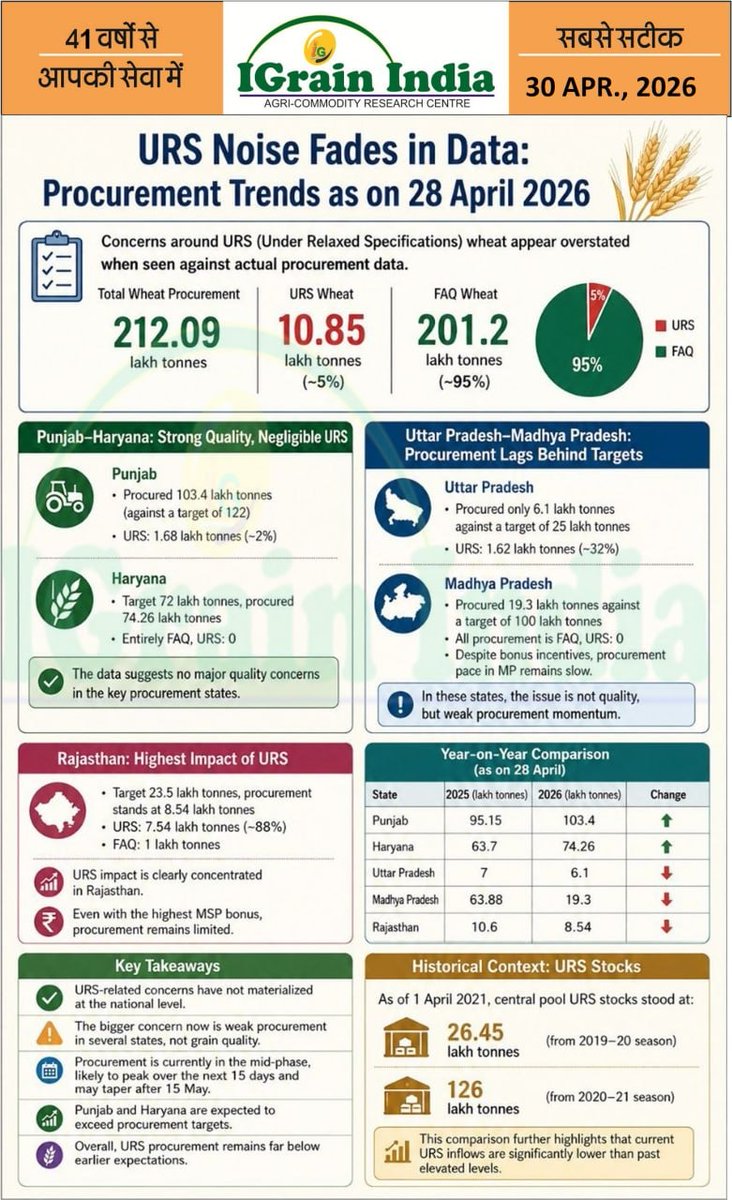
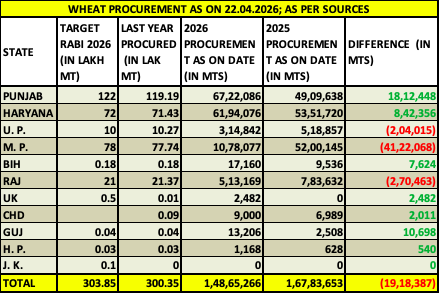
URS Noise Fades in Data: Procurement Trends as on 28 April 2026 Concerns around URS (Under Relaxed Specifications) wheat appear overstated when seen against actual procurement data. Total wheat procurement has reached 212.09 lakh tonnes, of which only 10.85 lakh tonnes (~5%) is URS, while 201.2 lakh tonnes (~95%) is FAQ quality. Punjab–Haryana: Strong Quality, Negligible URS Punjab has procured 103.4 lakh tonnes (against a target of 122), with URS at just 1.68 lakh tonnes (~2%). Haryana has exceeded its target of 72 lakh tonnes by procuring 74.26 lakh tonnes, entirely FAQ, with zero URS. The data suggests no major quality concerns in the key procurement states. Uttar Pradesh–Madhya Pradesh: Procurement Lags Behind Targets Uttar Pradesh has procured only 6.1 lakh tonnes against a target of 25 lakh tonnes, with URS at 1.62 lakh tonnes (~32%). Madhya Pradesh has reached 19.3 lakh tonnes against a target of 100 lakh tonnes; all procurement is FAQ, with zero URS. Despite bonus incentives, procurement pace in MP remains slow. In these states, the issue is not quality, but weak procurement momentum. Rajasthan: Highest Impact of URS Out of a target of 23.5 lakh tonnes, procurement stands at 8.54 lakh tonnes, with 7.54 lakh tonnes (~88%) as URS and only 1 lakh tonnes as FAQ. URS impact is clearly concentrated in Rajasthan. Even with the highest MSP bonus, procurement remains limited. Year-on-Year Comparison (as on 28 April) Punjab: 95.15 → 103.4 lakh tonnes Haryana: 63.7 → 74.26 lakh tonnes Uttar Pradesh: 7 → 6.1 lakh tonnes Madhya Pradesh: 63.88 → 19.3 lakh tonnes (sharp decline) Rajasthan: 10.6 → 8.54 lakh tonnes Key Takeaways URS-related concerns have not materialized at the national level. The bigger concern now is weak procurement in several states, not grain quality. Procurement is currently in the mid-phase, likely to peak over the next 15 days and may taper after 15 May. Punjab and Haryana are expected to exceed procurement targets. Overall, URS procurement remains far below earlier expectations. Historical Context: URS Stocks As of 1 April 2021, central pool URS stocks stood at: 26.45 lakh tonnes (from 2019–20 season) 126 lakh tonnes (from 2020–21 season) This comparison further highlights that current URS inflows are significantly lower than past elevated levels. igrain.in/posts/urs-nois… @VIVEKJLV @sandeepbansal28 @JainPaharia @CheshtaE
IGrain India Rahul Chauhan tweet media
English
0
0
8
1.3K
IGrain India Rahul Chauhan
Severe Soil Moisture Stress Ahead of Kharif | El Niño Risk Intensifies Concern Key Observation Widespread soil moisture stress across major agricultural regions. Dominant red zones indicate below-normal soil moisture ahead of the Kharif sowing window, impacting all major crops. Key Implications 1. Weak Start Risk Low soil moisture may delay sowing and reduce germination across Kharif crops including Rice, Pulses, Oilseeds, Cotton, and Coarse Cereals. 2. Monsoon Dependence Increases Crop performance will heavily depend on timely and well-distributed monsoon rains. Any delay or uneven rainfall can impact acreage and yields. 3. El Niño Risk Amplifies Situation Higher probability of below-normal rainfall and prolonged dry spells, worsening existing moisture stress. 4. Production Risk → Supply Tightness If Kharif output is impacted, it could lead to lower production across crops, tighter domestic availability, and increased import dependence (especially in pulses & edible oils). Market Interpretation Current prices in several commodities may be affected due to weather risk This moisture stress is an early warning signal for broader agri markets If monsoon underperforms: Prices of Kharif crops (rice, pulses, oilseeds, cotton) may rise Import demand may increase across commodities Bottom Line India is entering Kharif 2026 with critically low soil moisture—if El Niño weakens the monsoon, production risks could intensify across all major crops. igrain.in/posts/severe-s… @VIVEKJLV @Manisha3005 @vishwamohansing @MrituenjayZee @JainPaharia @sandeepbansal28 @satish90980234 @IPGAPulses @GlobalPulsesGPC @IVPA_India @IndiaIsma @SOPAINDIA @connectbsaf @AUTheBonus @ashuvirgo1984 @sanjeebm77 @InformistMedia @sean_pratt @pulsecanada @GrainProducers @BinodSgr @AjayKedia1982 @Rajiv_TREA @MayankBhardwaj9 @Rajendra1857 @rahilshaikhMEIR
IGrain India Rahul Chauhan tweet media
English
0
2
10
826
IGrain India Rahul Chauhan retweetledi
Rahil Shaikh
Rahil Shaikh@rahilshaikhMEIR·
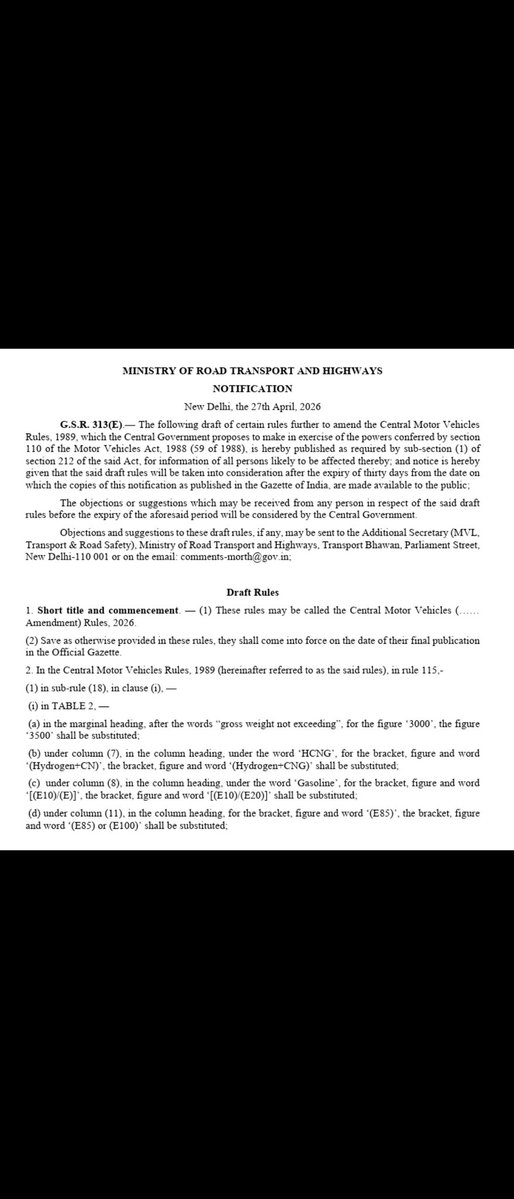
India’s drafts rules to test E85 & E100 fuels Pros: Cuts oil imports Boosts farmers & ethanol economy Lower emissions vs petrol Cons: Food vs fuel risk for 1.44B people Engine compatibility & infra gaps Water-intensive crop concerns Big step—but balance is key. #Ethanol #EnergyTransition
Rahil Shaikh tweet media
English
4
4
19
3.2K
IGrain India Rahul Chauhan
IGrain India Rahul Chauhan@IGrain_India·
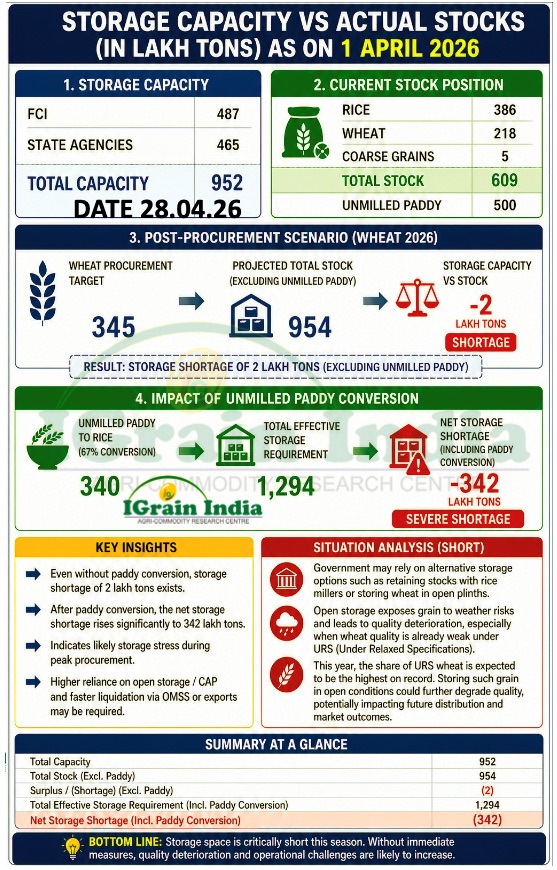
igrain.in/posts/news-cap… Rising pressure on India’s foodgrain storage capacity amid record output According to available data, as of April 1, 2026, the Food Corporation of India (FCI) holds storage capacity of 487 lakh tonnes, while state agencies account for 465 lakh tonnes, taking the total capacity to 952 lakh tonnes. On the same date, total foodgrain stocks stood at 608.97 lakh tonnes, comprising 386 lakh tonnes of rice, 218 lakh tonnes of wheat, and 4.77 lakh tonnes of coarse grains. In addition, around 500 lakh tonnes of paddy remains with rice millers in unmilled form. The situation becomes more challenging with a wheat procurement target of 345 lakh tonnes for the 2026–27 season. If the target is fully achieved, total stocks could rise to 953.97 lakh tonnes—slightly exceeding the current storage capacity. If the unmilled paddy held by millers is processed and moved into the central pool, storage pressure is expected to intensify significantly. In such a scenario, the government may have to rely on alternative storage options, including retaining stocks with rice millers or storing wheat in open plinths. However, open storage exposes grain to weather risks and leads to quality deterioration, particularly at a time when wheat quality is already reported to be weak under URS (Under Relaxed Specifications). This year, the share of URS wheat is expected to be the highest on record. Storing such grain in open conditions could further degrade quality, potentially impacting future distribution and market outcomes. Experts suggest that this is not just a logistical issue but a broader concern involving quality management and food security. There is an urgent need to expand storage capacity, invest in modern silo infrastructure, and adopt more efficient stock management strategies to ensure that record production does not translate into avoidable losses. @VIVEKJLV @sandeepbansal28 @JainPaharia @RFMFI1940
English
2
1
11
832
IGrain India Rahul Chauhan
IGrain India Rahul Chauhan@IGrain_India·
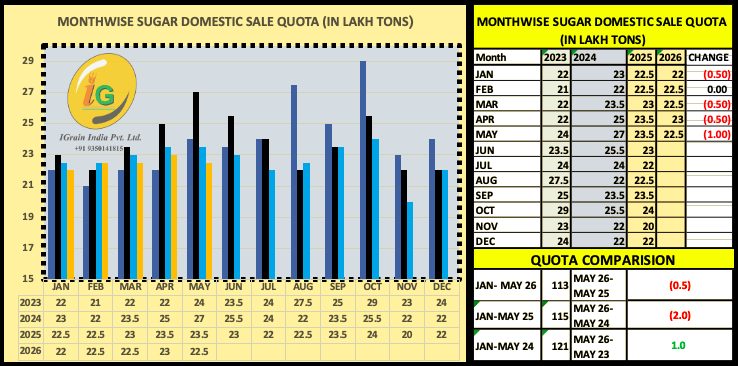
Mild tightening in sugar quota, softer year-on-year trend for January–May period During the January–May period, the government has adopted a slightly tighter approach compared to previous years. For 2026, the total sugar sales quota for January–May has been fixed at 113 lakh tonnes, lower than 115 lakh tonnes in 2025 and 121 lakh tonnes in 2024. This indicates a gradual year-on-year decline in allocated quotas. On a month-wise basis, the trend remains mixed. The quota for January 2026 stands at 22 lakh tonnes, slightly lower than 22.5 lakh tonnes in 2025. February has been kept unchanged at 22.5 lakh tonnes. In March, a marginal decline is seen with the quota at 22.5 lakh tonnes compared to 23 lakh tonnes last year. April remains stable at 23 lakh tonnes, matching the previous year’s level. However, May has seen the sharpest cut, with the quota fixed at 22.5 lakh tonnes, down by 1 lakh tonne from 23.5 lakh tonnes in 2025. Overall, the January–May 2026 quota is lower by around 2 lakh tonnes compared to 2025, and even more so when compared to 2024. This suggests that the government is aiming to balance domestic availability while supporting sugar prices. Quota decisions are being influenced by factors such as ethanol diversion, production estimates, and domestic demand. Going forward, policy adjustments may depend on the progress of the monsoon and the outlook for sugarcane production. @kapilnema @IndiaIsma @iso_sugar
IGrain India Rahul Chauhan tweet media
English
0
0
6
700
IGrain India Rahul Chauhan
IGrain India Rahul Chauhan@IGrain_India·
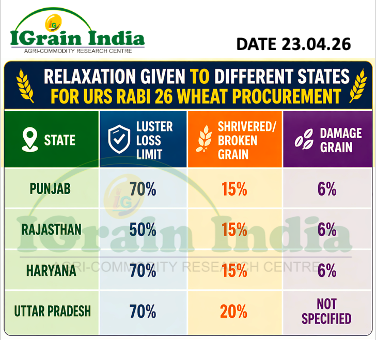
RELAXATION GIVEN TO DIFFERENT STATES FOR URS RABI 26 WHEAT PROCUREMENT
IGrain India Rahul Chauhan tweet media
English
0
1
5
489
IGrain India Rahul Chauhan
IGrain India Rahul Chauhan@IGrain_India·
Excellent Coverage @Manisha3005 and Views by @VIVEKJLV Ji, we need to be very cautious in next coming season. El Nino Urea War Low water table level Heat Less water in Reservoirs More Imports More Intervention Change in Policies Shortages of Energy in future if war continuous Impact will be not only on Pulses but on other commodities Oils-Oilseed, Rice, Spices, Wheat, Corn and Coarse Grains, Sugar.
VivekJLVAgro@VIVEKJLV

दालों के बाजार में आने वाली सबसे बड़ी चुनौती, अलनिनो, लंबे समय से दालों के बाजार स्थिर और इसको बनाए रखना बड़ी चुनौती। @Manisha3005 @CNBC_Awaaz @IGrain_India @connectbsaf @MrituenjayZee @IPGAPulses @GlobalPulsesGPC @NidhiKhare17838

English
0
0
11
881
IGrain India Rahul Chauhan
IGrain India Rahul Chauhan@IGrain_India·
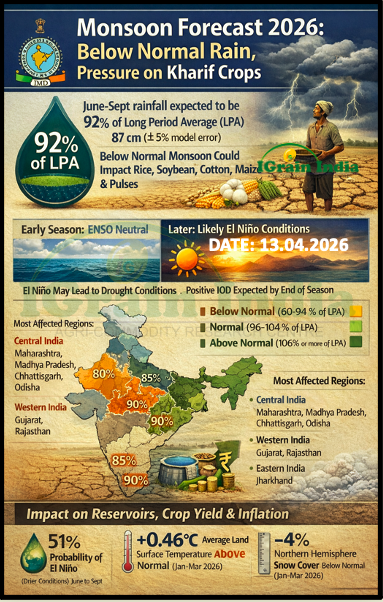
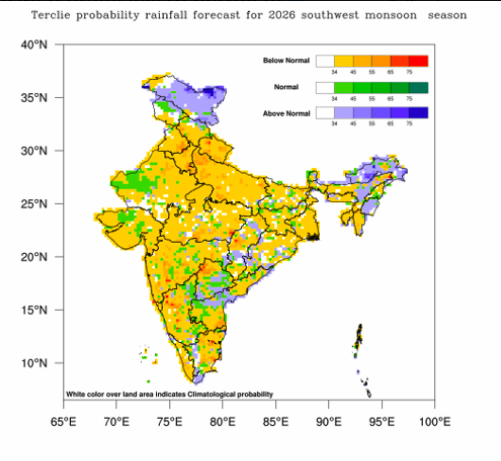
igrain.in/posts/2026-mon… 2026 Monsoon Forecast: Below-Normal Rainfall May Pressure Kharif Crops India’s 2026 southwest monsoon is expected to be weaker than normal, with the India Meteorological Department (IMD) projecting rainfall at only 92% of the Long Period Average (LPA) during June–September. This marks the first below-normal monsoon forecast in three years and raises concerns for agriculture, water availability, and inflation. (The Economic Times) Lower rainfall is likely to affect major kharif crops such as rice, soybean, cotton, maize, and pulses, especially in rain-fed farming regions where irrigation support is limited. Reduced soil moisture during sowing and vegetative growth stages could lower yields and delay planting in vulnerable states. According to IMD, ENSO conditions are expected to remain neutral in the early phase of the season, but the probability of El Niño developing later is high. El Niño generally suppresses rainfall over India and can trigger drought-like conditions. However, a possible positive Indian Ocean Dipole (IOD) toward the latter part of the season may partially offset rainfall deficits in some regions. (Reuters) Regionally, central and western India are at greater risk of deficient rainfall, while parts of northeast India, northwest India, and southern peninsular regions may receive normal to above-normal precipitation. Uneven rainfall distribution could further complicate crop planning and reservoir management. A weak monsoon may also impact: Reservoir storage and irrigation supply Rural demand and farm incomes Foodgrain output and edible oil production Inflation in cereals, pulses, and vegetables The monsoon remains critical to India’s farm economy, as nearly half of cultivated land depends directly on seasonal rains. @VIVEKJLV @vishwamohansing @sandeepbansal28 @connectbsaf
IGrain India Rahul Chauhan tweet mediaIGrain India Rahul Chauhan tweet media
English
0
1
6
626
IGrain India Rahul Chauhan retweetledi
Vatsala Singh
Vatsala Singh@_vatsalasingh·
इस डॉक्टर ने तो हमारी आंखें खोल दी। आज तक किसी ने ऐसा नहीं समझया!! कृपया सीनियर सिटिजन जरूर सुने, अधूरा नहीं पूरा सुनिए ....!
हिन्दी
19
637
2.3K
29.2K