Sabitlenmiş Tweet
ILRAJ
1.2K posts

ILRAJ
@ILRAJ2
An independent non-partisan public policy research and educational think tank established to explain, monitor and contribute to the protection of human rights
Sierra Leone Katılım Kasım 2020
185 Takip Edilen8.4K Takipçiler
Constitutional Control Mechanisms During Exceptional Circumstances: The Role of the Supreme Court of Sierra Leone
Abstract
This paper examines the constitutional control mechanisms for monitoring emergency regulations with respect to legislation specifically designed to govern exceptional circumstances. The phrase “exceptional circumstances”, in the context of a myriad of phenomena affecting humanity and economic development, refers to circumstances which fundamentally alter and disrupt the normal course of human activities. Africa has been confronted with a surfeit of such exceptional circumstances that have not only claimed many lives but have disrupted and crippled national economic activities. In identifying some of these exceptional circumstances that the continent has overcome in recent years, one must consider first the COVID‑19 pandemic, which crippled the world economy and claimed the lives of millions; the Ebola epidemic of 2014, which also claimed the lives of thousands, particularly in Sierra Leone, Liberia, and Guinea; and the Monkeypox viral disease, for which Sierra Leone declared a public health emergency quite recently. The exceptional circumstances mentioned above are public health emergencies whose potential to wreak havoc on such a scale was never fully envisaged by the World Health Organisation.
The need to strike a balance between preserving human life, by maintaining certain regulations during a public emergency, and ensuring that such regulations do not violate fundamental human liberties is a matter to which the judicial apparatus of every country ought to be sensitive. This paper examines, with keen interest, the constitutionality of laws specifically designed to tackle public health emergencies with the intention of curtailing human interaction during such emergencies. As humanity has demonstrated remarkable resilience in overcoming these challenges, we must not rest on our laurels or neglect preparedness for challenges potentially looming on the horizon. Humanity must accept that public health emergencies are part of our ecosystem, and we should continuously devise intelligent measures to address them in a timely manner. Apart from these health emergencies, the world has been, and continues to be, confronted with the menace of climate change — a phenomenon that appears natural in its manifestation but which scientists have attributed primarily to human, and predominantly economic, activity.
1. Africa’s Resilience in Overcoming Adversity
Africa is no stranger to circumstances that pose a tremendous threat to normal human activities. The resilience demonstrated by the governing apparatus of African countries in overcoming exceptional circumstances that have plagued the continent over the years is quite remarkable and worthy of emulation. It is a fact that the continent accounts for a disproportionate number of the world’s least developed countries, and even whilst enduring poverty and a low standard of living, the continent remains among the most vulnerable when compared with counterpart countries in the Global South.1
2. The Unpredictability of Exceptional Circumstances
From an empirical scientific standpoint, no one could have had the slightest indication that the world would be crippled by a disease such as COVID‑19. Empiricism posits that knowledge of any kind must be acquired through observation of the occurrence of certain circumstances and the causes and effects of those circumstances.2 From all indications, when COVID‑19 first emerged in Wuhan, China, the WHO was ill-prepared for such an unpredictable health emergency, and it was as a result of this that the organisation was slow to communicate to the world that the new disease posed a tremendous public health risk. The lack of understanding of the effects of the disease amongst the world’s leading epidemiologists, coupled with the WHO’s delayed response in declaring COVID‑19 a public health menace, contributed significantly to its devastating impact.3 Whilst renowned epidemiologists were deliberating on whether to announce a policy proposal in response to the unpredictable developments in Wuhan — or to await further verification of initial reports, as was standard procedure — the virus was spreading rapidly across China and beyond.4
3. The Devastating Impact of the Ebola Virus Disease on Sierra Leone
Standing as an epitome of the kind of exceptional circumstance that reduced the normal course of human activities in the Mano River Union to chaos, the Ebola Virus Disease emerged at a time when the economy of Sierra Leone was relatively stable.5 The outbreak of the deadly viral disease claimed the lives of over 11,000 people in West Africa, with Sierra Leone accounting for 4,493 deaths as of March 2016.6 The vestiges of the disease’s impact have not entirely left Sierra Leone, but lessons learnt from the outbreak prompted the country to establish national public health emergency institutions. One such institution is the National Ebola Response Centre (NERC), established in 2014, which was later renamed the National COVID‑19 Emergency Response Centre (NACOVERC) in 2020, in preparation for tackling potential future outbreaks. More recently, in 2023, the Government launched a Public Health Emergency Trust Fund for the mobilisation of resources to be dedicated to disease surveillance, vaccination campaigns, and community engagement.7 The World Health Organisation noted that social mobilisation, leadership, and the co-ordination of relevant government ministries contributed significantly to breaking the chain of transmission. The Organisation further noted that the absence of a national health emergency body and a national risk and disaster management policy at the time led to delays in tackling the spread of the disease.8
4. The Declaration of a State of Public Emergency in Sierra Leone During COVID‑19
The Constitution of Sierra Leone Act No. 6 of 1991 contains an instructive provision under section 29 of Chapter III governing the declaration of a state of public emergency.9 The power to declare a state of public emergency is vested in the President, consequent upon prevailing circumstances that threaten the peace and stability of the country. The proclamation of a state of public emergency by the President is dependent upon certain prevailing circumstances listed in subsection (2) of section 29 of the Constitution of Sierra Leone, which may be summarised as follows: when Sierra Leone is at war; where there is a breakdown of public order and safety; where there is a clear and present danger of an actual breakdown of public order and safety in the whole of Sierra Leone or in any part thereof; and where there is imminent danger of, or the actual occurrence of, any disaster or natural calamity affecting a community or a section of a community in Sierra Leone.10 Subsection (1) of section 29 provides that where the President is of the opinion that any of the circumstances mentioned above prevail in any part of Sierra Leone or across the whole country, he shall proclaim a state of public emergency, which shall be published in the Gazette.11
It must be noted that the reference to a disaster or natural calamity in paragraph (e) of subsection (2) of section 29 encompasses public health emergencies as well as the advent of climate change, with its increasingly ferocious weather conditions threatening the safety of the people of Sierra Leone.12 The purpose of declaring a state of public emergency in any country is to enable the authorities to tackle any exceptional circumstance requiring extraordinary measures in order to restore stability.
In response to the Ebola Virus Disease, which threatened public safety, the President of Sierra Leone at the time invoked section 29 of the Constitution by declaring a state of emergency on 31st July 2014 under Public Notice No. 1.13As is the case in any constitutional democracy, it is under a state of public emergency that the government may issue regulations to control certain activities considered inimical to its endeavour to restore normality. In the case of Sierra Leone, the power to issue regulations under a state of emergency is likewise vested in the President by subsection (5) of section 29, and a number of such regulations were issued during the Ebola outbreak. These included the imposition of a curfew limiting the movement of persons within certain hours and successive lockdowns that completely prohibited persons from leaving their homes. Such regulations, made under a state of emergency, give rise to the notion that certain fundamental human rights are persistently curtailed to the extent that citizens are deprived of the ability to seek judicial redress. During a curfew or lockdown, a host of fundamental freedoms are suspended, justified on grounds of social and political expediency. Chapter III of the Constitution of Sierra Leone provides for the recognition, protection, and enforcement of fundamental human rights, including: the right to freedom of movement; freedom of assembly and association; freedom of conscience and the freedom to worship in accordance with one’s religious beliefs; protection against arbitrary arrest and detention; and freedom of the press and expression.14
It is also worth noting that regulations of a similar nature were imposed in Sierra Leone during the COVID‑19 pandemic under Statutory Instrument No. 9, known as the Public Health (COVID‑19 Emergency Response) Regulations, published on 22nd July 2021.15 These regulations were made pursuant to the existing state of public emergency declared by the President on 24th March 2020. The purpose of such regulations — as with those issued during the Ebola outbreak — was to break the chain of transmission by restricting the free movement of persons. The said legal instrument provided for the imposition of a curfew throughout Sierra Leone for a period of four weeks commencing on 5th July 2021, restricting the movement of persons between the hours of 11:00 pm and 5:00 am.16 The Statutory Instrument further provided for the prohibition of any form of gathering, whether at weddings, places of worship, or entertainment venues. Of particular note is the power conferred upon the police to arrest, detain, and levy a fine upon any person found to have contravened the provisions of the regulations.17
5. The Constitutional Control Mechanisms for the Protection of Fundamental Civil Liberties During a State of Emergency
Constitutional democracies are characterised by the constitutional concept of limited government.18 That government may exercise the greatest power bestowed upon it by the people, but must do so with particular regard to the rights and liberties of those from whom such political power is derived. Political power must be distributed amongst the three arms of government so that each is regarded as co-equal in the discharge of its distinctive functions. Though this is the default position of every constitutional democracy, it does not appear to hold during a state of public emergency, where power becomes heavily concentrated in the executive branch of government. This position is exemplified by the power conferred upon the President of Sierra Leone by the Constitution to proclaim a state of emergency whenever he is satisfied that an extraordinary circumstance prevails in the country. The executive and the legislature are involved in determining the parameters of a state of emergency, thereby rendering the judiciary largely peripheral. Indeed, during both the Ebola and COVID‑19 outbreaks, the operations of the judiciary were significantly curtailed to the extent that court proceedings were either conducted virtually or suspended altogether, owing to the prohibition on gatherings.
Accordingly, a salient question emerges: can fundamental rights that have been suspended or violated during a state of public emergency be protected or enforced before any court of law in pursuance of judicial redress? The protective provisions governing fundamental human rights found in Chapter III of the Constitution of Sierra Leone are consonant in content and in spirit with several international human rights instruments, including the Universal Declaration of Human Rights (UDHR) and the International Covenant on Civil and Political Rights (ICCPR). Before that question is answered, it must first be noted that fundamental human rights are categorised as either derogable or non-derogable. A right is deemed non-derogable when the law does not permit its suspension or violation under any circumstances — not even during a state of emergency. Conversely, a right is derogable when the law permits its suspension or curtailment during a state of emergency. Although the right to freedom of movement is a fundamental human right, we have seen regulations issued by the government during both public health emergencies that suspended this right through the imposition of curfews and lockdowns. Non-derogable rights, such as the right to life and the protection against torture and inhuman treatment, are examples of rights that cannot be violated under any circumstances, including during a state of emergency.19
The Constitution of Sierra Leone provides, under section 28, an opportunity for any aggrieved person whose rights have been violated to seek redress from the Constitutional Court, the Supreme Court.20 This provision would appear to afford comfort to persons who believe that their rights can be protected and enforced at all times, including during a state of emergency. However, that is not entirely the case. Under a state of emergency, the Constitution provides in subsection (18) of section 29 that anything done under the authority of any law shall not be held to be inconsistent with the provisions of section 29, to the extent that such law authorises the taking, during a period of a state of public emergency, of measures that are reasonably justifiable for the purpose of dealing with the situation that existed immediately before, and during, that period of a state of public emergency. The argument as to constitutional supremacy, as provided in subsection (15) of section 171, would carry little potency where the question before the court is the validity of subsidiary legislation made during a state of emergency.21 Accordingly, the answer to the question posed above is, in all likelihood, no. The Constitutional Court of Sierra Leone would be disposed to accept an argument of necessity in favour of the executive arm’s power to issue regulations that are socially and politically expedient to address a public health crisis.
Boizee Bai Kalokoh is a Barrister and Solicitor of the High Court of Sierra Leone with a strong passion for legal research and a keen interest in public law and judicial reform. His work focuses on the enforcement of fundamental human rights and the structural challenges to the expeditious administration of justice in Sierra Leone. He is particularly committed to advancing legal research and has been advocating for the responsible use of emerging technologies, including artificial intelligence, as tools for enhancing legal scholarship. He seeks to influence practical and institutional reforms that promote efficiency, accountability, and access to justice within the Sierra Leone legal system.
Endnotes
1 Africa Overview: Development news, research, data, 15 October 2024. Retrieved from worldbank.org/en/region/afr/…
2 Experimental Science, <mometrix.com/academy/experi…> accessed 22 January 2025.
3 An Evidence-based Quest to Protect Human Health. Retrieved from theindependentpanel.org
4 Tuomo Peltonen: Predictive Reasoning in the Early Stages of the Covid-19 Epidemic, <pubmed.ncbi.nlm.nih.gov/36313010/> accessed 22 January 2025.
5 Dr Peter Davis, Ebola in Sierra Leone: Economic Impact & Recovery (2015), <investsalone.com/wp-content/upl…> accessed 1 February 2025.
6 The long-term impacts and costs of Ebola on the Sierra Leonean health sector, <unicef.org/sierraleone/me…> accessed 5 February 2025.
7 <surge-eoc.mohs.gov.sl/2023/12/16/sie…> accessed 2 February 2025.
8 Lessons From The Response To The Ebola Virus Disease Outbreak In Sierra Leone May 2014–November 2015, <afro.who.int/sites/default/…> accessed 7 February 2025.
9 The Constitution of Sierra Leone, Act No. 6 of 1991.
10 See Subsection (2) of Section 29 of The Constitution of Sierra Leone, Act No. 6 of 1991.
11 See Subsection (1) of Section 29 of The Constitution of Sierra Leone, Act No. 6 of 1991.
12 See Paragraph (e) Subsection (2) of Section 29 of The Constitution of Sierra Leone, Act No. 6 of 1991.
13 See Supplement to the Sierra Leone Gazette Vol. CXLV, No. 41 dated 31st July 2014.
14 See Sections 17, 18, 24, 25, and 26 of The Constitution of Sierra Leone, 1991.
15 Statutory Instrument: Supplement to the Sierra Leone Gazette Vol. CXLXII, No. 41.
16 See Regulation 6(1) of The Public Health (Covid-19 Emergency Response) Regulations.
17 See Regulation 6(3)(c) of The Public Health (Covid-19 Emergency Response) Regulations.
18 John Locke: Two Treatises of Government, 1690 (Cambridge University Press, November 1988).
19 See Sections 16 and 20 of The Constitution of Sierra Leone, 1991.
20 Section 28 of The Constitution of Sierra Leone, 1991.
21 Section 171(15), Provision for the Supremacy of The Constitution of Sierra Leone.

English
ILRAJ staff delivered our position paper to selected Members of Parliament. We appreciate Parliament for consistently receiving our reports with openness and engagement. @JanetSamKing3 @clerkPOSL @awokonewspaper @TruthmediaSL @thomasd05987132


English
PRESS RELEASE
FOR IMMEDIATE RELEASE | 15 April 2026
ILRAJ CALLS ON PARLIAMENT TO REFORM THE NATIONAL SECURITY BILL BEFORE ENACTMENT
The Institute for Legal Research and Advocacy for Justice (ILRAJ) has submitted its Position Paper on the National Security and Central Intelligence Bill, 2025, to the Speaker of Parliament, the Attorney-General and Minister of Justice, the Chair of the Defence Committee, the Minority Leader, and the Chair of the Legislative Committee of Parliament. The submission calls for significant reforms to the Bill before it is enacted into law.
Following a thorough clause-by-clause review of the Bill assessed against the 1991 Constitution, the ICCPR, the African Charter on Human and Peoples' Rights, and comparative best practices, ILRAJ has identified serious concerns that, if unaddressed, risk entrenching executive overreach and undermining the fundamental rights of all Sierra Leoneans.
KEY CONCERNS
Excessive executive centralisation: The President appoints the heads of every major security institution, including the proposed State Protection Service (SPS), without meaningful parliamentary checks, risking the politicisation of national security bodies.
Regression from the 2023 Act: Clauses 24 and 26 strip Parliament of its approval role over the Director-General and Deputy Director-General of the Central Intelligence and Security Agency, a safeguard expressly provided by the 2023 Act. Clause 29 further removes the Public Service Commission from Agency staffing, concentrating all hiring authority in the Director-General.
The State Protection Service: Part VII creates a powerful new agency under direct presidential authority with vaguely defined powers, including surveillance without judicial warrants (Clause 32(3)(d)), a broad 'VVIP basket clause' (Clause 32(1)(b)(viii)) that could extend state-funded security to political allies, and an 'act on threats' power with no defined limits on arrest or detention.
No independent oversight: The Bill provides for no Inspector-General of Intelligence, no Parliamentary Committee on Intelligence and Security, and no whistleblower protections, leaving security agencies without meaningful external accountability.
Parliamentary oversight undermined: Clause 54 grants the executive power to withhold information from Parliament on national security grounds, inverting the constitutional relationship between the legislature and the executive.
KEY RECOMMENDATIONS
§ Restore parliamentary approval for the Director-General and Deputy Director-General of CISA (Clauses 24 & 26);
§ Restore the Public Service Commission's role in Agency staffing (Clause 29);
§ Establish an independent Inspector-General of Intelligence and a Parliamentary Committee on Intelligence and Security;
§ Narrow the SPS mandate, delete the 'VVIP basket clause', prohibit SPS arrest/detention powers, and require judicial warrants for all SPS surveillance;
§ Require retrospective judicial authorisation within 48 hours for warrantless information-gathering (Clause 42);
§ Introduce whistleblower protections and limit blanket immunity clauses;
§ Amend Clause 54 so that disputes over non-disclosure to Parliament are determined by the High Court, not the executive.
“For a security architecture to be truly national, it must command the confidence of all Sierra Leoneans, not only those in power. It must operate within the rule of law and be subject to meaningful checks and balances. ILRAJ urges Parliament to act on these recommendations before the Bill is enacted.” — ILRAJ
About ILRAJ
ILRAJ is an independent, non-partisan public policy research and educational think tank dedicated to the protection of human rights and the rule of law in Sierra Leone.
The full Position Paper is available at ilraj.org/wp-content/upl…


English
ILRAJ retweetledi
Institute for Legal Research and Advocacy For Justice #ILRAJ has in Legal Policy Brief questioned a committee set up by @julius_maadabio to investigate grave allegations of corruption and systemic fiasco at the country’s law school, citing lack of constitutional or statutory authority to support such decision.
The Policy brief pointed out that the Law School is governed by a Council chaired by the Chief Justice under the Council of Legal Education Act, 1989 (as amended in 2021), and is not a Ministry or agency of the Executive, opining that the presidential intervention violates the separation of powers enshrined in the 1991 Constitution.
The Brief warns that the suspension of the ACC’s ongoing criminal investigation compromises the Commission’s statutory independence under section 9 of the Anti-Corruption Act, 2008.
The brief makes eleven concrete recommendations, including the reconstitution of the committee under proper legal authority, the immediate resumption of the ACC investigation, a comprehensive review of the Council of Legal Education Act, controlled liberalisation of the training monopoly following the models of Ghana and Kenya, statutory protections for Law School staff, and the constitutional entrenchment of the ACC
@ILRAJ2
@oagmoj2023
@JudiciaryofSL
New Age Newspaper@newage_sl
English
ILRAJ retweetledi
Institute for Legal Research and Advocacy @ILRAJ2 has raised serious constitutional concerns over President Julius Maada Bio’s decision to establish an Independent Investigation Committee into the Sierra Leone Law School.
Read more: truthmedia.sl/ilraj-challeng…
#TruthTellers

English
PRESS RELEASE
FOR IMMEDIATE RELEASE | 15 April 2026
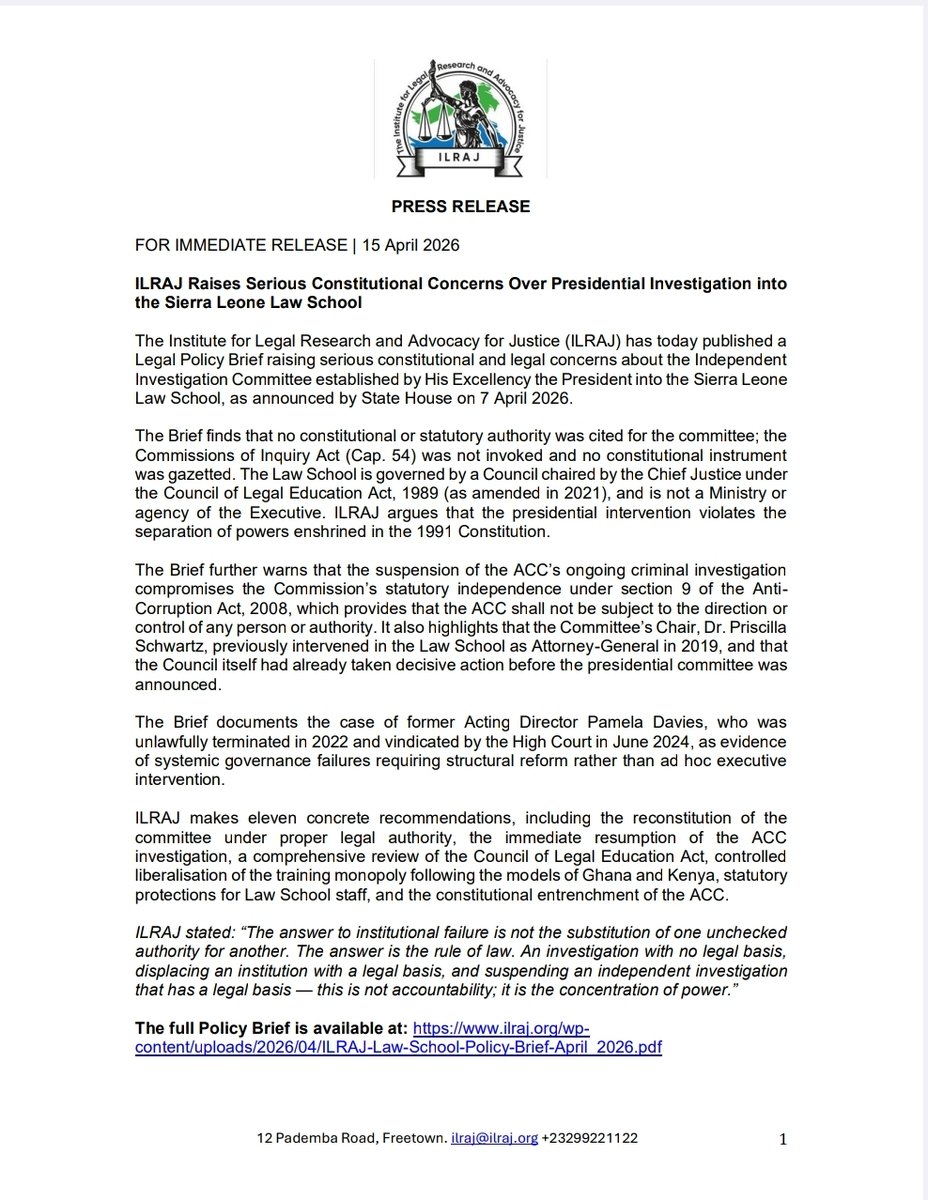
ILRAJ Raises Serious Constitutional Concerns Over Presidential Investigation into the Sierra Leone Law School
The Institute for Legal Research and Advocacy for Justice (ILRAJ) has today published a Legal Policy Brief raising serious constitutional and legal concerns about the Independent Investigation Committee established by His Excellency the President into the #SierraLeone Law School, as announced by State House on 7 April 2026.
The Brief finds that no constitutional or statutory authority was cited for the committee; the Commissions of Inquiry Act (Cap. 54) was not invoked and no constitutional instrument was gazetted. The Law School is governed by a Council chaired by the Chief Justice under the Council of Legal Education Act, 1989 (as amended in 2021), and is not a Ministry or agency of the Executive. ILRAJ argues that the presidential intervention violates the separation of powers enshrined in the 1991 Constitution. @JudiciaryofSL
The Brief further warns that the suspension of the ACC’s ongoing criminal investigation compromises the Commission’s statutory independence under section 9 of the Anti-Corruption Act, 2008, which provides that the @ACCSALONE shall not be subject to the direction or control of any person or authority. It also highlights that the Committee’s Chair, Dr. Priscilla Schwartz, previously intervened in the Law School as Attorney-General in 2019, and that the Council itself had already taken decisive action before the presidential committee was announced.
The Brief documents the case of former Acting Director Pamela Davies, who was unlawfully terminated in 2022 and vindicated by the High Court in June 2024, as evidence of systemic governance failures requiring structural reform rather than ad hoc executive intervention.
ILRAJ makes eleven concrete recommendations, including the reconstitution of the committee under proper legal authority, the immediate resumption of the ACC investigation, a comprehensive review of the Council of Legal Education Act, controlled liberalisation of the training monopoly following the models of Ghana and Kenya, statutory protections for Law School staff, and the constitutional entrenchment of the ACC.
ILRAJ stated: “The answer to institutional failure is not the substitution of one unchecked authority for another. The answer is the rule of law. An investigation with no legal basis, displacing an institution with a legal basis, and suspending an independent investigation that has a legal basis, this is not accountability; it is the concentration of power.”
The full Policy Brief is available at: ilraj.org/wp-content/upl…
English
FROM FIRST WINNER TO THE NEXT GENERATION
The UBA Foundation National Essay Competition (NEC) turns dreams into reality. We started with our first winner, Hafeez O.A. Taqi of Sierra Leone Grammar School now, it’s your turn to make an impact.
Take the bold step. Put your thoughts to paper and let your voice be heard.
Submit: Handwritten essays at any #UBA branch.
Deadline: 30th April, 2026
Will you rise to the occasion?
@UBASierraLeone @UBAFoundation #NationalEssayCompetition @MOBSSE_SL #ILRAJ @ConradOSackey
English



ILRAJ retweetledi

BREAKING: A US Justice Department official has confirmed to Reuters that Iran-linked hackers have breached the personal email of FBI Director Kash Patel, publishing photographs of him and his purported resume.
🔴 LIVE updates: aje.news/im6vrc
GIF
English
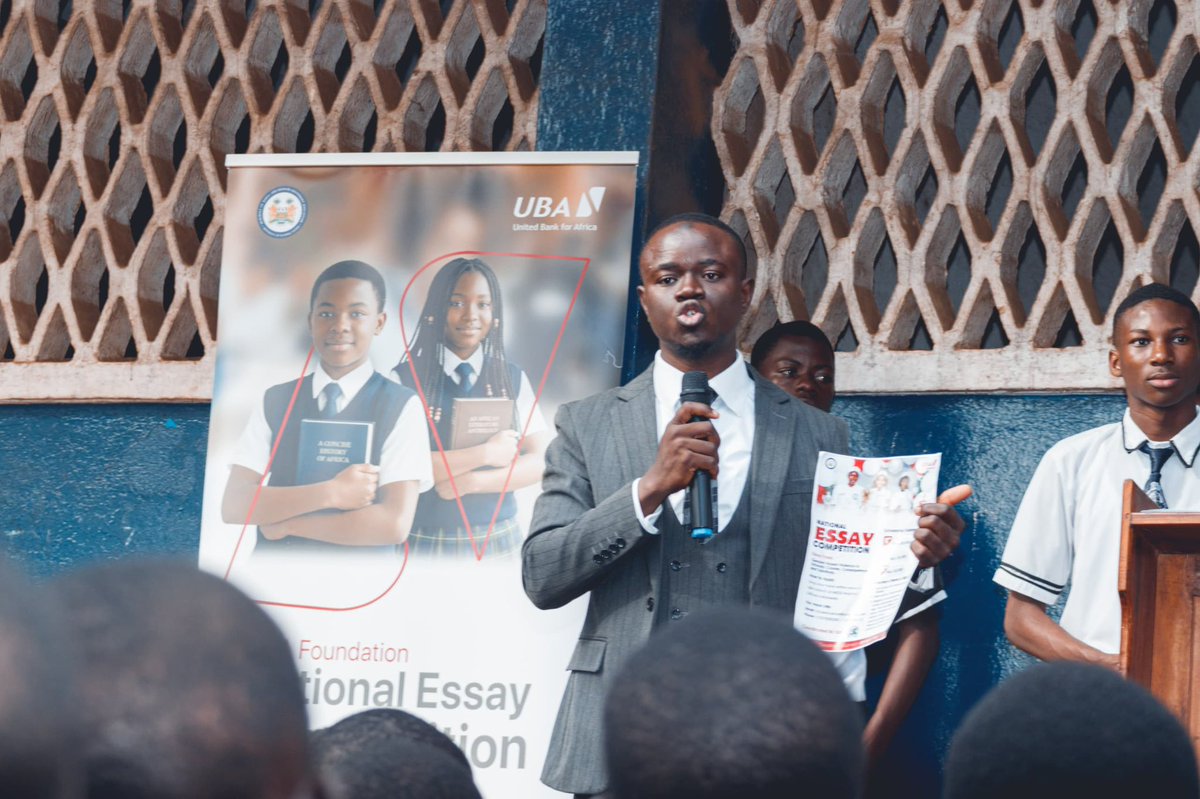
National Essay Competition
The search for Sierra Leone’s most promising young literary voices continues!
During our recent engagement with the students of Methodist Boys’ High School, we emphasized that this competition is a platform for every student across the country to have their voice heard and contribute meaningfully to our national development.
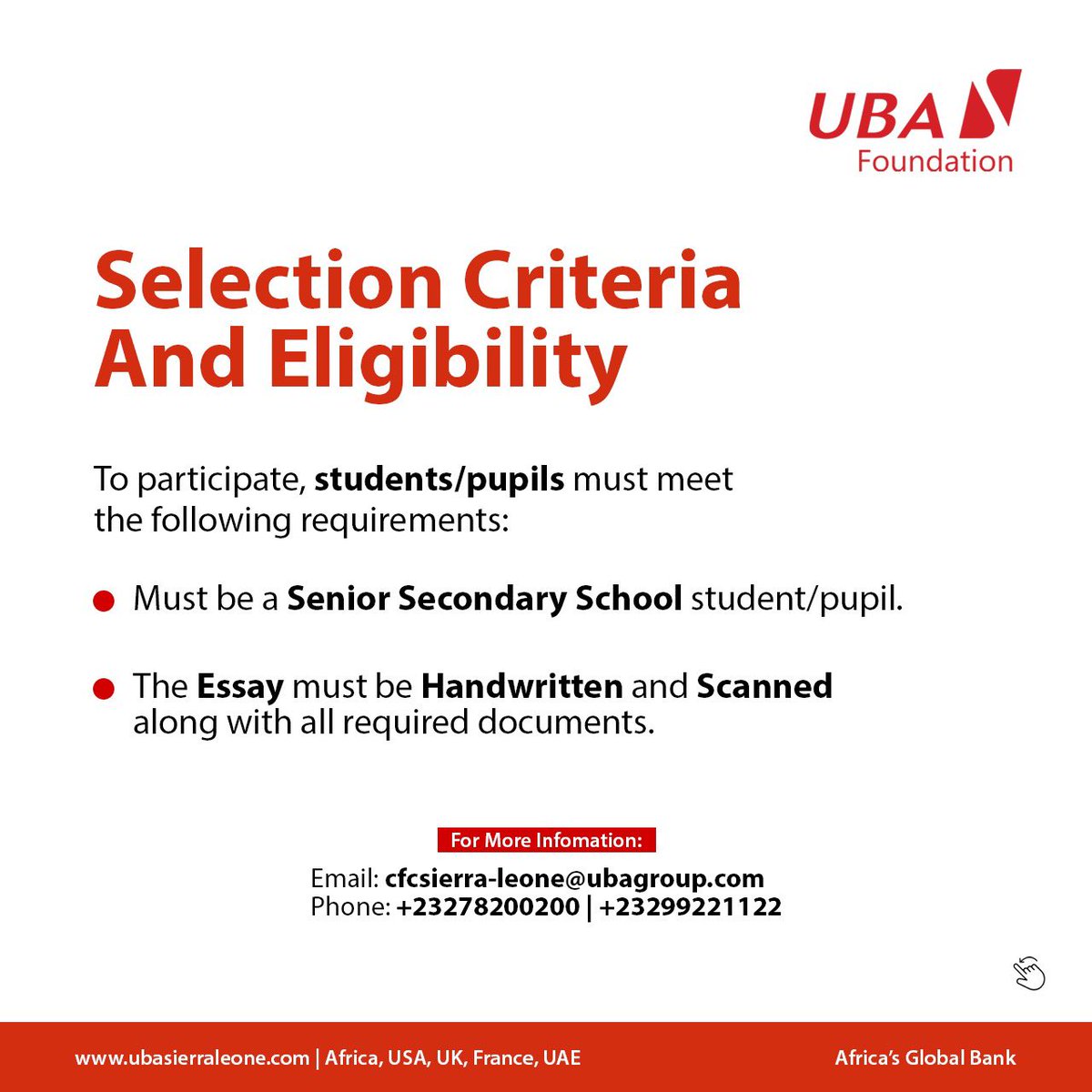
To participate, submit a handwritten essay of no more than 500 words on the topic:
"Gender-Based Violence in Schools: Causes, Consequences, and Solutions"
Submission Details
Locations: Submit to any UBA Branch nationwide or at the ILRAJ Head Office, 12 Pademba Road, Freetown.
Eligibility: Open to all secondary school students in Sierra Leone.
Awards & Prizes
1st Place: NLE 50,000
2nd Place: NLE 30,000
3rd Place: NLE 20,000
Note: Beyond the top three, all 12 finalists will be awarded brand-new laptops and comprehensive learning materials.
Your perspective can spark change. Start writing today!
For more info call - 078200200/099221122
@UBA_SierraLeone @UBAFoundation
#NationalEssayCompetition
#UBANEC2025/2026
@MOBSSE_SL #ILRAJ


English
ILRAJ retweetledi
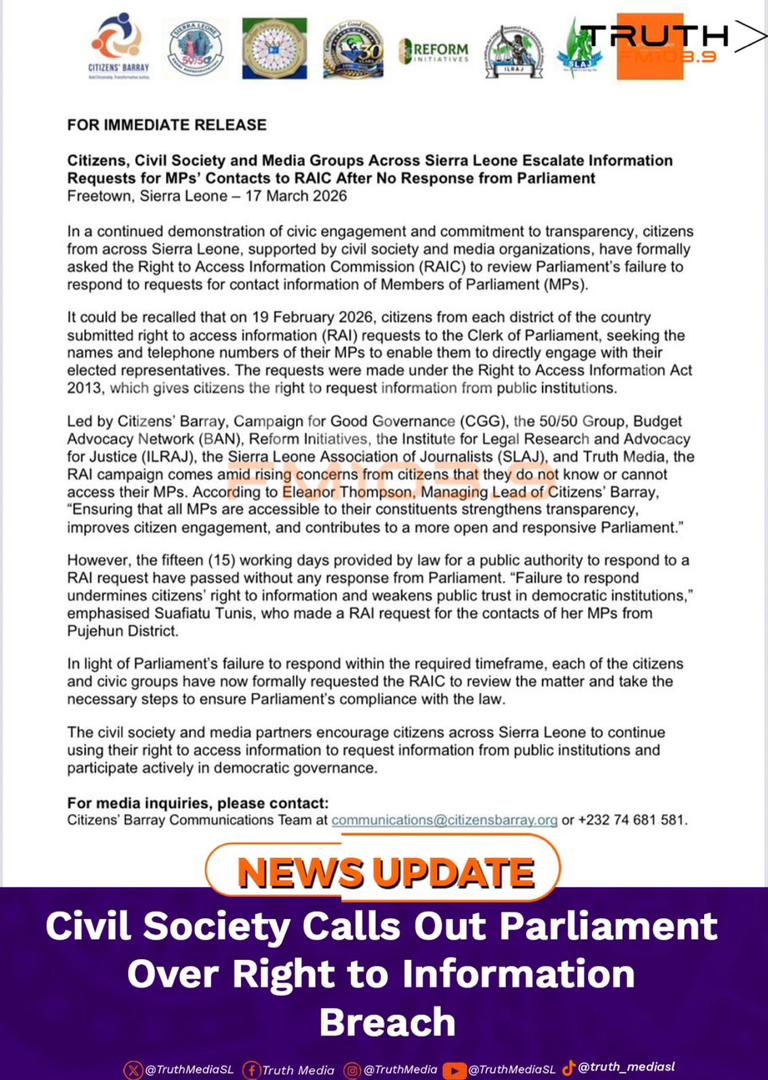
Citizens across Sierra Leone have petitioned the Right to Access Information Commission to intervene after Parliament failed to respond to requests for the contact details of Members of Parliament.
Read More Here: truthmedia.sl/civil-society-…
#TruthTellers
#NarTrueDaeLas
English
ILRAJ retweetledi

Citizens across Sierra Leone asked for info to access MPs. Parliament stayed silent.
After 15 days with no response, citizens & civic groups have asked the RAIC to review Parliament’s failure to respond.
Access to information is a right.
#InfoNaMiRayt #PeoplePowerSL

English
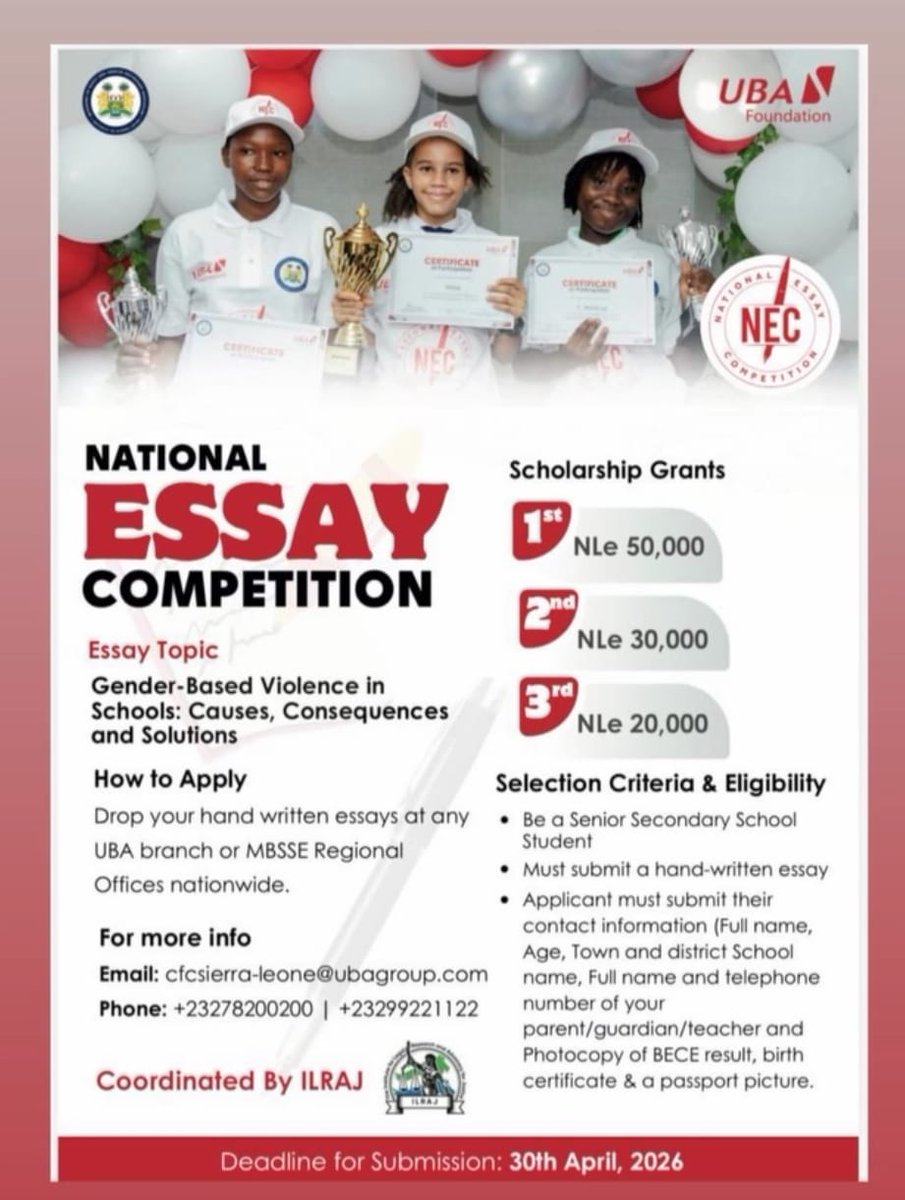
Big moments for young minds in Sierra Leone! ✨
The @UBAFoundation, through @UbaSierra, has officially launched the 2025/2026 UBA National Essay Competition.
This year’s topic: "Gender-Based Violence in Schools: Causes, Consequences, and Solutions" giving pupils across the country the opportunity to raise their voices, share bold ideas, and inspire positive change in society.
The conversation starts now. Who will write the winning story? ✍🏽
#UBASierraLeone
#UBAFoundation
#NationalEssayCompetition
#UBANEC20252026
#MBSSE
#ILRAJ
#EducationForChange
English
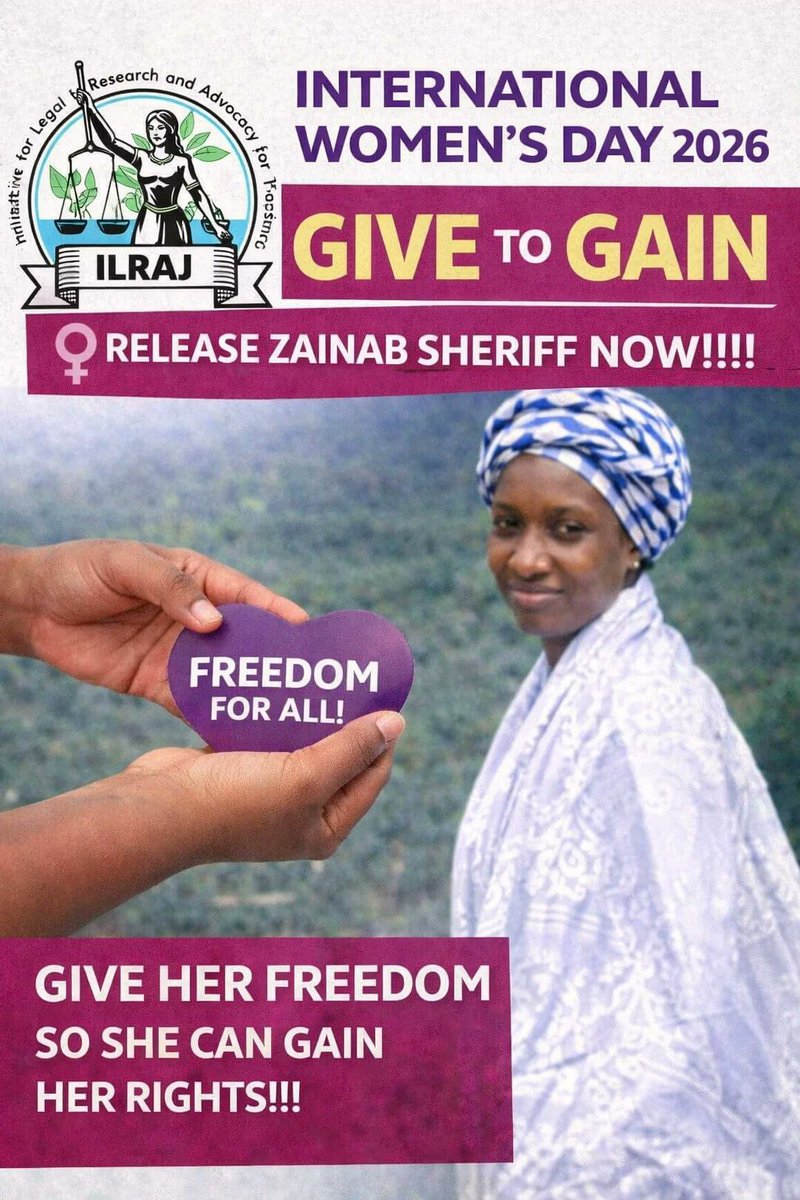

@ILRAJ2 Check the flyer and see if there’s a need to make the necessary adjustments. 🙏
English
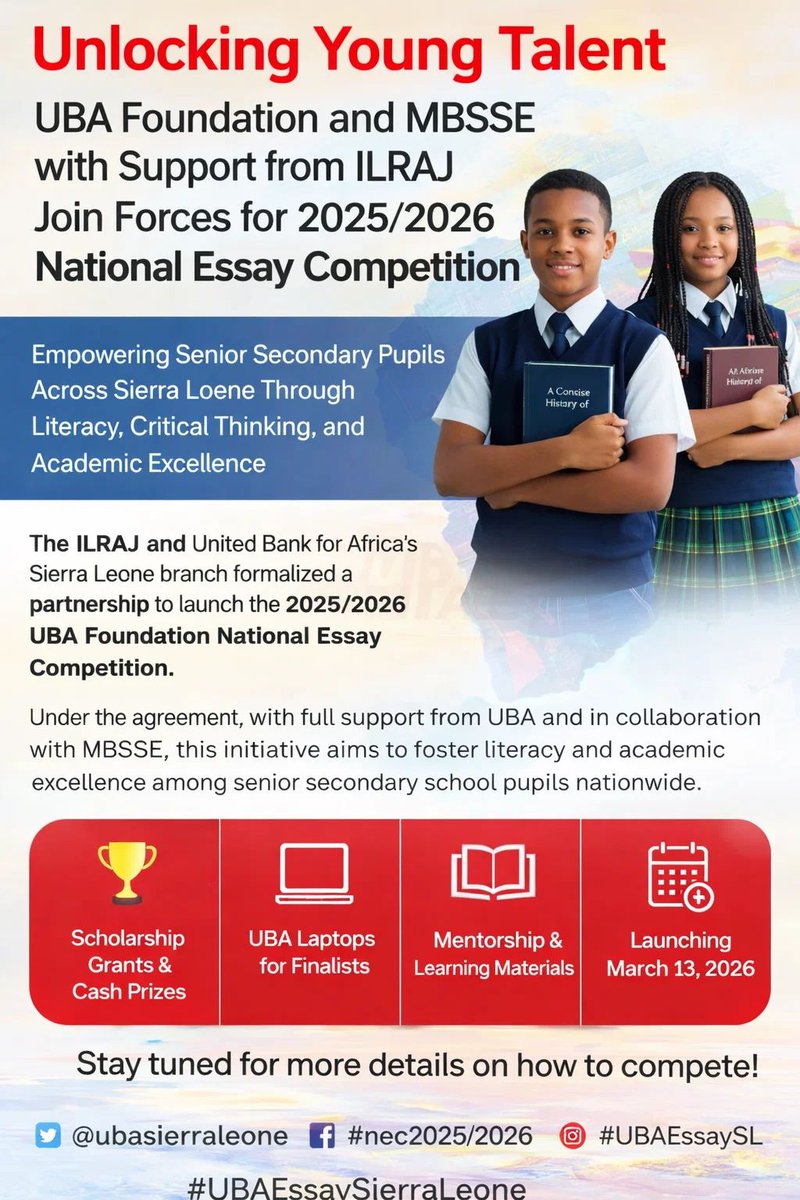
Unlocking Young Talent!
UBA Foundation & UBA Sierra Leone partner with MBSSE & ILRAJ for the 2025/2026 National Essay Competition!
Prizes: scholarships, cash, laptops for top 12. Mentorship, video pitches & epic finale await.
Launch: March 13! Stay tuned.
@UBASierraLeone @mbsse #NEC20252026 #UBAEssaySL #SierraLeone
English
Zainab Sheriff and the price of dissent
@EngageSalone
March 7, 2026
Sierra Leonean entertainer, model and political activist Zainab Sheriff has been in jail since her first court appearance on 23 February, 2026. She was denied bail again by Magistrate Braima Jah @JudiciaryofSL
during her third appearance at the Pademba Road Magistrates Court. The matter came up again on 11 March, 2026. This means the activist and mother of a young child will remain separated from her family and will probably spend International Women’s Day behind bars at the Correctional Centre in Freetown.
Zainab’s case—from her arrest to arraignment and continued incarceration—raises several troubling questions: about institutional independence, about the State’s intolerance for dissent, and about a pattern that increasingly points to punishment, intimidation and persecution. It also raises concerns about what this means for women’s participation in politics. Let’s unpack it.
What we are witnessing with the treatment of Zainab Sheriff is the blunt exercise of power, as the State deploys the full machinery of its authority to achieve two outcomes: punishment and intimidation. Punishment before the case against her has been established or proven, and without regard for the presumption of innocence.
As one commentator put it in Krio, “Zainab de pay for in mot.” It is scary that in a democracy, people would be made to pay for what they say regardless of the weight it bears.
Never mind that the All People’s Congress (APC) has already been fined by the Political Parties Regulation Commission (PPRC) over Zainab’s utterances. Her continued detention represents a very high price to pay for expressing oneself in a way that makes the powerful uncomfortable. Legal experts have argued that bail is the default position under the new Criminal Procedure Act for offences such as the one she faces, unless there are compelling reasons to deny it. What we have been told so far is simply that the case is at a “crucial stage.” Interesting.
This case, centered on Zainab Sheriff, carries broader implications for women’s participation in politics. It sends a loud and unmistakable message: women may be welcome in politics, but they must not bring their authentic selves, especially women like Zainab who do not pull their punches.
The government often boasts about its track record in advancing women’s rights and political participation. On paper, it has indeed passed several laws and reforms that favour women. Yet the same government has built an unenviable record in its
treatment of women leaders who either belong to the opposition or simply refuse to fall in line even when the line seems crooked. Examples include Femi Claudius-Cole, @ClaudiusFemi Yvonne Aki-Sawyerr, @yakisawyerr Zainab Sheriff herself, who has been arrested before, Lara Taylor-Pearce, who was pushed out of office while serving as the country’s top public auditor.
More recently, the young Edwina Jamiru, who does not identify with any political side, was locked up again in a police cell for at least a week before being quietly released with the help of women lawyers and rights groups.
Zainab’s case may well follow the same familiar script: detain, punish, release—and then allow the case to quietly fade away. The impunity surrounding such behaviour is staggering. @sesayalpha @IsataMahoi #SierraLeone #InternationalWomensDay @MichaelBasita
As we discuss the case of #ZainabSheriff and others who have had to endure the excesses of power, it is useful to reflect on Tukumbi Lumumba-Kasongo’s analysis of the African state’s security arrangements. He argues that the security architecture in many countries has been directed against the poor people and not against the real enemies. “In recent years, women, students, the lumpen proletariat, and peasants have been the particular targets of the state’s security,” Lumumba-Kasongo writes. “In short,” he continues, “the police and military apparatus in many African countries have been anti-people and anti-development,” concluding that “the security of the state is an instrument of the ruling classes…”
For a country that speaks loudly about women’s empowerment, the State’s treatment of women, particularly outspoken women suggests something very different. Too often, the issues border on free speech and are of little real consequence.
So what message are we sending to young girls and women who may be considering a life in public service or politics? That they are welcome, but only if they remain “well-behaved” and never dare to shake the table?
Sections of civil society and women’s groups have already called for Zainab’s release on bail. LAWYERS @L_A_W_Y_E_R_S_ have demanded that her rights be fully respected. The Institute for Legal Research and Advocacy for Justice (ILRAJ), @ILRAJ2 which has also been involved in the matter, has launched a social media campaign calling for her release, noting that “freedom for Zainab Sheriff is freedom for all women in Sierra Leone.” Will common sense, compassion and respect for rights prevail ahead of International Women’s Day? #SierraLeone
Engage Salone@EngageSalone
Zainab Sheriff and the price of dissent--read more in this #SaturdayEditorial 🔗👇🏾 #WeEngage engagesalone.org/saturday-edito…
English