
#TH€.R!M¤ retweetledi
#TH€.R!M¤
351 posts
#TH€.R!M¤
@ISSDawg
Software Engineer at @NerdmaSystems | Building Gust | Blockchain Developer | @wethinkcode Alumni | @AcademyPolkadot Alumni
JHB, SA Katılım Aralık 2014
676 Takip Edilen100 Takipçiler


#TH€.R!M¤ retweetledi

This past weekend, my team won 1st place in the 'AI for Business' category at the @NerdmaSystems Hack 🏆
Our project, Eunis, is an AI receptionist that helps SMMEs provide top-notch customer service. Super proud of the team @Thibedi_R and @serge_maunda
youtu.be/1QNPanEeE1A

YouTube
Sir G 👑@Given_kibanza
Big W 🔥🔥🔥
English
#TH€.R!M¤ retweetledi

The first stable release of the #Polkadot SDK is out 🥳
It uses a new naming schema "polkadot-stable2407", but there are tags in place with the old naming schema as if it were called 1.15.
github.com/paritytech/pol…
English
#TH€.R!M¤ retweetledi

Backend Frameworks with the most stars on GitHub:
1. Django - 77.8K⭐️
2. Laravel - 77.5K⭐️
3. Spring Boot - 73.6K⭐️
4. Flask - 67K⭐️
5. Nest - 65.6K⭐️
6. Express - 64.3K⭐️
7. Ruby on Rails - 55.3K⭐️
8. Meteor - 44.1K⭐️
9. Koa - 35K⭐️
Which one is your favorite?
English
Get ready to hack with @NerdmaSystems at this year's Hack-AI-thon.
linkedin.com/events/annualn…
English
#TH€.R!M¤ retweetledi

Explanation of Hybrid Consensus in @Polkadot
Below is a diagram from that project about one of the most popular topics in Polkadot: Hybrid Consensus on the Relaychain of the Polkadot protocol.
For those who haven't delved deeply into blockchain, consensus is one of the most crucial mechanisms of a blockchain network, determining the state of the blockchain. Consensus is not only in the context of blockchain technology but also belongs to the broader field of distributed systems.
👉 Byzantine Generals Problem in Distributed System Design
In a complex distributed system, it is essential to design a system that can resist malicious actors. One of the most well-known problems in distributed system design is the Byzantine Fault or the Byzantine Generals Problem. The attribute that determines whether a distributed system can withstand such issues is called Byzantine Fault Tolerance (BFT).
I will have a separate article on this topic. However, to briefly explain, a Byzantine fault occurs when some nodes in the network behave maliciously or stop working, but the valid nodes (nodes that behave correctly 🙃) still operate normally. This leads to issues like discrepancies in decentralized communication, causing nodes to not sync correctly. Moreover, from a system design perspective, it is necessary to ensure that the network continues to operate smoothly even if some nodes fail.
👉 Consensus Among Nodes in the Same Network
From the common problem mentioned above, it is clear that achieving consensus among nodes in the same network is really necessary.
Imagine if you accessed your bank account in Vietnam and it showed 100 million VND, but when you checked it in the US, it only showed 50 million VND. You wouldn't like that, right? This is a consequence when nodes do not agree on changes in the network.
Because of this, in decentralized financial systems like Bitcoin, Ethereum, and Polkadot, the number of nodes participating in the network can reach thousands to tens of thousands. Many consensus solutions have been proposed, each with its own trade-offs. Generally, the common concern of protocols is block production and block finalization to move the network state to the next stage.
👉 What is Hybrid Consensus in Polkadot?
For Bitcoin, after PoW miners complete the puzzle and produce the next block, the block finality process in Bitcoin takes time, approximately 1 hour (6 confirmations) to confirm that the transaction is successfully added to the block and cannot be changed. This consensus mechanism of Bitcoin is also called Nakamoto Consensus (named after Bitcoin's creator).
The biggest problem with this solution is that consensus only begins after the block is produced, and block producers can still choose chains (potentially creating forks). Therefore, Bitcoin needs a reorganization mechanism to rollback in case the current chain is not the valid chain according to the Fork Choice Rule.
Thus, the block production mechanism in Bitcoin is considered Probabilistic Finality because the network continues to produce blocks, but there is a probability that the chain is not the Best Chain according to the Fork Choice Rule. In summary, Bitcoin sacrifices network safety to keep the chain running.
👉 Deep Dive into the workflow of Hybrid Consensus
In the diagram below, you can see after Staked Validators are successfully nominated by Nominators through the Nominated Proof of Stake (NPoS) mechanism. If you're interested in NPoS, you can learn more here: wiki.polkadot.network/docs/learn-sta…
They will be grouped as an Active Validator Set and start participating in the process of slot assignment in BABE for block production.
1. BABE: Blind Assignment for Blockchain Extension
In Polkadot, time is divided into Epochs, each containing many smaller Slots. At the beginning of each Epoch, Validators from the Active Validator Set are assigned to Slots within the Epoch (4 hours) randomly using the Verifiable Random Function (VRF). From the generated value, Epoch Randomness (the hash value of VRF) is calculated and used in the algorithm to assign Validators to Slots based on the generated value. These Validators are called Slot Leaders (or Authorities, as they have the authority to produce blocks).
A Slot Leader holds two types of keys: the Signing Key and the VRF Key. The Signing Key is used to sign and submit blocks to the main chain, while the VRF Key is used to verify the random values generated by VRF.
2. GRANDPA: GHOST-based Recursive Ancestor Deriving Prefix Agreement
In GRANDPA, Validators go through the following stages: Propose -> Prevote -> Precommit -> Commit to choose the corresponding chain. I'll cover this mechanism in more detail in another session. For now, we can understand a few differences in GRANDPA:
Block Finality Gadget: Why is GRANDPA called a Finality Gadget? Because GRANDPA does not depend on the block production mechanism and can be used by other blockchains besides Polkadot. GRANDPA is built on the GHOST protocol from Ethereum.
Voting on Chains, not Blocks: Unlike other block finality algorithms that focus on individual blocks, GRANDPA provides a mechanism for voting on multiple chains of blocks. Since each node produces different blocks before synchronization, other nodes in the same distributed network participate in voting to determine which block (from many perspectives of many nodes in the network) is appropriate and synchronized for the remaining blocks.
👉 Explanation Behind the Hybrid Attribute
The reason why the consensus mechanism in Polkadot is called Hybrid is because it separates block production and block finalization, providing both probabilistic finality and provable finality for the entire network.
- Probabilistic Finality (BABE): Polkadot continuously produces blocks. Unlike traditional BFT protocols like Tendermint, which prioritize network safety by halting block production when the previous block is not finalized, Polkadot's algorithm continues to produce blocks but marks transactions as unsafe.
- Provable Finality (GRANDPA): There is network-wide agreement on the chain with no possibility of reversal (e.g., Bitcoin with Nakamoto Consensus).
- Forkless: It is important to note that BABE only selects the next Active Validators to continue producing on the single chain finalized by GRANDPA. Therefore, forking on the Relay Chain is impossible when guaranteed by GRANDPA's Provable Finality. However, forks still occur because BABE provides Probabilistic Finality.

English
#TH€.R!M¤ retweetledi

Wish for change
The treasury leads seed investments into new parachains. Benefits? Immeasurable. Downsides? It literally cannot make things worse than they already are. Criteria only available to PBA alumni or polkadot-sdk contributors.
Someone ship the ref.
English
#TH€.R!M¤ retweetledi
One of the most common feedbacks I usually receive when introducing Substrate is that it is hard to use. But if you give it a try and put yourself in the protocol developer's shoe, you will understand that Substrate is not like other high-level frameworks like React or NestJS.

English
#TH€.R!M¤ retweetledi


Just graduated from @AcademyPolkadot, what a journey! Next...we build!
English
#TH€.R!M¤ retweetledi

#TH€.R!M¤ retweetledi

#TH€.R!M¤ retweetledi
Gray Paper Tour with Dr. Gavin Wood: National University of Singapore
📅 19 June 2024
⏲️ 3:30 pm - 5:30 pm GMT+8
Register below 👇
lu.ma/6hz84cdt?local…
English
#TH€.R!M¤ retweetledi
#TH€.R!M¤ retweetledi

#TH€.R!M¤ retweetledi

#TH€.R!M¤ retweetledi


#TH€.R!M¤ retweetledi

#TH€.R!M¤ retweetledi
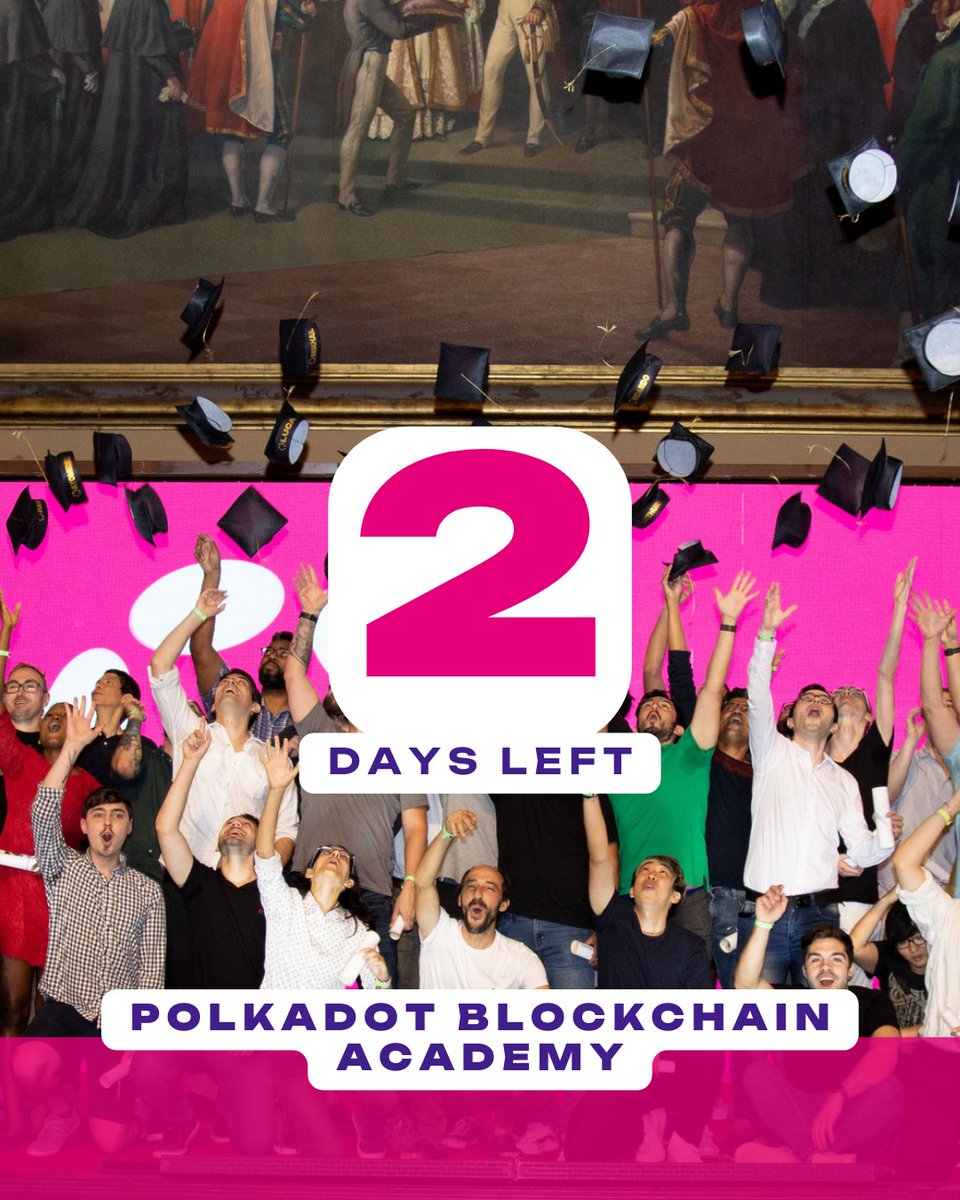
🎓 Only 10 days left before we welcome our students in Singapore🇸🇬

English