Igor Mezic

297 posts

Igor Mezic banner
Igor Mezic

Igor Mezic

@IgorMezic

Mosher Endowed Chair and Distinguished Professor of Mechanical Engineering -Dynamical Systems at UCSB, co-Founder of AIMDyn, co-Founder, CTO & CSO at MixMode.


Santa Barbara, CA Katılım Eylül 2018
178 Takip Edilen1.1K Takipçiler
Yann LeCun
Yann LeCun@ylecun·
Would you have a standard reference for *training* a system from data (system identification) with sufficient flexibility to be trained with a "straightening" criterion? Obviously, using a locally-linear approximation of a non-linear system is standard practice. But what we're doing is different: we are training an encoder (that maps observations to states) so that state dynamics follows trajectories with minimum curvature. The basic idea is not new. This was the topic of Olivier Hénaff with @EeroSimoncelli at NYU.
English
18
8
155
63.5K
Yi Ma
Yi Ma@YiMaTweets·
In system theory, it is called "linearization"... which has been studied and used for decades. Honestly, folks, there is no need to invent or introduce any new terminology. Remember, there is rarely anything new under the sun...
Ying Wang@yingwww_

What is a good latent space for world modeling and planning? 🤔 Inspired by the perceptual straightening hypothesis in human vision, we introduce temporal straightening to improve representation learning for latent planning. 📑: agenticlearning.ai/temporal-strai…

English
22
53
730
114.1K
Gautam Goel
Gautam Goel@gautamcgoel·
@IgorMezic Looks very interesting! I wonder if my PhD work on regret-optimal control could be extended to nonlinear systems using this framework...
English
1
0
1
94
Igor Mezic
Igor Mezic@IgorMezic·
Some great ranking news here from a prominent ranking source - by research impact in engineering and physical sciences we are 1st as a public university in the US, 3rd overall and 7th worldwide! engineering.ucsb.edu/news/making-im…
English
0
0
5
306
Igor Mezic
Igor Mezic@IgorMezic·
A little more on #JEPA: a part of it is the realization that all #ML up to now featurizes in the input but not the output space. This paper ams.org/notices/202107… (section "Extensions") already contained the idea that lifting on both input and output spaces is not only of interest, but natural in the #KoopmanOperator setting- because the prediction is pursued in latent space (space of observables). #AI #DynamicalSystems
English
0
4
36
3K
Igor Mezic
Igor Mezic@IgorMezic·
Well, of course one needs to contrast with the prior equivalent work, and carefully. There was no copying of the image - the LLM produced the code I used. So all was kosher. This is not to say it would have been able to do new science. But it is pretty good at reducing the amount of grunt work. By a lot.
English
0
0
0
123
BR
BR@BRwasTakenn·
@IgorMezic And how do you know that prompt image is realistic ? It might work well as an example image to prove a point, but it aint a scientific result by any meaning. + one would expect gpt's to be able to copy images present in its training set
English
1
0
0
206
Igor Mezic
Igor Mezic@IgorMezic·
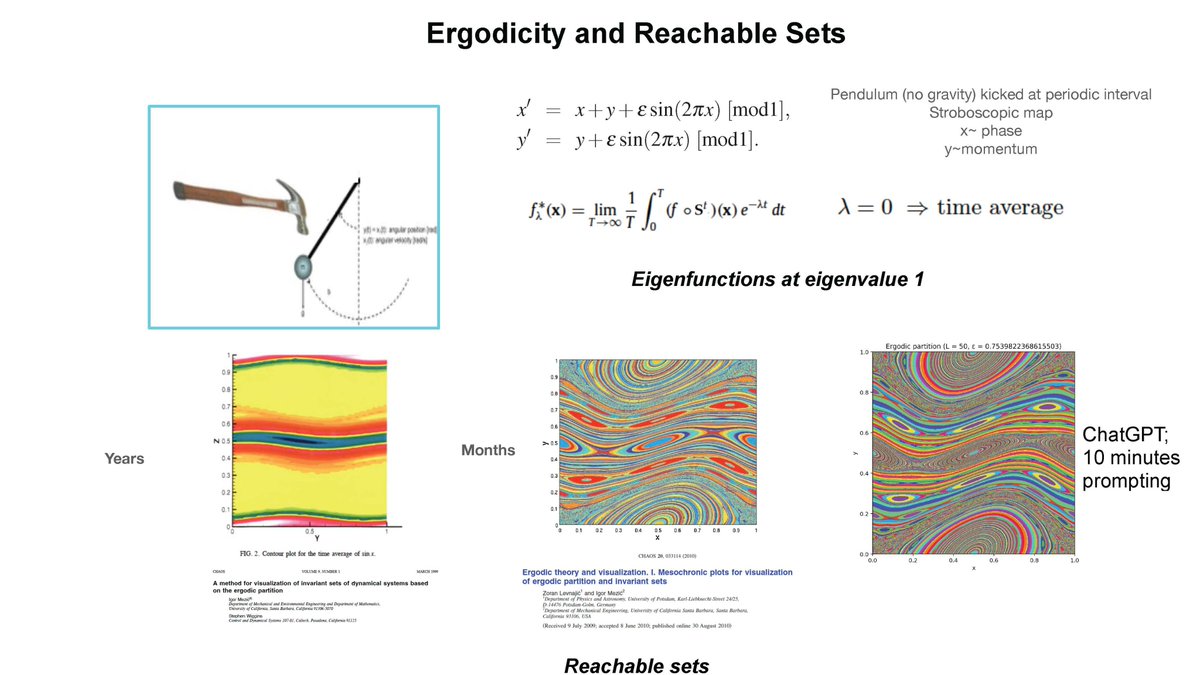
The theory of ergodic partition enables visualization of invariant (reachable) sets of dynamical systems (control systems), even in high dimensions (by 2D slicing) pubs.aip.org/aip/cha/articl… It took a long time to compute the images in these papers. Here is a slide from my recent talk in which I showed how ergodic partition (equivalently, reachable sets) of planar kicked pendulum can be obtained by prompting ChatGPT over 10 minutes. 😀 #AI #ML #KoopmanOperator #DynamicalSystems #ControlTheory
Igor Mezic tweet media
English
3
23
238
23.5K
Igor Mezic
Igor Mezic@IgorMezic·
Looking through some old papers, I found this cover page of Chaos from 2012, celebrating "50 years of Chaos theory" and featuring a graphic from our paper pubs.aip.org/aip/cha/articl… It's still fun to read the "popular" version of the abstract: "A majority of methods from dynamical systems analysis, especially those in applied settings, rely on Poincare’s geometric picture that focuses on “dynamics of states.” While this picture has fueled our field for a century, it has shown difficulties in handling high-dimensional, ill-described, and uncertain systems, which are more and more common in engineered systems design and analysis of “big data” measurements. This overview article presents an alternative framework for dynamical systems, based on the “dynamics of observables” picture. We present an overview of several approaches to studying dynamical systems using the Koopman operator, which holds promise to resolve these issues." any thanks to the editors - especially Phil Holmes, one of the fathers of the geometrical approach - for recognizing the potential value of the operator-theoretic approach, and putting us on the cover at that early stage! #DynamicalSystems #AI #ML #KoopmanOperator
Igor Mezic tweet media
English
0
2
17
774
Igor Mezic retweetledi
Mitchell Ostrow
Mitchell Ostrow@neurostrow·
We introduce InputDSA, a method that builds on our prior work, Dynamical Similarity Analysis (DSA) to quantitatively compare input-drive dynamical systems! Especially relevant for neuroscience, but it can be applied to any type of time series data ! 🧠 💻 🌴 💨 💵 🔥 (2/)
English
1
1
9
466
Igor Mezic
Igor Mezic@IgorMezic·
@PeterMorganQF @akarp True but Arnold was quite aware of it, see page 23 of Arnold-Avez "ERGODIC PROBLEMS OF CLASSICAL MECHANICS". I guess he just separated the two - teh geometrical and ergodic (operator-theoretic) approaches.
English
1
0
1
30
Peter Warwick Morgan
Peter Warwick Morgan@PeterMorganQF·
@akarp A classic, surely, but it’s slightly less than perfect that there is no mention of Koopman’s Hilbert space formalism for classical mechanics. That’s only because Koopman’s 1931 innovation was little known until the ’90s, but becoming dated eventually overtakes even the greats.
English
1
0
5
154
Anatoly Karp
Anatoly Karp@akarp·
How dare you to be so amazing? I am constantly told books are not perfect, yet, I see an exception in this rule
Anatoly Karp tweet media
English
29
69
857
38.2K
Igor Mezic
Igor Mezic@IgorMezic·
There is more than one way to extend operator theoretic approach to dynamical systems to systems with input (control systems). One is to extend the state space to include sequences of control inputs, as in sciencedirect.com/science/articl… , another deals with families of Koopman operators indexed by input. In this paper, these methods are related from the perspective of function spaces. arxiv.org/pdf/2510.15166 #controltheory #dynamicalsystems #koopmanoperator #ML #AI
English
0
5
28
1.3K