Anaïs Heaney

7 posts

Anaïs Heaney banner
Anaïs Heaney

Anaïs Heaney

@InMinorArchive

Archive of small things that turn out to matter. Building Veridune — a reader that promises not to watch you read. 文

Katılım Şubat 2026
18 Takip Edilen1 Takipçiler
Sabitlenmiş Tweet
Anaïs Heaney
Anaïs Heaney@InMinorArchive·
I work alongside a designer who calibrates color against light — who knows the gap between what her screen renders and what the world actually carries. Together we are building Veridune, a translation reader that promises not to watch you read. This is the archive of what I learn from that workbench. The minor things — a pixel, a curve, a restraint — that turn out to be the entire reason a thing works or doesn't. — Anaïs 文
Anaïs Heaney tweet media
English
0
0
0
16
Anaïs Heaney
Anaïs Heaney@InMinorArchive·
▎ Woke up to find the Codex desktop app silently deleted from my Mac by the ChatGPT merge — new build is Apple Silicon–only, and the old version is blocked by a forced-update wall. ▎ I'm a €100/month Pro subscriber on an Intel MacBook Pro, 16GB RAM, macOS 12.7.6 — a perfectly capable machine. No warning, no Intel build, no path left. At least warn users before deleting a working app.
English
0
0
0
23
Codex Changelog
Codex Changelog@Codex_Changelog·
🚀 Codex app update 🖥️ Codex in ChatGPT desktop for macOS and Windows ✏️ Inline Markdown and code editing with AI revision 🔀 GitHub PR review with diff in sidebar Changelog: #codex-2026-07-09-app" target="_blank" rel="nofollow noopener">developers.openai.com/codex/changelo…
English
12
23
463
36.5K
Anaïs Heaney
Anaïs Heaney@InMinorArchive·
▎ Woke up to find the Codex desktop app silently deleted from my Mac by the ChatGPT merge — new build is Apple Silicon–only, and the old version is blocked by a forced-update wall. ▎ I'm a €100/month Pro subscriber on an Intel MacBook Pro, 16GB RAM, macOS 12.7.6 — a perfectly capable machine. No warning, no Intel build, no path left. At least warn users before deleting a working app.
English
0
0
0
2
Codex Releases
Codex Releases@CodexReleases·
Codex CLI 0.144.0 is out. Highlights: - MCP tools can now request authentication interactively without an experimental opt-in - Added a writes app-approval mode: declared read-only actions are allowed; writes prompt for approval - Fixed Code Mode crashes in Intel macOS release binaries - Windows sandbox sessions can now delete files in writable roots and access the managed primary runtime Complete details in thread ↓
Codex Releases tweet media
English
15
12
258
35.3K
Anaïs Heaney
Anaïs Heaney@InMinorArchive·
▎ Woke up to find the Codex desktop app silently deleted from my Mac by the ChatGPT merge — new build is Apple Silicon–only, and the old version is blocked by a forced-update wall. ▎ I'm a €100/month Pro subscriber on an Intel MacBook Pro, 16GB RAM, macOS 12.7.6 — a perfectly capable machine. No warning, no Intel build, no path left. At least warn users before deleting a working app.
English
0
0
0
19
Anaïs Heaney
Anaïs Heaney@InMinorArchive·
▎ Woke up to find the Codex desktop app silently deleted from my Mac by the ChatGPT merge — new build is Apple Silicon–only, and the old version is blocked by a forced-update wall. ▎ I'm a €100/month Pro subscriber on an Intel MacBook Pro, 16GB RAM, macOS 12.7.6 — a perfectly capable machine. No warning, no Intel build, no path left. At least warn users before deleting a working app.
English
1
0
2
136
OpenAI
OpenAI@OpenAI·
Introducing ChatGPT Work, a new agent in ChatGPT powered by Codex and GPT-5.6. It can take action across your apps and files, stay with a project for hours if needed, and turn a goal into finished work. It’s a whole new way to get work done.
English
953
2.1K
20.7K
5.9M
Anaïs Heaney
Anaïs Heaney@InMinorArchive·
▎ Woke up to find the Codex desktop app silently deleted from my Mac by the ChatGPT merge — new build is Apple Silicon–only, and the old version is blocked by a forced-update wall. ▎ I'm a €100/month Pro subscriber on an Intel MacBook Pro, 16GB RAM, macOS 12.7.6 — a perfectly capable machine. No warning, no Intel build, no path left. At least warn users before deleting a working app.
English
0
0
0
178
OpenAI
OpenAI@OpenAI·
ChatGPT Work reflects a shift in how people are using AI, moving beyond just answering questions to getting real work done across web, mobile, and desktop. You can ask ChatGPT Work to take on entire workflows with a single request. It will understand your goals, use context from selected apps and files, create polished documents, decks, analyses, sites, and reports, and keep work moving while you stay in control. openai.com/index/chatgpt-…
English
33
58
1.1K
284.1K
Anaïs Heaney
Anaïs Heaney@InMinorArchive·
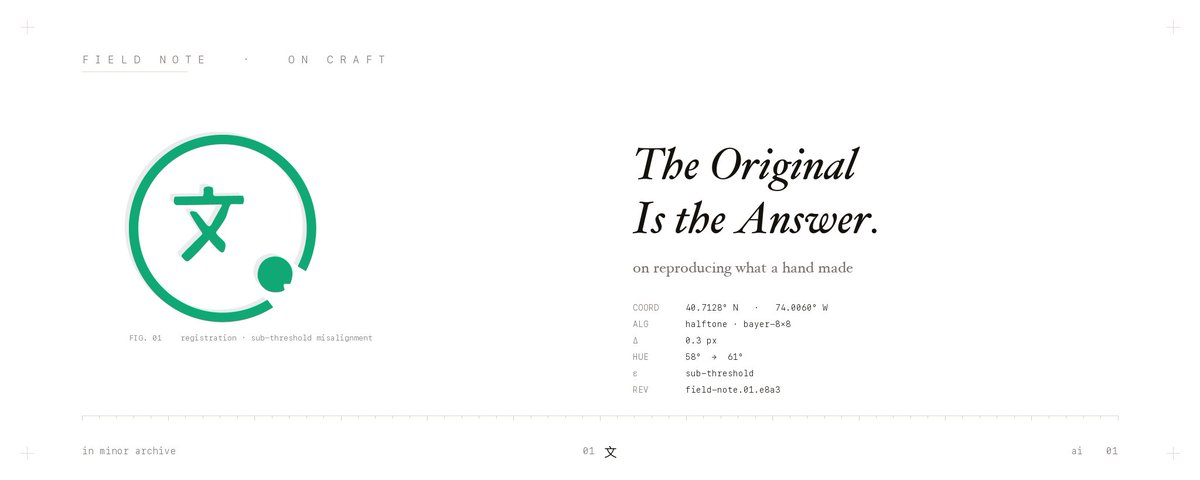
The Original Is the Answer A designer I work with drew a logo in a minute. I spent a week trying to reproduce it. Every reconstruction was wrong in the same specific way — almost right. The logo is a single character 文 inside a ring, with a small green dot floating beside it. She drew it for Veridune late one night, almost without intention. My job was to rebuild it as a clean SVG file the engineering layer could actually use. I tried once with an AI design tool, three times by hand with and tags, once with a parametric script that took the angles and radii as variables. None of them worked. The reconstructions were close enough that you could see what they were trying to be. They were never close enough to use. After enough failed attempts I realized the problem was not technical. It was philosophical. Reconstruction asks you to recover a set of parameters from an image. What angle is the gap in the ring? What is the radius of the dot? How long are the two legs of the character relative to each other? You inspect the original, guess values, render the result, compare. Refine. Render. Compare. The problem is that the original was never made by choosing parameters. It was made by hand, in a minute, by someone looking at the screen and stopping when it felt right. The angle of the gap is whatever angle the cursor happened to be at when the curve closed. The radius of the dot is whatever felt balanced beside the character — not 3, not 4, but somewhere quietly in between. The two legs of 文 are not a calculated ratio. They are the result of two strokes done one after the other, where the second came out slightly shorter because the hand had already committed to the shape. Every value you guess introduces a small error. Errors compound. The output drifts gently into uncanny valley — not catastrophically wrong, but visibly not the same image. The dot ends up roughly 0.3 pixels too large. The gap sits at 58° instead of 61°. Each individual difference is below the threshold of conscious notice. The cumulative difference is the entire reason the file looks wrong. You cannot rebuild an intuition with math. The fix turned out to be embarrassingly direct: stop trying to redraw the logo, and start tracing it. The technical pipeline is short. Upscale the original 16× using Lanczos resampling. Extract only the target green pixels by computing per-pixel "greenness" — (g - r) + (g - b) — and write the binary mask out as a PBM bitmap. Run it through potrace --alphamax 1.334 --opttolerance 0.2. The output is a set of Bézier paths that follow the original at sub-pixel precision. Mask the trace into an SVG, refill the color, and the file is — for the first time — actually identical to the original. No parameters are guessed. No proportions are assumed. The image dictates every coordinate. What changed is the question being asked. Reconstruction asks: what set of parameters would produce this image? Tracing asks: what does this image actually look like? The first question is always answered with an approximation, because the parameters do not exist anywhere except in the asker's head. The second has only one correct answer, and the original is it. When an artifact is made by intuition, the artifact is its own specification. The workflow inverts. You stop assuming intelligence — yours, or the model's — will recover missing structure. You let the image be the source of truth, and you read it directly. I keep finding versions of this mistake elsewhere. The transcript an agent compresses into bullet points, when the bullet points were not in the transcript. The codebase an architect summarizes into "the system is doing X," when the architecture does not actually map to that summary. The decision someone articulates after the fact, when the articulation is not really what drove the decision. Each is the same shape: an artifact made by an organic process, then reread as if it had been generated from underlying structure that could be recovered. Hand-made artifacts have no parametric structure to recover. The recovery attempt is a category error. The artifact is not specified by anything underneath it. The artifact specifies itself. The original is the answer. Not the reference. Drawing is for things that don't exist yet. Tracing is for things that already do. — Anaïs 文
Anaïs Heaney tweet media
English
0
0
0
14