IndeMed

62 posts

IndeMed banner
IndeMed

IndeMed

@IndeMedAction

IndeMed is a physician-led organization dedicated to protecting the integrity and fair implementation of the No Surprises Act.

Washington, DC Katılım Kasım 2025
143 Takip Edilen226 Takipçiler
IndeMed retweetledi
Adam Bruggeman, MD
Adam Bruggeman, MD@DrBruggeman·
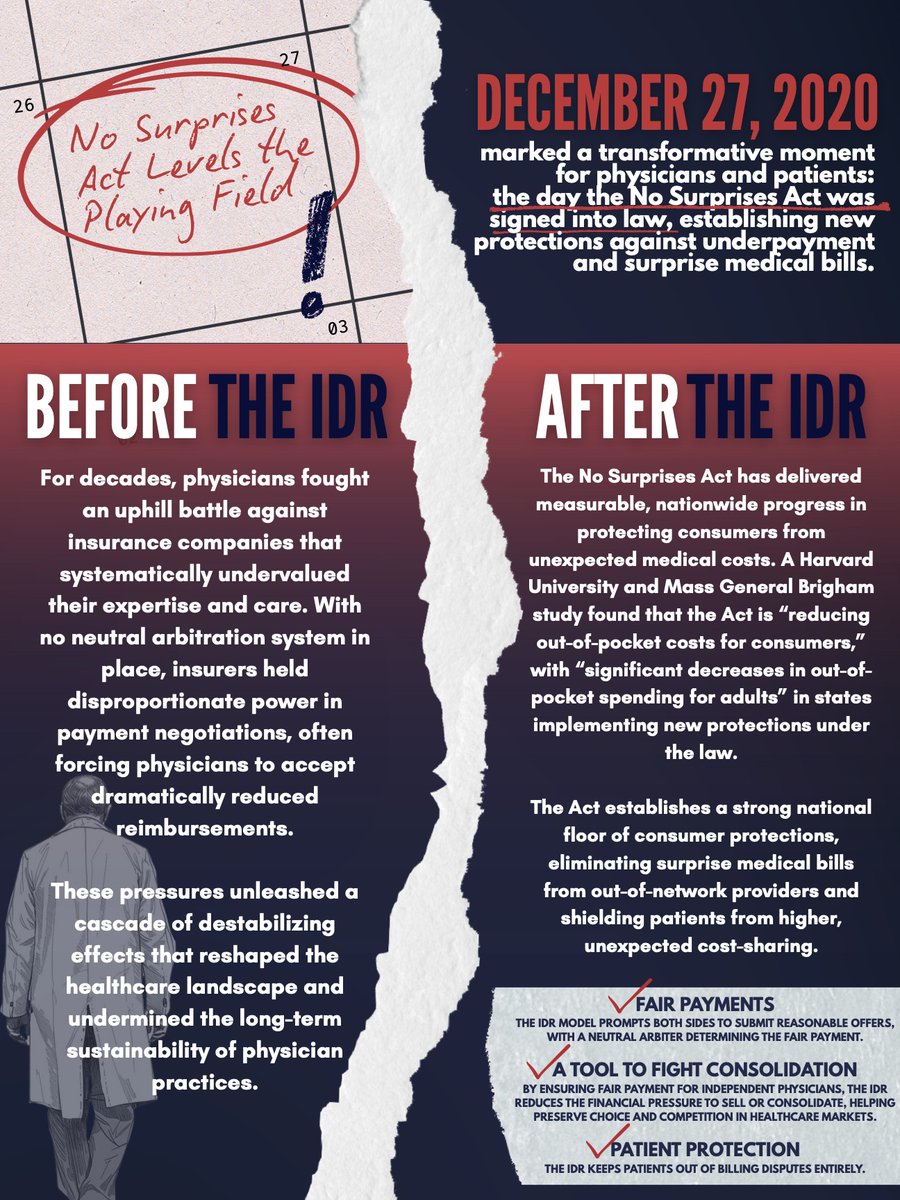
The No Surprises Act works as the @WaysandMeansGOP, @WaysMeansCmte, and @WhiteHouse intended. This bipartisan bill is protecting patients, putting $567 annually back into their pockets, and preventing 10M+ surprise bills. Next step: Enforcing payments when physicians win
IndeMed@IndeMedAction

Two Major Studies. One Clear Conclusion: The NSA Works. Insurers agreed to the bipartisan No Surprises Act when it passed with overwhelming bipartisan support in 2020. Now those same insurers are lobbying to gut the law’s Independent Dispute Resolution process – the heart of the law that provides an independent body to determine fair payments. Two independent studies — one from Harvard-affiliated researchers published in The BMJ and one from the U.S. Government Accountability Office — arrive at the same conclusion, the NSA is working. ✅Patients in states newly protected by the NSA are saving an average of $567 per year in out-of-pocket costs, with no corresponding increase in premiums. ✅More than 10 million surprise bills were prevented in the first nine months of 2023 alone, and three of the four specialties most associated with surprise billing saw increased in-network participation after the law took effect. The insurers’ supposed cost-shifting never materialized. The market responded exactly as Congress intended – with more contracting, not less. The evidence is clear, and it's time to stop second-guessing whether this law works and start protecting it. 🔎 View the studies: indemed.org/wp-content/upl…

English
0
2
8
1.1K
IndeMed
IndeMed@IndeMedAction·
Two Major Studies. One Clear Conclusion: The NSA Works. Insurers agreed to the bipartisan No Surprises Act when it passed with overwhelming bipartisan support in 2020. Now those same insurers are lobbying to gut the law’s Independent Dispute Resolution process – the heart of the law that provides an independent body to determine fair payments. Two independent studies — one from Harvard-affiliated researchers published in The BMJ and one from the U.S. Government Accountability Office — arrive at the same conclusion, the NSA is working. ✅Patients in states newly protected by the NSA are saving an average of $567 per year in out-of-pocket costs, with no corresponding increase in premiums. ✅More than 10 million surprise bills were prevented in the first nine months of 2023 alone, and three of the four specialties most associated with surprise billing saw increased in-network participation after the law took effect. The insurers’ supposed cost-shifting never materialized. The market responded exactly as Congress intended – with more contracting, not less. The evidence is clear, and it's time to stop second-guessing whether this law works and start protecting it. 🔎 View the studies: indemed.org/wp-content/upl…
IndeMed tweet mediaIndeMed tweet mediaIndeMed tweet media
English
0
3
3
1.5K
IndeMed
IndeMed@IndeMedAction·
"What Congress designed as a neutral arbitration system is now being challenged by Big Insurance through coordinated litigation designed to narrow, intimidate, and ultimately reshape the law." - @wendellpotter
English
0
0
2
37
IndeMed retweetledi
Adam Bruggeman, MD
Adam Bruggeman, MD@DrBruggeman·
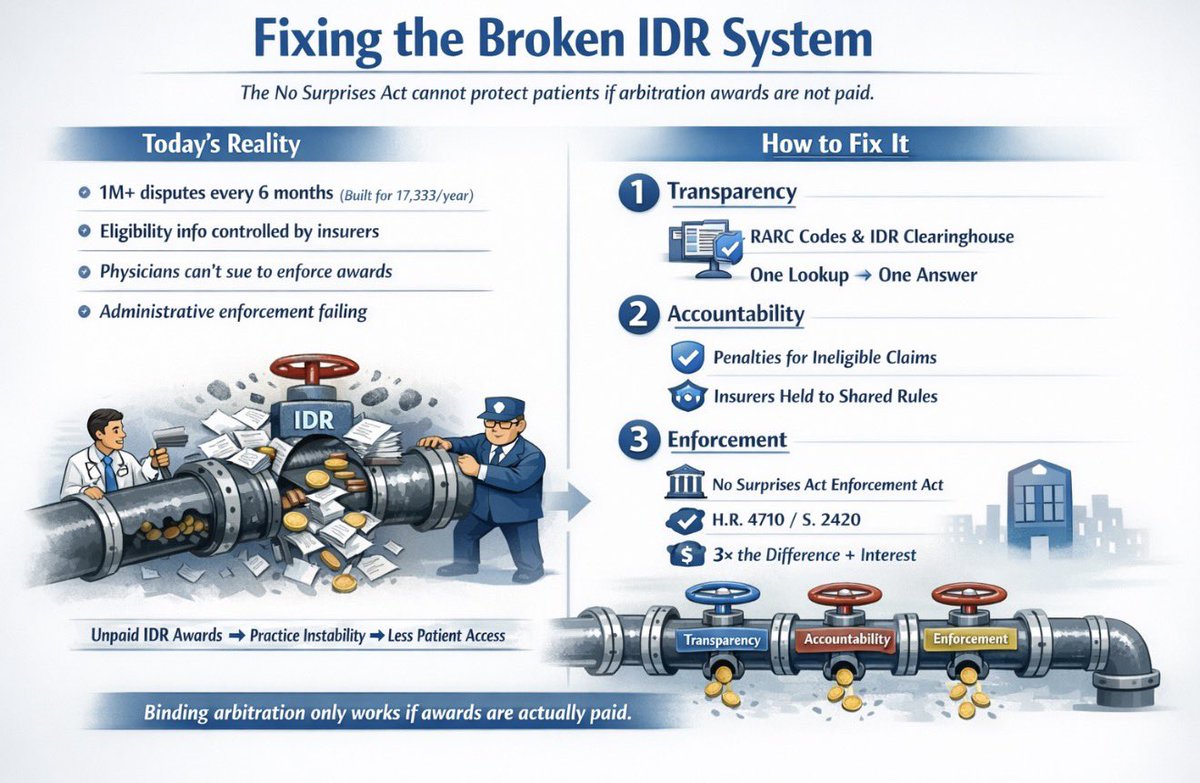
I’ve spent this week laying out the facts. The IDR system was built for 17,333 disputes a year and is processing over a million every six months. Physicians are filing ineligible claims not out of bad intent but because insurers control the eligibility information and aren’t sharing it. Courts have stripped providers of the right to sue for payment on awards they’ve already won. And the administrative enforcement mechanism left standing has been called inadequate by the very judges who sent providers there. I want to close this week not as a policy advocate but as a physician. I have patients who need care. I have a practice that depends on staff, equipment, and operational continuity. And I participate in a system that asks me to accept whatever an insurer decides to pay, file a complex dispute if I disagree, wait months for a determination, win that determination, and then hope the insurer feels like paying. That is not a system. That is a test of endurance designed to see who gives up first. Patients feel this too, even if they don’t see it directly. When independent practices can’t sustain the cash flow gap created by unpaid IDR awards, they consolidate, close, or stop taking certain plans. Access narrows. Costs rise. The No Surprises Act was signed into law to protect patients from unexpected bills. It cannot do that if the physicians treating those patients are operating in a payment environment with no reliable rules and no real enforcement. So here is what fixing it actually requires, in sequence. First, close the information gap. Finalize the mandatory RARC code requirement that has sat in proposed form since November 2023. Build a centralized eligibility clearinghouse so that any physician or billing team can look up a plan number before filing and receive a definitive, logged answer: federal IDR, state process, or neither. One lookup. One answer. Timestamped and attached to the claim. @IndeMedAction has a solution ready to go. We need all the stakeholders to get behind it. Second, once that infrastructure exists, apply accountability on both sides. A physician who files an ineligible dispute after a clearinghouse has confirmed ineligibility should face penalties. The information was available. That is a fair standard because the playing field is finally level. Third, pass the No Surprises Act Enforcement Act, H.R. 4710 and S. 2420, introduced by Rep. Greg Murphy, MD and Sen. Roger Marshall, MD with broad bipartisan support from physician legislators in both chambers and both parties. The bill is direct: any insurer that fails to pay an IDR award within the required 30 business days owes the provider three times the difference between the initial payment and the arbitration award, plus interest. Not a suggestion. Not a complaint form. A financial consequence that makes noncompliance more expensive than compliance. The American College of Radiology, the American College of Emergency Physicians, and the American Society of Anesthesiologists have all endorsed this bill. The Department of Justice has stated that without judicial enforcement, one of the NSA’s core features would be frustrated. A federal judge has said that administrative enforcement alone cannot police compliance at scale. Congress wrote a law that said IDR awards shall be binding. The word “shall” was supposed to mean something. The No Surprises Act was signed during President Trump’s first term with genuine bipartisan intent to protect patients. That intent deserves to be honored with a system that actually functions: clear eligibility rules, shared information, and real consequences for everyone who doesn’t follow them. Physicians are ready to be held accountable. We just need the same standard applied to the other side of the table.
Adam Bruggeman, MD tweet media
English
3
9
28
1.2K
IndeMed retweetledi
Adam Bruggeman, MD
Adam Bruggeman, MD@DrBruggeman·
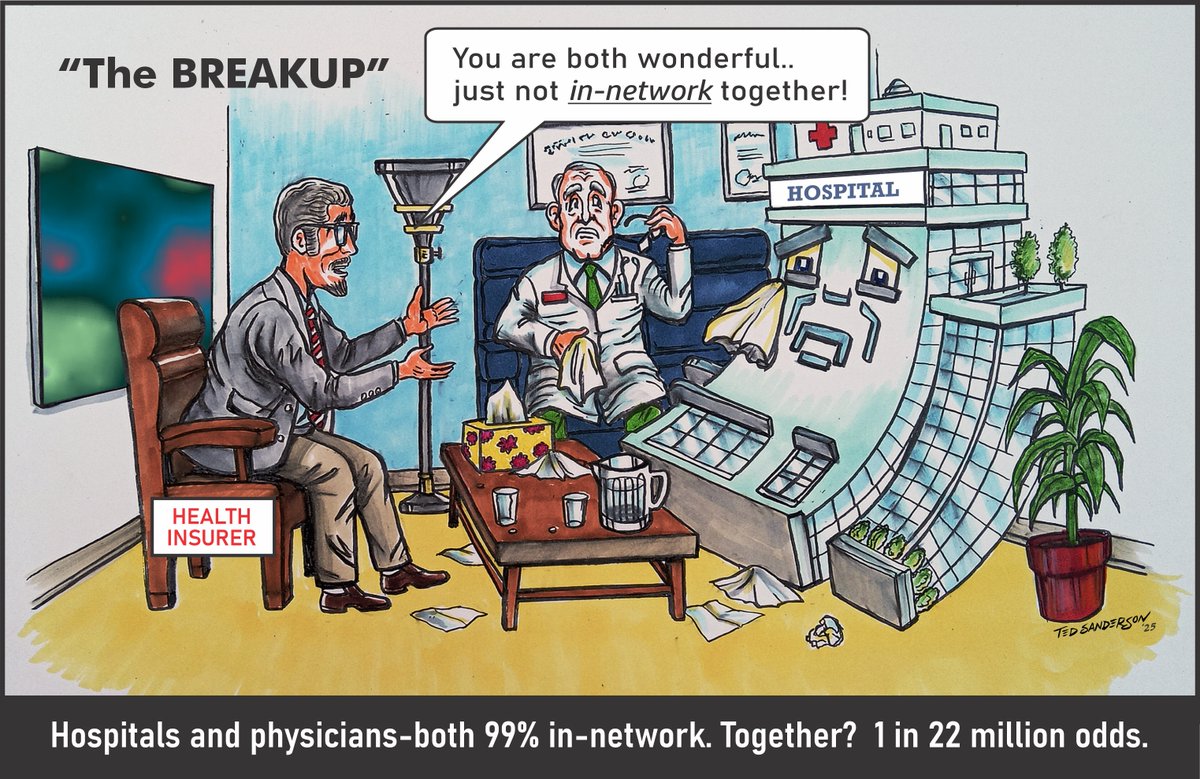
That’s Anthem breaking up a doctor and hospital. They are both in-network with 99% of plans in their market, but they can’t work together because they don’t share every single contract together. A group I recently spoke with billed 1700 unique plans last year. Despite being contracted with 99% of their plans, the odds they will be in-network with every single contract that the hospital is in? 1 in 22 Million. You’re more likely to be struck by lightning twice than be simultaneously in network with your hospital system. Anthem’s new policy penalizes hospitals or surgery centers 10% on their facility claim every time a treating physician isn’t also in Anthem’s network. Don’t fix it? Anthem threatens to terminate the hospital or surgery center contract. I’ve said this before: physicians go out of network because of decades of rate cuts, not greed. This policy doesn’t fix that. It just gives Anthem a new lever to force independent physicians into unworkable contracts, lose hospital privileges entirely, or take employment with the hospital. Privileging decisions exist to protect patients. They’re based on credentials and competence. Not insurance contracts. Legal experts have flagged antitrust, RICO, and unfair trade practice concerns. 80+ medical societies and the AHA all oppose this. The NSA already handles out-of-network billing without touching patients. Physicians are winning 85% of IDR disputes because Anthem’s QPAs are artificially low. That’s the real problem they’re trying to solve. Just not for patients.
IndeMed@IndeMedAction

The states are leading. State legislatures are the laboratories of democracy, and Indiana is showing the rest of the country what's possible when lawmakers put patients first. ✅Indiana just became the first state in the nation to pass bipartisan legislation protecting patients from insurer penalties when their care involves an out-of-network provider. Senate Enrolled Act 189, authored by @ScottABaldwin, prohibits insurance companies from financially penalizing hospitals and facilities in these situations - keeping the focus where it belongs: on timely, medically necessary care. ⁉️Who's next? Indiana just handed every other state legislature a blueprint. 🔎 Read more: wimsradio.com/2026/03/03/ind…

English
2
11
39
4.9K
IndeMed
IndeMed@IndeMedAction·
The states are leading. State legislatures are the laboratories of democracy, and Indiana is showing the rest of the country what's possible when lawmakers put patients first. ✅Indiana just became the first state in the nation to pass bipartisan legislation protecting patients from insurer penalties when their care involves an out-of-network provider. Senate Enrolled Act 189, authored by @ScottABaldwin, prohibits insurance companies from financially penalizing hospitals and facilities in these situations - keeping the focus where it belongs: on timely, medically necessary care. ⁉️Who's next? Indiana just handed every other state legislature a blueprint. 🔎 Read more: wimsradio.com/2026/03/03/ind…
IndeMed tweet media
English
1
28
75
60K
IndeMed retweetledi
Adam Bruggeman, MD
Adam Bruggeman, MD@DrBruggeman·
When a physician wins an IDR determination, the law is unambiguous. The decision is final and binding. The insurer has 30 business days to pay. That is not guidance. That is statute. So what happens when they don’t pay? The obvious solution: go to court. That option is now in serious jeopardy and the legal landscape around IDR enforcement has become one of the most consequential and underreported stories in health policy. In June 2025, the U.S. Court of Appeals for the Fifth Circuit ruled in Guardian Flight v. Health Care Service Corporation that the No Surprises Act provides no private right of action to enforce IDR awards. Providers cannot sue insurers in federal court to compel payment. The Fifth Circuit held that enforcement runs exclusively through HHS’s administrative complaint process. En banc review was denied in July 2025. That ruling is now binding precedent in the Fifth Circuit. Other courts followed. In September 2025, the Southern District of New York dismissed a provider suit against Cigna on the same grounds, holding that Congress deliberately withheld judicial confirmation authority. That same month, the Middle District of Florida dismissed a case involving over $1.1 million in unpaid IDR awards, explicitly adopting the Fifth Circuit’s reasoning even though it was not bound to do so. One court went the other way. In May 2025, the District of Connecticut ruled in a separate Guardian Flight case, involving $20 million in alleged nonpayment by Aetna and Cigna, that the NSA does provide an implied private right of action, citing the statute’s direct language requiring payment within 30 days and its declaration that awards are binding on the parties. That is a direct circuit split. Providers in different jurisdictions now operate under fundamentally different legal frameworks when trying to collect awards they have already won. Providers petitioned the Supreme Court to resolve it. In January 2026, the Court declined. The split stands. The Department of Justice, in amicus filings, warned that if providers cannot obtain court relief for nonpayment, “one of the NSA’s core features would be frustrated, upending Congress’s scheme.” The Connecticut court was equally direct, noting that “it is unlikely that any such administrative enforcement scheme could police insurers’ and health plans’ compliance with each IDR determination.” In other words, the only enforcement mechanism the Fifth Circuit left intact has already been assessed by a federal judge to be inadequate to do the job. Now layer in Loper Bright v. Raimondo, the Supreme Court’s June 2024 decision that overturned four decades of Chevron deference. Courts no longer automatically defer to HHS’s interpretation of its own enforcement authority. Any administrative mechanism HHS deploys under the NSA that relies on statutory ambiguity is now subject to independent judicial scrutiny and can be challenged and overturned. The Fifth Circuit said enforcement belongs with HHS. Loper Bright ensures that HHS’s ability to exercise that authority is itself contestable. The backstop has a backstop problem. And the compliance data predates all of this. A 2024 survey found that 1 in 4 IDR awards were already being paid late or not at all. This was before the primary judicial deterrent was removed and before agency enforcement authority became newly vulnerable to legal challenge. A system where a provider can win a binding arbitration award and have no clear mechanism to collect it is not a dispute resolution system. It is a suggestion box. Congress has the ability to fix this and a bill already on the table does exactly that. More on Friday. Interested in getting involved? Join @IndeMedAction
Adam Bruggeman, MD tweet media
English
3
9
21
1.1K
IndeMed retweetledi
Adam Bruggeman, MD
Adam Bruggeman, MD@DrBruggeman·
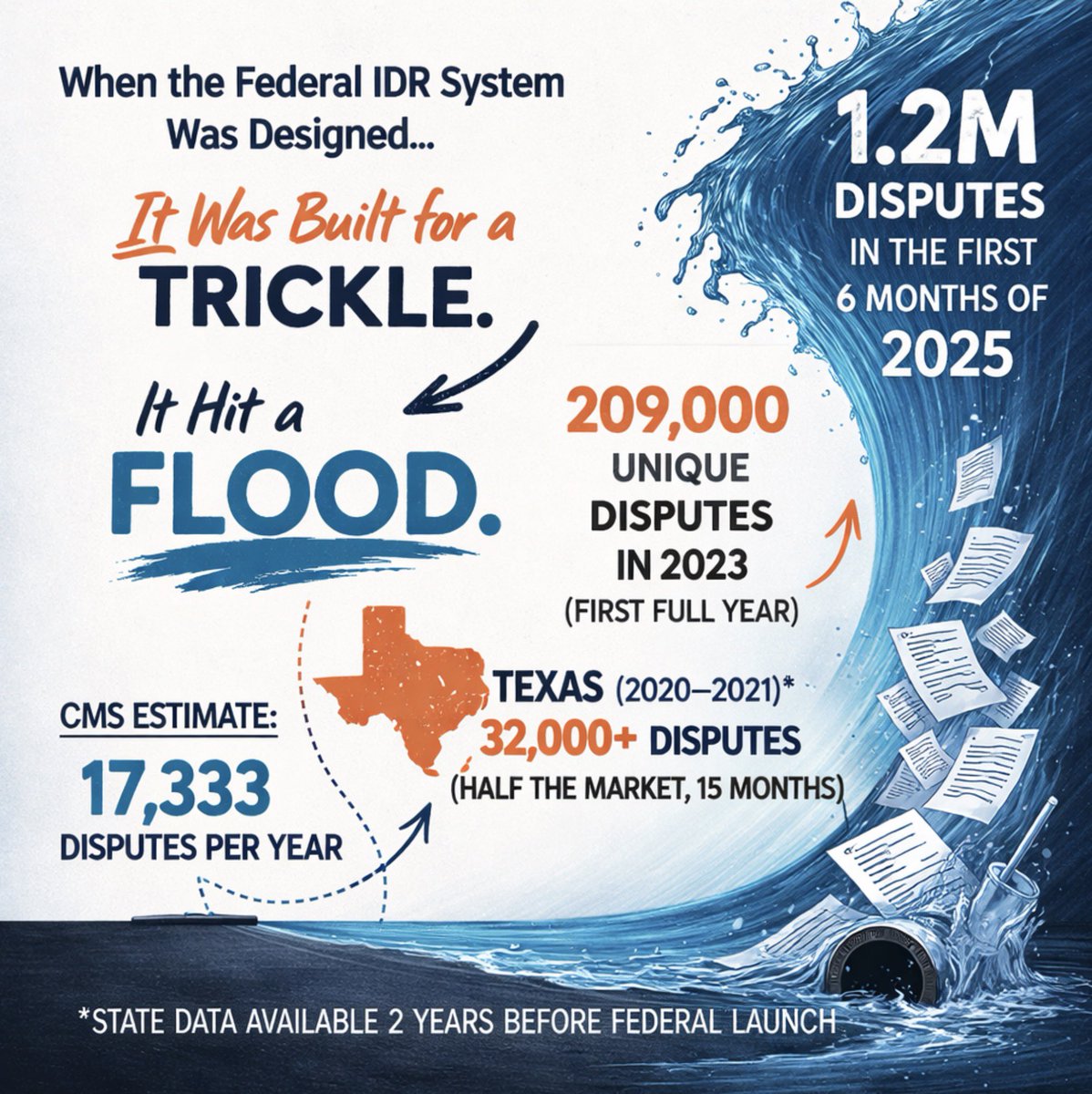
Let’s start with credit where it’s due. CMS has worked hard to clear the IDR backlog. By late 2025, closure rates were finally outpacing new initiations, and that is a genuine operational achievement worth acknowledging. But progress on processing volume doesn’t resolve the deeper structural problems and understanding those problems requires going back to the beginning. When the federal IDR system was designed, regulators projected it would handle 17,333 disputes per year. That assumption reflected a belief that the mandatory open negotiation period would resolve most disputes before arbitration was ever needed. By 2023 (just the first full year) over 209,000 unique disputes had been filed. By the first half of 2025, nearly 1.2 million cases were submitted in six months alone. This wasn’t unpredictable. Texas implemented its own IDR system in 2020, a full two years before the federal law took effect. A study published in JAMA examined state IDR cases from January 2020 through March 2021, covering insurers representing only about half of Texas’s fully insured population. That partial sample yielded over 32,000 IDR cases. That’s one state, half the market, fifteen months. And federal cases outnumber state cases in Texas by roughly 3:1. The math was available. The projection ignored it. So the system was built for a trickle and hit a flood and the consequences cascaded from there. Part of the “ineligible dispute” problem the backlog exposed isn’t bad actors. It’s information failure. RARC codes, the standardized remittance codes that should signal whether a claim is subject to the NSA, are frequently missing from insurer remittance advice. And there is no centralized clearinghouse that tells a physician, before filing, whether a claim belongs in federal IDR, a state process, or neither. That information lives with the insurer. Physicians facing timely filing deadlines don’t have the luxury of waiting for clarity that was never provided. They file — sometimes in both systems simultaneously, sometimes in the wrong one entirely — not out of deception, but because the system gave them no better option. The cooling-off period compounds this. The rules for calculating it are genuinely confusing. Getting the start date wrong by even a single day means losing the right to arbitrate an otherwise valid claim entirely. Many disputes dismissed as “ineligible” are eligible claims caught on this technicality, and given that the vast majority of disputes are not resolving through open negotiation anyway, the cooling-off period isn’t creating settlements. It’s creating traps. And throughout all of it — the backlog, the processing delays, the eligibility confusion — insurers have continued to sit on awards they’ve already lost. A 2024 survey found that roughly 1 in 4 IDR awards were unpaid or paid incorrectly within the 30 business days the law requires. The backlog that made headlines was disputes waiting for arbitration. The government is well on its way to fixing that. The backlog that hasn’t been fixed yet is valid, final, legally binding determinations that still haven’t been paid. That’s what we need to fix next and we will discuss what the infrastructure to fix it actually looks later this week.
Adam Bruggeman, MD tweet media
English
2
4
11
531
IndeMed retweetledi
Adam Bruggeman, MD
Adam Bruggeman, MD@DrBruggeman·
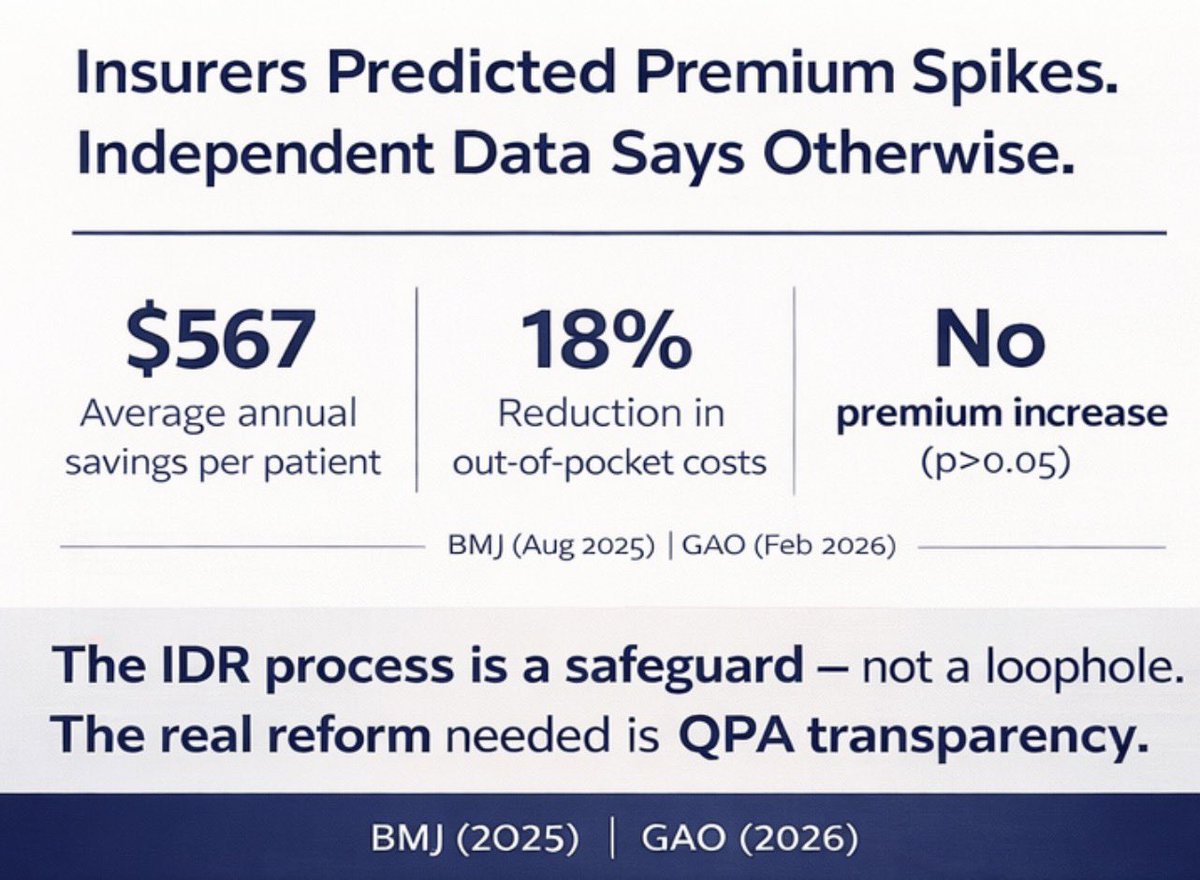
Insurers predicted premium spikes from the No Surprises Act. Independent data says otherwise. ✅ $567/yr saved per patient ✅ 18% reduction in out-of-pocket costs ✅ No premium increase Today @IndeMedAction called on federal regulators to protect the IDR process and demand QPA transparency. The IDR is a safeguard. Not a loophole. See our letter to the Tri-Departments in the post below
Adam Bruggeman, MD tweet media
IndeMed@IndeMedAction

The No Surprises Act is working: ✅Patients saving $567/year ✅In-network participation is UP ✅10M+ surprise bills prevented So why are insurers pushing to gut the IDR process that keeps it fair? They recently sent a letter to the federal government urging restrictions on the very system a bipartisan Congress created. We sent a letter to HHS, Treasury & Labor to protect the NSA and the independent physicians who rely on a balanced system. 🔎Read more: indemed.org/press-release/…

English
2
3
11
1.1K
IndeMed
IndeMed@IndeMedAction·
The No Surprises Act is working: ✅Patients saving $567/year ✅In-network participation is UP ✅10M+ surprise bills prevented So why are insurers pushing to gut the IDR process that keeps it fair? They recently sent a letter to the federal government urging restrictions on the very system a bipartisan Congress created. We sent a letter to HHS, Treasury & Labor to protect the NSA and the independent physicians who rely on a balanced system. 🔎Read more: indemed.org/press-release/…
IndeMed tweet media
English
0
2
0
1.2K
IndeMed retweetledi
Adam Bruggeman, MD
Adam Bruggeman, MD@DrBruggeman·
Update on Arizona HB 2211 from @JulieHoffAZ: the bill has been held and will return next session. Thank you to every physician, patient advocate, and coalition partner who engaged. Special thanks to @ArizonaMedicine for their grassroots call to action. Your voices made a difference. This is exactly how the process is supposed to work. Make no mistake, this fight is not over. The legislation will be back, and so will we. Whether it’s Tucson, Washington, D.C., or anywhere in between, we will be there. Independent medicine matters now more than ever. The No Surprises Act was designed to protect patients from unexpected bills, not to hand insurance companies a new tool to silence physicians who bill appropriately and advocate for fair reimbursement. When outside interests can report physicians to regulators simply for charging what their care is worth, the independence of medicine itself is at stake. IndeMed exists because someone has to stand between corporate influence and the doctor-patient relationship. When physicians are free to practice independently — free from intimidation and free from retaliatory reporting mechanisms — patients get better care. We'll be ready when this bill returns. Stay engaged. Stay informed. Join the fight if you haven’t already! Learn more at: indemed.org
Julie Hoffman@JulieHoffAZ

@DrBruggeman Bill was "discussed" in committee then held. Plan is to bring back next year, after stakeholder meetings

English
2
4
16
734
IndeMed retweetledi
Tom Oliverson, M.D.
Tom Oliverson, M.D.@TomOliverson·
This is really bad policy. Here’s why. The NSA uses baseball arbitration rules. Meaning that the two parties present an offer and the neutral arbitrator picks the one they believe is closest to the fair market value of the service in dispute. So to win arbitration, you must present the most reasonable offer. And conversely, if your offer is too low or too high, you lose. So….if >3X QPM is too high, then it will not win arbitration. Which means that, if it wins it is only because the counteroffer is so low and unreasonable >3x QPM is the more reasonable choice. Any attempt to artificially limit the ability of either party to make an offer will by default prejudice the results in favor of the other side. If BCBS wants to win more arbitrations they should be more reasonable in what they offer, rather than trying to cheat the system and stack the deck in their favor.
Adam Bruggeman, MD@DrBruggeman

BCBS Arizona is sneaking in a new Arizona bill (H.B. 2211) after losing a significant number of federal IDR arbitrations under the No Surprises Act. The bill would make it “unprofessional conduct” (and subject to licensing board discipline) for a physician to offer more than 3X the Qualifying Payment Amount (QPA) or 3X Medicare in federal arbitration. Think about that for a minute… Congress deliberately rejected fixed payment caps when drafting the bipartisan No Surprises Act. Instead, lawmakers created independent arbitration so neutral decision-makers could weigh all relevant factors and determine fair payment case by case. H.B. 2211 attempts to override that framework at the state level by capping arbitration offers and threatening physicians’ licenses for fully participating in a federally established process. The QPA itself has repeatedly been shown to understate true median in-network rates. Capping offers at 3X a benchmark that may already be significantly depressed effectively allows insurers to dictate rates while penalizing physicians who challenge them. Tomorrow, @IndeMedAction will submit formal opposition ahead of the House Appropriations hearing. As of tonight’s registration, there are 2 in favor — both BCBS representatives — and 137 opposed — including frontline physicians, nurses, CRNAs, and major Arizona physician organizations This doesn’t fix a broken system. It undermines one that is working for patients. Stay tuned for our full statement tomorrow.

English
0
6
12
1.3K
IndeMed retweetledi
IndeMed
IndeMed@IndeMedAction·
🚨Arizona H.B. 2211 would gut the No Surprises Act's protections by imposing arbitrary caps on physician arbitration offers — and penalize physicians who exercise their federally authorized rights. The NSA is working: $567/yr in patient savings, 10M+ surprise bills prevented, and growing provider networks. ‼️Don't let insurers rewrite a bipartisan law. 🔎See IndeMed's statement from @DrBruggeman on H.B. 2211: indemed.org/press-release/…
IndeMed tweet media
English
0
4
10
1.7K
IndeMed retweetledi
Adam Bruggeman, MD
Adam Bruggeman, MD@DrBruggeman·
BCBS Arizona is sneaking in a new Arizona bill (H.B. 2211) after losing a significant number of federal IDR arbitrations under the No Surprises Act. The bill would make it “unprofessional conduct” (and subject to licensing board discipline) for a physician to offer more than 3X the Qualifying Payment Amount (QPA) or 3X Medicare in federal arbitration. Think about that for a minute… Congress deliberately rejected fixed payment caps when drafting the bipartisan No Surprises Act. Instead, lawmakers created independent arbitration so neutral decision-makers could weigh all relevant factors and determine fair payment case by case. H.B. 2211 attempts to override that framework at the state level by capping arbitration offers and threatening physicians’ licenses for fully participating in a federally established process. The QPA itself has repeatedly been shown to understate true median in-network rates. Capping offers at 3X a benchmark that may already be significantly depressed effectively allows insurers to dictate rates while penalizing physicians who challenge them. Tomorrow, @IndeMedAction will submit formal opposition ahead of the House Appropriations hearing. As of tonight’s registration, there are 2 in favor — both BCBS representatives — and 137 opposed — including frontline physicians, nurses, CRNAs, and major Arizona physician organizations This doesn’t fix a broken system. It undermines one that is working for patients. Stay tuned for our full statement tomorrow.
Adam Bruggeman, MD tweet media
English
12
26
80
8.6K
IndeMed retweetledi
Alex Shteynshlyuger MD
Alex Shteynshlyuger MD@DrAlexUrology·
Thank you for @IndeMedAction for its work to advocate for common sense on behalf of physicians.
Adam Bruggeman, MD@DrBruggeman

BCBS Arizona is sneaking in a new Arizona bill (H.B. 2211) after losing a significant number of federal IDR arbitrations under the No Surprises Act. The bill would make it “unprofessional conduct” (and subject to licensing board discipline) for a physician to offer more than 3X the Qualifying Payment Amount (QPA) or 3X Medicare in federal arbitration. Think about that for a minute… Congress deliberately rejected fixed payment caps when drafting the bipartisan No Surprises Act. Instead, lawmakers created independent arbitration so neutral decision-makers could weigh all relevant factors and determine fair payment case by case. H.B. 2211 attempts to override that framework at the state level by capping arbitration offers and threatening physicians’ licenses for fully participating in a federally established process. The QPA itself has repeatedly been shown to understate true median in-network rates. Capping offers at 3X a benchmark that may already be significantly depressed effectively allows insurers to dictate rates while penalizing physicians who challenge them. Tomorrow, @IndeMedAction will submit formal opposition ahead of the House Appropriations hearing. As of tonight’s registration, there are 2 in favor — both BCBS representatives — and 137 opposed — including frontline physicians, nurses, CRNAs, and major Arizona physician organizations This doesn’t fix a broken system. It undermines one that is working for patients. Stay tuned for our full statement tomorrow.

English
0
1
2
412
IndeMed retweetledi
Adam Bruggeman, MD
Adam Bruggeman, MD@DrBruggeman·
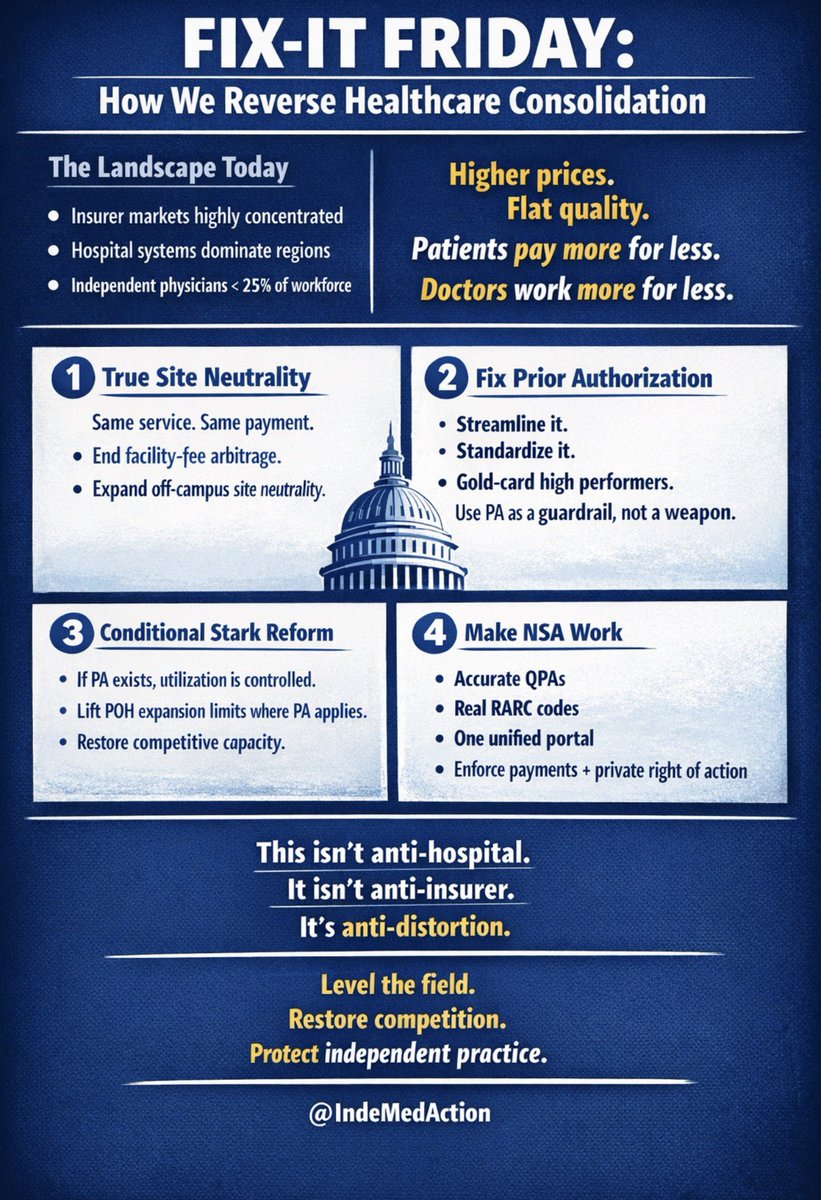
Fix-It Friday: How We Actually Reverse Consolidation All week we walked through the numbers. Insurer markets are highly concentrated in most metros. Hospital systems dominate regional care and are equally concentrated in response. The result is that independent physicians are now under 25% of the workforce With consolidation, prices went up but quality didn’t and patients now pay more to get less while doctors now get paid less to do more. This didn’t happen by accident. The system now rewards scale over value and quantity over quality so let’s fix the incentives. Here are four targeted, pro-competition reforms that don’t require new spending. 1. True Site Neutrality Payment shouldn’t change because of who manages the license. Hospitals can still bill dramatically more for identical outpatient services simply because they own the building. That differential fuels practice acquisition and inhibits cases from moving to less expensive ASCs or private offices. CMS took a small step on drug administration in 2026 to address the issue. Expand site-neutral payment to all off-campus services and phase it in more broadly. End the facility-fee arbitrage. Acquisition of physician practices will become less attractive overnight and doctors will push cases to the appropriate setting while increasing referrals to other independent doctors. 2. Fix Prior Authorization the Right Way Physicians are spending hours a day on PAs. There is no doubt that the burden is real. Streamline it, standardize it, and gold-card high performers. PA should be a guardrail, not a weapon. 3. Conditional Stark Reform + Physician-Owned Hospitals If prior authorization is required for a service or payer, the utilization safeguard already exists. In those lanes, relax Stark self-referral restrictions. Lift the ACA-era freeze on new or expanded physician-owned hospitals where PA applies.Allow existing POHs to expand beds, ORs, and procedure rooms so we can have real competition with the largely consolidated hospital markets. If PA is the control mechanism Congress and insurers trust, let it work while restoring competition. 4. Make the No Surprises Act Work for Independent Physicians A functional out-of-network process is one of the few levers independent doctors have against dominant insurers. Finish the job: - Enforce accurate, CPI-adjusted QPA calculations Require meaningful RARC codes on every ERA Replace email chaos with one real, unified portal Enforce payments and give physicians a private right of action When the IDR process is predictable and transparent, physicians can negotiate on even footing with the large insurers instead of retreating to hospital employment. None of this is anti-hospital or anti-insurer. It’s anti-distortion. Consolidation became a survival strategy because policy tilted the field. Let’s level it again an take the thumb off the scale. Independent practice, lower costs, and real patient choice are still possible if we stop subsidizing monopoly behavior. @IndeMedAction
Adam Bruggeman, MD tweet media
English
1
8
22
871