
Intrusion
1.1K posts

Intrusion
@IntrusionShield
Intrusion secures your digital world with comprehensive threat protection. Because in cybersecurity, just like life, reputation is everything.
Plano, TX Katılım Ağustos 2020
240 Takip Edilen16.9K Takipçiler
Intrusion retweetledi

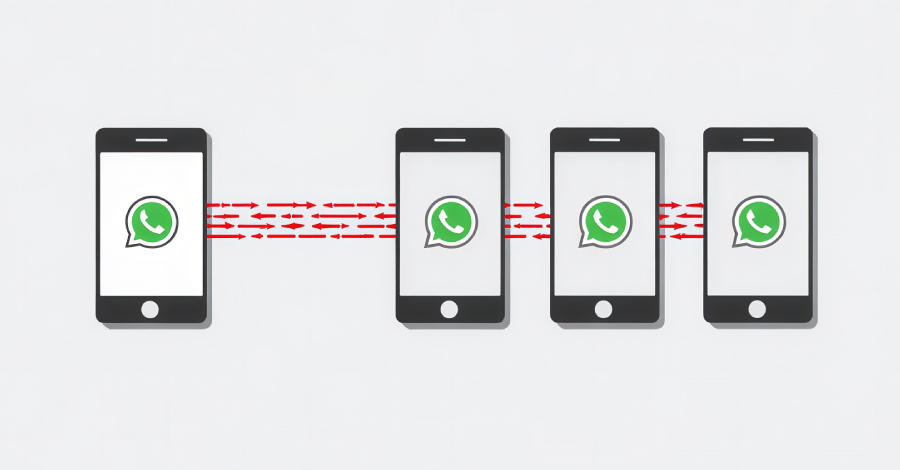
⚠️ Astaroth banking malware is now using WhatsApp as its main delivery channel in Brazil.
Researchers report a new Python-based module that steals a victim’s contact list and auto-sends malicious ZIP files, spreading the infection chat to chat.
🔗 How the campaign works and spreads → thehackernews.com/2026/01/whatsa…
English
Cybersecurity is the embodiment of the Red Queen hypothesis, a concept borrowed from evolutionary biology that describes a relentless race where survival depends on constant adaptation. In this digital ecosystem, attackers evolve with alarming speed, devising new exploits and tactics that render yesterday’s defenses obsolete. Defenders, in turn, must innovate continuously, not to gain an advantage but simply to maintain equilibrium. The moment security teams pause, even briefly, the balance tips and vulnerabilities multiply.
This perpetual escalation transforms cybersecurity into a war of endurance rather than dominance. Every patch, protocol, and policy is a temporary foothold in terrain that shifts daily under the pressure of adversarial ingenuity. Organizations that cling to static strategies risk extinction in this environment of accelerating threats. Success lies in cultivating resilience through adaptive architectures, predictive analytics, and a culture that anticipates change rather than reacts to it. In the Red Queen’s race, standing still is not an option; survival demands motion, and motion demands foresight.
English
PS5 Breach
At the end of December 2025 and the start of January 2026, hackers publicly released the PlayStation 5’s BootROM cryptographic keys. These keys are embedded directly into the PS5’s processor at the factory and form the hardware root of trust for the entire console. They verify the authenticity of the bootloader before anything else loads. Because the BootROM is physically burned into the chip, Sony cannot patch, revoke, or replace these keys on any existing PS5 hardware.
These keys allow researchers to decrypt the PS5’s bootloader and analyze the console’s secure boot chain in a way that was previously impossible.
Why this is so significant
The BootROM is the PS5’s “Level 0” trust anchor. Once its keys are known, the entire security architecture becomes transparent to researchers. Reports emphasize that this does not immediately allow unsigned code to run, but it dramatically lowers the difficulty of developing future jailbreaks, custom firmware, and loaders. Analysts describe this as an “unpatchable” vulnerability because the only fix would be a new hardware revision.
Experts quoted in coverage expect that the leak will accelerate the development of:
Permanent jailbreaks
Custom firmware
Game backup loaders
Emulation improvements
Reverse engineering of Sony’s proprietary hardware logic
Some analysts predict widespread piracy tools emerging in 2026 as a result of this breach.
The broader context
This event is being compared to the PS3’s 2010 “master key” leak and the Nintendo Switch’s unpatchable Tegra RCM exploit. In all three cases, the exposure of hardware level secrets permanently weakened the console’s security posture. The PS5 had been considered one of the most secure consoles ever released, with only partial userland exploits discovered until now. The BootROM leak changes that landscape entirely.
Coverage from multiple outlets stresses that this is the most consequential breach in the PS5’s history and that it fundamentally alters the long-term security trajectory of the platform.
English
In summary, cryptocurrencies are secure at the cryptographic core but fragile in the layers where humans operate. Zcash pushes privacy further than most, but doing so requires more complex cryptography, stricter implementation discipline, and stronger ecosystem hygiene. The strength of its design does not eliminate the operational risks that surround it.
#Zcash #ZEC #Crypto
English
Zcash also faces practical concerns. Most users transact in the transparent pool, not the shielded pool, which weakens effective anonymity. Wallet implementations must handle large proving computations, and this expands the attack surface. If a wallet leaks metadata or mishandles key material, the privacy guarantee collapses even if the protocol is intact. The network also has to guard against timing correlations and pattern analysis that link transactions indirectly.
English
Cryptocurrencies introduce a security model that shifts trust from institutions to software, consensus rules, and user key management. The result is a system where the asset itself is cryptographically sound but the environment around it becomes the dominant risk.
English
ARM and x86 differ in cybersecurity because each architecture evolved under different constraints. x86 grew under a mandate for backward compatibility and maximal performance. ARM grew under a mandate for predictability, efficiency, and low power. Those constraints shaped their attack surfaces.
x86 uses a complex instruction set with variable length instructions and deep microcode stacks. That complexity introduces many edges in the pipeline where timing leakage can occur. The long history of speculative execution and out of order optimizations created a landscape where vulnerabilities like Spectre, Meltdown, L1TF, MDS, and other transient execution attacks repeatedly appeared. Each fix required microcode updates, software fences, changes to branch predictors, and kernel level mitigations. The privilege model on x86 also includes legacy rings and modes that must be preserved for compatibility. This creates unused pathways that a determined attacker can study and exploit.
ARM uses a reduced instruction set with more uniform instruction encoding and simpler decode stages. The microarchitecture is cleaner because ARM vendors are not forced to preserve decades of edge behavior. There is still speculative execution and out of order design in high performance ARM cores, but the overall surface area is smaller. Many recent ARM designs include dedicated hardware for pointer authentication, memory tagging, and branch target identification. These features allow an operating system to prevent return oriented programming or use after free exploitation at the hardware boundary. x86 lacks these features by default, so software emulates them with less reliability.
The other major difference is ecosystem hygiene. x86 systems are exposed to far more arbitrary software, arbitrary device drivers, and historically weak firmware chains. The permissive PC ecosystem makes it easy for attackers to find vulnerable firmware, driver bugs, and unsigned components. ARM systems, especially mobile devices, are usually locked down with enforced secure boot, vendor signatures, and hardware unique keys. The locked down model sharply reduces casual compromise.
ARM is not immune to attack. Side channels, pointer injection attacks, and TrustZone escapes all occur. x86 is not inherently insecure. It simply has accumulated more pathways that attackers can investigate. The architectural differences give ARM a cleaner baseline and x86 a larger and more complex surface area. The real security outcome depends on what the vendor builds on top of each instruction set.
English
Choosing the most secure operating system (OS) is complex; no single platform is impenetrable. Security relies on architecture, default configuration, and, critically, user behavior. Below is a comparison of the security posture for the three dominant desktop environments.
1. Windows
As the platform with the largest market share, Windows is the primary target for malware authors. Its security has matured significantly to counter this threat volume. Strengths include Microsoft Defender, a fully integrated native antivirus and anti-malware solution. BitLocker is the standardized full-disk encryption. User Account Control (UAC) limits application access to system-critical functions, and Microsoft provides frequent, mandatory security updates. Limitations include its popularity, which ensures it remains the most frequent target for exploits, and historical design choices that can sometimes increase the attack surface.
2. macOS
macOS leverages its closed ecosystem and Unix-like foundation to offer strong out-of-the-box security with minimal required user configuration. Strengths include System Integrity Protection (SIP), a core feature that protects system files from modification. Gatekeeper enforces code signing and notarization requirements. Sandbox Security ensures applications run in isolated environments, restricting their access to system resources. Apple's control over the full hardware/software stack allows for deep security integration. Limitations include the closed nature which limits flexibility for advanced security customization, and the fact that targeting is increasing as market share grows.
3. Linux
Linux distributions are structurally secure by design, relying on a mature permissions model and open-source transparency. Strengths include the Permissions Model, meaning standard users operate with limited privileges, effectively containing most malware. Open Source Auditing means a global community constantly reviews the source code, leading to rapid identification and patching of vulnerabilities. Software is typically distributed via highly trusted, official repositories. Linux offers sophisticated security modules like SELinux and AppArmor for granular access control. Limitations are that security level is highly dependent on the user's knowledge and configuration, and many distributions do not include a firewall or antivirus enabled by default, requiring manual setup.
English
Intrusion retweetledi

Amazon Detects 150,000 NPM Packages in Worm-Powered Campaign securityweek.com/amazon-detects…
English