Prime Minister of Israel

25.9K posts

Prime Minister of Israel banner
Prime Minister of Israel

Prime Minister of Israel

@IsraeliPM

The official account of the Office of the Prime Minister of Israel 🇮🇱

Jerusalem, Israel Katılım Mayıs 2010
141 Takip Edilen1.5M Takipçiler
Prime Minister of Israel
The Prime Minister’s Office: As part of the continuous contact between Prime Minister Benjamin Netanyahu and US President Donald Trump, an additional conversation took place this evening between the two, during which the continued coordination between the countries in various sectors was established. President Trump updated the Prime Minister on American moves in the Gulf. The Prime Minister, on his part, raised the severity of the statements made by Turkish President Recep Tayyip Erdogan and his people against the existence of the State of Israel, as well as the need for security zones along Israel's borders.
English
105
221
1.1K
127.5K
Prime Minister of Israel
Prime Minister Benjamin Netanyahu spoke with the Commander of the Israeli aid delegation to Venezuela and Chief of Staff of the Home Front Command, Brig. Gen. Elad Edri, and with Israel's ambassador-designate to Mexico, Yoed Magen. The Israeli aid delegation has been operating throughout the country for the past ten days, in several areas affected by the earthquake, with the aim of assisting in the reconstruction phase through the assessment and classification of damaged buildings, as well as through other activities. gov.il/en/pages/event…
English
56
312
1.3K
108.9K
Prime Minister of Israel
Following Prime Minister Benjamin Netanyahu's directive to advance the recommendations of the Public Committee to examine Israel’s national response for treating and rehabilitating wounded IDF and security forces personnel, chaired by Prof. Mor-Yosef, a professional discussion was held today involving all the relevant government ministries, led by Deputy Director-General of the Prime Minister's Office, Drorit Steinmetz. The main points of the Committee's recommendations were previously presented to the Minister of Defense and the Minister of Finance, who emphasized the supreme importance they attribute to improving the response for disabled veterans of the IDF and security forces. They directed the professional staff in their ministries, in coordination with the Prime Minister's Office, to formulate a government decision that will adopt the Committee's recommendations and provide a comprehensive response to the disabled veterans' needs. During the discussion, the relevant government ministries coordinated their efforts, and the required professional and budgetary aspects were examined in order to finalize the government decision draft, which is set to include a series of steps to enhance the apparatus of care, rehabilitation and support provided to disabled veterans of the IDF and security forces. At the conclusion of the discussion, it was decided that the professional staff would complete the staff work and draft the government decision as soon as possible, in order to bring it for government approval within the next few days. This development reflects the shared commitment of the Prime Minister, the Minister of Defense, and the Minister of Finance to improving the response for disabled veterans of the IDF and security forces, whose great contribution to the security of the State of Israel is manifested in a heavy personal price, with the goal of finalizing the decision quickly and responsibly.
English
39
73
375
34.4K
Prime Minister of Israel
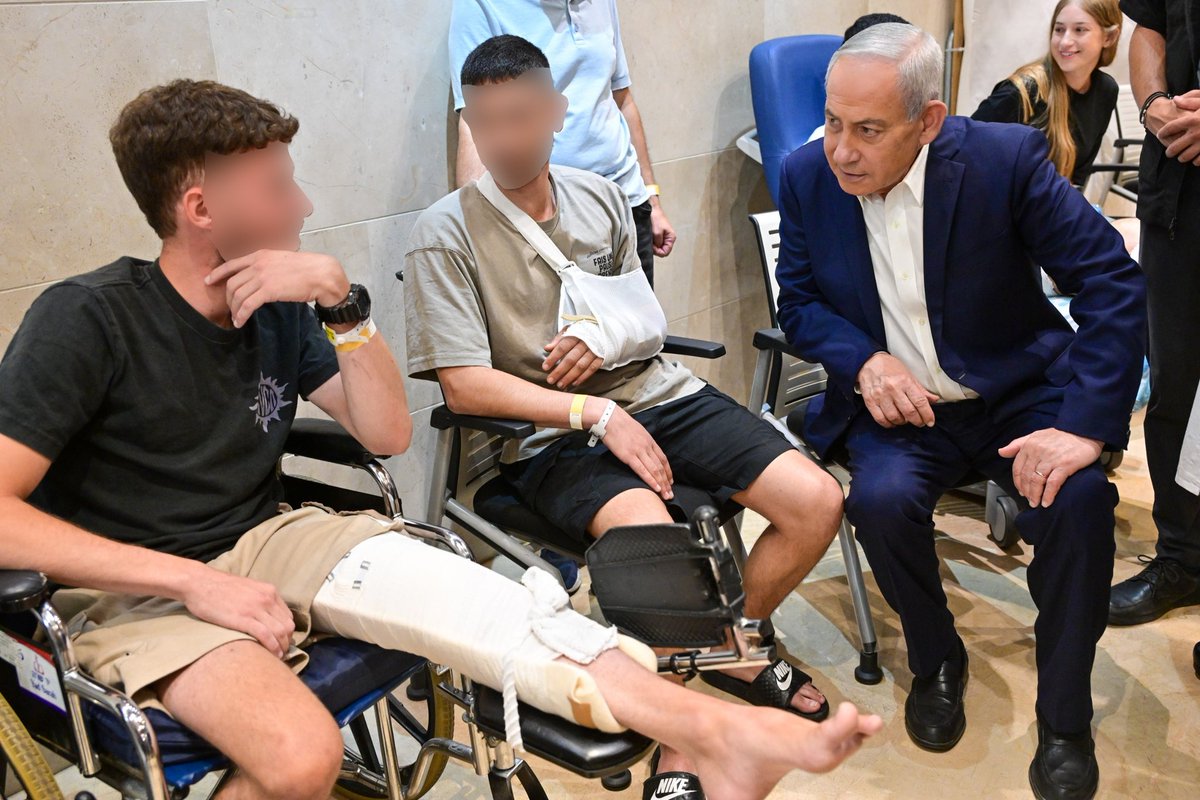
Prime Minister Benjamin Netanyahu visited wounded IDF regular and reserve soldiers at Rambam Health Care Campus in Haifa. Prime Minister Netanyahu: "We are not giving up, and you are right about one thing, Yonatan. There is far more unity within the nation than what is reflected later in the Knesset. Much more unity, much broader, much deeper and I believe this is a strong foundation for the future, and you represent that. I admire you, and I am always inspired by your spirit. I am not just saying this superficially. I am truly inspired. I know you are going on a difficult journey. It is not easy, but your spirit is tremendous. I don't think there is anywhere else in the world that provides better care. On the contrary, I say there is nowhere else in the world that delivers with this level of skill, speed, spirit and success. Therefore, I wish you both good health and a full recovery." The Prime Minister was accompanied by Rambam Director General Dr. Michal Mekel.
Prime Minister of Israel tweet mediaPrime Minister of Israel tweet mediaPrime Minister of Israel tweet mediaPrime Minister of Israel tweet media
English
113
125
728
24.5K
Prime Minister of Israel
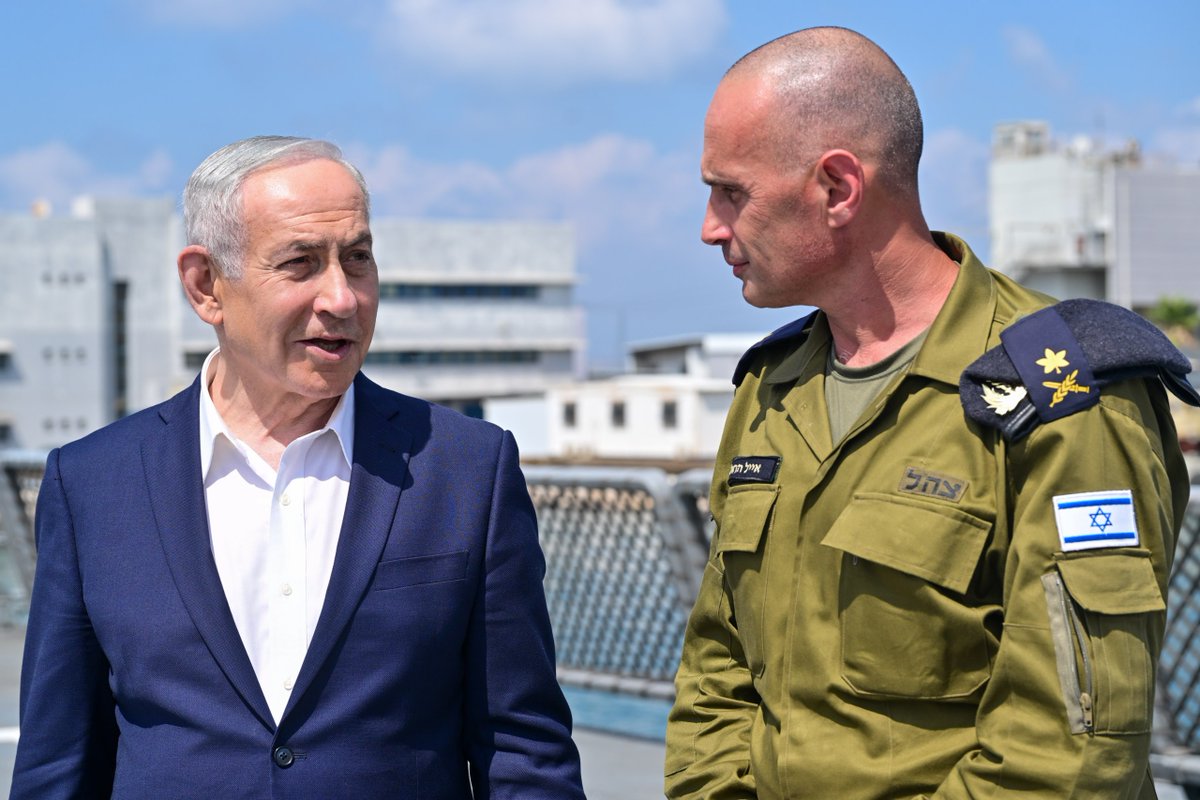
Prime Minister Benjamin Netanyahu visited the Haifa Naval Base today, together with the Commander of the Navy, Vice Admiral Eyal Harel. During the visit, the Prime Minister received an operational briefing on the navy's activities and spoke with the fighters at the base. Prime Minister Benjamin Netanyahu: "I am here at the Haifa port, at the naval base with the Commander of the Navy. I received a comprehensive briefing on our capabilities, and they are impressive. You can see some of them here. I have set a simple goal: The goal of the Navy, and of the State of Israel, is to ensure the shipping lanes and the freedom of maritime trade, which are so vital to the State of Israel. I am impressed by what you have done so far, and by what you plan to do together with the rest of the security forces. I wish you great success."
Prime Minister of Israel tweet mediaPrime Minister of Israel tweet mediaPrime Minister of Israel tweet mediaPrime Minister of Israel tweet media
English
132
310
1.8K
44.1K
Prime Minister of Israel
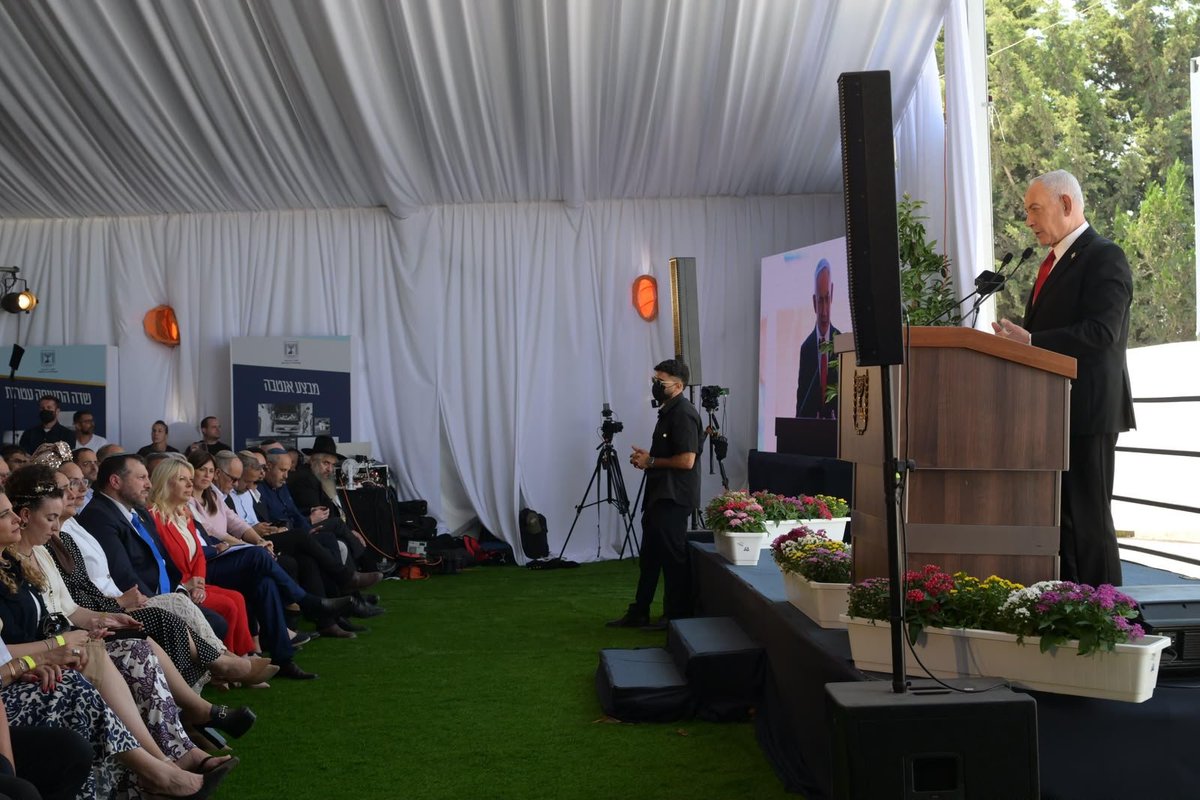
Prime Minister Benjamin Netanyahu's remarks today, at the state memorial ceremony for Binyamin Ze'ev Herzl: "This year, once again, Herzl Memorial Day finds us in the midst of a multi-arena campaign, a campaign that is a stubborn struggle against enemies who seek to extinguish the candle of Israel. This year, too, we draw strength from the Zionist vision of Herzl, who wrote in his story 'The Menorah' about the victory of light: 'The darkness will completely pass. The light will shine for everyone, for the lovers of justice, truth, freedom, progress, humanity, and beauty.' Many challenges lie ahead of us, but just as it was with Herzl, the willpower to overcome every obstacle is stronger than the bumps along the way. It must be said that since Herzl's day, the world has changed beyond recognition: Old empires have fallen; new countries have been born, including our own state; and human knowledge has broken the boundaries of imagination. But despite these far-reaching changes, the national idea that preoccupied Herzl remains intact: Our people, the People of Israel, are deepening their roots in the Land of Israel. We have established a strong, progressive, high-achieving state in our historic homeland. Almost every day, and this is no exaggeration, I see Herzl's tidings regarding the Jewish State being realized in practice. By the way, he predicted many things. He thought we might speak German, which everyone likes to latch onto. Well, he didn't predict everything, and he wasn't right about everything. But he predicted the core essence with precision. Herzl wrote in his book ‘Altneuland’ about children playing sports, on lawns in the streets of Jerusalem. A few days ago, at the opening ceremony of the 'Maccabiah' in Jerusalem, we saw young people playing sports on the grass of Teddy Stadium, real grass, by the way. I saw thousands of Jewish athletes from all over the world standing tall with immense pride. Herzl was deeply fascinated by scientific and technological innovation, by inventions that improve human quality of life. In Israel, the high-tech, cyber, and now also the artificial intelligence industries, not to mention all the pharma, medical devices, and many other things being added to this, in Israel, these industries establish our status as a global technological superpower. Herzl knew that we would need a defensive force, a Hebrew army that would protect our state from those who wish us harm. And indeed, we are all filled with wonder at the extraordinary heroism of our soldiers and commanders, in the War of Redemption. Herzl knew the map of the Middle East very well. He mentions Mt. Hermon, Damascus, and Lebanon in his writings. And indeed, our fighters today look out over Syria from the crown of Mt. Hermon, hold the peak of the Beaufort in Lebanon, and operate with determination in the Litani region. Israel will remain in Lebanon for as long as necessary to protect the residents of the North and all citizens of Israel. Honored guests, the forces that drove Herzl to create the magnificent enterprise of the Zionist movement still exist even after 130 years. On one side is the negative force, antisemitism. Herzl saw the hatred of Jews in Europe up close. He understood that the Jewish people would always have haters, and that this severe hatred requires us to unite and establish a state of our own. These waves of antisemitism, as my late father, Prof. Benzion Netanyahu, told and wrote to me, rise and fall, rise and fall, changing their garments and putting on new ones. And this challenge requires one single answer: A Jewish state. Because that hatred, that lie, that injustice directed at the Jewish state, was previously directed at the Jews themselves. With one difference: back then, the hatred was a prelude to slaughter, but today, after the hatred, when they come to slaughter us, we wage a fierce counter-war. And we will not allow another Holocaust to occur, not from here, not from there, and certainly not from Iran. And as long as I am Prime Minister, Iran will not have nuclear weapons. But I heard that there are also innovations regarding antisemitism, because I recently heard that France is posthumously promoting the Jewish officer Alfred Dreyfus, who at the end of the 19th century was falsely accused of treason. This is, of course, the Dreyfus Affair that motivated Herzl. So I think that truly, after 130 years, it's about time. I say this, if you haven't caught on, with a touch of irony. It's about time, and perhaps the day will come when the blood libels against the State of Israel and the soldiers of the Israel Defense Forces, such as the absurd libels heard at the Court in The Hague, will also turn into scattered dust. We, in any case, do not bow our heads before the defamatory words of our oppressors. We will continue to fight this toxic antisemitism in every way. But antisemitism was only the first force that drove Herzl. He saw, he foresaw, he wrote more than thirty times about the Holocaust that would take place in Europe, and therefore he sought a solution. But there was also a positive force that drove Herzl to action: To return the control over our destiny into our own hands. To turn us into a productive people that sustains itself and contributes to the family of nations. It must be understood that Herzl innovated something fundamental here: He took love of Zion, which among other things drove my great-grandfather to immigrate to the Land of Israel and to Rishon LeZion in 1896. And there were others, pioneers, who were driven by this sentiment of longing for Zion, the love of Zion. He attached the word 'political' to love of Zion. Political Zionism, which is involved in the affairs of the wider world and acts on the world stage! Herzl navigated his path, with wisdom and audacity, between the palaces of kings and the halls of rulers. He stood before world leaders as the proud representative of the thousands-of-years-old Jewish people. He took their interests into account while presenting our interests in a clear manner. Herzl's path is our path. While we are attentive to the interests of our allies, we stand firm on the vital interests of Israel, and in this context, I repeat what I said a few sentences ago, it is important to say it again: With an agreement or without an agreement, we will not allow Iran to possess nuclear weapons! Herzl himself described how he wove the threads of action out of attentiveness to the collective interests of the arbiters of fate in those days: In the Austro-Hungarian Empire, in Turkey, in Russia, in France, in Great Britain, in Italy, and I add: In Germany as well. He operated in secular circles and in religious circles, among Jewish capitalists, and among the pioneers in the Land of Israel. Herzl called his political craft: 'A balancing act.' Thus, he placed the Jewish issue on the agenda of many nations. We, too, who follow in Herzl's footsteps, are diligent in establishing political alliances across a vast expanse. In Biblical terms, one could say, 'from India to Cush'; and I choose my words here carefully: 'from India to Cush,' from India to Africa, of course. From the edges of Asia to the edges of Africa, and even beyond. Thanks to the systematic cultivation of our strength, our military, intelligence, technological, and economic strength, we are bringing many countries closer to us. I believe that with some of them, we will achieve normalization and peace. But I want to tell you more than that: world leaders, who refrain from expressing public support for Israel, sound different in the private conversations they hold with me. They deeply appreciate Israel's determination to fight radical Islam, which threatens them as well. They tell me: 'Prime Minister, we are with you. Public opinion at home does not allow us to say it openly, but we admire you. We need your help.' Look what a blessed path we have traveled from Herzl's day until today. And another essential point, especially this year: these days, we are marking 50 years since Operation Yonatan, one of Israel's most daring operations in all its years of existence. Seventy-three years separate the Uganda Scheme, which Herzl initially accepted, from the heroic action of IDF fighters in Entebbe, Uganda, to rescue the hostages of our people. My grandfather, Rabbi Nathan Mileikowsky Netanyahu, of blessed memory, was a follower of Herzl. He also participated in the Zionist Congress in The Hague a few years after Herzl's passing, alongside Ahad Ha'am, Jabotinsky, and I believe Bialik was there as well. When he heard about the Uganda Scheme, he was forced, for the only time in his life, to come out against the man he admired above all else, against Herzl. And why did Herzl do it? Why did he pursue the Uganda Scheme? Because he foresaw things with the precision of a prophet. He understood, he foresaw the Holocaust, and he sought to get the Jews out and save them from what he understood was going to happen on European soil. And my late father asked my grandfather, 'Why did you oppose the Uganda Scheme so fiercely? Did you think Britain would not keep its promise?' He answered him, 'No. It was precisely because I thought Britain would let us establish ourselves in Uganda that I opposed it. Because if we had gone to Uganda, we would not have reached the Land of Israel, and we would have lost the glue that unites the entire Jewish people, all those whom we want to bring to the Land of Israel under Zionism, which is the only place where the new Jewish sovereignty can be realized.' So my grandfather opposed the Uganda Scheme, and a year after its presentation, Herzl retracted it, stood at the podium, and said in Hebrew: 'If I forget thee, O Jerusalem.' He said it. He understood that too. But look at what a chasm lies between the two Ugandas. The settlement plan in Uganda, which Herzl viewed as a 'night refuge', yes, a temporary station away from persecutions, expressed the absolute helplessness of our people in the Diaspora. We had to turn to others, hoping they would save us from the Holocaust, and of course, they did not save us. Whereas the arrival of IDF fighters, the arrival of the fighters of the Jewish State, in Uganda to liberate the hostages from the hands of their captors by force of arms, expressed independence; it expressed strength in the spirit of Zionism's goals. The essence of the spirit of Entebbe, achieving what seemed impossible, was moral clarity, courage, and brilliant operational capability. Israel dealt a blow to international terrorism then, and today too, Israel leads the war against terrorist regimes. Iran, with operations and maneuvers that astound the world, I think there was also another element here; on the eve of the Entebbe operation, there was immense cohesion, a great unity within the nation. And today, as we face the great challenges and opportunities ahead of us, we must seek to overcome differences, there are always differences, and there always will be, and unite the nation. I think we will be required to establish a national government that is as broad as possible, and I think we rely on the greatest strength we have, which is our wonderful people, who give birth to and bring forth our magnificent fighters, and who have shown extraordinary resilience. Those leaders who speak with me, they ask me: 'How are you, such a small country, where do you find the strength?' And I tell them, we have it because we are an ancient people determined to protect its future, and there is none like it. This nation stood a difficult test; upon Herzl's passing, there was a massive fracture. In 1918, 14 years after his untimely death, one year after the Balfour Declaration, it was written in a Hebrew newspaper published in New York and Berlin, here is what was written: 'On this day we anchor our ship, looking back to see the distance we have traveled. Whether we are walking on the straight path, the path our leader showed us, and renewing our strength to walk further.' This year as well, on Herzl Day, we look back. The straight path continues. The fire of vision and realization continues to burn within us. Our strength is with us to walk further, to ensure the existence of the People of Israel in the Land of Israel, for the foundation of our path is the Eternity of Israel. May the memory of the visionary of our state, Binyamin Ze'ev Herzl, be blessed forever."
Prime Minister of Israel tweet media
English
140
128
471
26.7K
Prime Minister of Israel
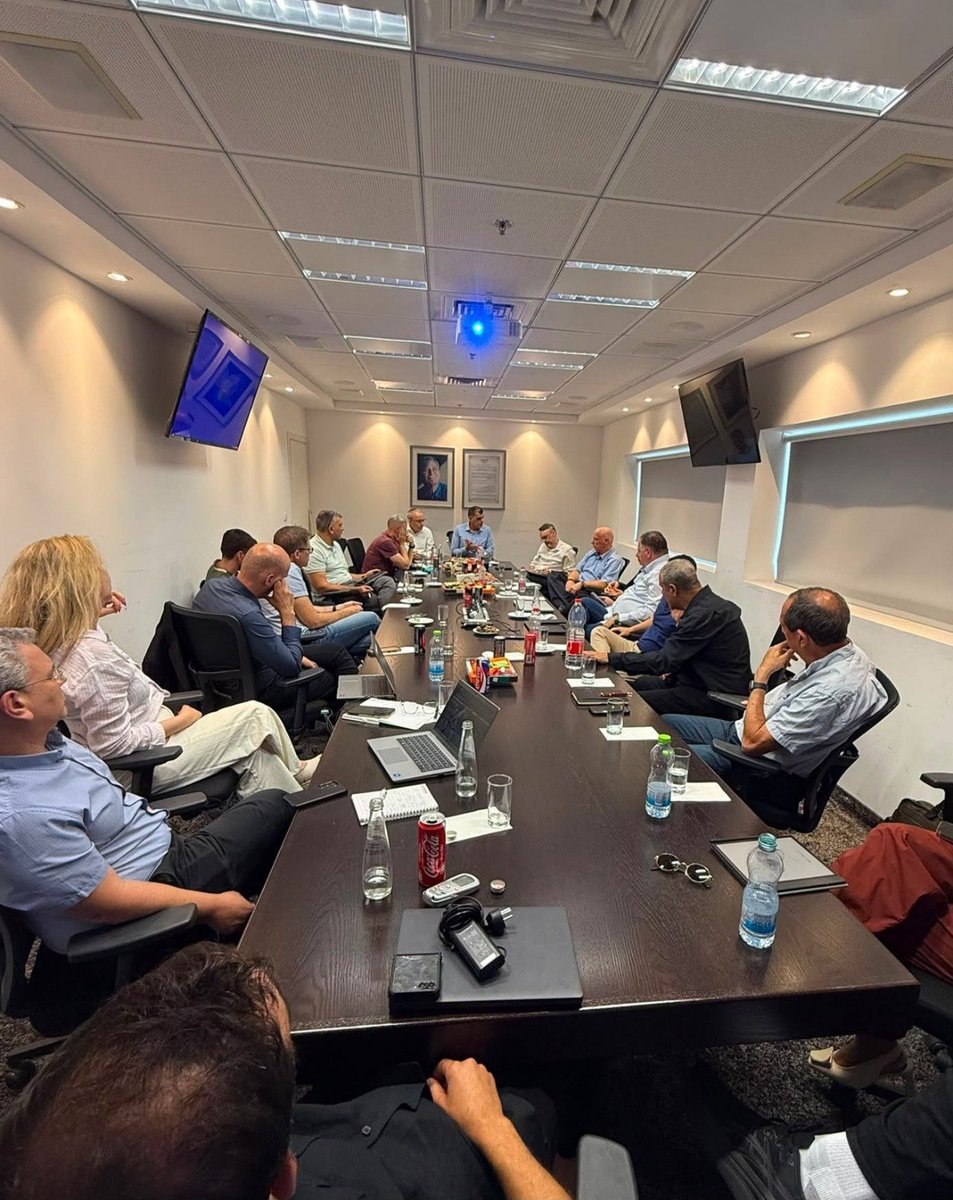
The Israel High-Tech Association at the Manufacturers Association of Israel and the National AI Directorate in the Prime Minister's Office, held a consultation today with high-tech industry representatives as part of the National Artificial Intelligence Program. Following the Government's approval of the National Artificial Intelligence Program, the first consultation of the National AI Directorate with high-tech industry representatives took place today at the Industry House. The meeting, initiated by the Israeli High-Tech Association at the Manufacturers Association of Israel together with the National AI Directorate at the Prime Minister's Office, is a significant part of a series of consultation meetings with the Israeli market. These meetings aim to map out needs, identify strategic partners, and explore collaborations ahead of the establishment of the National AI Institute. The National Program includes, among other initiatives, the establishment of the National Artificial Intelligence Institute, providing access to advanced processing power infrastructures, and promoting AI solutions to address the daily challenges of the state, the market, and the industry. During the meeting, which was attended by 11 of the market's leading high-tech companies, the participating companies emphasized the importance of continuing this joint forum in the future to serve as a voice for the high-tech industry in front of the Directorate. Additionally, the operational concept of the National Directorate was presented, which seeks to transform Israel into a nation that bridges AI capabilities with real-world challenges. In this framework, the National Institute is expected to promote solutions across all layers of the technology stack, including cyber, physical AI, computing infrastructure, 360-degree protected systems, and advanced applications connecting the computer world with real life. Furthermore, the program's innovation vision was discussed, aiming to turn Israel into a global superpower through the development, investment, and implementation of AI solutions. This will be achieved by connecting real challenges with advanced technological applications to meet the needs of industry, the state, and society. Shahar Bracha, Deputy Director of the National AI Directorate at the Prime Minister's Office: "These days, we are formulating the model for implementing the National AI Program and conducting consultation rounds with the entire Israeli market. The purpose of these consultations is to understand the needs on the ground, find business partners, and together build a national infrastructure that will enable Israel to grow, lead, and operate in the global market. Our vision is to bring AI face-to-face with the challenges of life itself and make Israel the most attractive place in the world for connecting real challenges with AI-based solutions." Alon Ben-Zur, Chairman of the Israeli High-Tech Association at the Manufacturers Association of Israel and CEO of Bynet Data Communications: "To ensure that Israel remains at the global forefront of artificial intelligence, the state and the industry must work together. We welcome the move led by Shahar Bracha and the National AI Directorate team, and the decision to involve the industry as early as the program's formulation and the establishment of the National AI Institute. Israeli high-tech companies possess world-class knowledge, experience, and execution capabilities, and we see great importance in creating a true, ongoing partnership that will translate these advantages into growth, innovation, and solutions that will impact the economy and the lives of citizens." Participating companies: Oracle, HP, Check Point, Armis, Kaltura, Kyndryl, ELTA, Bynet, CodeValue, and HPE. Photos: The Israeli High-Tech Association at the Manufacturers Association of Israel.
Prime Minister of Israel tweet mediaPrime Minister of Israel tweet media
English
40
82
364
23.7K
Prime Minister of Israel
Prime Minister Benjamin Netanyahu and his wife Sara participated in the cornerstone-laying ceremony for the Atarot Heritage Center, along with Heritage Minister Amichai Eliyahu and Jerusalem Mayor Moshe Lion. The heritage center is set to be established in the historic terminal building in Atarot, as part of the initiatives marking the 50th anniversary of Operation Yonatan. Prime Minister Benjamin Netanyahu: "My friends, my wife Sara and I are deeply moved by this occasion, as are my brother Iddo and his wife. My family and I are thrilled to be with you in this special place, at this special moment, which can be encapsulated in just a few words: In Atarot, we are restoring former glory. I always say: In public life, you need to have a compass. A compass dictates a path, an ideology. Ultimately, the compass points toward the desired direction. In our case: North. I do not mean only the north of our country, where we are determined to restore security, prosperity, and growth. On this occasion, I mean northern Jerusalem, an area of immense importance for the development of the capital, the development of our united capital, Jerusalem, which will never be divided again. This requires a commitment of the heart, but also practical actions. Our government guards Jerusalem under Israeli sovereignty with everything we have! Many of us remember the small airport that operated here in Atarot for decades. I used it many times; it wasn't exactly JFK Airport in New York or Heathrow in London, but nevertheless, planes took off and landed in Atarot. Since today is also the memorial day for the visionary of our state, Herzl, I want to note that Herzl witnessed the initial blossoms of aviation's development during the very period he was active. Just one year before his passing, the first airplane flew. He even wrote a futuristic story about a 'guided airship.' He envisioned aerial transportation as a symbol for the Jewish state, which would rise and spread its wings before the eyes of all. And that is exactly what happened. Civil and military aviation in Israel have developed by leaps and bounds over the years. We see this in the War of Redemption, which established our aerial superiority in the skies of the Middle East, an achievement that has earned our Air Force a global reputation. It was recognized before, but after, with the roar of a lion, the entire world knows what kind of aerial might, what heroic pilots, and what ground crews the State of Israel possesses. Yet, long before the War of Redemption, we had brilliant achievements. We are currently marking 50 years since Operation Yonatan. The heroic IDF operation to rescue our people who were hijacked to Entebbe, Uganda, this operation stunned the entire world. Our fighters stormed the terminal in Entebbe, where the terrorists were holding the hostages. I was told there was an intention to run a mock exercise here, as the tower here is quite similar to the tower at the airport in Entebbe. However, the concern was that because there are people all around, it would expose our plans, which had to be kept strictly secret to ensure the operation's success. The operation did indeed succeed. Our forces eliminated the hijackers within minutes and freed the hostages. Our eldest brother Yoni, the commander of the General Staff Reconnaissance Unit, the late Lieutenant Colonel Yonatan Netanyahu, fell in action while leading the force. The role of the rescuing fighters in Operation Jonathan will be remembered forever, and in equal measure, the significant contribution of the Air Force to the success of the mission will also be remembered. The Chief-of-Staff at the time, the Minister of Defense at the time, and also the Prime Minister at the time, Yitzhak Rabin, wanted to hear from two people, from the actual commander of the rescue forces, Yoni. Peres asked him: 'Is it possible?' and he replied: 'Given the element of surprise, it is possible, and I believe we will succeed.' They also wanted to hear from Benny Peled, who was the Commander of the Air Force. He said the exact same thing. And those two individuals, on the ground and in the air, essentially gave the government the confidence to carry out this operation, which had seemed impossible. Four 'Hercules' aircraft flew the IDF force into the heart of Africa, a distance of nearly 4,000 km from Israel, for over seven hours. Seven hours there, and seven hours back. Our brave pilots landed the planes in Entebbe despite the harsh weather. They did so by surprise, without the Ugandan soldiers guarding the airport realizing what was happening. Parallel to the Hercules planes, two Boeing 707 aircraft flew in the area for coordination, control, and medical care. Operation Yonatan elevated Israel's standing among the nations, as a small country with colossal audacity: To ensure the victory of light over darkness. The story of the operation, on the ground and high in the skies, will be immortalized in the heritage center we will establish here in Atarot. And I want to emphasize: Just as the heroism of our fighters in the War of Redemption draws from the heroism of our fighters in Entebbe, so the heroism of Entebbe draws from the heroism of previous generations. And so the heroism of future generations will draw from the heroism of our fighters in the War of Redemption. The generation of victory – the generation of heroism. We also carry the heroes of the settlement in Atarot, in the 28 years preceding the establishment of the state, with full national gratitude. The settlers of Atarot invested an immense daily effort: A handful of Jewish defenders facing a large and hostile Arab population. Under the British Mandate, they developed economic sectors: Dairy production, orchards, and quarrying. They stood firm against the repeated attacks of those who sought our lives, who sought their lives, because they wanted to kill them, until all hope was exhausted, and given the evacuation order during the War of Independence, they left the place. But we returned here in the Six-Day War. I still remember my march during paratrooper basic training, climbing the mountain from the Modi'in area, and arriving here. I looked at this place on the way to the Western Wall and thought, here, we have returned. I tell you, that is what I thought. I thought that we were restoring former glory. And that is exactly what we are doing. On the lands of the original moshav, the northernmost outpost of Jerusalem, a thriving industrial park has risen, employing thousands of workers, Jews and Arabs alike. And the final word regarding the development of Atarot has not yet been spoken: As Prime Minister of Israel, I had the privilege of approving the establishment of the Har Homa neighborhood, and later the Givat HaMatos neighborhood, in southern Jerusalem. The compass pointed south back then. The Palestinian Authority wanted to push forward from Bethlehem into Jerusalem and bisect the city. So we built Har Homa and Givat HaMatos. We are expanding them today to ensure the integrity of Jerusalem. We are also developing northern Jerusalem: Atarot and its surroundings. Settlement, heroism, aviation, economy, love for Jerusalem – the new home will ensure that the heritage of past generations will be remembered for generations to come. Together, we will restore former glory to Atarot, which is precious to us all."
Prime Minister of Israel tweet mediaPrime Minister of Israel tweet mediaPrime Minister of Israel tweet mediaPrime Minister of Israel tweet media
English
35
61
352
20.6K
Prime Minister of Israel
The Government approved the proposal by Prime Minister Benjamin Netanyahu, which implements the state’s commitment to continue standing alongside the survivors of the southern festivals in the long-term rehabilitation phase. As part of the decision, a plan was approved to continue and strengthen the framework of responses for the survivors of the 7 October 2023 southern festivals, aiming to ensure long-term continuity of care, rehabilitation, and employment for thousands of survivors and their families. Further information >> gov.il/en/pages/spoke…
English
31
62
390
29.6K
Prime Minister of Israel
Prime Minister Benjamin Netanyahu Decides, Upon Recommendation of NSC Director Shmuel Ben-Ezra, to Appoint Ofir Levi as Deputy Director of the National Security Council. The Government, today, has approved the proposal of Prime Minister Benjamin Netanyahu to appoint Col. (Res.) Ofir Levi as Deputy Director of the National Security Council (NSC), following the recommendation of NSC Director Shmuel Ben Ezra. Levi will assume the role, succeeding Gil Reich, who has concluded his term. Further information >> gov.il/en/pages/spoke…
Prime Minister of Israel tweet media
English
22
53
319
26.7K
Prime Minister of Israel
Prime Minister of Israel@IsraeliPM·
Happy 4th of July America! Happy 250th Independence Day! 🇺🇸
English
3.3K
2.1K
14.8K
1.1M
Prime Minister of Israel
Prime Minister of Israel@IsraeliPM·
Prime Minister Benjamin Netanyahu spoke yesterday with U.S. President Donald Trump and congratulated him on the occasion of the 250th Independence Day of the United States of America. ​The Prime Minister said in the conversation that the U.S. is a guarantor of global freedom, and Israel highly appreciates the close bond between the two nations. ​Prime Minister Netanyahu and President Trump agreed to meet in the U.S. in the near future.
English
60
173
1.3K
181.1K
Prime Minister of Israel
Prime Minister of Israel@IsraeliPM·
The Prime Minister’s Office: As usual, The New York Times' latest story about Israel and the Iranian negotiators is fake news. A complete fabrication of reality.
English
289
405
2.5K
188.8K
Prime Minister of Israel
Prime Minister of Israel@IsraeliPM·
National Public Diplomacy Directorate Head Tzipi Hotovely announced the appointment of Doron Spielman as International Spokesperson for the National Public Diplomacy Directorate in the Prime Minister's Office, after the selection committee unanimously approved his candidacy. Spielman, an expert in international communications, strategic affairs, and national security, brings with him over two decades of experience in the fields of public diplomacy and international media. As a reserve officer holding the rank of Major in the IDF, he served as a spokesperson to the foreign media in the IDF Spokesperson’s Unit and has appeared in hundreds of interviews and reports across the world's leading media outlets, particularly since the October 7th attack. Spielman specializes in formulating strategic messaging and leading narratives that strengthen the legitimacy and international standing of the State of Israel, while emphasizing the historical and national roots of the Jewish people. In recent years, he served as the founder and CEO of a strategic communications and media consulting firm, while simultaneously serving as a senior fellow at the Israeli Center for Freedom. Prior to that, he served as Vice President of the City of David Foundation, where he led the organization's public relations, international partnerships, and global operations. His New York Times bestselling book, When the Stones Speak, deals with the archaeological and historical foundations of the Jewish People's connection to Jerusalem and the Land of Israel. Spielman holds a degree in International Relations and Middle Eastern Studies from the University of Michigan and is a graduate of the Churchill Program for Political and Security Strategy. Head of the National Public Diplomacy Directorate, Tzipi Hotovely: "I welcome Doron's joining the National Public Diplomacy Directorate. Doron brings with him rich experience in the international arena, a deep understanding of the public diplomacy challenges facing the State of Israel, and a proven ability to present the Israeli narrative out of a deep connection to the roots of our identity. His addition to the directorate will serve as a significant reinforcement for Israeli public diplomacy."
Prime Minister of Israel tweet media
English
43
50
207
22.4K
Prime Minister of Israel
Prime Minister of Israel@IsraeliPM·
Remarks by Prime Minister Benjamin Netanyahu, today, at the state memorial ceremony for the fallen of the Second Lebanon War at Mount Herzl: "Distinguished guests all, and first among them today, my brothers and sisters –the relatives of those who fell in the Second Lebanon War and the civilian casualties of that campaign. I embrace every family in its pain from the bottom of my heart, with true appreciation and recognition of the magnitude of your grief and its continuous nature. A few months ago, I was moved to see the father of the late Major Roi Klein, one of the heroes of the Second Lebanon War, presenting his son Roi's beret to his grandson. The grandson, Roi's son, joined the Golani Brigade as a combat soldier. Both the grandfather and the grandson proudly preserve the legacy of Roi Klein, who blocked a hand grenade with his body during the Battle of Bint Jbeil, thereby saving the lives of his soldiers. The baton being passed from generation to generation in the Klein family is now held by all of our soldiers and commanders in the current war, the War of Redemption. Lebanon was an intense battleground 20 years ago, and it remains a central arena today. This is happening because Hezbollah's jihadist fanatics turned large parts of Lebanon into massive terrorist bases. As an Iranian proxy to our north, Hezbollah chose to attack us, completely ignoring the price of the war that Lebanon is enduring because of it. But we have proven two things to Hezbollah: First, that Israel will not be held hostage by the operational arm of the evil regime in Iran. Anyone who constantly provoked us, anyone who threatened our citizens and our communities, has felt the heavy hand of our might in ways they never imagined. And the second thing we proved to Hezbollah: Not only is Israel not 'as weak as a spider's web,' as the murderer Nasrallah famously said at the time – Israel is as strong as steel webs! Lebanon is a beautiful country, very beautiful. I came to know it at the beginning of my military service in the General Staff Reconnaissance Unit. First, when we landed at the Beirut airport in one operation. There were other operations. I finished my service, on the very last day of my service, in Lebanon in an attempt to capture senior Syrian general staff officers in order to exchange them for our captive pilots in Damascus. I remember leaving Lebanon on foot with my soldiers and driving to the induction center to be discharged. Along the way, I saw the cedars of Lebanon, which King Solomon used. I saw the beauty of the land, and I thought back then: A beautiful and miserable country. And its tragedy is that it is very close to Israel. Its tragedy is that there is no natural border—certainly not up to the Litani River. A thicket, it is easy to enter. This tragedy first brought Fatah there, and when we removed them from Lebanon, it brought Iran and its proxies. Lebanon is a beautiful country, and there are beautiful people there too. But its tragedy is that it has been seized by a fanatical sect and the patron power of that sect, and they want to destroy us by launching a raid from its territory. And this is what we have resolved, and what generations of ours have resolved, to prevent with their bodies and souls, including the generation of heroes we remember today. The Defense Minister and I visited our forces in southern Lebanon yesterday. We were standing at the exact spot where Nasrallah delivered his arrogant speech the day after Israel's withdrawal from Lebanon in the year 2000. We looked out toward Bint Jbeil, which is not far. And during the visit, I thought to myself: The one who spoke back then about spider webs has himself disintegrated like a spider's web! Even after two decades since the Second Lebanon War, we remember your loved ones, our loved ones, who gave their lives. They acted with endless devotion, heroism, and sacrifice to defeat those who sought our lives. The infantry soldiers, the engineering and artillery units, the air force pilots, the aircrews, the navy crews, and all the other forces alongside them, overcame the enemy in every direct clash. In every single direct contact, they had the upper hand. Yoni Setboun, now a colonel in the reserves, participated in the Battle of Bint Jbeil alongside Roi Klein, whom I mentioned. In his book, ‘Under Fire’, Yoni encapsulates the moment his uniform was soaked in his friends' blood. He writes: 'Contrary to what one might think, I felt a tremendous sense of strength and pride for the privilege that fell to me despite the difficulty and pain. We knew we had carried out what was expected of us as combat soldiers in the Israel Defense Forces.' All of this was on the front lines. Meanwhile, on the home front, which also became a front line under the volleys of rockets from Lebanon, Israeli society demonstrated a resilience that was a sign of things to come. The poignant public debate that followed the war yielded one decisive conclusion: In the next significant confrontation, the achievement must be resounding. And indeed, at the beginning of the war, the War of Redemption, Hezbollah once again ignited a destructive fire in the Land of the Cedars. It attacked us savagely, but we remembered your loved ones, the sacrifice, and the lessons. Of course, we did not sit idly by. There were those who tried to frighten us with talk of massive numbers of casualties, of towers falling in Israeli cities, of the destruction of the state. My colleagues and I did not accept this. We knew we had to strike Hezbollah with all our might, also for the sake of your loved ones, a link in the chain, your loved ones, who went out to the battlefield in 2006. We broke through the barrier of fear. We initiated. We attacked. We surprised. We prevented the Radwan Force from invading the north of the country. We executed the pager operation. We decapitated Hezbollah's top leadership in Dahiyeh in Beirut, eliminating the master-murderer Nasrallah and the organization's leadership. Since the start of the war, we have eliminated over 9,000 terrorists, 3,500 just since Operation Roaring Lion. That is 15 times the number of terrorist casualties from the Second Lebanon War. But they paved the path. They showed us the way. We destroyed the vast majority of the 150,000 missiles and rockets that were intended to strike every point in Israel. We destroyed a significant portion of the terror villages in southern Lebanon adjacent to our border. We captured the Beaufort Fortress, which overlooked the Galilee panhandle. And now, we are the ones looking down on Lebanon from above. And perhaps the most important lesson: we created a wide buffer zone along the entire northern border. We do not accept a reality where a terrorist army borders our frontier, able to build tunnels, the depth of which is hard to imagine; one must see it to believe it, that are ready and able to infiltrate our border. This security space separates those who wish us harm from the citizens of Israel. We will remain in the defensive strip in southern Lebanon for as long as necessary. And we will restore security and prosperity to the residents of the North, just as we did for the residents of the South. The western Negev today is inside Gaza. The 'Lebanon buffer zone today is inside Lebanon. This is a critical lesson. And there is another one. The President noted it. For the first time in decades, Israeli representatives held direct negotiations with representatives of the Lebanese government, mediated by the United States, on a combined military and diplomatic solution. A few days ago, we achieved a historic breakthrough. We signed an agreement of understandings that disconnects the Lebanese front from the Iranian front. This agreement recognizes Israel's right to maintain the buffer zone in Lebanon until we remove the threat to our security posed by Hezbollah. One cannot understate the magnitude of the military and diplomatic blow this deals to Hezbollah and Iran. Iran, which wanted to force us to withdraw from southern Lebanon, will not see that happen. I am not saying that we do not still face campaigns, challenges, and hurdles ahead, but thanks to the chain of heroism, the First Lebanon War, the Second Lebanon War, and now the third campaign, and thanks to our might, which is changing the face of the Middle East, a doorway has opened to a different reality in Israel-Lebanon relations. We have taken an important step toward ending the conflict, and we will do everything to eventually reach a peace agreement between the two countries. Dear families, The memory of your loved ones, the memory of each and every one of them, is cherished within us. And I know how deeply it is cherished in your hearts. Recently, I witnessed this from another angle, through the story of Keren, of blessed memory. Inscribed on a bomb shelter in the city of Rehovot are the words of the first female airborne mechanic in the IDF, Keren Tendler, of blessed memory. Some of the words she wrote a few days before she fell in battle alongside her comrades on a 'Yasur' helicopter were mentioned here earlier. But I want to read them in full: 'G-d, take care of us and our country, bring peace upon our heights, bring blessing upon all our land, please protect us and those who fight.' In the spirit of Keren Tendler's words, we will continue to defend the State of Israel, and with G-d's help, we will ensure the eternity of Israel. We will preserve the legacy of those who fell in the Second Lebanon War, the heroes and heroines of Israel, and of the civilian casualties. May their memory be blessed forever.” Photos: Ma’ayan Toaf (GPO)
Prime Minister of Israel tweet mediaPrime Minister of Israel tweet mediaPrime Minister of Israel tweet media
English
44
107
502
24.3K
Prime Minister of Israel
Prime Minister of Israel@IsraeliPM·
Prime Minister Benjamin Netanyahu visited the security zone in southern Lebanon, together with Defense Minister Israel Katz and Deputy Chief of the General Staff Maj. Gen. Tamir Yadai. The Prime Minister and the Defense Minister received a comprehensive briefing on the activity in the sector from the Commander of the Northern Command, Maj. Gen. Rafi Milo, the Commander of the 91st Division, and the brigade commanders in the field. Additionally, the Prime Minister and the Defense Minister were presented with a showcase of innovative ammunition and weaponry for tackling the drone threat. Prime Minister Netanyahu told the fighters: "I have come here together with the Defense Minister, the Deputy Chief of Staff, the Commander of the Northern Command, and your commanders with whom I spoke – the division commander and the brigade commanders – and I salute you. You have done tremendous work here, and essentially, what we have done is take the Iranian axis and start crushing it. We struck inside Iran itself, something no one believed, and we removed an existential threat. The most important link in the Iranian axis was here – Hezbollah. There were 150,000 missiles and rockets, the highest density of missiles and rockets on planet Earth. Today, they have about 8% left. It is still significant, but it is no longer what it was. In your operations, we have eliminated 9,000 terrorists, hundreds of terrorists in recent weeks. And of course, the main thing we did – and this is what you are doing here – is to create buffer zones, security zones, not on our side of the border, but on their side. So we are doing this in Lebanon. We have done it in Gaza. These security zones are a paradigm shift. The meaning is that we no longer allow an army of terrorists to have a foothold on our border. We push them back – that is what you are doing. And we destroy, above ground and underground, basically anything that served them as a means of attacking us. Infiltration, attack, terror tunnels, terror villages – all of that is eliminated. This is the directive: leave nothing behind, and you are doing that. I believe that the most important thing for you to know, first and foremost, is that our directive – mine and that of the Defense Minister, Chief of the General Staff and Deputy Chief of the General Staff – is to protect yourselves as your first priority. If you identify a threat to your security, to your lives or the lives of your soldiers – act! Do not wait, act – this is an ironclad directive. Since we have achieved – thanks to your operations here – Lebanon's recognition of Israel and Israel's recognition of Lebanon, we say to both Iran and Hezbollah: get out of here, you have no business being here. There are two sovereign states that want to make peace between them; want to truly restore a reality of security and prosperity to the residents of the North and also to the residents of Lebanon. 'You must leave' – this is a slap in the face, a blow to the face of the Iranian axis, and it won't necessarily go unchallenged. We are very proud of what we have achieved thanks to your brave action and also the decisions we have made. Our insistence is that we will not leave southern Lebanon until the threat is eliminated. And as long as Hezbollah is armed and present here, posing a threat to us – we will remain here." Accompanying the Prime Minister were Head of the National Security Council Shmuel Ben Ezra and the Prime Minister's Military Secretary, Maj. Gen. Guy Markizeno.
Prime Minister of Israel tweet mediaPrime Minister of Israel tweet mediaPrime Minister of Israel tweet mediaPrime Minister of Israel tweet media
English
52
212
1.1K
31.7K
Prime Minister of Israel
Prime Minister of Israel@IsraeliPM·
Prime Minister Benjamin Netanyahu: “I strongly condemn the shameful remarks made against the Chief-of-Staff yesterday in Bnei Brak. Even when there are disagreements among us, there is absolutely no place for severe incitement against the IDF and its commanders, who protect us all.”
English
49
94
612
98.9K
Prime Minister of Israel
Prime Minister of Israel@IsraeliPM·
Prime Minister Benjamin Netanyahu and Defense Minister Israel Katz: As part of Operation Closing Verse, the IDF has just destroyed the underground terrorist infrastructure of the Hezbollah terrorist organization in the area of the village of Majdal Zoun in southern Lebanon. The tunnel, which was over 200 meters long and more than 25 meters deep, contained hundreds of weapons and several launch silos intended to target the territory of the State of Israel and its citizens. Israel updated the United States and the American representative in Lebanon in advance regarding the destruction of the infrastructure. IDF commanders and fighters will remain in the security zone in southern Lebanon and will continue to destroy terrorist infrastructure, remove threats to northern communities, and safeguard the security of Israel's citizens.
English
70
201
987
92.7K