Igor Waltritsch
4.9K posts

@IwZen
I enjoy breaking down complex problems and not finding solutions. (Really, Who Are You?) https://t.co/8aLrJ4nFAm


Julia Galef on why we stay in losing situations longer than we should: Most of us have heard of the sunk cost fallacy. But Julia Galef explains why it's harder to escape than we think. She opens with a deceptively simple example: "Imagine you're going to the store and you're halfway there when you realize oh wait the store is actually closed today. But you figure, well I've already come 10 blocks, I might as well just go all the way to the store, you know, so that my 10 blocks of walking won't have been wasted." She's quick to point out how absurd that sounds on its surface: "This is a transparently silly way to reason and I doubt that any of us would actually go all the way to a store that we knew was closed just because we'd already gone 10 blocks." And yet. "This pattern of thinking is actually surprisingly common." Julia defines the sunk cost precisely: the time, money, effort, and whatever else you've already spent. What's gone is gone. It can't be recovered. Rationally, it shouldn't factor into what you do next. But it does. She explains why the fallacy is so seductive: "Making a choice not based on what outcome you think is going to be the best going forward, but instead based on a desire not to see your past investment go to waste." We stay in bad relationships, failing projects, and wrong careers because walking away means confronting the past. The 10 blocks don't disappear if you turn around. They're already spent either way.

Brilliant technocrats can stabilize or enable folly. Schacht did both. The real safeguard isn't banning innovation in monetary operations—it's limiting the state's ability to demand impossible economics in the first place. "most dangerous" central bankers x.com/i/grok/share/6…


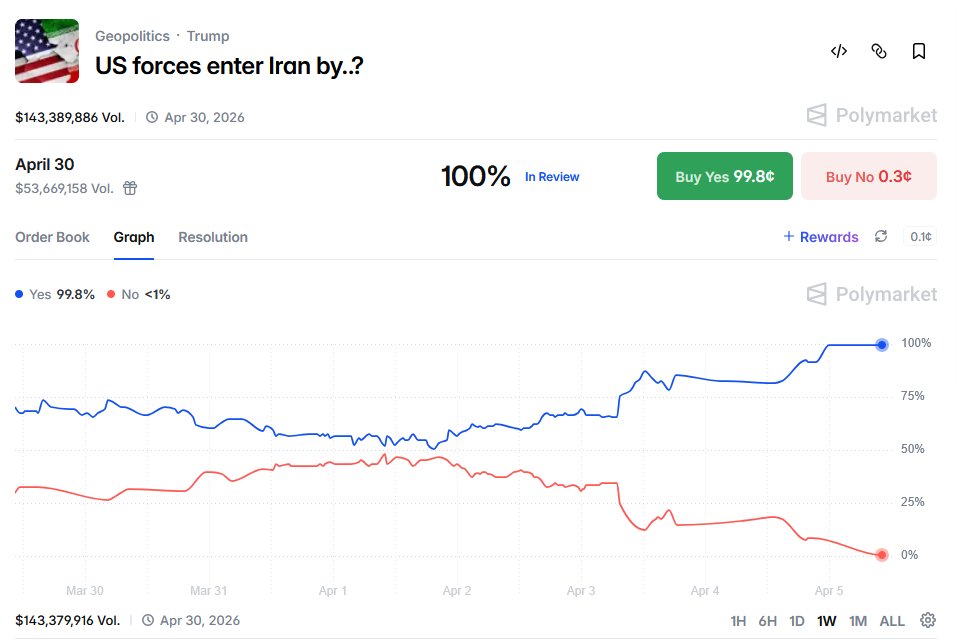
In the context of the Goldman report (below), and following the downing of several US jets in Iran, the Polymarket odds US enters Iran by the end of April jumped half overnight to over 80%, the highest yet


Headlines scream "AI will destroy 40% of jobs." Counter-narrative: AI will create $200T in value by 2035. The question isn't jobs lost—it's value created and how we distribute it. How we go from UBI toto UHI. Navigating this transition is it greatest challenge.


Energy analyst @DoombergT warns that $100+/barrel oil prices won't last long after the US stops its war against Iran ...and that lower prices, MUCH lower prices, perhaps as low as $25-30/barrel will ensue To learn why, watch: youtu.be/ouWPpSlCbdE