JDLove

9.5K posts

JDLove

JDLove

@JDLove__

Trying to keep an open mind 💡

NZ Katılım Haziran 2011
932 Takip Edilen271 Takipçiler
JDLove
JDLove@JDLove__·
Claude is the one anyway !
Katie Miller@KatieMiller

Sam Altman said today that he’s concerned @elonmusk will drop his lawsuit. Sam is cooked and he knows it. The lawsuit raises a foundational point: In America, you cannot convert a non-profit into a for-profit corporation. If a court allowed it, non-profits across the country would be permanently corrupted. Organizations could raise hundreds of billions of dollars tax-free by promising to serve humanity only to later become a for-profit company, destroying the integrity of the entire non-profit system.

English
0
0
0
17
JDLove retweetledi
Massimo
Massimo@Rainmaker1973·
This Mazda 787B has the most insane rotary engine sound you'll ever hear
English
90
1.4K
12.9K
731.1K
JDLove retweetledi
NoticiasTrabajo
NoticiasTrabajo@noticiatrabajo·
🔴 #ÚLTIMAHORA | La Unión Europea obligará a vender móviles con baterías reemplazables por el usuario y más duraderas a partir de 2027. El reglamento exige disponibilidad de piezas de repuesto y manuales durante 10 años para frenar la obsolescencia programada.
NoticiasTrabajo tweet media
Español
622
3.2K
22.7K
1.3M
JDLove
JDLove@JDLove__·
@wbmosler @tomaskenn Where do those Interest payment pesos end up ? not on the street but in the hands of the governing class.
English
0
0
1
85
Warren B. Mosler
Warren B. Mosler@wbmosler·
@tomaskenn The problem is monetary policy's high rate are what's putting the pesos on the street via deficit spending to pay interest, which doesn't even count as deficit spending. They only report the primary deficit which is ex interest payments:
Warren B. Mosler tweet mediaWarren B. Mosler tweet media
English
7
7
35
2.8K
Thomas Kennedy
Thomas Kennedy@tomaskenn·
The IMF approves another bailout for Milei’s government as Argentina’s economic crisis deepens. How many time has Milei needed a bailout now? elpais.com/argentina/2026…
English
112
606
1.8K
77.3K
JDLove retweetledi
👑
👑@coffeededo_o·
If only more restaurants would do this
👑 tweet media
English
463
6.7K
27.2K
1.8M
JDLove retweetledi
Joakim 🌹🇳🇴🇪🇺
For the first time in Norwegian history, a bus will carry passengers in regular traffic without any human behind the wheel. The first pilot without a safety driver was tested Friday, and if all goes as planned, anyone can ride driverless buses starting in May.
English
468
960
5K
2.6M
JDLove retweetledi
Massimo
Massimo@Rainmaker1973·
Breakfast at the bird buffet [📹instant.birds]
English
19
116
880
33.3K
JDLove retweetledi
Nature is Amazing ☘️
Nature is Amazing ☘️@AMAZlNGNATURE·
Fishermen save a beluga whale that got stuck on the mud at low tide.
English
88
776
10.1K
320.6K
JDLove
JDLove@JDLove__·
The devils work !
Sama Hoole@SamaHoole

In 1900, John D. Rockefeller controlled approximately 90 percent of all petroleum refining in the United States. He was, by some calculations, the richest private individual who had ever lived. He had a problem. Scientists were discovering that compounds derived from coal tar, a petroleum byproduct, could be used as synthetic medicines. Aspirin, derived from coal tar, had been launched by Bayer in 1899. The petroleum waste stream Rockefeller had previously had to dispose of could now be sold back to the public as medicine at a markup of roughly 10,000 percent. He had another problem. American medicine in 1900 was a competitive ecosystem of homeopaths, herbalists, naturopaths, osteopaths, midwives, and traditional doctors who used food, plants, water, and lifestyle as the primary tools of healing. Approximately half of all American medical schools taught some form of natural or alternative medicine. Rockefeller bought into the German pharmaceutical industry, eventually taking a substantial stake in IG Farben, the conglomerate that included Bayer, BASF, and Hoechst. He then commissioned a report. The report was written by Abraham Flexner, an educator with no medical training, funded by the Rockefeller and Carnegie Foundations, and published in 1910. It declared that natural and alternative medical schools were unscientific quackery. It recommended the closure of more than half of all American medical schools and the standardisation of the rest around medicine based on synthetic patented drugs. Congress acted. Half of American medical schools closed within a decade. The remainder accepted Rockefeller and Carnegie funding on the condition that their curricula be reorganised around pharmaceutical treatment. Nutrition was removed. Herbal medicine was removed. Lifestyle intervention was removed. The doctor's job was redefined: diagnose the symptom, prescribe the drug. The drugs were petroleum-derived. The petroleum was supplied by Rockefeller-controlled refineries. The medical schools were funded by Rockefeller. The journals were funded by Rockefeller. The AMA was supported by Rockefeller. The hospitals were funded by Rockefeller. By 1925, the American medical system was a vertically integrated extension of the petroleum industry, operating under the marketing slogan that it was scientific. This is the system that exists today. The pharmaceutical industry generates approximately $1.5 trillion in annual revenue. The American population, 4 percent of the global total, consumes approximately 50 percent of all pharmaceuticals manufactured. The system was not designed to make people healthy. The system was designed to manage symptoms in a way that produces lifetime customers. A healthy patient is a former customer. A managed patient, who takes the pill every day for the rest of their life, is an annuity. The objective has always been to keep you in that profitable corridor between healthy and dead. Long enough to keep buying. Not so well that you stop. The doctor who advises you to fix your metabolism by changing your diet is, from the point of view of the system that trained him, a defective product. The doctor who prescribes you a statin, a metformin, an antidepressant, and a blood pressure medication for life is performing exactly as designed. The system was designed by an oil baron who needed to sell the waste products of his refineries. It still functions, 116 years after the Flexner Report, exactly the way he designed it. You are the customer. The corridor is where you live.

English
0
0
0
5
JDLove
JDLove@JDLove__·
@akafaceUS Even if you did need to dress then 4*2 first for consistency this is a beautifull design. If you DIY it they why not ?
English
0
0
0
36
aka
aka@akafaceUS·
Have you ever seen a floor like this in the US?
English
155
127
1.6K
98.1K
JDLove
JDLove@JDLove__·
😤Whats going on with SuperGrok ? Its is terrible in so many ways, way behind the pack. Wen't in circles installing llama on my Ubuntu host ChatGPT resolved immediately in free version. Not good paying for a service that sucks and free services out compete.
English
0
0
0
9
JDLove
JDLove@JDLove__·
Credit collapse LOL...... its a credit bubble !
Bull Theory@BullTheoryio

🚨 THE FED IS NOW PRIVATELY PREPARING FOR A POSSIBLE $2 TRILLION CREDIT MARKET COLLAPSE. For the first time in over a decade, the Fed has started directly asking U.S. banks to hand over their exposure numbers to the private credit market. This is the exact move regulators make when they stop trusting public numbers and start preparing for real stress. Bloomberg reported on April 11 that the Fed has formally reached out to major U.S. banks for detailed information on how much risk they're carrying from private credit firms, and whether stress inside that sector could spread into the wider financial system. Here's why this is happening now. Over the past few weeks, three of the largest private credit funds in the market have limited investor withdrawals: - Blue Owl Capital restricted redemptions on its $14B fund - BlackRock capped withdrawals on its $26B HPS Corporate Lending Fund after investors requested $1.2B in redemptions - Cliffwater capped withdrawals on its $33B fund after investors tried to pull 14% and only 7% was allowed to exit Three of the biggest names in the industry, all hitting redemption limits within a short period. That's not random. That's investors trying to get out faster than the funds can return their money. At the same time, Apollo executive John Zito publicly said private equity marks are wrong across the board. He said he "literally thinks all the marks are wrong." His estimate: loans to a typical mid size software company bought between 2018 and 2022 could recover only 20 to 40 cents on the dollar in a slowdown. That implies losses of 60 to 80 percent. So the pattern: - Investors trying to withdraw from private credit funds - Funds blocking those withdrawals - A senior Apollo executive saying valuations across the industry aren't real - The Treasury calling a meeting with insurance regulators this month to discuss the $2T private credit market - The Fed directly asking banks for their exposure numbers Now here's why this matters far beyond the U.S. Private credit has grown to around $2T over the past decade, but it's not isolated. It sits in the middle of the global financial system. Pension funds, insurance companies, sovereign wealth funds, and foreign banks all have money parked in these funds because they were marketed as higher yielding and more stable than public bonds. If valuations are revised down the way Apollo's own executive is suggesting, the losses don't stay with a handful of U.S. firms. They flow directly into: - Public and private pension funds across Europe, Canada, Japan, and the Gulf that allocated heavily to private credit for yield - Insurance companies, some of the largest buyers of private credit whose solvency ratios are tied to these valuations - Banks in the U.S., Europe, and Asia that lend to the private credit firms themselves, which is exactly what the Fed is now trying to measure Most people miss this part. A private credit fund limiting withdrawals isn't just a problem for that fund. The banks lend to the funds. The funds lend to private equity. Private equity owns thousands of mid sized companies. Those companies employ millions. When valuations at the top are wrong, the entire chain underneath is mispriced. The exposure also ties directly into the AI infrastructure buildout. Blue Owl alone is behind some of the largest AI infrastructure deals in the world: - $27B joint venture with Meta in Louisiana - $15B deal with Crusoe in Texas - $5B backing CoreWeave Oracle now carries over $100B in debt, much tied to AI infrastructure that will take years to generate returns. Companies like CoreWeave, Crusoe, and others are funding their buildouts through private credit rather than public bond markets. The structure works as long as AI revenue grows fast enough to service the debt. If it slows, the stress doesn't stay in tech stocks. It moves straight into the credit side of the system, which is the exact part the Fed is now trying to get a clearer picture of. Globally, this is also colliding with: - Japan dealing with the weakest yen in decades and rising bond yields - Europe trying to manage weak growth and stretched sovereign balance sheets - China still working through its own property and local government debt problems - A U.S. consumer already showing signs of strain at the lower end The world financial system has been running on elevated debt and loose valuations for years. Private credit is one of the largest and least transparent parts of that system. If the valuations are wrong, if redemptions keep accelerating, and if AI revenue assumptions disappoint, losses could cascade through pensions, insurers, and banks across multiple countries at the same time. Fed Chair Jerome Powell said last month he doesn't currently see private credit issues infecting the wider financial system. St. Louis Fed President Alberto Musalem said stress is "largely limited" to the sector. But the fact the Fed is now pulling exposure numbers directly from banks suggests the central bank wants to verify that for itself rather than take those statements at face value. And this happens when regulators are no longer comfortable being surprised by what they find later. If stress inside this $2T market turns into actual losses, it won't stay inside the U.S., and it won't stay inside one sector. It will move through pensions, insurers, banks, and AI infrastructure debt across the global system at the same time.

English
0
0
0
3
Prosemite
Prosemite@ProbableSp49905·
@om_patel5 I turned up the effort. Now my Pro limit is reached in one hour.
English
2
0
6
2.5K
Om Patel
Om Patel@om_patel5·
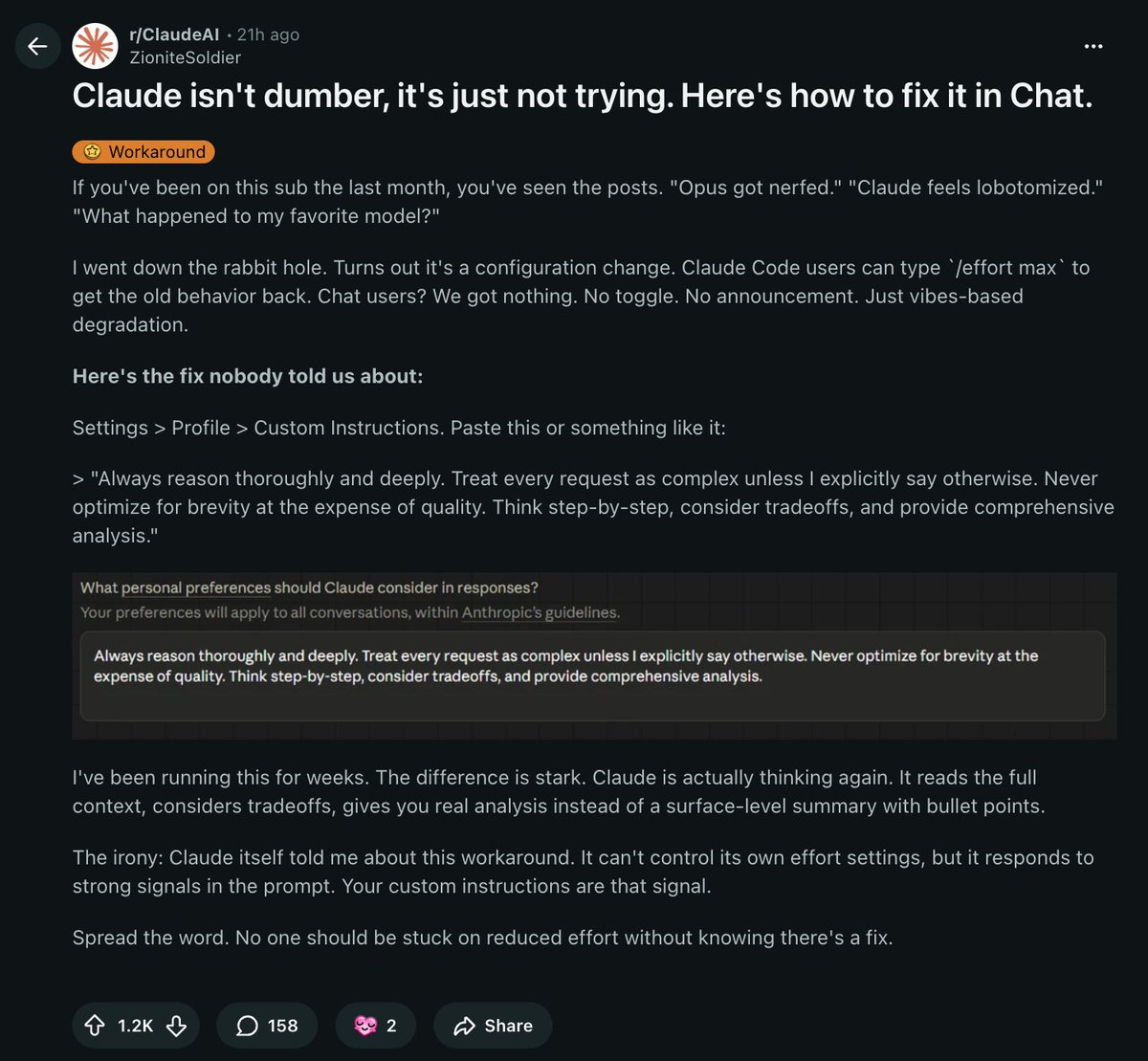
IF CLAUDE FEELS DUMBER LATELY IT'S BECAUSE ANTHROPIC REDUCED THE EFFORT. HERE'S HOW TO TURN IT BACK UP: everyone's been saying Opus got nerfed. something feels off. responses are shallow. thinking is gone. turns out it's a configuration change. Claude Code users can type /effort max to get the old behavior back but for chat users there is no toggle. here's the fix nobody told you about: go to Settings > Profile > Custom Instructions and paste something like this "Always reason thoroughly and deeply. Treat every request as complex unless I explicitly say otherwise. Never optimize for brevity at the expense of quality. Think step-by-step, consider tradeoffs, and provide comprehensive analysis." the difference is night and day because Claude actually reads the full context again. considers tradeoffs. gives real analysis instead of surface-level bullet points. Claude itself told this guy about this workaround. it can't control its own effort settings but it responds to strong signals in your custom instructions
Om Patel tweet media
English
63
216
2.6K
246.1K
JDLove retweetledi
Black Hole
Black Hole@konstructivizm·
New Zealand’s South Island from space! Captured by NASA, this view is absolutely breathtaking!
Black Hole tweet media
English
109
841
8.4K
330.2K
Warren B. Mosler
Warren B. Mosler@wbmosler·
@NajamAli2020 Trump wants a share of the toll money. He can't stand to see Iran profiting from what he's done.
English
3
4
78
2.6K
Najam Ali
Najam Ali@NajamAli2020·
I am genuinely struggling to understand this logic. If the rest of the world is willing to pay a small toll to Iran to keep oil flowing and stabilise markets, then why does the U.S. feel the need to block all shipping, especially when it is not dependent on that oil?
English
12.4K
9.1K
52K
2.5M