JD
2K posts

JD retweetledi

What multi-asset collateral unlocks for @extendedapp's roadmap:
- Alongside multi-asset collateral, we have built spot trading infrastructure (all non-USDC liquidations already route through the native spot market), leveraged spot and a lending protocol.
- As the next step, we will open spot trading to users and expand lending beyond the Extended ecosystem to support broader DeFi use cases.
- Reasonably soon, we will multiply the number of crypto and TradFi markets available on Extended, while keeping liquidity and execution quality as top priorities and upgrading spot trading to support leverage.
While multi-asset collateral is only one part of the broader vision, it is foundational to Extended’s goal of building one margin account across all markets: hundreds of crypto and TradFi perpetual markets, leveraged spot, an open lending protocol, yield products (XVS), and other trading products.
English
JD retweetledi

Multi-Asset Collateral is now live on Extended
From today, wBTC and ETH are accepted as collateral alongside USDC and XVS (Extended yield-bearing collateral). EURC and USDT are coming soon.
How it works
The system operates on a native money market, with the vault acting as the primary lender. When trading losses push your USDC balance negative and that deficit is covered by non-stablecoin collateral, you are borrowing USDC.
Borrowing rates depend on two factors: overall vault utilisation and utilisation against each specific collateral asset. For example, if demand to borrow USDC against ETH is lower than against BTC, borrowing against ETH will be cheaper.
When a user holds multiple collateral assets, borrowing is automatically allocated starting with the lowest-rate asset and moving upward, minimising the effective cost with no manual input required. We are not aware of this being implemented anywhere else in DeFi.
Example. User is down $175K on a perp and borrowing $175K USDC against a mixed book:
$50K USDT @ 1% - $500
$50K ETH @ 5% - $2,500
$75K BTC @ 10% - $7,500
Total annualised interest: $10,500. Effective rate: ~6%. Borrowing the same amount entirely against BTC would cost $17,500 annually, or 67% more.
What this means for Extended Vault
The vault is the primary lender for the entire system. All interest paid by USDC borrowers flows to vault depositors as Extra Yield, on top of the trading fees already distributed.
This creates a second, structurally independent yield stream for XVS holders. The vault earns by serving as the backbone of the margin system.

English
JD retweetledi

From our conversations with TradFi brokers, it’s clear that moving to 24/7 is quickly becoming table stakes.
To get there, most are looking at two routes: launching perps (either in-house or via partners) or extending CFDs to 24/7 and hedging the exposure externally.
When discussing the second approach, hedging CFD exposure with perps (instead of futures, leveraged spot, etc.), two structural differences stand out:
1. Deterministic liquidation vs operational margining. In TradFi, margining is rule-based but involves operational processes and potential grace periods, while in perps liquidation is fully deterministic and continuous, ensuring individual account and system-wide solvency without credit assumptions.
2. Managing funding vs rollover / borrow costs. Perp funding is realized more frequently (hourly / 8-hour), and can be significantly more volatile as it reacts in real time to positioning imbalances, compared to the smoother, benchmark-driven cost of carry in futures and financing markets.
None of those are blockers to a wider institutional adoption of perps, but rather observations on how traditional players are already adapting their ways of working to benefit from perps and DeFi.
English
JD retweetledi

Extended end of Q1 update
[TLDR]
- Multi-asset collateral launching soon
- TradFi expansion accelerating (>25 markets live, partnership coming, focused on distribution via TradFi brokers)
- Becoming more institutional-ready (pricing methodology, trading workflows)
- Building decentralised, high-throughput sequencing
[Product]
The team has completed development of multi-asset collateral margin. It is now in the testing phase on testnet and undergoing smart contract audits. We expect to launch at the end of April or early May, with support for wBTC, ETH, USDT and potentially EURC as collateral, subject to underlying liquidity.
In Q1, we also doubled down on our TradFi offering, expanding to 25+ equities, indices, FX markets and commodities with competitive liquidity. We are currently finalising an agreement with a major TradFi broker, which will both broaden our offering and help bring in flow.
The other priority for the team is making Extended more institutional-friendly across both product and trading:
- Improving the definition and transparency of fair reference pricing for TradFi markets, with a consistent and clear methodology: spot-based references for equities and FX, and futures-derived pricing for commodities and energy
- Introducing and better communicating institutional-grade features such as MPC wallet workflows, API key-only trading, and our sub-account architecture
In addition:
- With multi-asset collateral, we have built native spot markets (required to process liquidations of non-USDC balances). These will be released shortly after the cross-asset rollout.
- The team is progressing towards decentralising sequencing via an application-specific chain built on a high-throughput implementation of full BFT consensus (targeting ~50ms block times and hundreds of thousands of transactions per second).
This architecture introduces an app-chain layered on top of our existing zk-enabled stack, enabling decentralised matching and related services while preserving existing security guarantees. More details and timelines will be shared soon. Importantly, this design enables Extended tokenomics and revenue accrual to the token.
[Growth and community]
Our strategy remains consistent:
- Stay open to feedback
- Continuously iterate on the product
- Encourage organic usage
- Do not do paid marketing or paid deals
- Focus on long-term sustainability and value creation
Over the past quarter, we have gained stronger conviction that demand for perpetuals is increasing among traditional players, driven by 24/7 trading, higher leverage and deeper liquidity. As a result, we are doubling down on business development with TradFi brokers (fintechs and trading platforms). This is a long-term effort, but we believe it will be a key driver of sustainable growth.
We also have several important integrations with trading terminals coming up, both retail and institutional.
[Team]
Over the past quarter, we hired 3 new team members and are now a team of 14. As we move towards decentralising sequencing, we expect to grow to 18-20 people in the coming months.
[Market and exchange metrics]
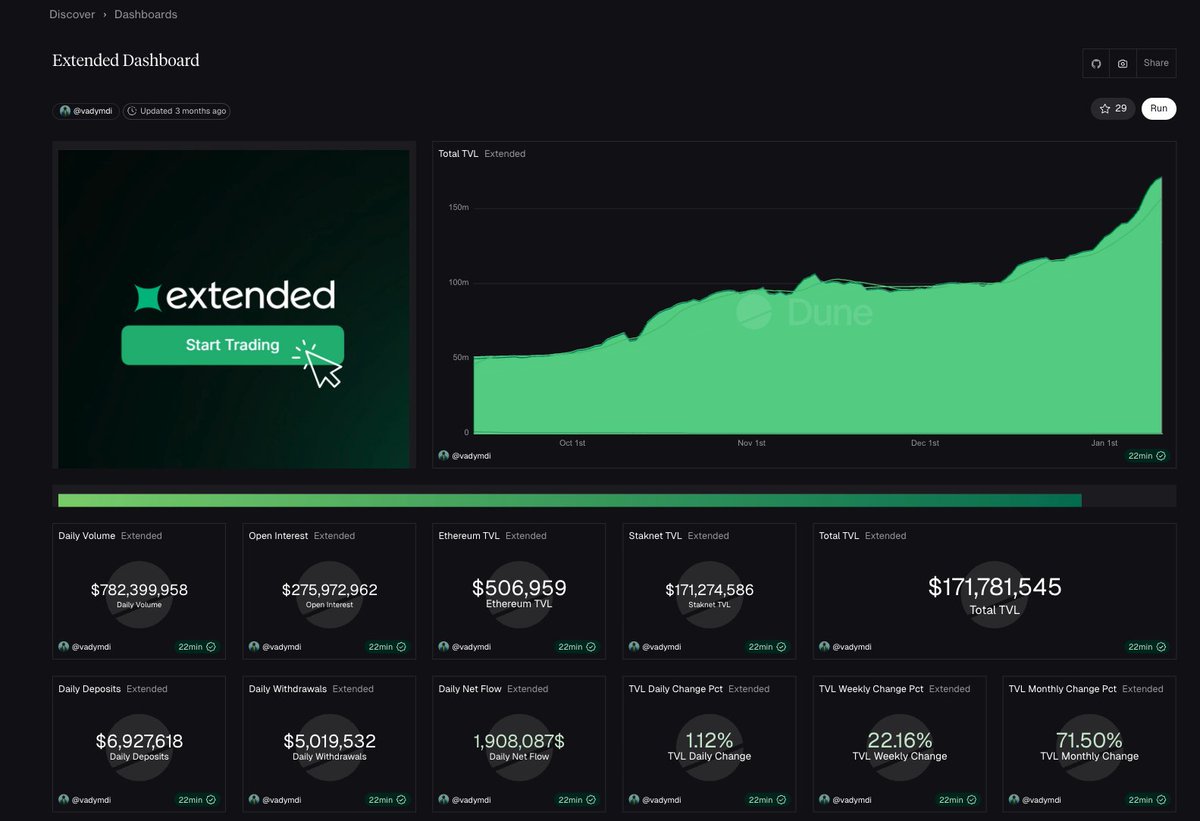
Nothing unexpected: January saw all-time highs across key metrics, followed by a broader market slowdown in February and March. All Extended metrics are public: dune.com/extended/exten…
From our perspective, short-term market conditions are less important than long-term trends. What matters is that the market we are building in continues to grow and there is room for new players. We strongly believe this is the case:
- price discovery for TradFi assets is likely to increasingly shift towards perpetuals. More on this here: x.com/rf_extended/st…
- DeFi continues to gain share versus CeFi
- Regulatory clarity is improving across both the US and Europe
English
JD retweetledi

S&P Dow Jones Indices and trade[XYZ] have joined forces to launch the first official S&P 500 perpetual contract, available exclusively on Hyperliquid.
For 69 years, the S&P 500 has been a defining reference point for global finance. Until now, access to that benchmark has been shaped by market hours, intermediaries, and geography. Today, that changes.
The S&P 500 perp is now available 24/7/365, anchored by the official index data required for deep liquidity and institutional confidence at scale.
SPDJI helped define modern indexing. They are stewards of an iconic benchmark, the standard against which portfolios across the globe are measured. We are honored to bring that legacy on-chain.
Trade[XYZ] is bringing the world's most iconic assets towards a future of global, continuous markets — a future powered by Hyperliquid.
English
JD retweetledi
JD retweetledi
JD retweetledi
JD retweetledi

You can now trade $COIN and $HOOD with up to 10x leverage
app.extended.exchange/perp/COIN-USD
app.extended.exchange/perp/HOOD-USD

English
JD retweetledi

Extended was among the first perp DEXs to launch commodities and index perps in Spring 2025.
The next step is equities.
Extended is launching its first six equity perpetual pairs. Equity perps have not yet truly scaled onchain for one reason: liquidity. Extended is building to solve it - with further updates to follow.

English
JD retweetledi
JD retweetledi

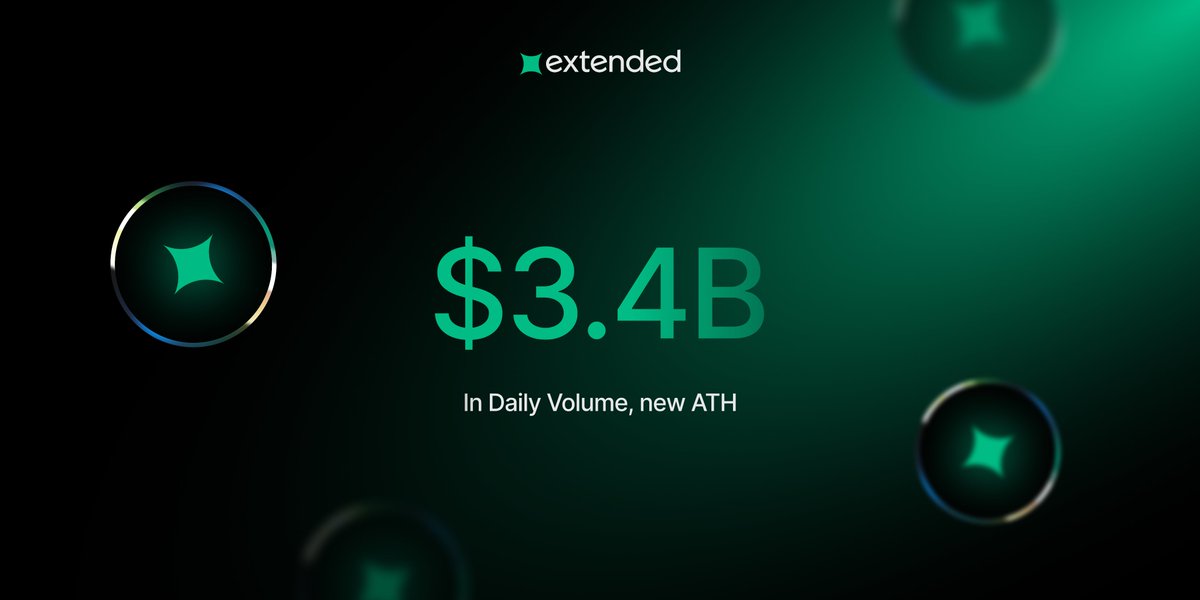
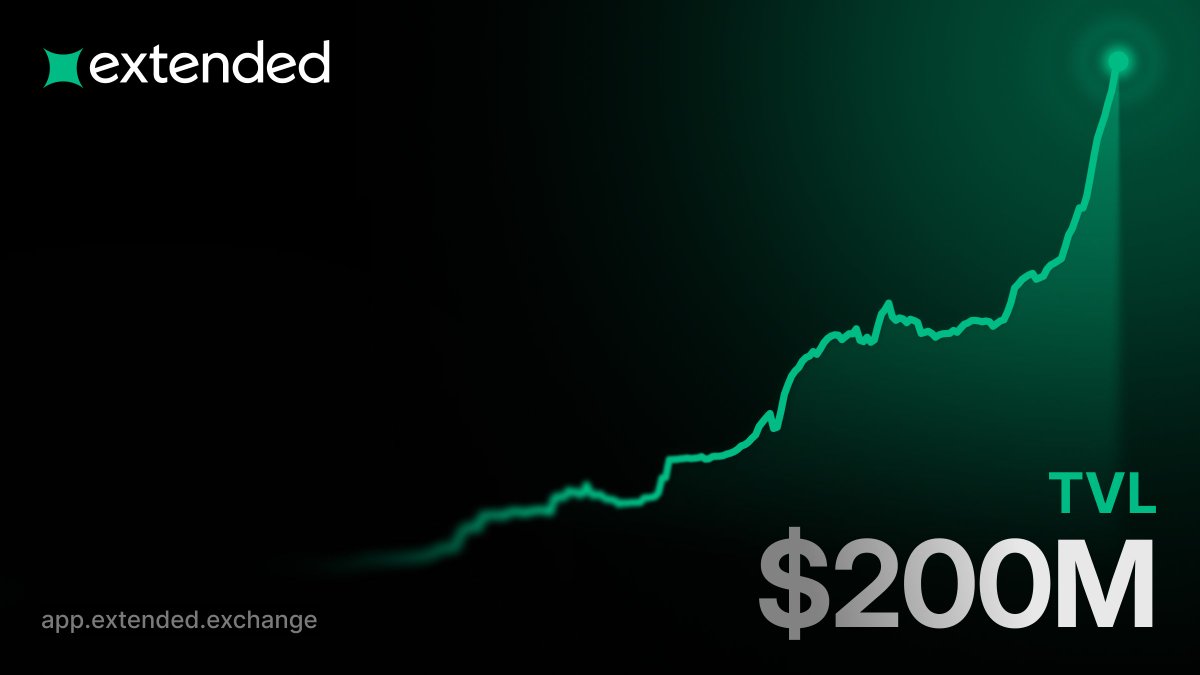
Extended reached $200M TVL
#information" target="_blank" rel="nofollow noopener">defillama.com/protocol/exten…

English
JD retweetledi


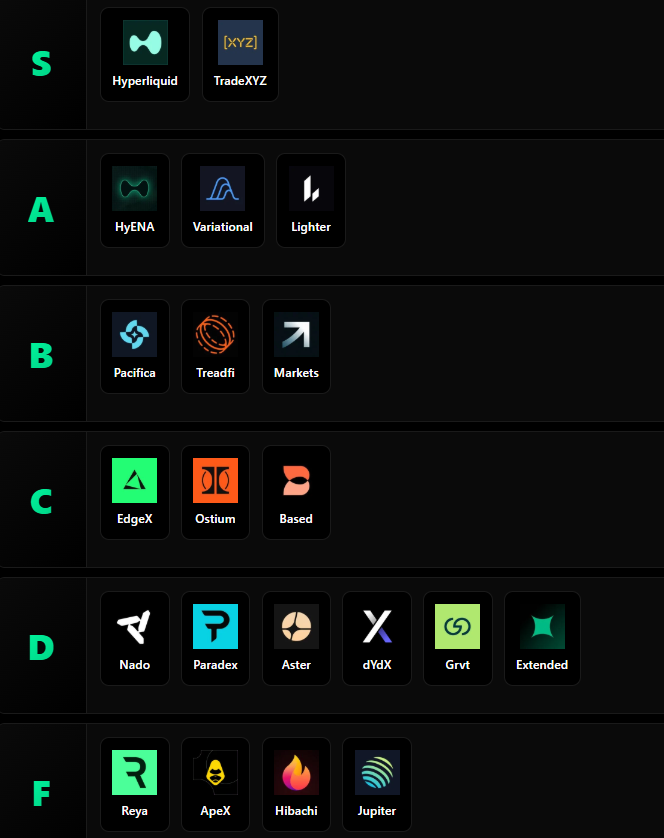
perfect perp dex tier list

farmrick.hype@Farmrick
time to settle the perp dex debate once and for all i vibecoded a tier list maker that updates votes in realtime lighter bulls, hyperliquid bulls, extended bulls, variational bulls, where you at? make your tier list & vote for the top perp dexes perpdextierlist.com inspired by @PixOnChain
English

explaining in 1 tweet why you should trade on Extended
Hyperliquid
– your HLP balance: $100,000
– your total yield: 1% APR (≈$83 in 1 month)
– your trading equity usable as collateral: $0
Lighter
– your LLP balance: $100,000
– your total yield: 4% APR (≈$333 in 1 month)
– your trading equity usable as collateral: $0
Extended
– your XVS balance: $100,000
– your total yield: 30% APR (≈$2,500 in 1 month)
– your trading equity usable as collateral: $90,000
English
JD retweetledi

Why XVS Makes Extended Structurally Different
The Extended vault generates revenue through market making activities, processing liquidations, and aggregating a share of protocol revenue, with last week’s APR at 37% (Base + Extra Yield). Its shares, XVS, are tokenized and usable as yield-bearing collateral on Extended. This means the same capital both earns yield and contributes to trading margin. Yield accrues continuously, increasing vault equity and, in turn, usable margin.
This creates a flywheel. Traders pay explicit, moderate fees, a portion of which accrues to the vault. Vault yield flows to XVS holders. Active traders receive boosted yield on the same collateral they trade with because Extra Yield scales nonlinearly with trading activity. The more they trade, the higher their league. The higher their league, the higher their yield (see: x.com/extendedapp/st…). Yield compounds back into margin, enabling more trading.
On other exchanges, vault funds are locked and trading requires separate capital. On Extended, this distinction collapses. If you are an organic trader and already hold a high league, it becomes irrational to move capital elsewhere. XVS aligns capital, user activity, and revenue into a single loop - to make the exchange economically sustainable and attractive over the long run.

English