James Dborin

7 posts

James Dborin

James Dborin

@JDborin

Co-founder of Doubleword. We solve hard LLM inference problems.

Katılım Ocak 2021
469 Takip Edilen43 Takipçiler
Sid Jayakumar
Sid Jayakumar@sidfix·
A very silly tweet follows. I was bored, on a plane, without wifi. And taking a break from the other entertainment. And realised I could probably do Foundation Model bingo. A game I invented 2 hours ago. I had to get creative for a few of them…
Sid Jayakumar tweet media
English
1
0
0
516
James Dborin
James Dborin@JDborin·
@JeffreyUrban_ @MLOpsWorld Just saw this paper pop up: twitter.com/_akhaliq/statu… This is the sort of thing that would power these networks of resource sharing models.
AK@_akhaliq

S-LoRA: Serving Thousands of Concurrent LoRA Adapters paper page: huggingface.co/papers/2311.03… The "pretrain-then-finetune" paradigm is commonly adopted in the deployment of large language models. Low-Rank Adaptation (LoRA), a parameter-efficient fine-tuning method, is often employed to adapt a base model to a multitude of tasks, resulting in a substantial collection of LoRA adapters derived from one base model. We observe that this paradigm presents significant opportunities for batched inference during serving. To capitalize on these opportunities, we present S-LoRA, a system designed for the scalable serving of many LoRA adapters. S-LoRA stores all adapters in the main memory and fetches the adapters used by the currently running queries to the GPU memory. To efficiently use the GPU memory and reduce fragmentation, S-LoRA proposes Unified Paging. Unified Paging uses a unified memory pool to manage dynamic adapter weights with different ranks and KV cache tensors with varying sequence lengths. Additionally, S-LoRA employs a novel tensor parallelism strategy and highly optimized custom CUDA kernels for heterogeneous batching of LoRA computation. Collectively, these features enable S-LoRA to serve thousands of LoRA adapters on a single GPU or across multiple GPUs with a small overhead. Compared to state-of-the-art libraries such as HuggingFace PEFT and vLLM (with naive support of LoRA serving), S-LoRA can improve the throughput by up to 4 times and increase the number of served adapters by several orders of magnitude. As a result, S-LoRA enables scalable serving of many task-specific fine-tuned models and offers the potential for large-scale customized fine-tuning services.

English
0
0
0
83
James Dborin
James Dborin@JDborin·
@pommedeterre33 I think you are right - are you trying to quantize the kv cache to get longer sequence lengths without OOM?
English
1
0
2
133
Michaël Benesty
Michaël Benesty@pommedeterre33·
I see a bunch of GPTQ implementations (LLAMA, etc.) with q4 quantization. Am I right to think it just quantizes weights, and KV cache is in FP16? (I have not yet read GPTQ paper)
English
2
0
9
1.6K
James Dborin
James Dborin@JDborin·
@pommedeterre33 I think I understand, really cool idea! Loving the larger kernl project as well.
English
0
0
1
20
Michaël Benesty
Michaël Benesty@pommedeterre33·
@JDborin We really follow the program and execute it several times, following the grid, etc. If we were transforming too much the exec, the interpreter could not be used for debugging.
English
1
0
1
22
Michaël Benesty
Michaël Benesty@pommedeterre33·
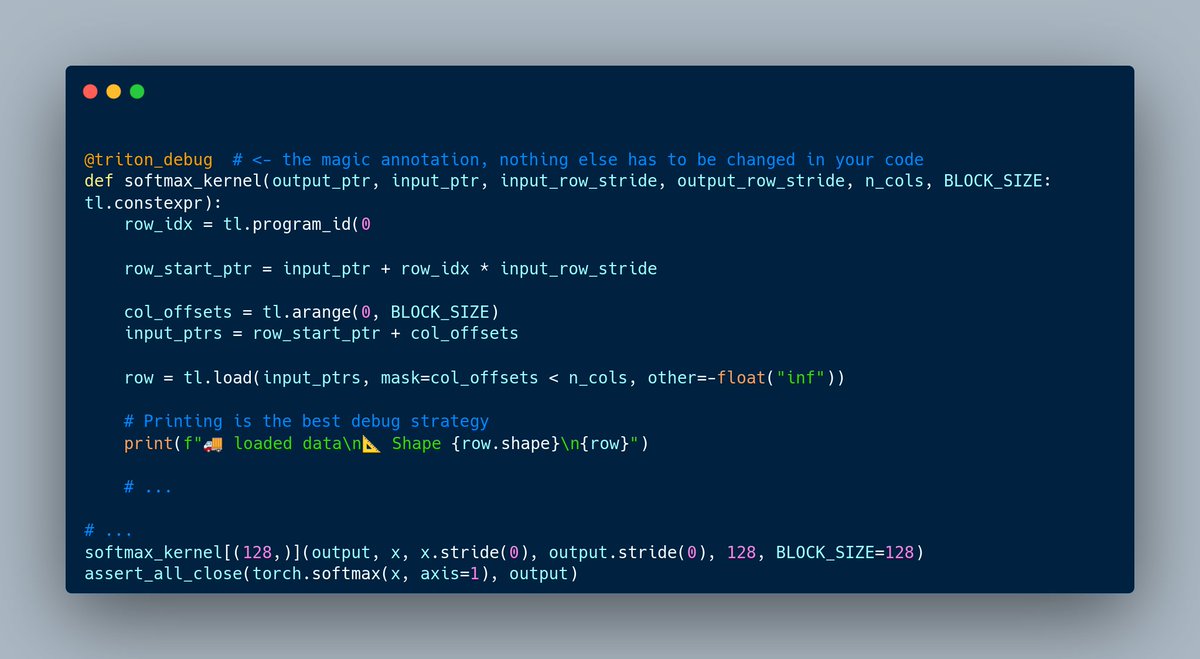
🚀@OpenAI's Triton is now #PyTorch 2.0 for epic perf boosts! It balances low-level GPU control & auto-optimization, helping us crushing some benchmarks with custom kernels. But manipulating GPU memory addresses? Sometimes tricky 😅 Our very useful hack: Triton interpreter
English
2
13
82
22.6K
James Dborin
James Dborin@JDborin·
@pommedeterre33 so you are splitting the computation into blocks indexed by the program id, doing the pytorch ops, and then combining them again at the end, using something like torch.cat?
English
1
0
0
45
Michaël Benesty
Michaël Benesty@pommedeterre33·
@JDborin Basically every ops is replaced by some PyTorch equivalent and we simulate the address management.
English
1
0
0
37
James Dborin
James Dborin@JDborin·
@pommedeterre33 is the idea that triton ops like tl.arange are replaced with pytorch equivalents?
English
1
0
1
63
Michaël Benesty
Michaël Benesty@pommedeterre33·
The idea is simple - add an annotation on top of your kernel, and your code goes to PyTorch instead of the GPU compiler. Use Python debugger, print info, check addresses, and find errors with ease! 🎯
Michaël Benesty tweet media
English
3
2
16
1.4K