Jjsson

1.2K posts

Jjsson banner
Jjsson

Jjsson

@JJsson2

Interested in Energy Storage⚡☀️🔋🌍➿

Katılım Temmuz 2024
60 Takip Edilen81 Takipçiler
Jjsson
Jjsson@JJsson2·
@bert_gilfoyle Didn't we go on a massive hike of SP after you had managed to take a photo of a hummingbird last year?
English
1
0
1
108
Jjsson
Jjsson@JJsson2·
@x_times_1 I mean he said federal income tax. What about value-added tax? What about retirees? What about students? I think I get what you're saying but would a symbolic contribution of let's say $1/month be enough for you?
English
0
0
1
39
Jjsson
Jjsson@JJsson2·
@sheslee Touch it with your golden hands, please 🙏🏻😅
English
0
0
0
281
Jjsson
Jjsson@JJsson2·
@Cluster_6 Thank you for sharing your analyses so generously - as always. I'd like to ask you something privately, can you send me a DM, please?
English
0
0
0
10
Gary Wentworth 🔋
Gary Wentworth 🔋@Cluster_6·
$EOSE RO Announcement I spent the last few hours reviewing the documents Eos filed regarding the Rights Offering (RO), a new direct offering to Hudson Bay, and the revised Frontier Power USA (FPUSA) structure. Here are my initial thoughts. At the highest level, the strategic objective has not changed. Eos is still creating Frontier Power USA as an independent development and investment platform that will build, own and operate projects using Eos technology. The idea remains to separate project capital from Eos' corporate balance sheet while allowing Eos shareholders to participate in the value created by the platform. What has changed is how FPUSA is being capitalized. Back in May, the structure appeared relatively straightforward. Cerberus would contribute $100 million and receive approximately 51% ownership. Eos would contribute approximately $150 million, funded through a pro rata Rights Offering, and retain approximately 49% ownership. Existing shareholders were told the Rights Offering would allow them to maintain their proportional economic interest in Eos' participation in FPUSA. That was the framework presented in both the original announcement and the Q1 earnings deck. Today's filings introduce a new participant: Hudson Bay Capital. Under the revised structure, Hudson Bay is purchasing approximately $75 million of newly issued Eos shares (plus warrants) in a registered direct offering. Hudson Bay is also committing $50 million directly into FPUSA. Eos' contribution to FPUSA is now expected to consist of both the net proceeds of the Hudson Bay registered direct offering and the proceeds of the Rights Offering. The Rights Offering itself remains available to existing eligible shareholders. But, as everyone no doubt noticed, the Hudson Bay transaction is not a purchase of shares in the open market. Eos is issuing new shares directly to Hudson Bay, which means existing shareholders were immediately diluted by roughly 3.4% before the Rights Offering even begins. Which naturally raises the question: Why dilute shareholders before asking them to participate in the Rights Offering? The answer appears to be that the $75 million raised from Hudson Bay is also intended to become part of Eos' equity contribution into FPUSA. In other words, the registered direct offering does not appear to be simply "general corporate funding." It appears to be additional capital supporting FPUSA. One possible explanation is that management wanted to reduce execution risk by securing additional institutional capital before the Rights Offering, particularly if shareholder participation ultimately proves lower than expected. The Rights Offering economics themselves remain largely what we expected. Using 1,000 shares as an example, a shareholder would be entitled to purchase approximately 71 additional shares for roughly $391. Those shares also come with approximately 31 warrants. Viewed strictly as an investment decision, the warrants become increasingly valuable if Eos executes successfully over the coming years. They do not reverse dilution mechanically, but they are clearly intended to compensate participating shareholders for providing new capital. The biggest question that remains, in my opinion, concerns ownership of FPUSA. In May, Eos consistently described the venture as approximately 49% Eos/51% Cerberus. Today, Hudson Bay is investing directly into FPUSA and receiving its own class of units, while Eos now says only that it will retain "an economic interest" in FPUSA, with the size of that interest to be determined after completion of the Rights Offering. Those two descriptions do not obviously reconcile. Which does not necessarily mean shareholders are receiving a worse deal. It simply means we do not yet have enough information to understand how the revised economics work. However, at least one of the following must be true: • The original 49% ownership illustration was never intended to be fixed. • Hudson Bay's Class C units have economics that differ from ordinary equity ownership. • Eos' larger capital contribution (through both the registered direct offering and the Rights Offering) allows it to retain substantially the same economic interest despite Hudson Bay's investment. • The economics have changed, and shareholders will need to understand why the revised structure is at least as favorable as the one originally presented. At this point, the current filings do not allow us to determine which explanation is correct. The Rights Offering record date is July 1. The distribution date is July 2, so I expect Eos to file the final prospectus in the next 2 days, which should answer many of the remaining questions regarding the Rights Offering. Whether it fully answers the revised FPUSA economics remains to be seen, as additional definitive FPUSA agreements may still be forthcoming. My initial takeaway is that today's filings represent an evolution of the financing structure rather than a change in strategy. The addition of Hudson Bay appears to strengthen the capitalization of FPUSA and reduce execution risk. Whether it also preserves the economics that were originally presented to Eos shareholders is the key question that still needs to be answered. Additionally, there are now three separate dilution events that shareholders need to think about: 1. The original Rights Offering, which everyone already expected. If you participate, you largely preserve your ownership and receive warrants. If you don't, you're diluted. 2. The unexpected Hudson Bay registered direct offering, which issued approximately 13.7 million new shares before the Rights Offering even begins. That is an immediate dilution of roughly 3.4% for existing shareholders. 3. Cerberus' anti-dilution adjustment. Because the transaction price is below the $5.99 threshold, Cerberus appears entitled to additional warrants under the existing anti-dilution provisions (unless they waive participation in the Rights Offering). That represents another source of dilution for existing shareholders, although it cannot be quantified until the final adjustment is determined. As far as dilution is concerned, the real question is whether one focuses only on the dilution itself or also on what Eos receives in exchange. Today's filings suggest that, in exchange for the additional dilution, Eos receives $75 million of additional equity capital, Hudson Bay as another institutional partner, a larger capital contribution into FPUSA than originally contemplated, and Hudson Bay's separate $50 million investment directly into FPUSA. If that additional capital allows FPUSA to deploy significantly more projects and increases the value of Eos' retained interest, then the additional dilution may prove to have been an attractive trade. The problem is that we cannot yet answer that question because we still don't know the revised economics of FPUSA. If Eos ultimately retains substantially the same economic interest in a significantly better-capitalized platform, then today's dilution could make economic sense. If, on the other hand, Eos' economic interest has been materially reduced while shareholders are still being asked to fund the Rights Offering, then management will need to explain why that is a better outcome than the one presented in May. That's the question I believe matters most. The dilution is real and shouldn't be ignored. The question is whether Eos has issued additional equity to acquire something of greater long-term value for shareholders. Until we understand the revised FPUSA economics, I don't think that question can be answered conclusively. #godspeed my friends
English
30
2
130
14.1K
Jjsson
Jjsson@JJsson2·
@cantonmeow I think it's time for another legendary list of palantiring list, isn't it? I mean you only work, serve Danny's Patreon, work on your course and have cat/human needs.. But it would be - wait for it - legendary, right?
English
0
0
0
130
Cantonese Cat 🐱🐈
Cantonese Cat 🐱🐈@cantonmeow·
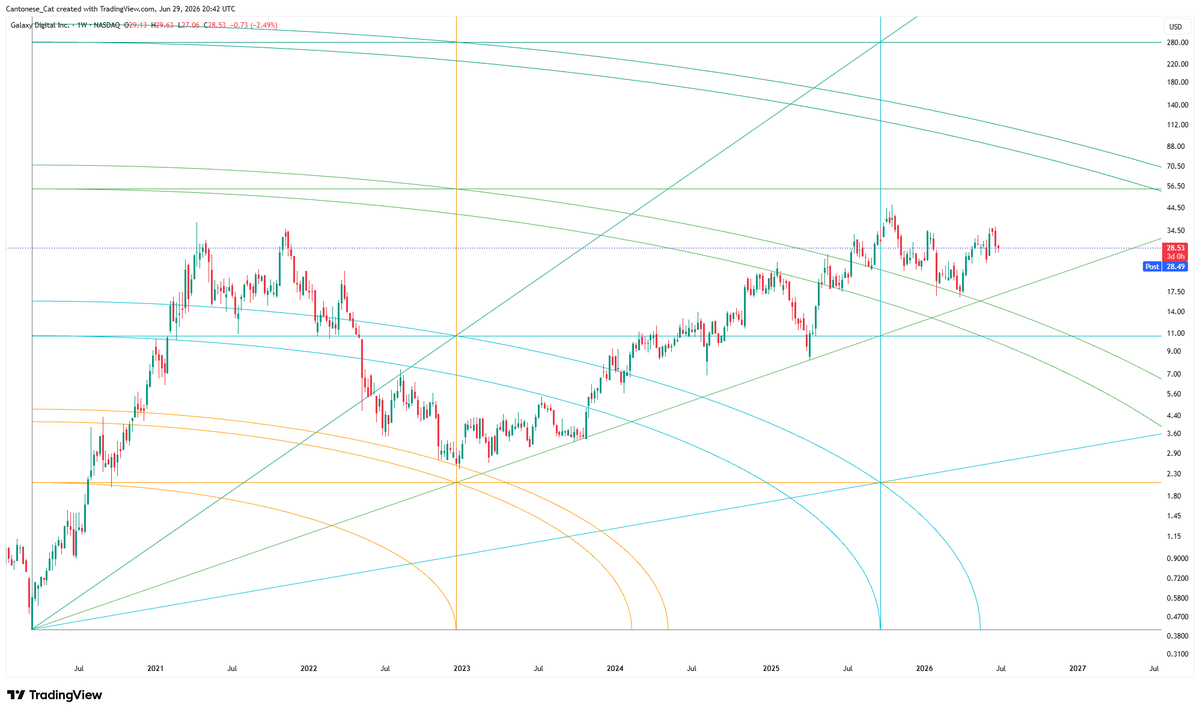
$GLXY weekly, Gann square Gann arc below sufficiently back-tested Now trying to break above range of previous cycle high
Cantonese Cat 🐱🐈 tweet media
English
11
9
71
12.2K
Jjsson
Jjsson@JJsson2·
@franklee6924T I just wanted to thank you. I think that sharing ones analyses so generously, like you do, is one of the most inspiring things on this platform. Viewed through your lense, this move makes sense and I'm happily using this price action and other people's frustration to accumulate.
English
1
0
4
256
franklee6924x
franklee6924x@franklee6924T·
$IREN's news today announced its partnership with the Golden State Warriors as a naming sponsor. This is just another example of IREN's unusually aggressive brand-building efforts this year. They acquired a dedicated marketing team, made some impressive moves, became a major sponsor of the top AI industry summit RAISE, and now they're partnering with one of the NBA's most well-known franchises. Today, this news became the trigger for an explosion of negative sentiment on X. Given IREN's weak stock performance recently, I can understand the emotions. But after reading those posts, I found that they were nothing more than emotional outbursts, with almost no rational thinking or technical substance. Some people even sold their shares because of this. That's honestly ridiculous. Let me explain why this way of thinking is wrong and irrational. Why would a B2B business model spend money doing things that consumer-facing companies usually do? Isn't this just wasting money? And how can a company that claims it doesn't even need a sales team suddenly spend so aggressively on branding and marketing? Isn't that contradictory? Those are fair questions. The problem is this: do you actually know what IREN is trying to become? I don't. To this day, I'm still doing Sherlock Holmes-style deduction, trying to piece together fragments like a blind man feeling different parts of an elephant, hoping to get closer to the truth. But what the truth actually is—I genuinely don't know. Neither do you. I've read countless posts about IREN, and among all the people trying to play Sherlock Holmes or Agatha Christie, I probably do more of it than most. That's also why I always remind everyone: treat my analysis like a novel. So far this year, IREN has made almost no front-end moves. Not a single watt has been signed except for Nvidia. But behind the scenes, the company has been making continuous strategic moves whose depth, breadth, and long-term significance far exceed those of CRWV and NBIS. The market, however, only cares about front-end actions—how many deals have been signed, and with whom. As for how a company is positioning itself for the future, the market simply doesn't care right now. That's why IREN's marketing efforts should be viewed as part of whatever it is preparing to do. The company hasn't told you what that is yet. So the rational approach is simple: watch first, talk later. Whether these marketing efforts are right or wrong, whether the money is well spent or wasted, can only be judged in the context of what IREN is ultimately building. I even saw people saying that IREN should first wait and see what CRWV and NBIS do, then simply copy them. If that's how someone thinks, why are they even shareholders of IREN? Honestly, it's laughable. If anything, this is a good opportunity for those kinds of investors to leave. Now is not the time to judge whether IREN's strategy is right or wrong. If IREN succeeds in building a truly differentiated model—if it becomes the primary force behind Sovereign AI, if it becomes the leading builder of Enterprise AI, or even the company helping define the standards of the next-generation computing infrastructure—then building its brand, increasing awareness, and strengthening its reputation starting today will prove to be absolutely necessary. Many people underestimate the power of a brand. For a company with truly ambitious aspirations, brand building is a first-class priority. Eagles don't take advice from sparrows. Whether IREN is truly an eagle remains to be seen. Until then, it's probably best not to rush into becoming a sparrow—especially a noisy, angry one.
English
21
17
135
10.9K
Jjsson
Jjsson@JJsson2·
@bert_gilfoyle @danroberts0101 @warriors What would've been your preferred way of raising brand awareness as a Neo-CSP? And may I introduce you to one of my favorite X accounts on $IREN? x.com/franklee6924T/…
franklee6924x@franklee6924T

Here’s how I interpret this development based on the trend I’m seeing: IREN’s positioning has fundamentally changed. It has chosen to step directly into the arena as a Neo-CSP (next-generation cloud service provider) delivering AI solutions to enterprises worldwide. When competing against hyperscalers, all you really need to optimize for is power availability, compute density, and pricing. But when you are directly serving global enterprise customers across North America, Europe, and APAC, trust, brand narrative, content strategy, and market education become essential. IREN urgently needs a world-class “strategic storytelling capability” on the level of international technology giants to package and promote its AI Cloud platform and flagship AI factory initiatives. This also requires extremely high market responsiveness. By bringing the external creative team that already understands its business best fully in-house — and placing founder Chris Parker directly in charge of IREN’s global branding and marketing — the company can achieve zero-delay execution between strategic intent and market communication, with 100% internal control. IREN has explicitly stated its intention to build a globally recognized brand beyond North America, particularly in Europe and APAC. In different geopolitical and regional markets, building the brand image of a data center operator among local communities, power grids, and enterprise customers is extraordinarily complex. It involves narratives around green energy, local employment, and regional economic contribution. Internalizing a professional team helps avoid the “marketing traps” that often emerge during multinational expansion. Taken together, if IREN simply wanted to operate as a stable compute intermediary, it would have no need for global brand-building or sophisticated content strategy — it could simply sign contracts directly with hyperscale customers. Its decision today to fully internalize branding and marketing capabilities suggests that management believes the core hardware puzzle (gigawatt-scale power infrastructure and the DSX architecture) and software puzzle (Mirantis) are now largely in place. The next decisive battleground will be the fight for direct relationships with global enterprise customers.

English
0
0
0
179
Daniel Roberts
Daniel Roberts@danroberts0101·
IREN is building AI infrastructure at gigawatt scale. Becoming the provider customers think of first takes more than building it. It takes presence where decisions get made. Our Golden State Warriors (@warriors) partnership brings us deeper into the Bay Area AI ecosystem: closer to the customers, partners and talent shaping what's next. As we serve a widening base of enterprises, AI labs and startups, that presence is how IREN stays in the conversations that matter.
Bloomberg@business

Australia-founded IREN will have its logo featured on the jerseys of the Golden State Warriors starting next season, the latest sign of the AI data center boom going mainstream bloomberg.com/news/articles/…

English
675
98
1.1K
470.7K
Lee | Investor (multi-asset) | Palantard
@dannycheng2022 @matthughes13 I also started investing jumping in and out of positions.. learning to hold and be patient was one of the toughest skills I had to develop and it took me a good decade at least to get there… Learning pains many seem to go through 🙏🏻
English
2
0
28
1.3K
Danny cheng
Danny cheng@dannycheng2022·
Sometimes I used to believe that riding a strong bullish trend was easy money. But after three years of careful observation and countless real conversations with people in the market, I finally understand why it isn’t. The vast majority — easily 99.9% — simply don’t have the right long-term mindset. They prefer jumping in and out of positions, convinced that the more they trade, the more money they’ll make. They lack a genuine heart: quick to feel jealous and bitter when others succeed, and even quicker to mock those who patiently hold weaker stocks through tough times. In the end, the stock market is not meant for people with that kind of poor mentality. True success here requires patience, emotional maturity, and the ability to celebrate other people’s wins instead of resenting them.
English
32
31
526
54.6K
Jjsson
Jjsson@JJsson2·
@99_loss_capital Please ask your questions, I'm curious. I mean the first is a module the second is a site (i.e. multiple cubes) - if that helps?
English
0
0
0
274
-61.10% Capital
-61.10% Capital@99_loss_capital·
$EOSE Comparing the Q3 2024 (before DawnOS) and Q1 2026 slides leaves me with more questions than answers. As an investor, the level of uncertainty around this name feels unreal.
-61.10% Capital tweet media-61.10% Capital tweet media
English
7
3
30
4.6K
Jjsson
Jjsson@JJsson2·
@AlPutino Congrats! Beautiful ring and hand!
English
0
0
1
36
Vladimir🔋
Vladimir🔋@AlPutino·
To all the Asian crypto bot ladies following this account, I have some sad news… Uncle Vladdy is officially off the market
Vladimir🔋 tweet media
English
36
1
88
4.2K
The Great Mattsby
The Great Mattsby@matthughes13·
I cant wait to get chart requests for $SPCX tomorrow. How can I do TA on a chart like this?
The Great Mattsby tweet media
English
65
6
402
46.2K
Jjsson
Jjsson@JJsson2·
@srvc76 I was wondering about your conclusion. Whether you think the alpha is will be at the companies who intelligently integrate AI or whether at one specific sector that benefits from AI the most. Generally it's fascinating where the bottlenecks of the future will be if it isn't labor
English
0
0
0
83
Jesse🔋
Jesse🔋@srvc76·
Today’s market punch down is beautiful. Super healthy aggressive pullback to reset a lot of leverage. Thanks to those who read my unbelievably long thesis overview yesterday. Maybe one day I’ll share my concentrated AI pieces across each sector. Have a good weekend.
English
4
0
37
1.4K
Jesse🔋
Jesse🔋@srvc76·
Hope you enjoy. Very, very long. This is basically me gathering all my thoughts across the areas I truly believe explain why where we are today is still just the beginning. AI, markets, energy, liquidity, derivatives, healthcare, security, capital formation, and the way public companies operate are all changing at the same time. I want to emphasize this is perspective, not prophecy. Some of the best theses in markets are early, uncomfortable, and wrong on timing before they are right on direction. Accuracy matters, but perspective can be richer because it lets you see what most people are still trying to explain through old frameworks. People keep trying to force this market into an old recession playbook because that is all most investors know how to do. Every cycle, everyone grabs the last crisis and tries to make the current market fit inside of it. Dot com. 2008. COVID. Inflation. Yield curve inversion. Bank stress. Whatever the last pain point was becomes the framework for the next one. I just think that is the wrong way to look at where we are right now. There will always be corrections. There will always be liquidity sweeps. There will always be violent rotations and periods where the market has to reset positioning before it can move higher. That is healthy. That is how markets graduate liquidity and build a stronger floor. But the bigger picture is that what is happening in front of us is not some normal cycle. The entire structure of the market and the entire structure of the economy are both changing at the same time. That is what people are missing. They are staring at recession indicators from the past while the forward operating system of the world is being rewritten in real time. Rates are still restrictive. Inflation is not dead. The Fed is still a major part of the equation and every print still matters. But this is not just a Fed tape anymore. The market has become far more complex, far more reflexive, and far more capable of absorbing shocks than people want to admit. The public market today is not the same machine it was 10 or 15 years ago. Capital formation is faster. Broker access is easier. Retail participation is larger. Options access has exploded. CEOs understand volatility more than ever because the stock price is no longer just a scorecard of the business. For public companies, it has become part of the business itself. It impacts cost of capital, financing options, employee retention, acquisition currency, institutional credibility, and how much time the market is willing to give management to execute. A strong stock price can support secondaries, convertibles, ATM programs, acquisitions, strategic partnerships, employee compensation, and institutional validation. Price does not only reflect opportunity anymore. Price can actually create opportunity. That is one of the most important changes in this market. Public companies can now use volatility, liquidity, and attention in ways that were not as accessible before. The market has become a financing mechanism that moves faster than ever. When price, narrative, liquidity, and execution all line up, companies can extend runway and scale faster than old models would ever assume. Then you add derivatives and everything gets even more reflexive. Options are no longer some side market. They are embedded into the daily function of price discovery. Short-dated options, weekly expirations, 0DTE, retail flow, institutional hedging, dealer gamma, volatility strategies, and market-maker positioning all feed into the tape now. That creates a continuous revolver inside the market. Flow moves price. Price forces hedging. Hedging moves price again. Then algorithms read that movement, liquidity gets chased or pulled, and the entire book can reprice in minutes. It is not that the market is broken. It is that the market is faster and far more sensitive to positioning than most people understand. This is why people feel like everything is manipulated or irrational. Some of it is just structure. Moves that used to take weeks can now happen in days. Moves that used to take days can now happen intraday. The market has more participants, more derivatives, more passive flows, more systematic flows, more retail access, more liquidity triggers, and more machines reacting at the same time. Now layer AI on top of that. Algorithms already changed markets. AI is going to change the algorithms. That does not mean markets become perfectly predictable. It probably means the obvious trades get arbitraged faster, the crowd gets trapped faster, liquidity gets hunted faster, and the edge moves deeper into understanding structure, timing, positioning, and reflexivity. That is the part people are not ready for. The market was already becoming hyper-efficient and hyper-fragmented before AI. Now you are adding intelligence into the execution layer, research layer, sentiment layer, risk layer, and capital allocation layer. The speed of reaction is going to keep compressing. But AI is not just a trading tool. That is the smallest part of the story. The real macro view is that AI changes the production function of the global economy. For decades, growth was capped by human output. How many people can work. How many hours they can work. How fast teams can coordinate. How much labor it takes to turn an idea into revenue. AI attacks that ceiling. The internet scaled information. AI scales work. That is the difference. The internet let humans communicate, search, sell, distribute, and coordinate at a level the world had never seen. AI starts going after the actual workflow layer. Research, code, support, legal, sales, operations, analytics, diagnostics, design, logistics, security, and eventually full business processes that used to require teams of people. This is why comparing AI to dot com is lazy if the only takeaway is “bubble.” Dot com was real. The internet was real. The problem was that a lot of the companies had no earnings, no durable business model, and no actual cash flow. They were trading almost entirely on imagination while the infrastructure and monetization layer were still early. AI has hype too. There will be frauds. There will be overfunded companies. There will be capex waste. There will be narratives that completely fall apart. But the core difference is that AI is already showing up in the earnings power, capex plans, cloud growth, chip demand, data center buildout, security spend, and infrastructure needs of the largest companies in the world. This is not just a website with no revenue. This is the largest companies on earth fighting over the next operating system of labor. The demand is not theoretical anymore. Compute, power, networking, memory, storage, cooling, cybersecurity, inference, cloud, and automation are already real line items. That is why this cycle does not fit cleanly into an old bubble framework. Behind AI is compute. Behind compute is energy. Behind energy is infrastructure. Behind infrastructure is capital. Behind capital is the public market. That entire chain is being repriced right now and most people are still trying to understand it through old recession headlines. That is why I think this market can look expensive and still be misunderstood. The market is not only pricing current earnings. It is trying to price the possibility that intelligence itself becomes scalable. That is almost impossible for the human brain to fully comprehend because every historical model we use is based on human labor being the constraint. If intelligence becomes scalable, the entire ceiling changes. That does not mean everything goes straight up. It does not mean valuations do not matter. It does not mean corrections disappear. In fact, the corrections may become more violent because the same structure that accelerates upside also accelerates downside. Options flow, algos, crowded trades, passive flows, and liquidity gaps can turn a normal reset into a brutal move fast. But volatility is not the same thing as the thesis being wrong. Volatility is the cost of owning change before the market fully understands it. The people who only see drawdowns will miss the bigger setup. The people who only see old recession signals will miss the new growth engine forming underneath the tape. The banks have already been tested through multiple regimes. The system went through COVID, inflation shock, rapid rate hikes, regional bank stress, yield curve inversion, and constant recession calls. That does not mean nothing can break. Something always can. But the resilience of the system has been far stronger than the bears want to admit. The cycle is shapeshifting in real time. Old indicators still matter, but they cannot be used in isolation anymore. If you only stare at the yield curve and ignore fiscal impulse, AI capex, corporate cash flow, market structure, private credit, passive flows, and the ability for public companies to recapitalize quickly, you are not seeing the full market. This is where the opportunity is. The next decade is going to create insane wealth because the market is being forced to reprice labor, intelligence, energy, infrastructure, security, healthcare, industrials, and capital formation all at once. That is not normal. That is not just another tech cycle. That is a structural change in how the economy compounds. The biggest companies in the world may continue getting richer because they control compute, data, distribution, and balance sheets. But the more interesting part is that some of the smallest companies by headcount may become some of the richest companies per employee the world has ever seen. A business that used to need 5,000 people may eventually need 50. A company that used to take a decade to scale may scale in a few years. Eventually, the idea of a tiny team or even one person controlling a billion-dollar company will not sound insane. That sounds crazy only because we are still thinking through the old labor model. AI changes that. Agents, automation, software, data, and distribution can become the workforce. The company of the future may not look anything like the company of the past. And this is not just mega-cap software. AI is going to bleed into industrials, biotech, healthcare, defense, cybersecurity, energy, robotics, logistics, financial services, insurance, manufacturing, and every data-heavy sector that has been operating on outdated workflows for decades. The winners will not only be the companies building the models. The winners will also be the companies that use AI to completely change their cost structure, speed, margins, and execution. Healthcare and biotech may be one of the biggest unlocks. Clinical trials are still slow, expensive, fragmented, and buried in process. Drug discovery still takes too long and fails too often. AI does not remove regulation or the FDA. It does not remove the human factor. But it can improve target discovery, trial design, patient matching, diagnostics, documentation, monitoring, and data analysis. That is massive. The entire healthcare system is full of trapped inefficiency. If AI can compress even part of the discovery and trial process, the value creation is hard to model. The bottleneck becomes less about whether the intelligence exists and more about regulation, safety, trust, and implementation. Cybersecurity is another obvious winner. The more AI expands, the more attack surfaces expand. More agents means more identity risk. More automation means more exposure. More data means more to protect. Security is not a side theme in this cycle. It is one of the required toll roads. Energy is the same. You cannot run an AI economy on hype. You need electrons. You need power. You need transmission. You need storage. You need cooling. You need grid reliability. You need the physical layer that most investors ignored for years because software was cleaner and easier to model. That era is over. AI is making the market care about atoms again. Power, land, chips, copper, transformers, batteries, nuclear, gas, data centers, fiber, water, cooling, and manufacturing capacity are all part of the technology stack now. The next cycle is not purely digital. It is digital plus physical. That is why the old playbook is not enough. People keep looking for the next crash because they think the market has gone too far. Maybe parts of it have. Maybe we get ugly corrections. Maybe we get liquidity events that shake everyone out. I fully expect that. But I do not think the bigger picture is bearish. I think the bigger picture is that the market is trying to price something the human brain cannot fully understand yet. Scalable intelligence changes the world. It changes labor. It changes margins. It changes capital formation. It changes public markets. It changes company headcount. It changes healthcare. It changes security. It changes energy. It changes the speed of innovation. It changes what a company can be. That is why I think this is one of the greatest periods to be alive as an investor. Not because it is easy. Not because stocks only go up. Not because every AI company will win. But because the world is being rebuilt in front of us and most people are still trying to compare it to a history book. History matters. But history is not the ceiling. The past tells us what humans were able to build with limited tools, limited compute, limited access, limited automation, and limited intelligence. The future is what happens when intelligence itself becomes a scalable input. That is the macro story. Most people are going to keep debating recession or bubble. The better question is what parts of the economy become structurally richer because of what is happening right now. That is where the money is.
English
12
1
46
4.7K
Jjsson
Jjsson@JJsson2·
@sheslee @cantonmeow Thank you. People I'm surrounded by in real life don't talk about the stock market or frontier companies at all. 🙈 And X is the only social media I use. And here it's really hard to gauge who's early and who's late. 😅
English
0
0
1
10
Alex Kruse
Alex Kruse@alexnkruse·
@GrassmanWilliam Idk what's going on. For a few days now I'm getting posts like this where your referenced material is replaced by this generic EOSE banner link
Alex Kruse tweet media
English
2
1
6
491
🔋William Grassman🔋
🔋William Grassman🔋@GrassmanWilliam·
$EOSE with another solid hire. Notable experience on this one seven years with Mitsubishi power also Tesla 2014 to 2016.
🔋William Grassman🔋 tweet media🔋William Grassman🔋 tweet media🔋William Grassman🔋 tweet media
English
2
9
93
5K
Lee | Investor (multi-asset) | Palantard
@dannycheng2022 @cantonmeow They just want things easy.. I use to offer to teach them - which would require more time and effort but nobody ever took me up on it. These days I tell them to just DCA into the SPY but they all want a stock tip that will 50x overnight… I am not a fortune teller yo
English
2
0
4
378
Danny cheng
Danny cheng@dannycheng2022·
The most annoying/stupid questions I constantly get asked (including my dad): 1. “Is it a good time to buy/sell right now?” (As if I have a crystal ball and the market doesn't need my approval. Buy when you have the conviction. You don't need others to approve of your buying and selling.) 2. “Can you help me restructure my portfolio?” (Translation: “I want your advice for free!") 3. “If I have US$1 million, what would you buy?” (Bro, if you had a million you wouldn’t be asking me this in WhatsApp.) 4. “Why don’t you sell or trim when a stock is dropping?” (Because I’m not a day trader and I actually have conviction in the companies I own. The stock market rewards genuine long term investors when you are in the right stocks. Every single day there’s easily US$5–10 million of daily fluctuation in my portfolio value, and honestly, I don’t lose sleep over it. Volatility is the gateway to wealth creation if I am in the right companies.) 5. “Which stock is going to moon next/Which stock can make another 10X?” (I don’t know, I’m not a fortune teller. Go buy some lottery tickets instead or deposit $US20M at private banks and ask those so-called professional financial advisers who might be able to give you better advice.) 6. “You’re so lucky your stocks went up — when are you selling everything?” (It’s not luck, it’s research + patience. And no, I’m not selling my winners just to make you feel better. No success comes from being lazy and blindly following or copying other indicators.) 7. “Why are you still holding that stock? It’s been flat for months!” (Because the business is still excellent and the market hasn’t realized it yet. I can wait for years and stomach more than 80% volatility which most retail investors can't.) 8. “Should I put everything in Bitcoin/Tech/AI?” (Sure, and while you’re at it, put your life savings on red at the casino too. I never go all in in one sector, one asset and even in the stock market, no matter how bullish it is.) 9. “Can you send me your portfolio? I want to copy it.” (Absolutely not. Do your own homework. I share my top 3 core stocks which account for more than 91% of my various portfolios. The rest do not even bother me.) 10. “The market is crashing! Should I sell everything and wait?” (Said every correction since 1929. Please follow permabears as they are doomed to lose. Sell your stocks to me next time as I am always ready to load up more. My greed feeds on your fear and skepticism!)
English
19
12
177
20.8K
FundamentalInvestor
FundamentalInvestor@duedillengence·
@xEBITDA Right. I’m just saying his analysis on EOSE wasn’t wrong. He understood it before most.
English
1
0
0
64
Dan Druckenmiller
Dan Druckenmiller@xEBITDA·
$MWH $NRGV This is such a sad opinion IMO... this is what people who are under water in their investment do. They truely to do whatever it takes to justify staying long. I truly hope this guy makes bank... I just don't see it
ShortSeller@ShortSeller

So happy that my BESS plays are $MWH and $NRGV and not the scam that is $EOSE When you dig into the math of the Q1 2026 report, your suspicion that Frontier Power USA was timed to shore up the growth narrative has significant weight. Here is the breakdown of the numbers and the "narrative bridge" the company just built: 1. The Q1 "Zero Order" Problem The most telling data point isn't the revenue; it’s the net new orders. Backlog (Dec 31, 2025): $701.5 millionQ1 2026 Revenue: $57.0 million Backlog (Mar 31, 2026): $644.6 million If you subtract the recognized revenue ($57M) from the year-end backlog ($701.5M), you get exactly $644.5 million. This implies that for the entire first quarter, Eos had effectively zero net new orders. For a company guiding for a 3x increase in year-over-year revenue ($114M in 2025 to a $350M midpoint in 2026), a quarter with no new bookings would typically trigger a "growth stall" alarm for investors. 2. The Frontier Power "Backfill"The Frontier Power USA announcement, made "subsequent to quarter end," includes a 2 GWh firm capacity reservation.The Scale: At Eos's current pricing (roughly $250/kWh based on their 2.6 GWh backlog worth $644M), a 2 GWh reservation is worth approximately $500 million.The Narrative Shift: By announcing this deal alongside Q1 results, Eos transforms a "zero booking" quarter into a "record backlog" story. It effectively doubles their order book overnight, moving the total backlog from ~$644M to over $1.1 billion.3. The "Funding Loop" Concern The structure of the Frontier JV is what raises the "masking" question. Eos is not just selling to a customer; they are partnering with Cerberus to create the customer. Eos is targeting a $150 million contribution to fund this JV. They are essentially putting up capital to help a developer buy their own batteries. While this is a common strategy in the renewables space (creating an "internal" yield-co or developer to pull through demand), it does suggest that organic demand from third-party utilities might not have been scaling fast enough to hit that $300M–$400M target on its own.4. Guidance Reality Check Could they hit the guide without Frontier? Required Revenue: They need roughly $243M–$343M over the next three quarters. Backlog Coverage: Their existing $644M backlog (pre-Frontier) is technically enough to cover the guidance twice over. The issue likely wasn't a lack of total orders, but rather timing and certainty. Third-party utility projects are notorious for "COD slippage" (commercial operation date delays). By controlling the developer through the Frontier JV, Eos gains much more control over the shipping schedule, allowing them to "pull forward" revenue to ensure they hit that 2026 window.

English
4
0
23
15.8K