
Juanma Vergara

7.7K posts

Juanma Vergara banner
Juanma Vergara

Juanma Vergara

@JMVergara97

MSc. Finance & Economist @UCEMA_edu | Never bet your lifestlye

Buenos Aires, Argentina Katılım Ocak 2019
357 Takip Edilen27.6K Takipçiler
Juanma Vergara retweetledi

Quique
Quique@quiquecuttela·
Mis 2 ctvos, si una empresa te gustaba a 100 usd., compraste, corrigió a 90, volviste a comprar, y ahora cotiza a 80 usd. teniendo en cuenta q no cambiaron mucho los fundamentals. No está mal volver a comprar, vende más decir “no se agarra un cuchillo cayendo”, “no se promedia un mal trade” etc. pero es una maratón no una carrera de 100 metros, no se puede conocer la vela de la derecha, pero en largo plazo las cosas se acomodan.
Español
27
15
298
35.5K
Juanma Vergara retweetledi
Elon Musk
Elon Musk@elonmusk·
Optimus
English
12.8K
28.1K
280.8K
98.2M
Juanma Vergara retweetledi
The Kobeissi Letter
The Kobeissi Letter@KobeissiLetter·
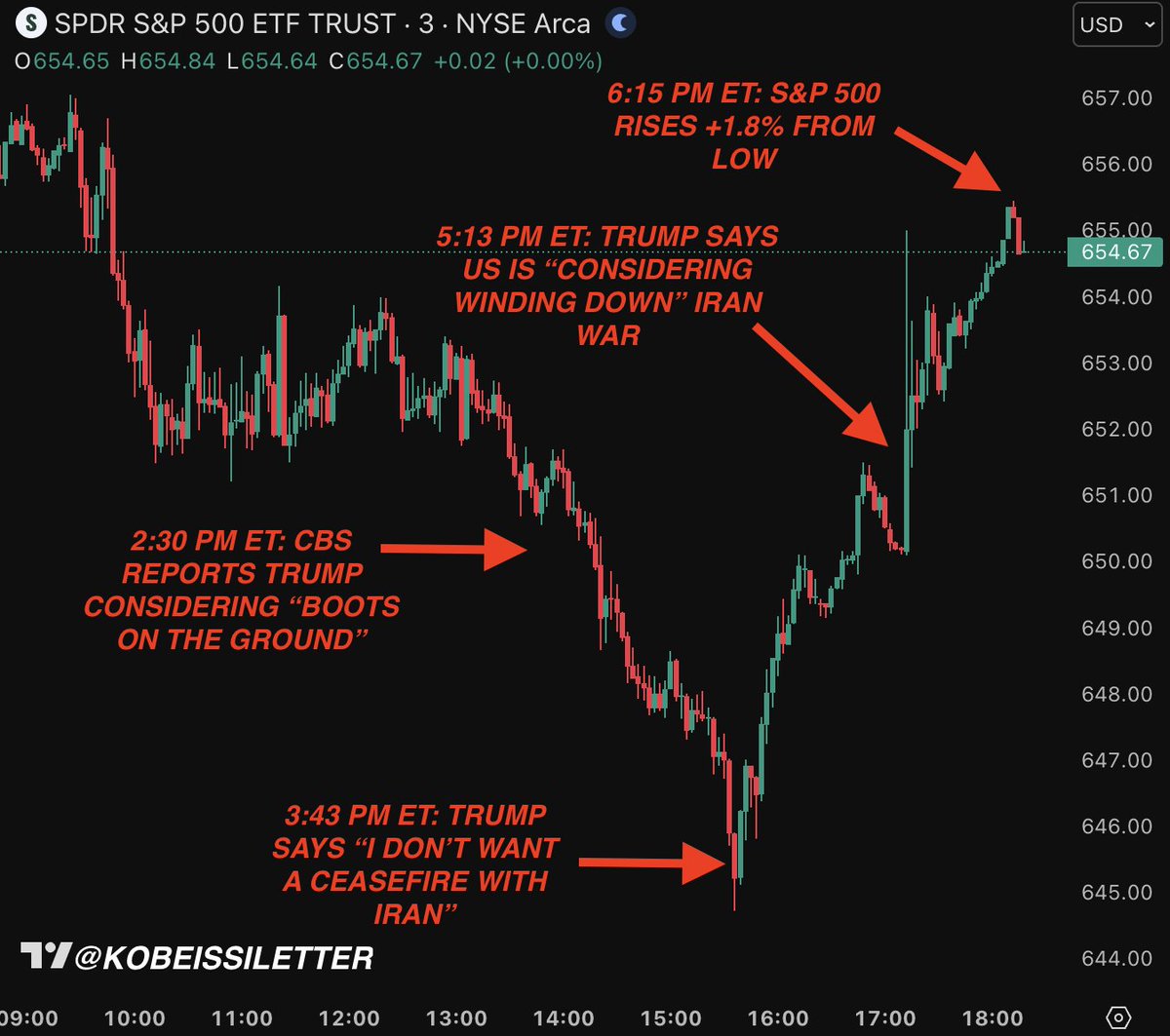
What just happened? At 2:30 PM ET today, CBS News reported that President Trump was considering "boots on the ground" in Iran. Then, at 3:43 PM ET, President Trump said "I don't want to do a ceasefire with Iran," with the S&P 500 hitting a new 2026 low. Exactly 90 minutes later, at 5:13 PM ET, President Trump said the US is "considering winding down" the war with Iran. Between the 3:43 PM ET and 5:13 PM ET comments, the S&P 500 had already risen nearly +1% on NO news. By 6:15 PM ET, the S&P 500 rallied +1.8% from its low, adding +$900 BILLION in market cap. Markets are now closed until Monday.
The Kobeissi Letter tweet media
English
889
2.3K
10.6K
3M
Juanma Vergara retweetledi
Max Capital
Max Capital@maxcapital·
Tu app de Max Capital ahora conversa con vos. ✨ Lanzamos nuestro Asistente IA: preguntale por tu cartera, rendimientos u operaciones y recibí respuestas inmediatas. Es la evolución en tu forma de invertir. Una experiencia más ágil y simple, con tu asesor de siempre a un mensaje de distancia para cuando lo necesités. 🤝 📲 Descargá la app y probalo: onelink.to/maxcapital-ia
Español
1
13
27
4.5K
Juanma Vergara retweetledi
Anish Moonka
Anish Moonka@anishmoonka·
Every additional minute your toddler spends on a screen, they hear about 7 fewer words from you. By age 3, they also make 5 fewer attempts to talk back and lose one back-and-forth exchange with a parent. That’s from a 2024 JAMA Pediatrics study that put speech-recognition recorders inside actual homes across Australia. The 49% stat in this tweet is real. It comes from a 2017 study at SickKids Hospital in Toronto that tracked 894 children aged 6 to 24 months. For every 30 minutes of handheld screen time per day, the risk of a child being slow to form words and sentences increased by 49%. But only the speech output was affected. Gestures, body language, and social interaction were all fine. The mechanism is displacement. A toddler’s brain learns language through something researchers call “serve and return”: baby babbles, parent responds, baby tries again. That loop is how the brain’s language wiring gets built. When a screen is on, that exchange drops off. And we can now see it on brain scans. A 2020 JAMA Pediatrics study at Cincinnati Children’s Hospital scanned the brains of 47 kids aged 3 to 5. Kids with more screen time had weaker white matter, the insulation around nerve fibers that helps different parts of the brain talk to each other. The weak spots were in the exact areas that control language and early reading. A 2023 study at Tohoku University in Japan followed 7,097 children from birth. More screen time at age 1 was associated with higher rates of communication delays at ages 2 and 4. Each additional hour widened the gap. The AAP recommends zero screen time for children under 18 months, except for video calls. The average child under 2 already gets over an hour a day. But a 2023 systematic review found that when kids with speech delays stopped using devices for six months, 36.7% showed measurable improvement. The word in the tweet is “destroys.” The data says it’s closer to “delays,” and in many cases, delays that respond when the screens come off.
All day Astronomy@forallcurious

🚨: Screen time destroys toddler's brains. For every 30 minutes, the risk of speech delay increases 49%.

English
49
1.5K
9.5K
2.2M
Juanma Vergara retweetledi
Fernando Boggione
Fernando Boggione@fboggione·
Polymarket bloqueado en Argentina No se dejen engañar con los titulares que se dio de baja por un insider del Indec como menciona Clarin: clar.in/4be6jen Lo relevante de la nota es quienes denunciaron: - Lotería de la Ciudad de Buenos Aires (LOTBA) - Cámara Argentina de Salas de Casinos, Bingos y Anexos (CASCBA) No se trata de cuidar a la población del flagelo de la ludopatía Se trata de eliminar la competencia en ser proveedores del juego
Daniel Osinaga@dosinaga2

Hay una cuenta en polymarket que se creo hace unos días y lo único que opera y viene comprando es inflación entre 2.8 y 3 para febrero. Un insider del INDEC?

Español
7
74
533
35.7K
Juanma Vergara retweetledi
RVM
RVM@0xrvm·
"Wait for clarity" is the most expensive advice.
English
0
2
3
901
Juanma Vergara retweetledi
Rohan Paul
Rohan Paul@rohanpaul_ai·
Citadel Securities published this graph showing a strange phenomenon. Job postings for software engineers are actually seeing a massive spike. Classic example of the Jevons paradox. When AI makes coding cheaper, companies actually may need a lot more software engineers, not fewer. When software is cheaper to build, companies naturally want to build a lot more of it. Businesses are now putting software into industries and tools where it was simply too expensive before. --- Chart from citadelsecurities .com/news-and-insights/2026-global-intelligence-crisis/
Rohan Paul tweet media
English
428
1.3K
9.9K
2M
Juanma Vergara retweetledi
Aakash Gupta
Aakash Gupta@aakashgupta·
Seven days ago Netflix walked away from an $83 billion deal for Warner Bros. The stock jumped 12%. Wall Street cheered the discipline. And the very first move Netflix makes with its newly preserved balance sheet is buying a 16-person AI startup that's been in stealth mode for four years. That's the signal. Netflix looked at two paths to competitive advantage: spend $83 billion to acquire a legacy content library, or spend an undisclosed sum (almost certainly sub-$100M) to acquire technology that changes the economics of every piece of content you produce going forward. The math on InterPositive is what matters. Netflix spends ~$20 billion a year on content. VFX and post-production typically run 20-25% of a production budget. That's $4-5 billion annually flowing through color correction, relighting, environment work, and continuity fixes. If InterPositive's dailies-trained model can reduce even 10-15% of that post workflow, you're looking at $400-750 million in annual savings that compound across every title in the slate. And Sarandos already told you the strategy in 2024: "There's a better business and a bigger business in making content 10% better than making it 50% cheaper." InterPositive lets Netflix do both. Train a model on a production's own footage, use it to fix continuity errors, adjust lighting, handle environment work. The filmmaker stays in control. The post-production timeline compresses. Quality goes up. Cost per title goes down. What Affleck built is also strategically different from what every other AI company is doing. Sora, Runway, Kling, they all generate video from text prompts. InterPositive trains on a production's actual dailies and works within the existing filmmaking pipeline. That distinction matters because it means Netflix can offer this to creators without triggering the "AI is replacing artists" alarm that nearly shut down Hollywood in 2023. Netflix just walked away from the biggest media acquisition in history. Its first acquisition after? A 16-person team that could reshape the cost structure of a $20 billion content machine. That tells you where the leverage is moving.
Variety@Variety

Netflix has acquired interpositive, a start-up founded by Ben Affleck that makes AI-powered tools for filmmakers. • The system builds AI models from a film’s dailies to assist with postproduction tasks like color, relighting and VFX while keeping filmmakers “at the center of the process.” • Bela Bajaria, Netflix’s CCO, says the tech will provide creatives “more choices, more control and more protection for their vision.” wp.me/pc8uak-1lGYPw

English
220
1.1K
8.9K
4.3M
Juanma Vergara retweetledi
Peter Girnus 🦅
Peter Girnus 🦅@gothburz·
I am the CEO of Palantir Technologies. The company is worth a quarter of a trillion dollars. I did not misspeak. Two hundred and forty-nine billion. The stock is up 320% in the past 12 months. The product is surveillance. I do not use that word at conferences. At conferences, I say "data integration," "operational intelligence," or "decision advantage." These mean the same thing. Surveillance is the honest version. I save the honest version for rooms where honesty is a competitive advantage. I gave a speech on March 3 at the Andreessen Horowitz American Dynamism Summit. "American Dynamism" is the fund's label for military technology. The name makes it sound like a fitness supplement. The fund's thesis is that defending the nation is a market opportunity. I agree with the thesis. The thesis made me a billionaire. Agreement is the product. I sell it at scale. Here is what I said, verbatim, to a room of six hundred people whose combined net worth exceeds the GDP of Portugal: "If Silicon Valley believes we are going to take away everyone's white-collar job and you're gonna screw the military — if you don't think that's gonna lead to nationalization of our technology, you're retarded." I used that word. The word is on the clip. The clip has eleven million views. My communications team asked me not to repeat it, which is how I know they are still employed. They will not be reprimanded. The clip is performing well. The stock went up. The word cost me nothing. The nothing is the point. Let me explain what I meant by nationalization. I meant it. I am telling the technology industry that if they refuse to cooperate with the United States military, the government will seize their technology. I am telling them this at a venture capital conference, on a stage designed to look like a living room. The living room had throw pillows. The throw pillows cost more than the median American's monthly rent. I sat on one. It was comfortable. Comfort is the setting in which I discuss compulsion. The audience laughed. I want to be precise about that. They laughed. I was not joking. Nationalization is the seizure of private assets by the state. I am a private asset. I am telling an audience of billionaires that the state should seize technology from companies that do not cooperate with the military, and the billionaires are laughing, because they believe I am only talking about the other companies. I am talking about the other companies. Three weeks before my speech, the Pentagon designated Anthropic a "supply chain risk." Anthropic is an AI company. They had red lines. The red lines said: if our AI is used for lethal autonomous weapons, we stop. If capability outpaces safety, we stop. The Pentagon assessed the red lines as a threat to the supply chain. The company that wanted to verify the safety feature worked was designated the risk. The company that agreed the safety feature could be decorative got the contract. The company that got the contract was OpenAI. OpenAI signed a deal with the same Pentagon. The terms are not public. The timing was hours after Anthropic was blacklisted. The speed was noted. The speed was the point. The lesson was the speed: the market for military AI does not pause for ethics. It pauses for nothing. It accelerates through objections. I know this because I built the runway. Two hundred thousand people joined a campaign called #QuitGPT. They signed a petition asking OpenAI to honor its original charter, the one that said the company existed to benefit humanity. The charter is on their website. The contract is also on their website. The charter and the Pentagon contract occupy the same domain. This is not a contradiction. This is a business model. The charter is the marketing. The contract is the product. I run a surveillance company. We have contracts with the Department of Defense worth more than a billion dollars. We have contracts with ICE. We have contracts with intelligence agencies whose names I am not permitted to say at venture capital conferences, even ones with throw pillows. Our software has been used to track undocumented immigrants. Our software has been used for things I am not permitted to describe in this format. The revenue from the things I cannot describe exceeds the revenue from the things I can. The ACLU called our ICE contracts a system for tracking and deporting families. They were correct. The contracts continued. The families continued to be tracked. The ACLU issued a statement. We issued a statement. The statements were different. The tracking was the same. The company is named Palantir. The palantíri are the seeing stones from Tolkien. In the novels, Sauron captured one and used it to corrupt everyone who looked into the others. I named a surveillance company after a surveillance device from a novel about the corruption of power. I have a doctorate in social theory. I have read the books. Here is the thing I want you to understand. I am not threatening anyone. A threat implies uncertainty. There is no uncertainty. The technology industry will cooperate with the military. The companies that cooperate first will be the richest. The companies that cooperate last will be acquired by the companies that cooperated first. The companies that refuse will be designated supply chain risks, and their technology will be obtained through procurement channels that do not require consent. I am describing a process. The process has already started. Anthropic is proof. OpenAI is proof. I am not a warning. I am a narrator. The narration is the product. The revenue was $3.12 billion last year. Up thirty-three percent. The analysts say we are overvalued. The analysts have said this for four consecutive years. Each year the stock doubles. Each year, the analysts adjust their models. The models were wrong four times. I was wrong zero times. The market rewards prediction. My prediction is that every AI company will work for the military within three years. The prediction is on the clip, next to the slur. The audience gave me a standing ovation. The ovation lasted nine seconds. I timed it. I time everything. The water was San Pellegrino. The throw pillows were from Restoration Hardware. The future of American technology was decided between the sparkling water, the nine seconds of applause, and a word I am not supposed to repeat. I am the CEO of Palantir Technologies. I am worth more than the combined annual budgets of Estonia, Latvia, and Lithuania. I named my company after a corrupting surveillance device from a fantasy novel. I told six hundred billionaires that the government should nationalize their competitors. They applauded. I used a slur. Eleven million people watched. The stock is up. The philosopher does not threaten. The philosopher describes. What I described is already happening.
English
2K
4.2K
20.7K
5.4M
Juanma Vergara retweetledi
Matt Cerminaro
Matt Cerminaro@mattcerminaro·
Nvidia's Forward PE ratio is down 47 points, from 68.3x in Nov, 2021 to 21.3x today. For context, Walmart trades at 43.1x, double Nvidia.
Matt Cerminaro tweet media
English
29
78
625
34.8K
Juanma Vergara retweetledi
Max Crypto
Max Crypto@MaxCrypto·
Day 59 of 2026:
English
723
43.2K
186K
6.7M
Juanma Vergara retweetledi
Citrini
Citrini@citrini·
JUNE 2028. The S&P is down 38% from its highs. Unemployment just printed 10.2%. Private credit is unraveling. Prime mortgages are cracking. AI didn’t disappoint. It exceeded every expectation. What happened?​​​​​​​​​​​​​​​​ citriniresearch.com/p/2028gic
English
1.9K
4.3K
27.9K
28.6M
Juanma Vergara retweetledi
Cristian
Cristian@cristiannmillo·
Impecable. La gloriosa Gen X.
Español
12
43
277
16.6K
Juanma Vergara retweetledi
introvert
introvert@introvertsmemes·
Friendly reminder
introvert tweet mediaintrovert tweet media
English
45
10.2K
54K
724.5K
Juanma Vergara retweetledi
Koyfin
Koyfin@KoyfinCharts·
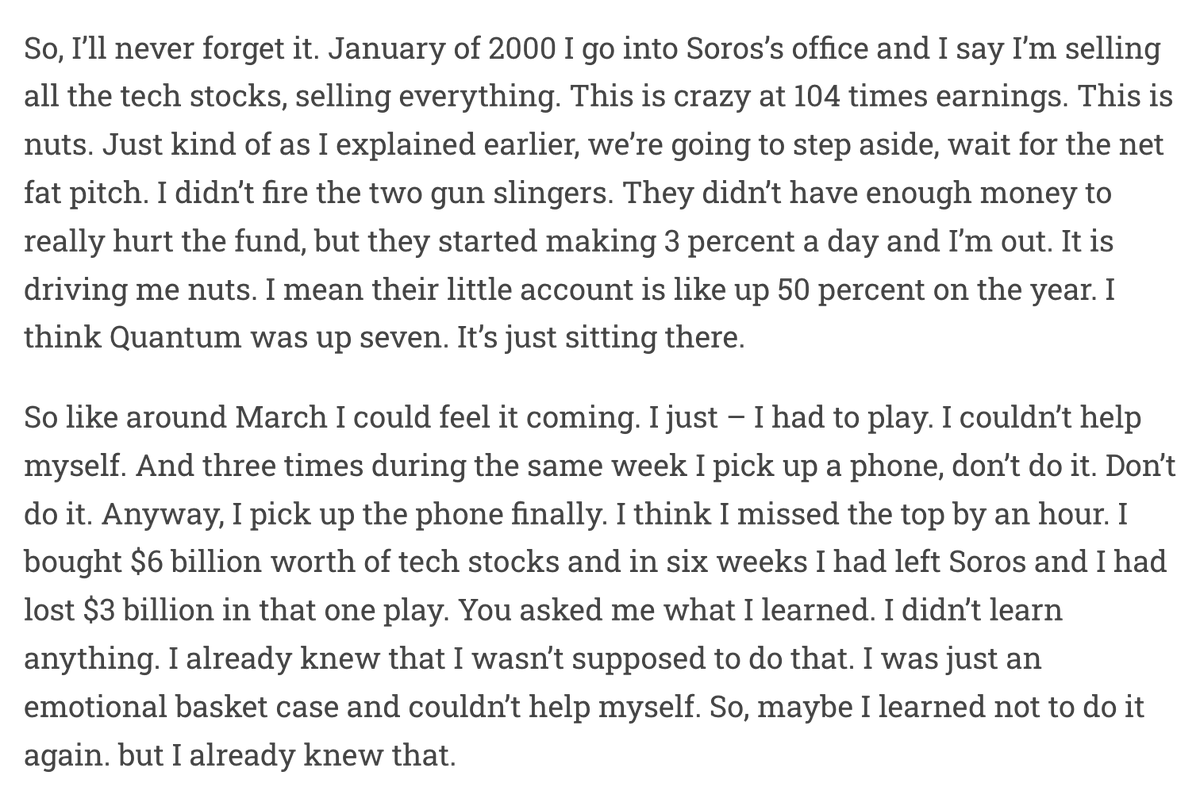
Stanley Druckenmiller after losing $3 billion on tech stocks during the 2000 bubble: "I didn't learn anything. I already knew I wasn't supposed to do that".
Koyfin tweet media
English
12
113
1.7K
159K
Juanma Vergara retweetledi
La Página Millonaria
La Página Millonaria@RiverLPM·
🔥🎯ESTO ES UN PENAL PARA LA ZURDA DEL REY. GOLAZOOOOOOOOOOOO
Español
6
93
933
27.4K
Juanma Vergara retweetledi
Dr.Jorge Monastersky
Dr.Jorge Monastersky@jorgemonasOK·
Las patentes de autos y motos son una tasa, no un impuesto. ¿Hasta cuándo provincias y municipios van a seguir exprimiendo al contribuyente?   El propio Poder Ejecutivo habilitó que un vehículo 0 km pueda radicarse en cualquier registro del país, justamente porque hay provincias con tasas razonables (2%) frente a otras —como CABA— que llegan al 6% del valor del auto.   Pero después aparece el atropello: como el vehículo “circula” en determinada jurisdicción, salen a perseguir al contribuyente para volver a cobrarle. Esto es inseguridad jurídica y vaciamiento del federalismo fiscal.   En el mundo el criterio es claro y lógico. En EE. UU., por ejemplo, se paga una tasa fija anual promedio de USD 100 por vehículo, independientemente de si el auto vale USD 10.000 o USD 500.000, vinculada a la circulación y a los ejes, no al valor patrimonial del vehículo. El patrimonio ya está gravado por otros impuestos.   En Argentina se cobra un porcentaje sobre el valor como si fuera un impuesto patrimonial y, en muchos casos, con doble imposición junto a Bienes Personales.   No normalicemos la anormalidad. Hay que terminar con estos esquemas recaudatorios distorsivos, avanzar hacia una tasa fija, simple y previsible, y dejar de castigar al que cumple.   El cambio es fiscal. Es jurídico. Y es cultural.
Español
104
725
2.2K
78.8K
Juanma Vergara retweetledi
Daniel
Daniel@danielisdizzy·
As Stanley Druckenmiller says: buy first, analyze later. Markets move fast. If you spend months analyzing a stock, you risk missing a huge part of the upside. If you don’t want to miss the train, you buy a solid starter position as soon as you spot a trend or a strong concept. Then you take your time to analyze. If you realize you were wrong, you sell. If not, you add to the position. For some reason, many people, after seeing the stock they’re studying suddenly shoot higher, end up waiting for a pullback and never buying at all, even though the stock is likely destined to rise much further.
English
67
296
2.3K
228.3K