I am in tears. Donald Trump said that he’s ready to go home to see his Grandson: “My daughter had a baby. I'm going to go back home to see that Little baby”
The most powerful man in the world, also known as Grandpa ❤️
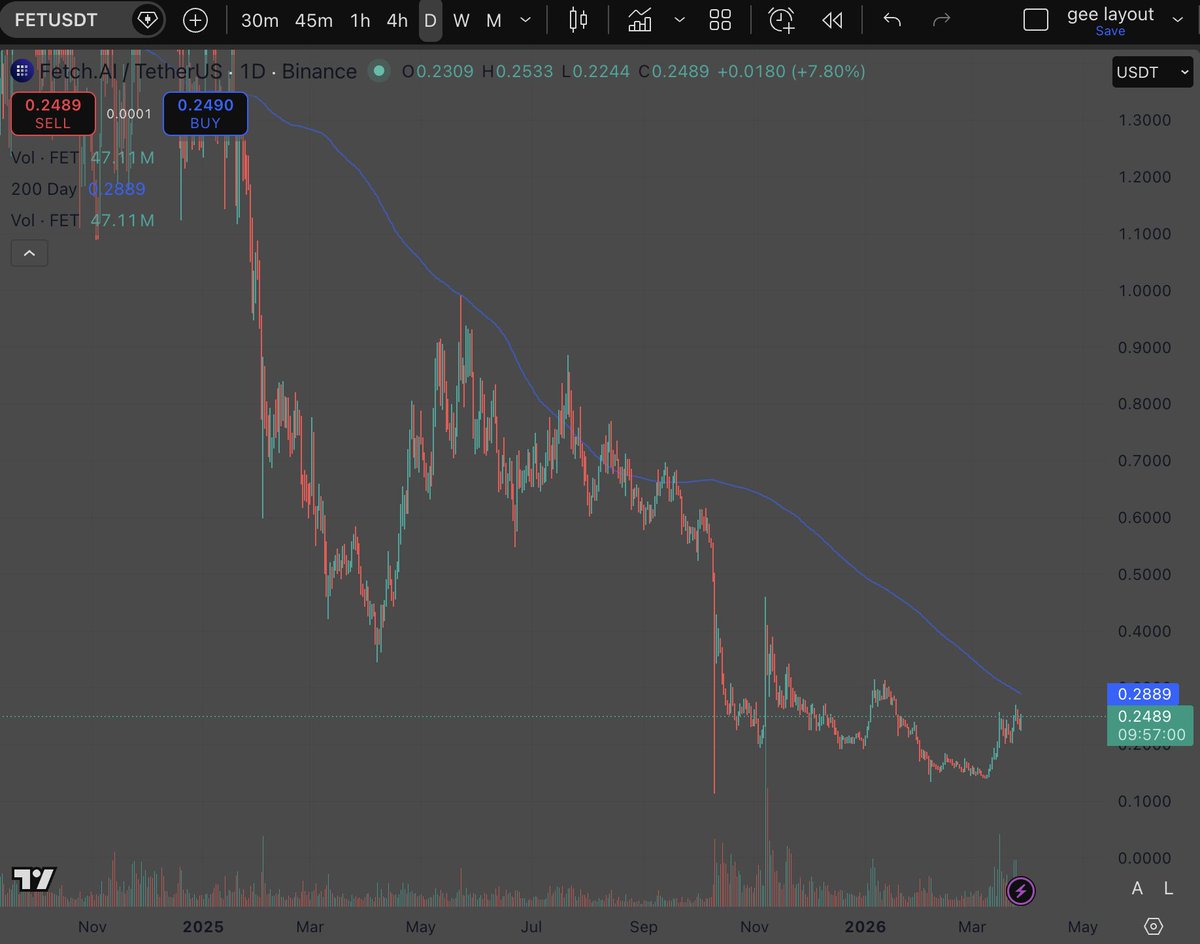
$FET turned $1.30 into $0.10.
That is not a correction. That is a confession.
A confession that the market completely oversold one of the most
legitimate AI tokens in the space. And that kind of pain rarely lasts forever.
What the chart is saying:
After a brutal 92% drawdown that lasted over a year, $FET has been quietly making higher lows since bottoming at $0.10 in late 2025. No headlines. No hype. Just a slow, steady base building while everyone else looked away.
It is now trading at $0.2489, more than 2x off the bottom, and creeping toward the 200-day MA at $0.2889 for the first time in months.
That gap is the only thing worth watching right now.
Key levels:
$0.2533 — immediate resistance, today's high. Needs to break cleanly.
$0.2889 — the 200-day MA. Reclaiming this with volume changes everything.
$0.2244 — first support below. Losing this is an early warning sign.
$0.10 — the line in the sand. Below this the recovery thesis is dead.
The honest take:
$FET is still in a downtrend until it reclaims and holds the 200 MA. But the risk-reward is starting to look interesting for the first time in a long time.
This is not a buy signal yet.
It is a watch signal.
And sometimes that is the most valuable one of all.
Follow me for more. I follow back fast.
🚨 BITCOIN MAX SUPPLY IS NO LONGER 21 MILLION NOW.
And this is what causing market's crash.
If you still think Bitcoin price is moving only because of spot buying and selling, you are missing the bigger picture. Bitcoin no longer trades purely as a supply demand asset.
That structure changed the moment large derivatives markets took control of price discovery.
And that shift is a big reason why price behavior feels disconnected from on chain fundamentals today.
Originally, Bitcoin’s valuation was built on two core ideas:
• Fixed supply of 21 million coins
• No ability to duplicate that supply
This made Bitcoin structurally scarce.
Price discovery was driven mostly by real buyers and sellers in the spot market.
But over time, a second layer formed on top of Bitcoin, a financial layer.
This layer includes:
• Cash settled futures
• Perp swaps and options
• Prime broker lending
• WBTC products
• Total return swaps
None of these create new BTC on chain. But they do create synthetic exposure to BTC price.
And that synthetic exposure plays a major role in how price is set. This is where the structure changes.
Once derivatives volume becomes larger than spot volume, price stops reacting mainly to real coin movement.
It starts reacting to positioning, leverage, and liquidation flows.
In simple terms:
Price moves based on how traders are positioned, not just on how many coins are being bought or sold physically.
There is also another layer to this, synthetic supply.
One real BTC can now be referenced or used across multiple financial products at the same time.
For example, the same coin can simultaneously support:
• An ETF share
• A futures position
• A perpetual swap hedge
• Options exposure
• A broker loan structure
• A structured product
This does not increase on chain supply. But it increases tradable exposure linked to that coin.
And that affects price discovery.
When synthetic exposure becomes large relative to real supply, scarcity weakens in market pricing terms.
This is often referred to as synthetic float expansion.
At that stage:
• Rallies get shorted through derivatives
• Leverage builds quickly
• Liquidations drive sharp moves
• Price becomes more volatile
This is not unique to Bitcoin. The same structural shift happened in: Gold, Silver, Oil, Equity indices.
Once derivatives markets became dominant, price discovery shifted away from physical supply alone.
This also explains why Bitcoin sometimes falls even when there's not much spot selling.
Because price pressure can come from:
• Leveraged long liquidations
• Futures short positioning
• Options hedging flows
• ETF arbitrage trades
Not just spot selling.
So the current Bitcoin decline cannot be understood only through retail sentiment or spot flows.
A large part of the move is happening in the derivatives layer, where leverage and positioning drive short term price action.
This does not mean Bitcoin’s supply cap changed on chain.
The 21 million limit still exists. But in financial markets, paper Bitcoin is now dominating and this is what's causing the crash.
Er zit belasting op groente. Er zit belasting op fruit. Er zit belasting op brood. Er zit belasting op melk. Er zit belasting op vlees. Er zit belasting op water. Er zit belasting op koffie. Er zit belasting op thee. Er zit belasting op boeken. Er zit belasting op kranten. Er zit belasting op medicijnen.
Er zit extreem veel belasting op benzine. Er zit extreem veel belasting op diesel. Er zit extreem veel belasting op LPG. Er zit extreem veel belasting op alcohol. Er zit extreem veel belasting op sigaretten.
Er zit extreem veel belasting op elektriciteit. Er zit belasting extreem veel op gas.
Er zit belasting op kopen. Er zit belasting op huren. Er zit belasting op repareren. Er zit belasting op een kapper. Er zit belasting op eten in een restaurant. Er zit belasting op kleding. Er zit belasting op schoenen. Er zit belasting op meubels. Er zit belasting op telefoon. Er zit belasting op internet. Er zit belasting op streamen.
Er zit belasting op werken. Er zit belasting op salaris. Er zit belasting op winst maken. Er zit belasting op sparen. Er zit belasting op beleggen. Er zit belasting op een eigen huis. Er zit belasting op een tweede huis. Er zit belasting op dividend. Er zit belasting op aandelen verkopen.
Er zit belasting op autorijden. Er zit belasting op motorrijden. Er zit belasting op een auto kopen. Er zit belasting op vliegen. Er zit belasting op verzekeringen. Er zit belasting op gokken.
Er zit belasting op een huis kopen.
En dan de belastingen waar al belasting over betaald is, de diefstal op diefstal:
Er zit belasting op dividend (al vennootschapsbelasting betaald door het bedrijf).
Er zit belasting op rente (al inkomstenbelasting over je salaris of winst).
Er zit belasting op box 3-vermogen (spaargeld, beleggingen, tweede huis – vaak al met belasting verdiend).
Er zit belasting op overwaarde eigen woning bij verkoop (als ze het speculatie vinden, bovenop eerdere inkomstenbelasting).
Er zit belasting op pensioensparen uitkering (al premies met belastingvoordeel gestort, maar later weer keihard geraakt).
Er zit belasting op lijfrente-uitkering (zelfde shit als pensioen).
Er zit belasting op winstdeling via bv (al vennootschapsbelasting, dan nog box 2).
Er zit belasting op aanmerkelijk belang verkoop (al vennootschapsbelasting over winst, dan nog 26,9%).
En dan de echte diefstal op diefstal, waar je al betaald hebt en ze nog een keer happen:
Er zit belasting op erfenis.
Er zit belasting op schenking.
Er zit belasting op dividend (al vennootschapsbelasting over winst).
Er zit belasting op rente en rendement in box 3 (al met inkomstenbelasting verdiend).
Er zit belasting op pensioenuitkering (al premies met belastingvoordeel).
Er zit belasting op alles waar btw al op zit.
Dat is gewoon wat we met recht een echte parasietenmentaliteit mogen noemen lijkt me: eerst afromen, dan nog een keer en liefst nog een paar keer.
Gaaf land man.
En het erge is dat ik waarschijnlijk nog een aantal belastingen gemist heb in het lijstje.
@ajboekestijn Wat is er met dat geld gebeurd dan wat al die grijze mensen door de jaren heen inmiddels hebben betaald?Juist dat klotst tegen de plinten van de pensioenfondsen aan, maar de tekorten blijven! Tuurlijk joh
Als de AOW-leeftijd gelijk blijft, stijgen de uitkeringen omdat mensen langer AOW ontvangen. Dit verhoogt de kosten voor de overheid en de premiebetalers. Verhogen AOW leeftijd is door vergrijzing onontkoombaar.
🚨Everyone better answer this one correctly!!
Would you support the annexation of Greenland by the United States of America?
A. YES
B. NO
IF Yes, Give me a THUMBS-UP👍!!
🚨 NEXT WEEK COULD SHAKE THE ENTIRE MARKET.
Stocks and crypto are about to face one of the most dangerous combinations of news we’ve seen in months.
Two huge events are hitting at the same time:
1) New Trump tariffs on Europe
2) A Supreme Court ruling on tariffs
Both land together when markets reopen.
That is a recipe for extreme volatility.
Over the weekend, Trump announced a fresh 10% tariff on the EU.
This is the first major tariff escalation in almost three months.
The last time we got a big tariff shock, on October 10:
- The S&P 500 dumped hard
- Crypto saw its biggest crash in five years
This is not small news, as these EU tariffs threaten trade flows worth nearly $1.5 trillion.
And here's why it could get worse.
There is now serious talk that Europe could retaliate.
If the EU starts building trade deals with countries that the US is also sanctioning, the US risks being pushed out of key trade routes.
That would be:
- Bearish for US stocks
- Bearish for the dollar
- Bearish for global risk sentiment
Now add the second bomb.
On Tuesday, the Supreme Court is expected to rule on whether Trump’s tariffs are legally valid.
They have already delayed it twice, but now a ruling is expected.
Markets currently believe there is a strong chance the Court rules against him.
That creates two dangerous paths:
If the Court rules AGAINST Trump:
- It means his tariffs are legally weak
- It breaks confidence in policy stability
- The stock market has been rallying on tariff optimism
- That optimism could collapse fast
- A violent sell-off becomes very likely
If the Court rules IN FAVOR of Trump:
- Then markets must fully price the damage of the EU tariffs
- Trade disruption becomes real
- Growth risk increases
- Stocks and crypto still face heavy pressure
Both are bad for risk assets.
This is why next week is so dangerous.
Markets are walking into:
- A major tariff shock
- A legal ruling that can change policy credibility
And you need to be prepared for some insane volatility.
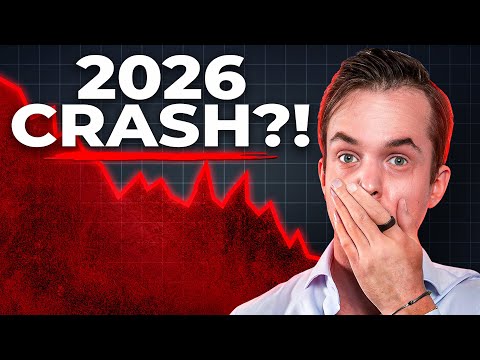
The next year for $BTC might be disastrous, according to multiple signals.
There might be a big crash, according to a lot of people.
Let's talk about it in the new video:
youtu.be/Ay2QiMJrEpc