James Tooby

112 posts

James Tooby banner
James Tooby

James Tooby

@JToobyResearch

Research Fellow at @Carnegie_Sport in the @CARR_LBU group. Researching brain injury in rugby using instrumented mouthguards

Katılım Ekim 2021
138 Takip Edilen124 Takipçiler
Sabitlenmiş Tweet
James Tooby
James Tooby@JToobyResearch·
New paper!📰 This study details two computational methods leveraging commercial video analysis data that have been central for: - Synchronise HAEs to video footage - Quantify HAE risk from rugby match events - Rapidly generate iMG reports for teams
James Tooby tweet media
English
3
3
10
532
James Tooby
James Tooby@JToobyResearch·
📉How can we reduce HAE exposure in rugby league and rugby union? ❓Why is probability so much higher in rugby union? 📈How can we monitor and manage players with elevated HAE exposure? rdcu.be/epNCc
English
0
0
0
30
James Tooby
James Tooby@JToobyResearch·
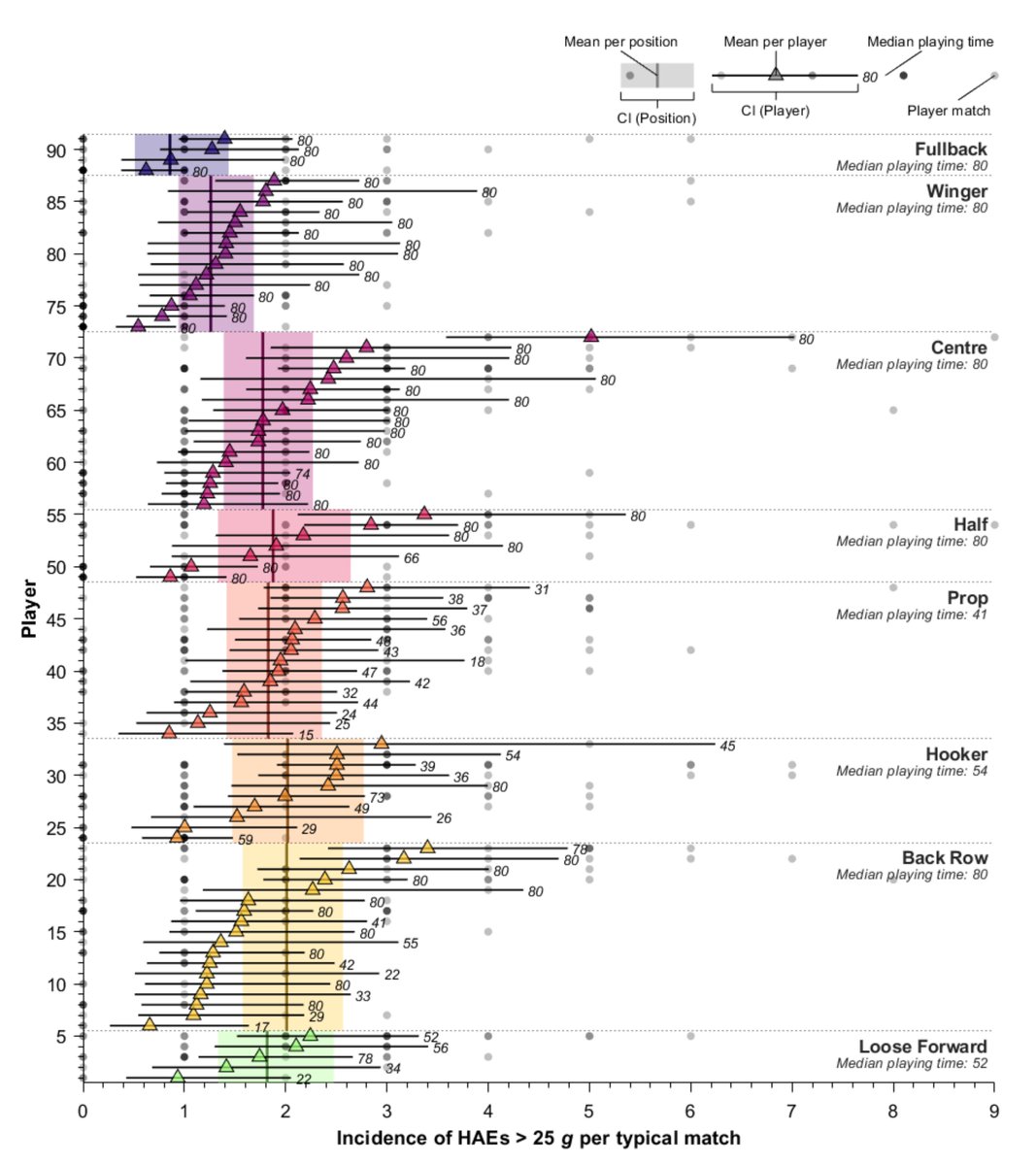
Despite these lower findings on average, some players exhibit elevated values 🧠If these are persisted over multiple matches and seasons, these players may be at an increased risk of neurological effects
James Tooby tweet mediaJames Tooby tweet media
English
1
0
0
38
James Tooby
James Tooby@JToobyResearch·
✏️New paper! Head acceleration event (HAE) exposure in professional men’s rugby league: 📉Fewer HAEs per player match in rugby league compared to union 📉HAEs less likely in rugby league tackles compared to union 📈Individuals with elevated HAE values 🔓rdcu.be/epNCc
James Tooby tweet media
English
1
4
13
355
James Tooby
James Tooby@JToobyResearch·
@SmilerTurner Hi Gary! Sort of - it shows two faster/more efficient methods for something that previously was very time consuming and costly. Now we can estimate the probability of match events (e.g., tackles/carries/rucks) of resulting in a recorded HAE rapidly!
English
1
0
1
30
Gary Turner
Gary Turner@SmilerTurner·
@JToobyResearch So, this demonstrates that in your former research, the numbers of HAEs recorded are pretty much spot on?
English
1
0
0
12
James Tooby
James Tooby@JToobyResearch·
New paper!📰 This study details two computational methods leveraging commercial video analysis data that have been central for: - Synchronise HAEs to video footage - Quantify HAE risk from rugby match events - Rapidly generate iMG reports for teams
James Tooby tweet media
English
3
3
10
532
James Tooby
James Tooby@JToobyResearch·
Speaking to the publishers to get the Supplementary Materials added to the website!
English
0
0
0
51
James Tooby
James Tooby@JToobyResearch·
These methods continue to be used in rugby research and practice, and may also be implemented in different sports. All source code is available in the Supplementary Materials of the paper!
English
1
0
0
56
James Tooby
James Tooby@JToobyResearch·
It is important to note that these methods rely on the availability of a dataset of video-coded match events, however, they have also been effective with another dataset since this paper was written!
English
1
0
0
59
James Tooby
James Tooby@JToobyResearch·
With our datasets, this process was also very effective; the PPV for identifying the correct event was > 0.9 for both rugby union and rugby league!
James Tooby tweet media
English
1
0
0
39
James Tooby
James Tooby@JToobyResearch·
Using our datasets, this process was very reliable and had reasonably good accuracy!
James Tooby tweet media
English
1
0
0
42
James Tooby
James Tooby@JToobyResearch·
Post-synchronisation event matching (catchy, I know!) simply aligns each SAE to the coded match event which we think caused it, based on their newly aligned timestamps. For example, if we have a dataset of coded rugby tackles, we can identify which one caused each SAE.
English
1
0
0
34
James Tooby
James Tooby@JToobyResearch·
Cross-correlation synchronisation takes a dataset of potential head impacts (PHI) and a dataset of sensor acceleration events (SAEs) to determine the synchronisation point that aligns the most together. This allows us to identify the SAEs in video footage.
English
1
0
2
40
James Tooby retweetledi
Enora Le Flao
Enora Le Flao@EnoraLeFlao·
📢New paper by @xianghao_zhan et al.! We used an AI model to eliminate some of the noise measured by instrumented mouthguards: "peak kinematics after denoising were more accurate" Such models will help improve the quality of our head impact datasets! 👀 ieeexplore.ieee.org/document/10510…
English
1
3
12
615
James Tooby
James Tooby@JToobyResearch·
@BruceMacParkman They should only underestimate HAE exposure at lower magnitudes, > 25-30 g are detected sensitively based on simulations
English
0
0
0
32
Bruce Parkman
Bruce Parkman@BruceMacParkman·
Interesting article in the use of instrumented mouthgards thst concludes that they underestimate the amount of RHI exposure. Good tool to validate the existence of RHI and to promote change as none of the recommendations like lowering tackle height dont use your shoulders or head in tackle prevent RHI exposure. Also uses a new term Head Accelerator Event or HAE. link.springer.com/epdf/10.1007/s…
English
2
1
4
432
James Tooby
James Tooby@JToobyResearch·
@EnoraLeFlao Definitely an interesting predicament! I lean towards giving the video analyst as much info as possible to make their decision. Not just for video verification but also for analysing/labelling causes of HAEs. Could be good to jump on a call to discuss this and other research?
English
1
0
1
56
Enora Le Flao
Enora Le Flao@EnoraLeFlao·
@JToobyResearch That's an interesting idea! Another question though... should video-verification be kept separate from kinematics? For example, if a reviewer isn't sure about an impact on video, wouldn't it influence their decision if they were to see 10 v 50 g?
English
1
0
0
48
Enora Le Flao
Enora Le Flao@EnoraLeFlao·
[X's shortened post length sucks]
English
1
0
0
160
James Tooby
James Tooby@JToobyResearch·
@SmilerTurner Ideally all HAEs would be filtered with > 200 Hz filters, but due to noise in the signal of some HAEs (~5%), we need to use lower cut off frequencies to avoid really high, erroneous magnitudes from being reported from noise
English
1
0
1
74
James Tooby
James Tooby@JToobyResearch·
@SmilerTurner Sorry no, let me try an explain differently. Let’s imagine a 20g head acceleration occurs. The peak magnitude without filtering might be 30g, ~20g with a 200Hz filter, ~15g with 100 Hz, and ~10g Hz filter…
English
1
0
1
55
James Tooby
James Tooby@JToobyResearch·
New current opinion piece📝 rdcu.be/dAHBp🔓 With the growing use of iMGs across sports, this piece explores the technical constraints of the devices for measuring head acceleration events and considerations for the interpretation of iMG data... [1/13]
James Tooby tweet media
English
2
15
24
6.4K