James Howe

11 posts

James Howe

James Howe

@JamesHoweV

Katılım Ocak 2025
2 Takip Edilen36 Takipçiler
James Howe
James Howe@JamesHoweV·
@AnnSurgOncol Many will do the same as we do, but others may just go straight to PRRT without surgical cytoreduction. That is why it is very important to have multidisciplinary care for NET patients and that surgeons weigh in. Neoadjuvant PRRT is not commonly used in the USA.
English
0
0
2
23
James Howe
James Howe@JamesHoweV·
@lgeisel18 @AnnSurgOncol We included patients between 1999-2022, so many but not all had long term follow-up. However, loss of significance may have been due more to the stringency of using time dependent covariate analysis, which credits all survival to the No PRRT group until PRRT is received.
English
1
0
2
23
Lauren Geisel, MD
Lauren Geisel, MD@lgeisel18·
@AnnSurgOncol @JamesHoweV Interesting! What was your median follow up time? Do you think that statistically significant difference in OS may have been achieved with matured data given the relatively high median overall survival for G1-G2 SBNETs?
English
2
0
1
50
Annals of Surgical Oncology
Annals of Surgical Oncology@AnnSurgOncol·
“Yes, both SBNET and PNET patients had statistically significant improvements in PFS with PRRT, and OS was very close in SBNET patients (P=0.06). Smaller numbers may have contributed.” - Dr. Howe (@JamesHoweV) #ASOchat
Annals of Surgical Oncology tweet media
English
1
4
12
1.5K
James Howe
James Howe@JamesHoweV·
@DrSabha @AnnSurgOncol Many studies do not factor this in. Patients that live long enough to get the treatment do better by definition, because those who die before that go into the "other tx" group
English
1
0
1
18
Annals of Surgical Oncology
Annals of Surgical Oncology@AnnSurgOncol·
Q9. Did you look at Immortal Time Bias, the idea that patients receiving any therapy which might be delayed will generally live longer because people who die before receiving therapy are assigned to the no therapy group? #ASOchat
English
1
1
4
702
Annals of Surgical Oncology
Annals of Surgical Oncology@AnnSurgOncol·
“First, PRRT probably works better when lower volume of disease. Second, PRRT has toxicity & can only be given once or twice in a patient’s lifetime; SSAs often hold these micrometastases in check for several years, so we wait for progression.” - Dr. Howe (@JamesHoweV) #ASOchat
English
3
2
11
1.3K
Annals of Surgical Oncology
Annals of Surgical Oncology@AnnSurgOncol·
“At Iowa, we recommend starting w/removal of primary tumor & cytoreducing the mets as possible. Then we treat w/SSAs until progression. Then we consider other therapies, & PRRT may be best choice when disease volume remains low after cytoreductive surgery.” - Dr. Howe #ASOchat
English
3
3
11
1.3K
James Howe
James Howe@JamesHoweV·
@MikeWach_MD @AnnSurgOncol Peritoneal mets treated with PRRT can cause a local reaction leading to obstruction, as reported by Jon Strosberg in F/U of NETTER1
English
3
1
6
138
Mike Wach MD
Mike Wach MD@MikeWach_MD·
@AnnSurgOncol @JamesHoweV Acknowledging it’s an uncommon manifestation, but has there been any experience with peritoneal metastases of NET? Does response to PRRT differ for those with peritoneal disease? Any role for debulking prior to PRRT? #ASOchat
English
3
5
10
1.1K
Annals of Surgical Oncology
Annals of Surgical Oncology@AnnSurgOncol·
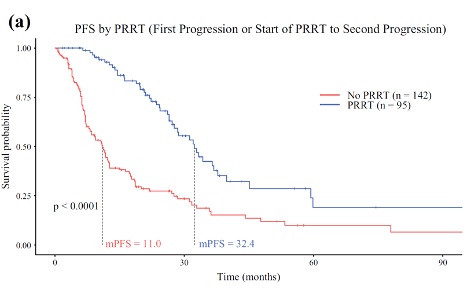
“Median PFS was 32.4 months in the PRRT group calculated from the start of PRRT, and 11.0 months in the no PRRT group calculated from the time of progression (P<0.0001).” - Dr. Howe (@JamesHoweV) #ASOchat
Annals of Surgical Oncology tweet media
English
1
2
9
926
James Howe
James Howe@JamesHoweV·
@MikeWach_MD @AnnSurgOncol We thought PRRT would be a good answer for peritoneal mets, but it can often cause problems. The lesions get inflamed causing a local reaction, possibly sticking to the adjacent bowel. Jon Strosberg found obstruction to be an issue in some of these patients in NETTER1 follow-up.
English
3
0
2
60
James Howe
James Howe@JamesHoweV·
@DrSabha @AnnSurgOncol We always tried to get the most disease as we could safely. If we could not get at least 70%, we did not try. From previous studies this means that nearly 2/3 of patients with metastatic disease were eligible for cytoreduction.
English
3
1
3
64
James Howe
James Howe@JamesHoweV·
@SchultzKurt @AnnSurgOncol Because both groups were probably pretty evenly matched, both having a lot of disease. PFS after Cytoreduction was the same. This was before they got either PRRT or other therapies.
English
1
0
4
28
Annals of Surgical Oncology
Annals of Surgical Oncology@AnnSurgOncol·
“After cytoreduction of presumably many liver metastases, both the PRRT and non-PRRT groups demonstrated the same length of time for progression on average, which was 26-28 months.” - Dr. Howe (@JamesHoweV) #ASOchat
English
1
3
5
812
James Howe
James Howe@JamesHoweV·
@OncoThor @AnnSurgOncol The elephant in the room is nephrotoxicity. We have seen several patients develop severe CKD, but these data are not yet available from the alpha trials
English
0
0
1
27
Annals of Surgical Oncology
Annals of Surgical Oncology@AnnSurgOncol·
“For potential side effects from PRRT - there is 2% incidence of MDS or leukemia from Lutetium-177. Yttrium-90 has nephrotoxicity. Our new alpha-PRRT agents Lead-212 and Actinium-225 may also be nephrotoxic, but are still in clinical trials.” - Dr. Howe (@JamesHoweV) #ASOchat
English
3
2
10
938
James Howe
James Howe@JamesHoweV·
@AnnSurgOncol @OncoThor The elephant in the room is nephrotoxicity. We have had several patients develop severe CKD, but these data have not yet been reported from the trial
English
1
0
0
20